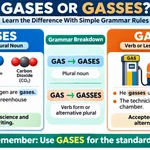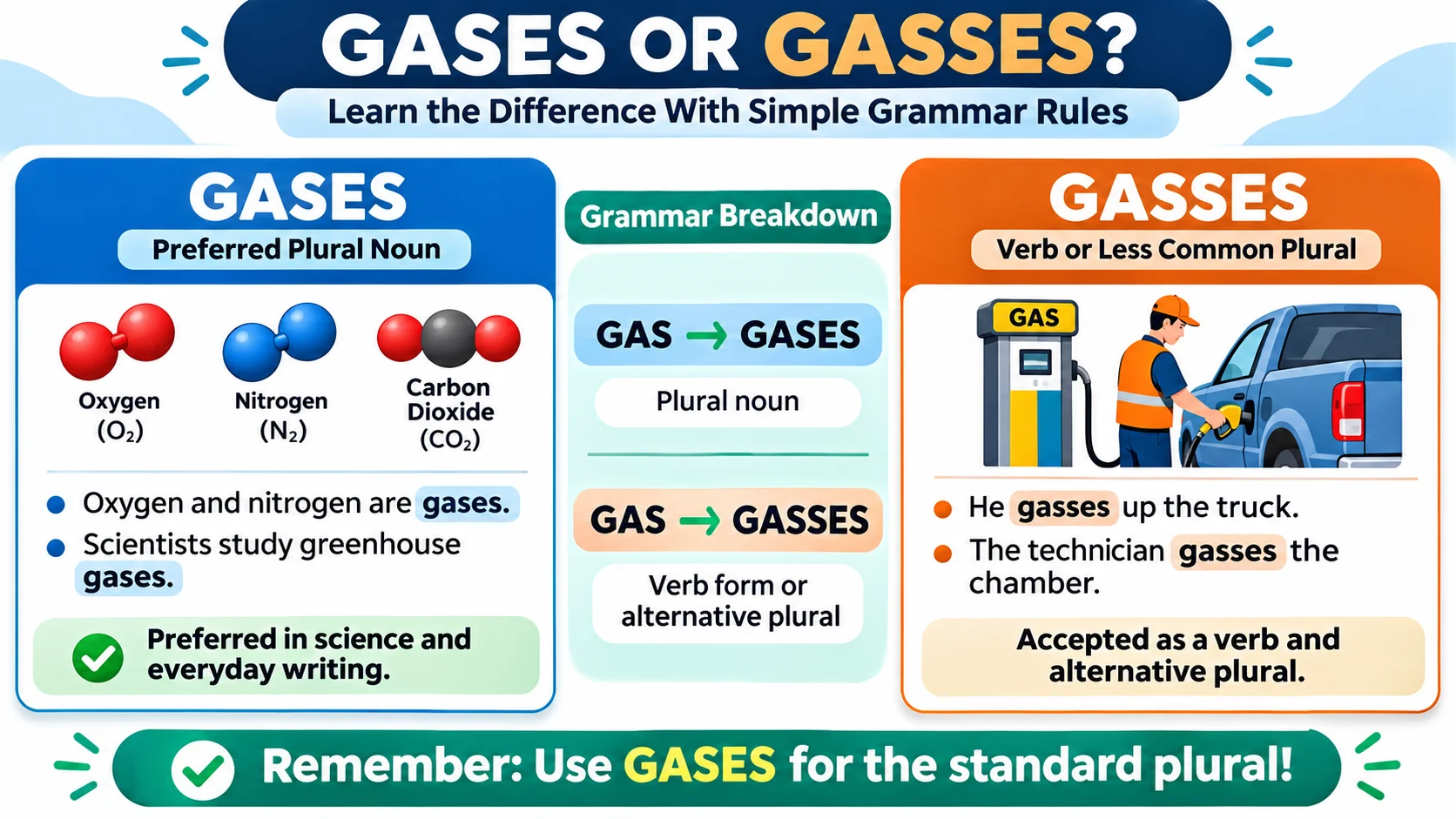
Gases or gasses are both accepted spellings, but gases is the preferred plural form of the noun gas. For example, “Oxygen and nitrogen are gases.” Meanwhile, gasses is also used as a third-person singular verb meaning to expose something to gas or fill it with gas. Although gasses can be an alternative plural, gases is recommended in scientific, academic, and everyday writing.
Have you ever wondered whether to write gases or gasses when discussing oxygen, carbon dioxide, or other substances in the air? Although these spellings look almost identical, choosing between them can sometimes be confusing. Both appear in English dictionaries; however, one is generally preferred when referring to more than one gas.
The confusion comes from the spelling rules of English nouns and verbs. While gases is the standard plural form of gas, gasses is also recognized as a less common plural spelling and a verb form. Therefore, understanding their grammatical functions can help you select the most appropriate word for your sentence.
Moreover, these terms frequently appear in science textbooks, environmental reports, academic papers, and everyday conversations. For example, scientists discuss greenhouse gases, whereas a mechanic might talk about an engine that is being gassed up. Consequently, using the appropriate spelling improves clarity and makes your writing appear more professional.
In this guide, you’ll learn the difference between gases and gasses, their meanings, grammar rules, pronunciation, and practical examples. Additionally, we’ll explore common spelling mistakes, scientific usage, and frequently asked questions so you can use both forms confidently.
What Is the Difference Between Gases and Gasses?
The main difference concerns standard usage and grammatical function.
Gases is the preferred plural noun form of gas. It refers to multiple substances in the gaseous state, including oxygen, hydrogen, nitrogen, and carbon dioxide.
On the other hand, gasses is an accepted but less frequently used plural form. It is also a recognized third-person singular present-tense form of the verb gas.
For example:
- Correct: “Several gases are present in Earth’s atmosphere.”
- Also accepted but less preferred: “Several gasses are present in Earth’s atmosphere.”
- Correct verb usage: “The technician gasses the chamber before the experiment.”
In formal scientific writing, the first example is generally the better choice.
Quick Comparison Table
| Feature | Gases | Gasses |
|---|---|---|
| Part of speech | Primarily plural noun | Verb or alternative plural noun |
| Main meaning | More than one gas | Exposes to gas, fills with gas, or multiple gases |
| Usage frequency | Preferred spelling | Less common as a plural |
| Scientific writing | Recommended | Usually avoided as a plural |
| Everyday English | Standard choice | Accepted in certain contexts |
| Example | Oxygen and hydrogen are gases. | The technician gasses the chamber. |
Although both spellings exist, using gases for plural nouns is the safest choice for most writing situations.
What Does Gases Mean?
The word gases is the plural form of the noun gas.
A gas is a state of matter that has no fixed shape or volume. Unlike a solid, which maintains its shape, or a liquid, which maintains a nearly fixed volume, a gas spreads out to fill its available container.
For example, oxygen and nitrogen are gases found in Earth’s atmosphere.
Other familiar examples include:
- Hydrogen
- Carbon dioxide
- Helium
- Neon
- Argon
- Methane
When discussing two or more such substances, the standard plural spelling is gases.
Examples of Gases in Sentences
- Oxygen and nitrogen are important atmospheric gases.
- Scientists study gases under different temperatures and pressures.
- Greenhouse gases influence Earth’s climate.
- Some gases are colorless and odorless.
- Industrial processes can release harmful gases.
- Different gases have different chemical properties.
- The laboratory stores several compressed gases.
- Certain gases are used in medical treatments.
- Natural gases can form through geological processes.
- Researchers measured the concentrations of various gases.
As these examples demonstrate, the plural form appears naturally in scientific and general writing.
What Does Gasses Mean?
The word gasses can function as an alternative plural of gas. However, it is less frequently used than gases for that purpose.
Additionally, it can function as the third-person singular present-tense form of the verb gas.
As a verb, gas can mean to expose a person or object to gas, fill something with gas, or, in certain informal expressions, supply fuel.
For example:
“The technician gasses the chamber.”
Here, the word describes an action rather than multiple substances.
Another example is:
“He gasses up the vehicle before leaving.”
In this sentence, gasses up is an informal expression meaning to fill a vehicle with gasoline.
Nevertheless, the related expression gases up is also recorded as a variant in some dictionaries.
Examples of Gasses as a Verb
- The technician gasses the testing chamber under controlled conditions.
- He gasses up his truck before a long journey.
- The mechanic gasses up the vehicle before the road test.
- The equipment automatically gasses the sealed container.
- The operator gasses the chamber during the industrial process.
These examples demonstrate how the word can describe an action.
However, since the verb may refer to hazardous gas exposure, its precise meaning depends on the context.
Is Gases or Gasses the Correct Plural of Gas?
The preferred plural form of gas is gases.
Although some dictionaries recognize gasses as an alternative plural, the single-s spelling is generally preferred in edited English.
For instance:
Preferred: “The atmosphere contains several important gases.”
Less preferred but accepted: “The atmosphere contains several important gasses.”
Both sentences communicate the same basic meaning. Nevertheless, the first is more conventional in educational and scientific contexts.
According to Oxford Learner’s Dictionaries, gases is the main plural form, while gasses is listed as less frequent.
Therefore, students, researchers, and professional writers should normally choose gases when referring to multiple gaseous substances.
Why Is Gas Pluralized as Gases?
English nouns ending in certain sounds often form their plurals by adding -es.
For example:
- Bus → Buses
- Box → Boxes
- Dish → Dishes
- Watch → Watches
- Gas → Gases
The added ending makes the plural easier to pronounce.
However, English spelling isn’t perfectly uniform. Some accepted alternative forms exist because words develop through different usage patterns over time.
Consequently, gasses also appears in dictionaries, even though gases remains the conventional plural form.
Understanding the Spelling Rule
The word gas ends in a single “s.”
To create its standard plural, add “es”:
Gas + es = Gases
There is no need to double the final “s” when forming the preferred plural.
Meanwhile, the verb follows a different pattern in some forms:
Gas → Gasses → Gassed → Gassing
This difference helps explain why writers encounter both spellings.
Gases vs. Gasses in American English
In American English, gases is generally preferred when referring to more than one gas.
The spelling appears in scientific writing, environmental discussions, educational materials, and professional communication.
For example:
“Scientists are studying the gases released during combustion.”
Similarly, American English recognizes gasses as a less common plural and as a verb form.
Consider the sentence:
“The operator gasses the chamber during the procedure.”
Here, the double-s form is acceptable because the word functions as a verb.
However, some dictionaries also recognize gases as a verb spelling.
Therefore, the clearest general guideline is to use gases for plural nouns while following your chosen dictionary or style guide for verbal forms.
Gases vs. Gasses in British English
British English also generally prefers gases as the plural of gas.
For example:
“The laboratory examined several gases.”
Although some learners assume gasses is exclusively British, that distinction is inaccurate.
Both spellings appear in English dictionaries, and the less common plural form isn’t restricted to one country.
Furthermore, British and American writers usually use gassed and gassing for the past tense and present participle of the verb.
Therefore, the difference between the two plural spellings is primarily a matter of preferred usage rather than a strict national spelling rule.
Gases or Gasses in Scientific Writing
Scientific writing generally favors gases because it is the conventional plural form.
Scientists frequently discuss gaseous substances in chemistry, physics, biology, and environmental research.
For example:
- Atmospheric gases
- Noble gases
- Greenhouse gases
- Industrial gases
- Combustion gases
- Medical gases
- Exhaust gases
These expressions are common in educational and technical contexts.
Using the standard spelling also helps maintain consistency across scientific documents.
Examples from Chemistry
In chemistry, gases are substances in the gaseous state under specified conditions.
For instance, hydrogen is commonly studied as a gas, while oxygen plays an important role in combustion and respiration.
Scientists also examine how gases behave when temperature, pressure, and volume change.
Therefore, a chemistry textbook would typically use sentences such as:
“Different gases respond to changes in temperature and pressure.”
Examples from Environmental Science
Environmental scientists often discuss greenhouse gases when examining climate change.
For example:
“Carbon dioxide and methane are important greenhouse gases.”
In this context, the standard plural spelling is particularly important because it matches widespread scientific terminology.
Examples from Physics
Physics uses the term when explaining the behavior of matter.
For instance:
“Gases expand to occupy the available volume of their containers.”
Additionally, gas laws describe relationships among pressure, temperature, volume, and the amount of gas.
Consequently, gases is the natural spelling in most physics lessons and academic materials.
Greenhouse Gases or Greenhouse Gasses?
The preferred expression is greenhouse gases.
This term refers to atmospheric gases that absorb and emit infrared radiation, influencing Earth’s energy balance.
Common examples include carbon dioxide, methane, nitrous oxide, and water vapor.
Although greenhouse gasses may appear in informal writing, greenhouse gases is the established spelling in scientific communication.
For example:
Preferred: “Reducing greenhouse gases is an important climate policy goal.”
Less preferred: “Reducing greenhouse gasses is an important climate policy goal.”
The second sentence can be understood, but the first follows standard terminology.
Therefore, use greenhouse gases in reports, school assignments, articles, and professional documents.
How Do You Pronounce Gases and Gasses?
Both spellings have two syllables, but their pronunciation can vary according to accent and grammatical context.
Gases is commonly pronounced approximately “GAZ-iz” when referring to multiple gaseous substances.
Gasses may be pronounced approximately “GAS-iz,” particularly as a verb.
However, dictionaries and speakers may vary in their treatment of the two forms.
Since pronunciation alone doesn’t always reveal the intended grammatical function, context remains important.
For example:
- “The gases expanded.” — Plural noun.
- “He gasses up the truck.” — Verb.
Therefore, identifying the role of the word is more reliable than relying only on how it sounds.
Gas, Gases, Gasses, Gassed, and Gassing
Understanding related forms makes the spelling distinction easier.
| Word | Grammatical Form | Example |
|---|---|---|
| Gas | Singular noun | Oxygen is a gas. |
| Gases | Preferred plural noun | Several gases fill the container. |
| Gasses | Alternative plural noun | The gasses were collected. |
| Gasses | Third-person singular verb | He gasses up the car. |
| Gassed | Past-tense verb | The chamber was gassed. |
| Gassing | Present participle | The technician is gassing the chamber. |
Although the words share the same root, their roles change according to grammatical structure.
Gas as a Singular Noun
“Helium is a gas.”
The sentence refers to one substance in a particular state of matter.
Gases as a Plural Noun
“Helium and neon are gases.”
Here, the plural refers to two substances.
Gasses as a Verb
“He gasses the chamber.”
The word describes an action carried out by the subject.
Gassed as a Past-Tense Verb
“The chamber was gassed yesterday.”
This sentence describes an action completed in the past.
Gassing as a Present Participle
“The technician is gassing the chamber.”
The sentence describes an action in progress.
Common Mistakes When Using These Spellings
Although the difference is relatively simple, several mistakes occur in everyday writing.
Using Gasses as the Default Scientific Plural
Writers sometimes assume that doubling the final consonant is necessary.
For example:
Less preferred: “The scientist analyzed three gasses.”
Preferred: “The scientist analyzed three gases.”
Since the conventional plural is gases, there is usually no reason to choose the alternative.
Assuming Gasses Is Always Incorrect
Another common mistake is treating the double-s spelling as nonexistent.
However, major dictionaries recognize gasses as an alternative plural.
Additionally, the word can function as a verb.
Therefore, its correctness depends on both context and the writing style being used.
Confusing Gases With Gassed
The past-tense form is gassed, not gased.
For example:
Incorrect: “The chamber was gased.”
Correct: “The chamber was gassed.”
This spelling rule applies to the related present participle, gassing.
Assuming American and British Rules Are Opposite
Some writers believe that Americans use gases while British speakers always use gasses.
However, both varieties generally prefer gases as the plural noun.
Consequently, the distinction should not be presented as a straightforward American-versus-British difference.
Switching Between Spellings Unnecessarily
Using two plural spellings within the same document can make the writing appear inconsistent.
For example, an article might discuss “greenhouse gases” in one paragraph and “greenhouse gasses” in another.
Although readers may understand both, consistent spelling improves professionalism.
Therefore, choose gases for plural references throughout your document unless a particular editorial requirement specifies otherwise.
Easy Trick to Remember the Difference
A simple memory trick can make these spellings easier to distinguish.
Gases = Multiple gases
Think of the single-s spelling as the standard choice for science and everyday plural references.
For example:
“Two gases were measured in the laboratory.”
Gasses = An action or less common plural
Remember that the double-s spelling commonly appears in descriptions of gas-related actions.
For example:
“He gasses up his car.”
Although gasses can also be a plural noun, treating gases as your default will help you avoid most spelling mistakes.
Practice Examples: Choose the Correct Word
Test your understanding with the following sentences.
Practice Questions
Sentence A: Several ______ are released during the chemical reaction.
Options: gases / gasses
Sentence B: The technician ______ the testing chamber before beginning the process.
Options: gases / gasses
Sentence C: Oxygen and nitrogen are two important atmospheric ______.
Options: gases / gasses
Sentence D: The mechanic ______ up the truck before the test drive.
Options: gases / gasses
Sentence E: Scientists measured the concentrations of several greenhouse ______.
Options: gases / gasses
Answers and Explanations
Sentence A: Gases
This is the preferred plural noun spelling.
Sentence B: Gasses
The word functions as a verb describing an action.
Sentence C: Gases
The sentence refers to two atmospheric substances.
Sentence D: Gasses
Here, the word is used as a verb in the informal phrase gas up.
Sentence E: Gases
The established scientific expression is greenhouse gases.
Although alternative forms may be dictionary-accepted in some examples, these answers reflect the preferred usage distinctions.
Why Correct Spelling Matters
Choosing the appropriate spelling improves communication in academic, professional, and everyday situations.
Academic Accuracy
Students writing science assignments should use conventional terminology.
For example, noble gases is the standard term in chemistry.
Therefore, using established spelling helps make assignments clearer and more consistent.
Professional Communication
Editors, researchers, and technical writers often follow standardized spelling conventions.
Moreover, consistency can make reports easier to understand.
A document that uses conventional terminology generally requires fewer corrections.
Reader Understanding
Readers may interpret gasses as a verb rather than a plural noun, depending on context.
Consequently, using gases for plural references reduces potential ambiguity.
Search Engine Clarity
Online articles benefit from accurate terminology and natural language.
However, repeating a spelling comparison excessively does not improve the reading experience.
Instead, writers should answer the main question clearly, explain relevant distinctions, and use examples where necessary.
Frequently Asked Questions
Which is correct, gases or gasses?
Both are recognized spellings, but gases is the preferred plural noun form of gas. Meanwhile, gasses is a less common plural variant and an accepted present-tense verb form.
What is the plural of gas?
The standard plural of gas is gases. For example, “Oxygen and nitrogen are gases.” Although dictionaries may also list gasses, the single-s spelling is recommended for most contexts.
Is gasses a real word?
Yes, gasses is a real English word. It can serve as an alternative plural of gas or as a verb meaning to expose something to gas or supply fuel in certain expressions.
Should I write greenhouse gases or greenhouse gasses?
Write greenhouse gases. This is the conventional spelling in scientific, environmental, and academic writing. Although the alternative spelling may be understandable, the standard form is more appropriate.
Is gasses American or British English?
The word is not exclusive to either variety. Both American and British English generally prefer gases as the plural noun. Additionally, gasses appears as an alternative form in dictionaries.
Why does gasses have two S letters?
The spelling reflects an accepted variation and the doubled-consonant pattern used in related verb forms, such as gassed and gassing. However, the conventional plural noun is formed by adding -es to gas.
Is gases a noun or a verb?
Gases is primarily recognized as the plural noun form of gas. Some dictionaries also record it as a verb spelling. Therefore, its grammatical role depends on the sentence and the dictionary convention being followed.
What is the past tense of gas?
The standard past tense is gassed. For example, “The container was gassed during the industrial process.” Similarly, the present participle is gassing.
Is gasses acceptable in scientific writing?
Although gasses is a recognized plural variant, gases is strongly preferred in scientific writing. Consequently, terms such as noble gases, atmospheric gases, and greenhouse gases should use the standard spelling.
How can I remember the correct spelling?
Remember that gases is the preferred spelling when discussing multiple gases. Meanwhile, gasses can describe an action or function as a less common plural alternative.
Conclusion
Understanding the difference between gases or gasses is easier once you recognize their grammatical functions. Both spellings exist in English, but gases is the conventional plural form of gas, while gasses is a less common plural variant and a recognized verb form.
Therefore, when discussing oxygen, carbon dioxide, nitrogen, or other gaseous substances, gases is usually the best choice. In contrast, gasses may be appropriate when describing an action, such as filling a chamber with gas or fueling a vehicle.
Moreover, using established expressions such as greenhouse gases, noble gases, and atmospheric gases helps maintain clarity in scientific and professional writing.
Ultimately, the simplest rule is to use gases for the plural noun and recognize gasses as an accepted alternative and verb form. With this distinction in mind, you can avoid common spelling mistakes and write more confidently.
References and Further Reading
For additional information about accepted spellings, grammatical forms, and dictionary usage, consult these resources:
- Cambridge Dictionary — Gas — Definitions, examples, and accepted plural forms.
- Oxford Learner’s Dictionaries — Gas — Standard and less frequent plural spellings.
- Collins English Dictionary — Gas — Noun and verb forms, pronunciation, and examples.