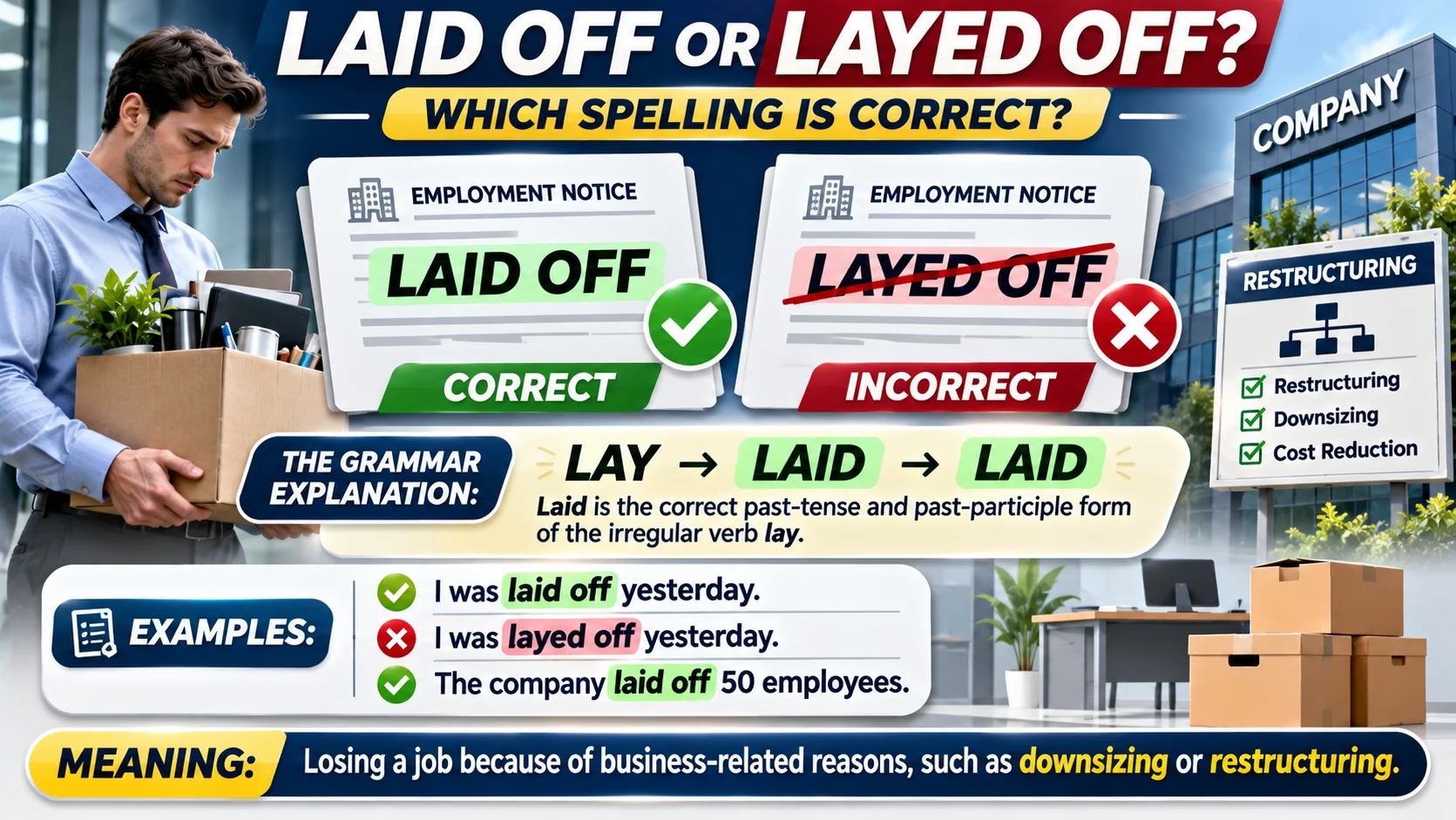
Laid off is the correct spelling, while layed off is incorrect in standard English. The phrase comes from the phrasal verb lay off, meaning to dismiss an employee from a job, usually because of financial difficulties, restructuring, or reduced business needs. For example, “Several employees were laid off last month” is grammatically correct.
Have you ever wondered whether to write laid off or layed off when talking about someone losing their job? Although both spellings may look reasonable, only one is correct in standard American English. The correct expression is laid off, and it refers to an employee being dismissed from a job, often because a company needs to reduce its workforce.
The confusion usually comes from the past-tense forms of the verbs lay and lie. However, their spelling rules are different, which makes it easy to choose the wrong form. Moreover, the word laid can look unusual to people who expect a regular past-tense spelling such as “layed.”
Understanding this difference is especially useful when writing professional emails, discussing employment changes, preparing resumes, or sharing workplace news. In this guide, you’ll learn why laid off is correct, what the expression means, how to use it in sentences, and which common grammar mistakes to avoid.
Laid Off vs. Layed Off
| Comparison | Laid Off | Layed Off |
|---|---|---|
| Correct spelling | Yes | No |
| Grammar | Correct past-tense form | Incorrect spelling |
| Meaning | Dismissed from employment | No standard meaning |
| Verb form | Past tense of lay off | Not a valid standard form |
| Professional writing | Recommended | Avoid |
| Example | She was laid off yesterday. | She was layed off yesterday. |
Remember: Whenever you describe someone losing a job because an employer reduces its workforce, use laid off, not layed off.
What Does Laid Off Mean?
Laid off means that an employer has ended an employee’s employment, usually because of business-related reasons rather than personal performance or misconduct.
For example, a company might lay off workers when it experiences financial difficulties, closes a department, changes its business strategy, or introduces technology that reduces the need for certain positions.
The expression is commonly used in workplaces, business news, employment discussions, and everyday conversations.
Consider this example:
“Mark was laid off after his company closed its local office.”
This sentence means Mark lost his job because the company closed the office where he worked.
Importantly, being laid off does not automatically mean an employee did something wrong. Instead, the decision often comes from the employer’s financial or operational needs.
Why Is Laid Off Correct?
The expression laid off is correct because laid is the standard past-tense and past-participle form of the verb lay.
The verb lay follows an irregular pattern:
- Present: Lay
- Past tense: Laid
- Past participle: Laid
- Present participle: Laying
Therefore, when you use the past tense of lay off, the correct expression is laid off.
For example:
- Present: The company lays off workers during difficult periods.
- Past: The company laid off 50 employees last year.
- Present perfect: The company has laid off several employees.
- Passive voice: Several employees were laid off.
Notice that the spelling remains laid in these different grammatical constructions.
Why Is Layed Off Incorrect?
Layed off is incorrect because lay is an irregular verb, and its past-tense form is laid, not layed.
Although English has many regular verbs that form their past tense by adding “-ed,” this rule does not apply to every verb.
For example:
- Walk → Walked
- Talk → Talked
- Play → Played
- Lay → Laid
As a result, writing “layed off” is a spelling mistake in standard English.
You might occasionally see this spelling in informal online conversations or social media comments. However, that does not make it grammatically correct.
For professional communication, academic writing, employment documents, and published content, always use laid off.
Laid Off vs. Layed Off: Understanding the Grammar
The easiest way to understand this spelling difference is to examine the verb forms.
The Verb Lay
Lay means to put or place something down.
Examples:
- Please lay the documents on my desk.
- She laid the book on the table.
- He has laid the foundation for a new business.
The verb requires an object in its ordinary meaning.
The Verb Lay Off
Lay off is a phrasal verb that can mean to dismiss employees from their jobs.
Examples:
- The company may lay off workers.
- Management laid off 20 employees.
- Several employees have been laid off.
Here, laid remains the correct past-tense and past-participle form.
What About Layed?
The spelling layed is not the standard past tense of lay. Therefore, it should not replace laid in the expression laid off.
The distinction is simple: use laid whenever you need the past-tense form of lay.
Laid Off Meaning in the Workplace
In professional settings, being laid off generally means an employee has lost their job because of a business decision.
However, layoffs can happen for several reasons.
Company downsizing: An organization reduces the number of employees to lower operating costs.
Financial problems: A business experiences declining revenue and cannot afford its existing workforce.
Department restructuring: An employer reorganizes its operations and removes certain positions.
Business closure: A company shuts down completely or closes a particular location.
Reduced demand: A business no longer needs as many employees because customer demand has decreased.
Technological changes: Automation or new systems reduce the need for certain job responsibilities.
For instance, a technology company might lay off employees after changing its product strategy. Similarly, a manufacturing business might reduce its workforce when production slows down.
Laid Off vs. Fired: What’s the Difference?
Although both expressions describe situations where someone loses a job, their meanings are different.
| Laid Off | Fired |
|---|---|
| Usually related to business needs | Usually related to individual circumstances |
| May result from downsizing | May result from misconduct or poor performance |
| Often affects multiple employees | Can affect one employee |
| Not necessarily the employee’s fault | May involve employee-related concerns |
| Example: The company reduced its workforce. | Example: He was fired for repeated misconduct. |
For example:
“Sarah was laid off because her company closed its marketing department.”
This suggests a business decision rather than a problem with Sarah’s performance.
On the other hand:
“Sarah was fired because she repeatedly violated company policies.”
This sentence describes an employment decision connected to her conduct.
Nevertheless, the exact circumstances can vary. A layoff may affect an individual employee, and the reasons behind termination can sometimes overlap.
Laid Off vs. Let Go
The expressions laid off and let go are sometimes used interchangeably, but they are not always identical.
Laid off usually refers to job loss caused by organizational or financial decisions.
Let go is a broader informal expression that can describe an employer ending someone’s employment for different reasons.
Examples:
- “The company laid off 30 workers during restructuring.”
- “The manager let him go after several performance issues.”
Therefore, laid off is generally more specific when discussing workforce reductions.
Real-Life Examples of Laid Off in Sentences
Understanding the phrase becomes easier when you see how people use it in everyday situations.
Workplace Examples
- The company laid off 100 employees last month.
- My brother was laid off after the factory closed.
- Several workers have been laid off because of budget cuts.
- Management announced plans to lay off employees next quarter.
- She was worried about being laid off during the restructuring.
- The organization laid off some of its temporary staff.
- Many employees were laid off when the business shut down.
- Our department may lay off additional workers this year.
Everyday Conversation Examples
- “I heard John was laid off. Is he doing okay?”
- “My company laid off several people yesterday.”
- “She has been looking for work since she was laid off.”
- “I’m afraid I might get laid off soon.”
- “He was laid off, but he has already started applying for new jobs.”
Professional Writing Examples
- “The organization laid off 25 employees as part of its restructuring plan.”
- “Employees affected by the layoffs will receive additional information.”
- “The company has laid off workers across several departments.”
- “Management confirmed that no further layoffs are currently planned.”
These examples demonstrate that laid off works in both casual and professional communication.
How to Use Laid Off in Different Tenses
The phrase can appear in different tenses depending on when the employment action happens.
| Tense | Correct Form | Example |
|---|---|---|
| Present | Lay off | The company may lay off workers. |
| Past | Laid off | They laid off 30 employees. |
| Present perfect | Have/has laid off | The company has laid off several workers. |
| Past perfect | Had laid off | The company had laid off employees before closing. |
| Future | Will lay off | Management will lay off some employees. |
| Passive voice | Was/were laid off | Several workers were laid off. |
| Present continuous | Am/is/are laying off | The company is laying off employees. |
Notice that layed off does not appear in any of these correct forms.
Common Mistakes When Using Laid Off
Even experienced English speakers sometimes confuse irregular verbs. Here are common mistakes and their corrections.
| Incorrect | Correct |
|---|---|
| I was layed off yesterday. | I was laid off yesterday. |
| They layed off 20 workers. | They laid off 20 workers. |
| She has layed off employees. | She has laid off employees. |
| He got layed off last week. | He got laid off last week. |
| We were layed off together. | We were laid off together. |
| The company is laid off workers. | The company is laying off workers. |
Grammar tip: Remember that laid is the past form, while laying is the present participle. The spelling layed is not appropriate in these constructions.
Synonyms for Laid Off
Several expressions can communicate a similar meaning, although their exact implications may differ.
| Synonym or Alternative | Meaning |
|---|---|
| Dismissed | Removed from employment |
| Let go | Informally released from a job |
| Made redundant | No longer needed for a position |
| Terminated | Employment officially ended |
| Discharged | Released from a job |
| Workforce reduction | A decrease in the number of employees |
| Downsized | Reduced in organizational size or staffing |
| Job eliminated | A position removed by an employer |
For professional communication, laid off, position eliminated, and workforce reduction are often useful choices.
Advantages and Disadvantages of Using the Phrase Laid Off
The expression is useful because it communicates a specific type of employment situation. However, it also carries emotional and professional implications.
Advantages
- Clear meaning: It communicates that someone lost a job because of an employer’s decision.
- Professional usage: It is widely understood in workplace communication.
- Specific context: It distinguishes many business-related job losses from performance-related dismissals.
- Common expression: Employers, employees, journalists, and job seekers frequently use it.
Disadvantages
- Negative association: The phrase can create anxiety because it relates to unemployment.
- Emotional impact: Someone who has recently lost a job may find the expression upsetting.
- Context matters: Not every employment termination is technically a layoff.
- Possible confusion: Some people incorrectly use it interchangeably with fired.
Is Laid Off the Same as Unemployed?
No. Although the expressions are related, they describe different things.
Laid off describes how someone lost their job.
Unemployed describes a person’s current employment status when they do not have a job and are seeking or available for work, depending on the definition being used.
For example:
“David was laid off from his company last month.”
This describes how David lost his job.
“David is currently unemployed.”
This describes his present employment situation.
Someone who has been laid off may later find another job. Therefore, being laid off does not mean a person will remain unemployed.
How to Remember Laid Off or Layed Off
A simple memory trick can help you avoid this spelling mistake.
Remember this pattern:
Lay → Laid → Laid
The past tense of lay is laid, just as the past tense of pay is paid.
For example:
- Pay → Paid
- Lay → Laid
- Say → Said
Although these verbs have different meanings, remembering their irregular forms can make spelling easier.
Another helpful trick is to remember the sentence:
“I was laid off, not layed off.”
Repeat this sentence whenever you are unsure which spelling to choose.
Related Comparisons: Similar Grammar Confusions
English contains many words and expressions that look or sound similar but follow different spelling rules.
Here are some useful comparisons:
Laid vs. Layed: Laid is the correct past tense of lay, while layed is generally incorrect in standard English.
Lay vs. Lie: Lay means to put something down, while lie means to recline or rest.
Paid vs. Payed: Paid is the usual past tense of pay. Payed has limited specialized nautical uses.
Fired vs. Laid Off: Both describe job loss, but fired commonly relates to individual employment circumstances, whereas laid off usually relates to business decisions.
Lose vs. Loose: Lose means to fail to keep something, while loose means not tight.
Then vs. Than: Then relates to time or sequence, while than is used for comparisons.
Learning these distinctions can improve your spelling and make your professional writing more accurate.
Practice Exercises: Laid Off or Layed Off
Test your understanding by choosing the correct spelling in each sentence.
Fill in the Blanks
Choose between laid off and layed off.
- The company ______ several employees last week.
- My uncle was ______ after the factory closed.
- Management has ______ 15 workers this month.
- She is worried about getting ______.
- Many employees were ______ during the recession.
- The organization may ______ additional workers next year.
- He was ______ because his position was eliminated.
- The business has ______ employees across three departments.
Multiple-Choice Questions
Which sentence is correct?
A. I was layed off yesterday.
B. I was laid off yesterday.
Which is the correct past tense of lay?
A. Layed
B. Laid
Which sentence uses the phrase correctly?
A. The company has layed off workers.
B. The company has laid off workers.
What does laid off usually mean?
A. Receiving a promotion.
B. Losing a job because of business-related reasons.
Which sentence is grammatically correct?
A. Several employees were laid off.
B. Several employees were layed off.
Exercise Answers
Fill in the blanks:
- Laid off
- Laid off
- Laid off
- Laid off
- Laid off
- Lay off
- Laid off
- Laid off
Multiple-choice answers:
- B. I was laid off yesterday.
- B. Laid.
- B. The company has laid off workers.
- B. Losing a job because of business-related reasons.
- A. Several employees were laid off.
If you answered all the questions correctly, you understand the difference between the two spellings.
Frequently Asked Questions
Is it laid off or layed off?
Laid off is correct. Layed off is an incorrect spelling in standard English because the past tense of lay is laid.
Is layed off ever correct?
No, layed off is not the standard spelling of this expression. Always use laid off when describing someone who has lost a job because of an employer’s decision.
Why do people spell laid off as layed off?
People often make this mistake because many English verbs form their past tense by adding “-ed.” However, lay is irregular, so its past-tense form is laid.
What is the past tense of lay off?
The past tense of lay off is laid off. For example, “The company laid off 50 employees last year.”
Is laid off one word or two words?
It is written as two words: laid off. The first word is the past-tense form of lay, while the second is the particle off.
What does getting laid off mean?
Getting laid off means losing your job because an employer decides to reduce its workforce or eliminate a position. It usually does not mean the employee was dismissed for misconduct.
Is being laid off the same as being fired?
No. Being laid off usually results from business-related decisions, such as budget cuts or restructuring. Being fired more commonly refers to termination connected to an employee’s performance or conduct.
Can I say I got layed off?
No. The correct expression is “I got laid off.” For example, “I got laid off last Friday, so I’m searching for a new job.”
Is laid off formal or informal?
Laid off is appropriate in both formal and informal English. It appears in professional announcements, business reports, employment discussions, and everyday conversations.
What is another word for laid off?
Depending on the context, alternatives include dismissed, let go, made redundant, terminated, and released from employment. However, these expressions do not always have exactly the same meaning.
Should I use laid off on my resume?
You can use the phrase when explaining why a previous job ended. However, you generally do not need to mention a layoff on your resume unless the information is relevant to your employment history or a specific application question.
What is the difference between laid off and laid-off?
Laid off is normally written as two words when used as a verb phrase, such as “She was laid off.” The hyphenated form laid-off may appear before a noun as a compound modifier, such as “laid-off employees.”
Key Takeaways
The correct spelling is laid off, not layed off. The expression comes from the irregular verb lay, whose past-tense and past-participle forms are both laid.
Remember these important points:
- Laid off is the correct spelling.
- Layed off is incorrect in standard English.
- The expression usually means losing a job because of business-related decisions.
- Layoffs can happen because of downsizing, restructuring, financial difficulties, or reduced demand.
- Being laid off is not necessarily the same as being fired.
- Use laid off in professional documents, everyday conversations, and online writing.
Conclusion
Choosing between laid off or layed off becomes easy once you understand the irregular verb lay. The correct expression is always laid off in standard English because laid is the proper past-tense and past-participle form of lay.
Although layed off may look reasonable, it is not grammatically accepted in standard American English. Therefore, whether you’re discussing workplace changes, writing a professional email, or explaining why someone lost a job, always choose laid off.
Ultimately, remembering the simple pattern lay, laid, laid will help you avoid this common spelling mistake and communicate more confidently.