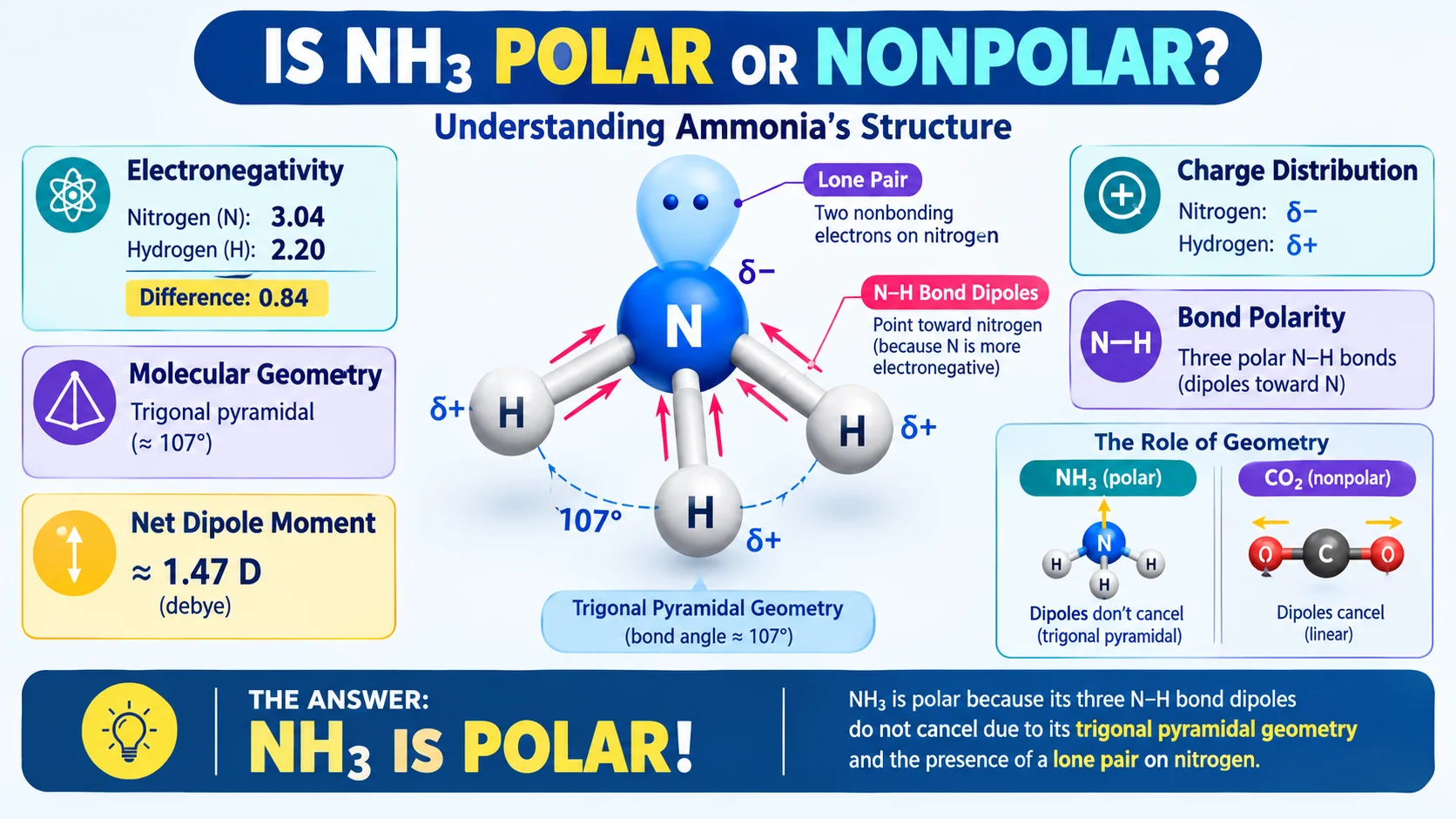
NH3 (ammonia) is a polar molecule because it has a trigonal pyramidal molecular shape and an uneven distribution of electrical charge. Nitrogen attracts shared electrons more strongly than hydrogen, creating polar N–H bonds. Additionally, nitrogen’s lone pair prevents the bond dipoles from canceling, resulting in a net dipole moment.
Understanding whether NH3 polar or nonpolar is an important part of learning molecular geometry, chemical bonding, and electronegativity. Ammonia (NH3) is a common chemical compound found in household cleaning products, fertilizers, industrial processes, and biological systems. Although its molecular formula looks simple, its three-dimensional structure plays a major role in determining its physical and chemical properties.
The answer is straightforward: NH3 is a polar molecule. However, its polarity depends on more than just the difference in electronegativity between nitrogen and hydrogen. The arrangement of its atoms and the presence of a lone electron pair on the central nitrogen atom also influence the molecule’s overall charge distribution.
Moreover, understanding ammonia’s polarity helps explain why it interacts with water, forms hydrogen bonds, and has several important chemical properties. In this guide, you’ll learn why ammonia is polar, examine its Lewis structure, explore its molecular geometry, and understand how bond dipoles contribute to its overall polarity. You’ll also discover examples, comparisons, common mistakes, and practice questions to strengthen your chemistry knowledge.
Is NH3 Polar or Nonpolar?
| Property | Answer |
|---|---|
| Chemical formula | NH3 |
| Common name | Ammonia |
| Molecular polarity | Polar |
| Central atom | Nitrogen |
| Bond type | Polar covalent |
| Molecular geometry | Trigonal pyramidal |
| Electron geometry | Tetrahedral |
| Lone pairs on nitrogen | 1 |
| Bond angle | Approximately 107° |
| Electronegativity of nitrogen | 3.04 |
| Electronegativity of hydrogen | 2.20 |
| Dipole moment | Approximately 1.47 D |
| Overall charge | Neutral |
Key takeaway: NH3 is polar because its trigonal pyramidal shape creates an uneven distribution of electrical charge.
What Is NH3?
NH3 is the chemical formula for ammonia, a compound made of one nitrogen atom and three hydrogen atoms. It is a colorless gas with a strong, recognizable smell.
Ammonia is an important chemical in several industries. For example, manufacturers use it to produce fertilizers, cleaning products, plastics, and other chemical compounds.
From a chemistry perspective, ammonia is especially interesting because its molecular structure determines its polarity.
Nitrogen sits at the center of the molecule and forms three covalent bonds with hydrogen atoms. However, nitrogen also contains one lone pair of electrons that does not participate in bonding.
Consequently, the molecule develops a trigonal pyramidal shape rather than a flat triangular structure.
This three-dimensional arrangement is the main reason ammonia has an overall dipole moment.
Why Is NH3 Polar?
NH3 is polar because nitrogen attracts shared electrons more strongly than hydrogen, and its molecular geometry prevents the individual bond dipoles from canceling.
There are three important reasons behind its polarity:
- Electronegativity difference: Nitrogen attracts bonding electrons more strongly than hydrogen.
- Polar covalent bonds: Each nitrogen-hydrogen bond has an uneven distribution of electrons.
- Asymmetrical molecular shape: The trigonal pyramidal structure prevents the bond dipoles from canceling.
Together, these characteristics produce a molecule with a partial negative charge near nitrogen and a partial positive charge toward the hydrogen atoms.
Therefore, ammonia has a net dipole moment of approximately 1.47 debye.
Let’s examine these factors in more detail.
Electronegativity Difference Between Nitrogen and Hydrogen
Electronegativity describes how strongly an atom attracts shared electrons in a chemical bond.
Nitrogen is more electronegative than hydrogen. On the Pauling scale, their approximate electronegativity values are:
| Element | Electronegativity |
|---|---|
| Nitrogen (N) | 3.04 |
| Hydrogen (H) | 2.20 |
The electronegativity difference is:
3.04 − 2.20 = 0.84
This difference means nitrogen attracts the shared electrons in each N–H bond more strongly than hydrogen.
As a result, the electron density shifts toward nitrogen.
Consequently:
- Nitrogen develops a partial negative charge (δ−).
- Each hydrogen develops a partial positive charge (δ+).
This unequal sharing of electrons makes every N–H bond polar covalent.
However, bond polarity alone does not determine whether an entire molecule is polar. Molecular geometry must also be considered.
NH3 Lewis Structure
The Lewis structure of ammonia helps explain why the molecule is polar.
Nitrogen has five valence electrons, while each hydrogen atom contributes one valence electron.
Therefore, the total number of valence electrons in NH3 is:
5 + (3 × 1) = 8 valence electrons
Nitrogen uses three pairs of electrons to form three single covalent bonds with hydrogen atoms. The remaining two electrons form one lone pair.
A simplified Lewis structure looks like this:
       ..
       N
     / | \
    H  H  H
The two dots above nitrogen represent its lone pair of electrons.
This lone pair is important because it affects the molecule’s three-dimensional arrangement.
Furthermore, the lone pair occupies more space around nitrogen than a bonding pair. As a result, it pushes the N–H bonds closer together.
The molecule therefore has a trigonal pyramidal geometry.
Molecular Geometry of NH3
The molecular geometry of NH3 is trigonal pyramidal.
According to Valence Shell Electron Pair Repulsion (VSEPR) theory, electron groups around a central atom arrange themselves to minimize repulsion.
In ammonia, nitrogen has four electron groups:
- Three bonding pairs connected to hydrogen atoms.
- One lone pair of electrons.
These four electron groups produce a tetrahedral electron geometry. However, because one position contains a lone pair rather than an atom, the molecular geometry is trigonal pyramidal.
<IMAGE_PLACEHOLDER>
The three hydrogen atoms form the triangular base, while nitrogen occupies the top region of the pyramidal arrangement.
Additionally, the lone pair occupies the remaining electron-group position.
This arrangement creates an H–N–H bond angle of approximately 107°, which is smaller than the ideal tetrahedral angle of 109.5°.
The geometry is important because the three N–H bond dipoles do not point in opposite directions. Instead, their horizontal components combine, producing a net dipole moment.
Does NH3 Have a Lone Pair?
Yes, ammonia has one lone pair of electrons on its central nitrogen atom.
A lone pair consists of two valence electrons that belong to an atom but are not shared in a covalent bond.
In NH3, nitrogen forms three bonds with hydrogen atoms and retains two nonbonding electrons.
This lone pair has two important effects:
It determines molecular geometry.
The lone pair occupies one of the four electron-group positions around nitrogen, producing a trigonal pyramidal molecular shape.
It influences molecular polarity.
The lone pair contributes to the asymmetric electron distribution around the nitrogen atom. Meanwhile, the three N–H bond dipoles combine to create a net molecular dipole.
Therefore, the lone pair is an important factor in explaining why ammonia is polar.
NH3 Bond Dipoles and Molecular Dipole Moment
A bond dipole occurs when two bonded atoms share electrons unequally because of their different electronegativities.
In ammonia, nitrogen attracts electrons more strongly than hydrogen. Therefore, each N–H bond has a dipole directed toward nitrogen.
The three bond dipoles do not cancel because of the molecule’s trigonal pyramidal geometry.
Instead, their horizontal components cancel each other, while their vertical components combine.
This produces an overall molecular dipole directed toward the nitrogen and lone-pair side of the molecule.
The molecular dipole moment of ammonia is approximately:
1.47 Debye (D)
A nonzero dipole moment confirms that NH3 is polar.
It is important to understand that the molecule remains electrically neutral overall. Polarity does not mean that ammonia carries a permanent net electrical charge. Rather, it means that positive and negative electrical charges are distributed unevenly within the molecule.
NH3 Shape: Why Does Geometry Matter?
Molecular geometry is one of the most important factors in determining molecular polarity.
Even when individual chemical bonds are polar, a molecule can be nonpolar if its bond dipoles cancel because of a symmetrical arrangement.
For example, carbon dioxide (CO2) has two polar C=O bonds. However, its linear geometry causes the two bond dipoles to cancel.
Ammonia behaves differently.
Its trigonal pyramidal geometry does not allow the three N–H bond dipoles to cancel completely.
As a result, NH3 has an uneven charge distribution and a net dipole moment.
Therefore, both electronegativity and molecular shape must be considered when determining molecular polarity.
How to Determine Whether a Molecule Is Polar or Nonpolar
You can use a few simple steps to determine whether a molecule is polar or nonpolar.
Check the molecular formula.
First, identify the atoms present in the molecule and determine which atom occupies the central position.
Compare electronegativity values.
Next, compare the electronegativity of the bonded atoms. A significant difference generally indicates a polar covalent bond.
Draw the Lewis structure.
Determine how many valence electrons are available and identify bonding pairs and lone pairs.
Find the molecular geometry.
Use VSEPR theory to identify the three-dimensional shape of the molecule.
Examine the bond dipoles.
Finally, determine whether the individual bond dipoles cancel or combine.
If the dipoles cancel completely, the molecule is nonpolar. However, if they produce a net dipole moment, the molecule is polar.
Applying these steps to ammonia confirms that NH3 is polar.
Properties of Polar NH3 Molecules
Ammonia’s polarity influences several of its physical and chemical properties.
Solubility in Water
Ammonia is highly soluble in water because it is polar and can interact strongly with water molecules.
Both ammonia and water can form hydrogen bonds. Consequently, ammonia dissolves readily in water.
When ammonia dissolves, some of it reacts with water to produce ammonium and hydroxide ions:
NH3 + H2O ⇌ NH4+ + OH−
This reaction makes an aqueous ammonia solution basic.
Hydrogen Bonding
Ammonia can form hydrogen bonds because nitrogen has a lone pair and its hydrogen atoms are bonded to an electronegative nitrogen atom.
These interactions contribute to ammonia’s relatively high boiling point compared with similar-sized non-hydrogen-bonding molecules.
Nevertheless, ammonia’s hydrogen bonding is generally weaker than the hydrogen bonding found in water.
Dipole-Dipole Interactions
Because ammonia is polar, its molecules experience dipole-dipole attractions.
The partially positive hydrogen regions of one molecule are attracted to the partially negative nitrogen region of another.
Furthermore, these attractions contribute to the intermolecular behavior of ammonia.
Boiling Point
Ammonia has a boiling point of approximately −33.3°C at standard atmospheric pressure.
Although it is a relatively small molecule, hydrogen bonding increases its boiling point compared with what would otherwise be expected for a molecule of its size.
Electrical Behavior
Pure molecular ammonia is not a strong electrical conductor because it does not contain a large concentration of freely moving ions.
However, when ammonia dissolves in water, a small portion reacts to produce ammonium and hydroxide ions.
Therefore, aqueous ammonia solutions can conduct electricity.
Is NH3 Polar or Nonpolar Compared With Other Molecules?
Comparing ammonia with other molecules makes the concept of polarity easier to understand.
| Molecule | Molecular Shape | Polarity | Reason |
|---|---|---|---|
| NH3 | Trigonal pyramidal | Polar | Bond dipoles do not cancel |
| H2O | Bent | Polar | Asymmetrical geometry |
| CO2 | Linear | Nonpolar | Bond dipoles cancel |
| CH4 | Tetrahedral | Nonpolar | Symmetrical geometry |
| BF3 | Trigonal planar | Nonpolar | Bond dipoles cancel |
| HCl | Linear | Polar | Different electronegativities |
| SO2 | Bent | Polar | Bond dipoles do not cancel |
| CCl4 | Tetrahedral | Nonpolar | Symmetrical arrangement |
Notice that both NH3 and CH4 contain a central atom surrounded by four electron groups. However, their molecular geometries and polarities differ.
In CH4, four identical hydrogen atoms surround carbon symmetrically, so the bond dipoles cancel.
In contrast, NH3 has one lone pair and three hydrogen atoms. Consequently, its molecular structure is asymmetrical, and the dipoles do not cancel.
Difference Between Polar and Nonpolar Molecules
Polar and nonpolar molecules differ in how electrical charges are distributed.
| Feature | Polar Molecules | Nonpolar Molecules |
|---|---|---|
| Charge distribution | Uneven | Even or symmetrical |
| Dipole moment | Nonzero | Zero |
| Bond polarity | Often polar bonds | Can have polar or nonpolar bonds |
| Molecular geometry | Often asymmetrical | Often symmetrical |
| Water solubility | Often higher | Often lower |
| Examples | NH3, H2O, HCl | CO2, CH4, BF3 |
However, these are general patterns rather than absolute rules. Some nonpolar molecules contain polar bonds, and some polar molecules have complicated three-dimensional structures.
For instance, CO2 contains polar bonds, but its symmetrical linear shape makes the entire molecule nonpolar.
Real-Life Applications of Ammonia Polarity
Ammonia’s polarity is important in several everyday and industrial applications.
Fertilizer Production
Ammonia is a major raw material in fertilizer manufacturing.
Its chemical properties allow manufacturers to produce nitrogen-containing fertilizers that support plant growth.
For example, ammonia is used to manufacture ammonium nitrate and urea fertilizers.
Household Cleaning Products
Ammonia is used in certain household cleaning products because it dissolves readily in water and can help remove grease and dirt.
However, ammonia-based cleaners should never be mixed with bleach because dangerous toxic gases can form.
Industrial Refrigeration
Ammonia is used as a refrigerant in industrial cooling systems.
Its physical and thermodynamic properties make it useful in large refrigeration applications, including food processing and cold storage.
Chemical Manufacturing
Ammonia serves as an important starting material in the production of several chemicals.
Additionally, manufacturers use it in processes involving plastics, synthetic fibers, and pharmaceutical ingredients.
Environmental and Biological Systems
Ammonia also plays a role in natural nitrogen cycling.
Living organisms produce and process nitrogen-containing compounds, while microorganisms help convert ammonia into other nitrogen compounds in soil and water.
Thus, ammonia’s chemical behavior is important in both biological and environmental systems.
Common Misconceptions About NH3 Polarity
Several common mistakes can make it difficult to understand why ammonia is polar.
Mistake: NH3 Is Nonpolar Because It Has Three Identical Hydrogen Atoms
Having identical surrounding atoms does not automatically make a molecule nonpolar.
Although ammonia has three identical N–H bonds, its trigonal pyramidal geometry prevents their dipoles from canceling.
Therefore, NH3 is polar.
Mistake: NH3 Has a Trigonal Planar Shape
Ammonia does not have a trigonal planar molecular geometry.
Instead, it has a trigonal pyramidal shape because nitrogen contains one lone pair.
This difference is important when determining polarity.
Mistake: NH3 Has No Lone Pair
Nitrogen has five valence electrons. Three participate in N–H bonding, while the remaining two form one lone pair.
Consequently, ignoring the lone pair leads to an incorrect prediction of molecular geometry.
Mistake: Polar Molecules Must Have an Electrical Charge
A polar molecule does not need to carry an overall positive or negative charge.
Ammonia is electrically neutral, but its electrons are distributed unevenly.
Therefore, it has partial positive and negative regions.
Mistake: Polar Bonds Always Produce Polar Molecules
This statement is incorrect.
A molecule can contain polar bonds and still be nonpolar if its geometry allows the bond dipoles to cancel.
Carbon dioxide is a common example.
Advantages and Disadvantages of Understanding NH3 Polarity
Learning about ammonia’s polarity provides several benefits for chemistry students.
Advantages
- Helps explain molecular geometry and chemical bonding.
- Makes electronegativity easier to understand.
- Explains why ammonia dissolves readily in water.
- Helps predict intermolecular forces.
- Improves understanding of hydrogen bonding.
- Supports the study of molecular dipole moments.
- Provides a useful example of VSEPR theory.
Limitations and Challenges
- Molecular polarity cannot be determined from the chemical formula alone.
- Students may confuse electron geometry with molecular geometry.
- Bond polarity and molecular polarity are different concepts.
- Three-dimensional molecular structures can be difficult to visualize.
- Dipole cancellation requires understanding vector direction.
Nevertheless, practicing with different molecules makes these concepts much easier.
Related Chemistry Comparisons
Understanding other molecules can help reinforce why NH3 is polar.
NH3 vs. H2O
Both ammonia and water are polar molecules.
However, they have different molecular geometries.
NH3 has three bonding pairs and one lone pair around nitrogen, giving it a trigonal pyramidal shape.
In contrast, H2O has two bonding pairs and two lone pairs around oxygen, resulting in a bent molecular shape.
Both molecules can form hydrogen bonds, although water generally forms stronger hydrogen-bonding interactions.
NH3 vs. CH4
Ammonia and methane both contain four electron groups around their central atoms.
However, ammonia has one lone pair, while methane has four bonding pairs.
Therefore, NH3 has a trigonal pyramidal shape and is polar, whereas CH4 has a tetrahedral shape and is nonpolar.
NH3 vs. CO2
NH3 is polar because its bond dipoles do not cancel.
Meanwhile, CO2 is nonpolar because its linear molecular structure creates two equal and opposite bond dipoles.
This comparison demonstrates why molecular geometry matters just as much as bond polarity.
NH3 vs. BF3
Both molecules contain three surrounding atoms around a central atom.
However, NH3 has a trigonal pyramidal shape because nitrogen contains one lone pair.
BF3 has a trigonal planar shape with three identical B–F bonds arranged symmetrically.
Consequently, NH3 is polar, while BF3 is nonpolar.
Practice Questions: Is NH3 Polar or Nonpolar?
Test your understanding with these simple chemistry questions.
Question: Is NH3 polar or nonpolar?
Answer: NH3 is polar because its trigonal pyramidal geometry produces a net dipole moment.
Question: What is the molecular geometry of NH3?
Answer: Its molecular geometry is trigonal pyramidal.
Question: How many lone pairs does NH3 have?
Answer: Ammonia has one lone pair on its central nitrogen atom.
Question: Are N–H bonds polar?
Answer: Yes. Nitrogen is more electronegative than hydrogen, so the bonding electrons are attracted toward nitrogen.
Question: What is the bond angle in NH3?
Answer: The H–N–H bond angle is approximately 107°.
Question: What is the dipole moment of NH3?
Answer: Its dipole moment is approximately 1.47 debye.
Question: Why do NH3 bond dipoles not cancel?
Answer: Its trigonal pyramidal structure is asymmetrical, so the three bond dipoles produce a net molecular dipole.
Question: Is NH3 soluble in water?
Answer: Yes. Ammonia is highly soluble in water because of its polarity and its ability to form hydrogen bonds.
Multiple-Choice Questions
Which molecular shape does NH3 have?
A. Linear
B. Bent
C. Trigonal pyramidal
D. Tetrahedral
Correct Answer: C. Trigonal pyramidal.
How many lone pairs are present on nitrogen in NH3?
A. Zero
B. One
C. Two
D. Three
Correct Answer: B. One.
Which atom attracts the bonding electrons more strongly in NH3?
A. Hydrogen
B. Nitrogen
C. Both equally
D. Neither
Correct Answer: B. Nitrogen.
What is the approximate dipole moment of NH3?
A. 0 D
B. 1.47 D
C. 2.50 D
D. 3.00 D
Correct Answer: B. 1.47 D.
Why is NH3 polar?
A. It has a symmetrical structure.
B. It contains no lone pairs.
C. Its bond dipoles do not cancel.
D. It has no electronegativity difference.
Correct Answer: C. Its bond dipoles do not cancel.
Frequently Asked Questions
Is NH3 polar or nonpolar?
NH3 is a polar molecule. Its trigonal pyramidal geometry and polar N–H bonds create an uneven distribution of electrical charge.
Why is ammonia considered a polar molecule?
Ammonia is polar because nitrogen attracts shared electrons more strongly than hydrogen. Additionally, its trigonal pyramidal structure prevents the bond dipoles from canceling.
Is NH3 a polar covalent compound?
Yes. Ammonia contains polar covalent N–H bonds because nitrogen and hydrogen have different electronegativity values.
What is the molecular geometry of ammonia?
Ammonia has a trigonal pyramidal molecular geometry. Its central nitrogen atom is connected to three hydrogen atoms and contains one lone pair.
Is NH3 symmetrical or asymmetrical?
NH3 has an asymmetrical molecular shape. Although its three hydrogen atoms are identical, the lone pair on nitrogen creates a trigonal pyramidal arrangement.
Does NH3 have a dipole moment?
Yes. Ammonia has a molecular dipole moment of approximately 1.47 debye, confirming that it is polar.
Can NH3 form hydrogen bonds?
Yes. Ammonia can form hydrogen bonds through its nitrogen lone pair and its hydrogen atoms bonded to nitrogen.
Is NH3 soluble in water?
Yes. Ammonia dissolves readily in water because it is polar and can interact with water molecules through hydrogen bonding.
Is the NH3 molecule electrically neutral?
Yes. Ammonia has no overall electrical charge. However, its electrical charge distribution is uneven, creating partial positive and negative regions.
What is the difference between NH3 and NH4+?
NH3 is a neutral ammonia molecule containing one lone pair on nitrogen. NH4+ is the ammonium ion, which carries a positive charge and has four N–H bonds with a tetrahedral geometry.
Is NH3 more polar than CH4?
Yes. NH3 is polar because its bond dipoles do not cancel. In contrast, CH4 is nonpolar because its symmetrical tetrahedral structure causes the bond dipoles to cancel.
What is the bond angle in ammonia?
The H–N–H bond angle in ammonia is approximately 107°. The lone pair compresses the bond angle compared with the ideal tetrahedral angle of 109.5°.
Key Takeaways: NH3 Polar or Nonpolar
- NH3 is a polar molecule.
- Its common name is ammonia.
- Nitrogen is the central atom.
- Nitrogen has one lone pair of electrons.
- Its molecular geometry is trigonal pyramidal.
- Its electron geometry is tetrahedral.
- The H–N–H bond angle is approximately 107°.
- Nitrogen is more electronegative than hydrogen.
- Its N–H bonds are polar covalent.
- The molecular dipole moment is approximately 1.47 D.
- Its bond dipoles do not cancel.
- Ammonia can form hydrogen bonds and dissolves readily in water.
Conclusion
So, is NH3 polar or nonpolar? The answer is clear: ammonia is polar. Its nitrogen-hydrogen bonds are polar covalent because nitrogen attracts shared electrons more strongly than hydrogen. Furthermore, the presence of one lone pair on nitrogen creates a trigonal pyramidal molecular geometry that prevents the individual bond dipoles from canceling.
As a result, ammonia has a net dipole moment of approximately 1.47 debye, with its negative end directed toward nitrogen. This polarity explains several of its important properties, including its ability to dissolve in water and form hydrogen bonds.
Remember that molecular polarity depends on both electronegativity and molecular geometry. Once you understand these two factors, determining whether molecules such as NH3, H2O, CO2, and CH4 are polar or nonpolar becomes much easier.