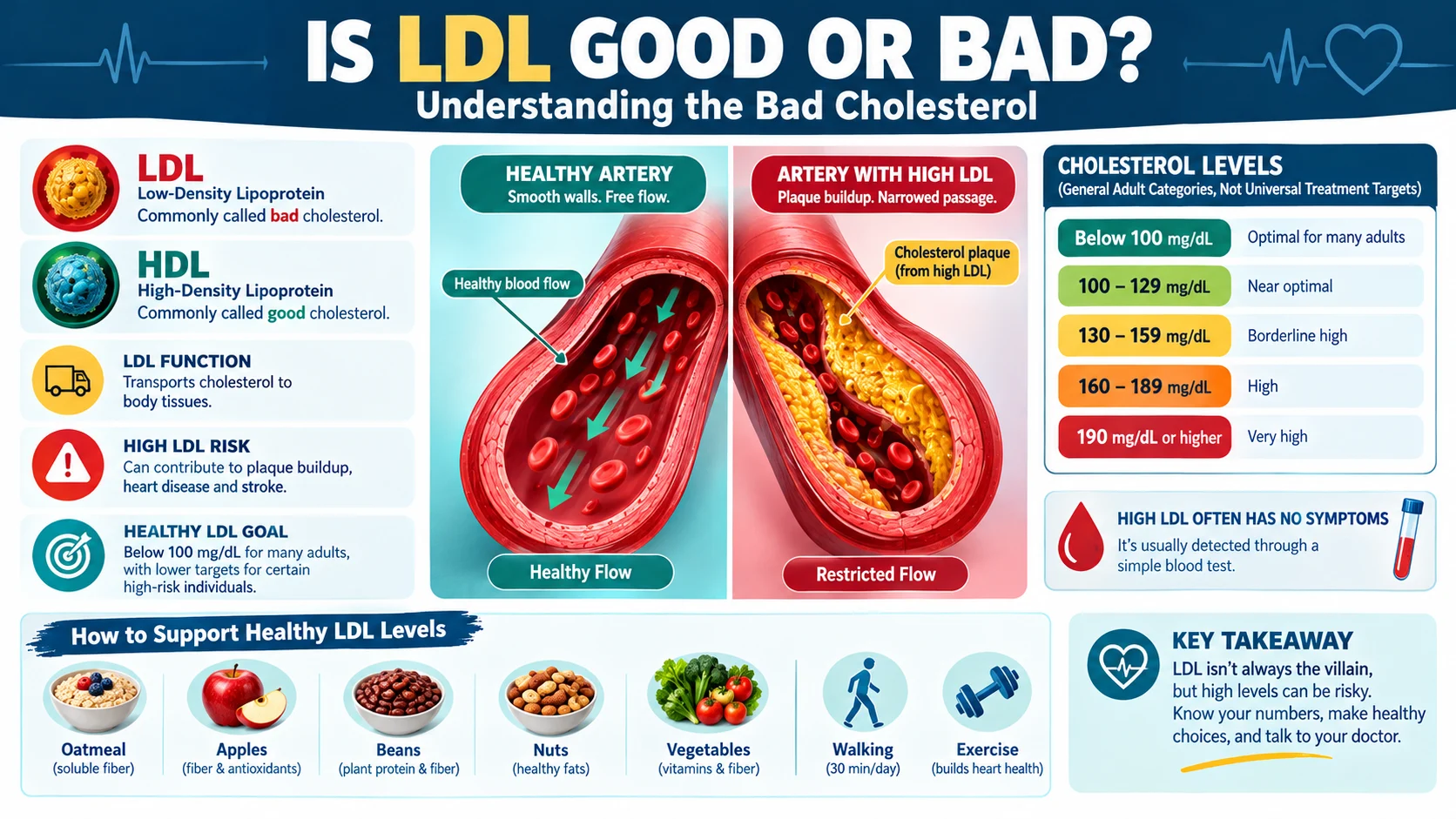
LDL (low-density lipoprotein) is commonly known as bad cholesterol because high levels can cause fatty deposits to build up inside arteries. Over time, this buildup can narrow blood vessels and increase the risk of heart disease, heart attacks, and strokes. Although the body needs cholesterol for essential functions, keeping LDL at a healthy level supports better cardiovascular health.
Is LDL good or bad? This is a common question when people receive their cholesterol test results or learn about heart health. LDL stands for low-density lipoprotein, a particle that carries cholesterol through the bloodstream. Although cholesterol plays an important role in the body, having too much LDL can increase the risk of serious cardiovascular problems.
Doctors often call LDL the “bad cholesterol” because excessive amounts can contribute to plaque buildup inside the arteries. Consequently, these deposits can restrict blood flow and make it harder for blood to reach the heart and brain. However, LDL is not entirely useless because the body needs cholesterol to build healthy cells and produce certain hormones.
Unlike LDL, HDL is commonly known as good cholesterol because it helps transport cholesterol back to the liver for processing. Therefore, understanding the difference between these two types is important when evaluating your cholesterol levels.
In this guide, you’ll discover what LDL cholesterol means, why high levels can be harmful, what numbers are considered healthy, and how LDL compares with HDL. Additionally, you’ll learn about common causes of high LDL, heart-healthy foods, lifestyle changes, and frequently asked questions.
What Is LDL Cholesterol?
LDL stands for low-density lipoprotein. It is a type of lipoprotein that transports cholesterol through your bloodstream to different parts of your body.
Cholesterol is a waxy, fat-like substance that your body needs to perform several important functions. For example, it helps build cell membranes, produce certain hormones, and support the formation of vitamin D.
However, cholesterol cannot travel through the bloodstream on its own because it does not mix well with blood. Instead, the body uses special particles called lipoproteins to transport it.
LDL is one of the main types of these particles. When too much LDL circulates in the bloodstream, cholesterol can accumulate in artery walls and contribute to a condition called atherosclerosis.
Over time, this buildup can make arteries narrower and less flexible. As a result, blood flow may become restricted, increasing the risk of heart attacks and strokes.
Why Is LDL Called Bad Cholesterol?
LDL receives the name “bad cholesterol” because elevated levels are associated with a greater risk of cardiovascular disease.
When LDL particles enter artery walls, they can contribute to the development of fatty deposits called plaques. These deposits gradually build up and may reduce the space available for blood to flow.
Furthermore, some plaques can become unstable and rupture. This may trigger blood clot formation, potentially blocking blood flow to the heart or brain.
For this reason, healthcare professionals generally recommend keeping LDL cholesterol under control.
Nevertheless, the word “bad” does not mean LDL has no useful function. The problem is having too much LDL circulating in the blood over time.
Is LDL Good or Bad for Your Body?
LDL is generally considered bad for heart health when its levels become elevated. However, the complete answer requires understanding the difference between cholesterol itself and the particles that transport it.
Your body needs cholesterol to:
- Build and maintain cell membranes.
- Produce important hormones.
- Support vitamin D production.
- Help produce bile acids that assist digestion.
- Maintain several normal biological processes.
LDL helps transport cholesterol to cells that need it. Therefore, it has a natural role in maintaining normal body functions.
However, consistently high LDL levels can contribute to plaque formation in arteries. Consequently, this increases the likelihood of cardiovascular complications.
The important distinction is that cholesterol is essential, but excessive LDL can be harmful.
What Are Normal LDL Cholesterol Levels?
LDL cholesterol levels are usually measured through a blood test called a lipid panel. Results are commonly reported in milligrams per deciliter (mg/dL), although some countries use millimoles per liter (mmol/L).
For many adults without significant cardiovascular risk factors, an LDL level below 100 mg/dL is considered optimal. However, individual targets can differ depending on medical history and overall health.
Here is a general guide to traditional adult LDL cholesterol categories:
| LDL Level (mg/dL) | Category | General Interpretation |
|---|---|---|
| Below 100 | Optimal | Generally desirable |
| 100–129 | Near optimal | Slightly above optimal |
| 130–159 | Borderline high | May increase cardiovascular risk |
| 160–189 | High | Requires medical evaluation |
| 190 or higher | Very high | Needs prompt medical assessment |
These categories provide general information rather than personalized treatment targets. In particular, someone with existing heart disease may need a much lower LDL level.
What Is a Healthy LDL Level?
For many adults, an LDL level below 100 mg/dL is a commonly used general target.
However, people with a history of heart attacks, strokes, diabetes, or other cardiovascular risk factors may need lower levels.
Depending on individual risk, healthcare professionals may recommend:
- Below 100 mg/dL for many people without established cardiovascular disease.
- Below 70 mg/dL for certain high-risk individuals.
- Below 55 mg/dL for some people at very high cardiovascular risk.
Therefore, a laboratory result should never be interpreted without considering your complete health picture.
Is LDL Below 100 Good?
Yes. An LDL level below 100 mg/dL is generally considered optimal for many adults.
Nevertheless, having an LDL result of 95 mg/dL does not automatically mean your cardiovascular risk is low. Other factors, including blood pressure, smoking, diabetes, age, and family history, also matter.
Similarly, people with existing cardiovascular disease may have a lower recommended LDL target.
Why Is High LDL Cholesterol Dangerous?
High LDL cholesterol can contribute to atherosclerosis, a condition in which fatty deposits accumulate inside artery walls.
Initially, this process may develop without noticeable symptoms. However, as plaque builds up, arteries can become narrower and less flexible.
Consequently, the heart and other organs may receive less oxygen-rich blood.
Here are some important health risks associated with elevated LDL cholesterol.
Increased Risk of Heart Disease
High LDL contributes to plaque formation in coronary arteries, which supply blood to the heart.
As these arteries become narrower, the heart may receive less oxygen. Therefore, a person may develop coronary artery disease.
Higher Risk of Heart Attack
A heart attack can occur when blood flow to part of the heart becomes blocked.
For example, a plaque inside a coronary artery may rupture and trigger a blood clot. If the clot blocks blood flow, heart muscle tissue can become damaged.
Although LDL is not the only cause of heart attacks, elevated levels are an important risk factor.
Increased Risk of Stroke
High LDL can also contribute to plaque buildup in arteries supplying the brain.
If blood flow becomes blocked, an ischemic stroke may occur. In addition, a blood clot originating elsewhere in the body can sometimes travel to the brain and block an artery.
Peripheral Artery Disease
Peripheral artery disease (PAD) develops when narrowed arteries reduce blood flow to the limbs, particularly the legs.
People with PAD may experience leg pain while walking, slow-healing wounds, or reduced circulation.
Thus, controlling LDL is important for more than just protecting the heart.
What Causes High LDL Cholesterol?
Several factors can contribute to elevated LDL cholesterol. Some are related to lifestyle, while others involve genetics, age, or underlying health conditions.
Understanding these causes can help people make informed decisions about managing their cholesterol.
Unhealthy Eating Habits
A diet high in saturated fats and trans fats can raise LDL cholesterol.
Common sources include:
- Fatty cuts of meat.
- Butter and ghee.
- Full-fat dairy products.
- Processed meats.
- Commercial baked goods containing unhealthy fats.
- Foods prepared with partially hydrogenated oils.
However, not every high-fat food has the same effect on cholesterol. Replacing saturated fats with unsaturated fats can help improve LDL levels.
Lack of Physical Activity
Regular physical activity supports cardiovascular health and can improve several cholesterol-related measurements.
On the other hand, a sedentary lifestyle may contribute to weight gain and unfavorable lipid levels.
Therefore, incorporating regular movement into your daily routine can be beneficial.
Excess Body Weight
Being overweight, particularly when excess fat accumulates around the abdomen, may contribute to unhealthy cholesterol levels.
Additionally, excess body weight can be associated with higher triglycerides and lower HDL cholesterol.
Maintaining a healthy weight can help improve your overall cardiovascular risk profile.
Family History and Genetics
Genetics can significantly influence cholesterol levels.
For example, familial hypercholesterolemia is an inherited condition that causes very high LDL cholesterol from an early age.
People with this condition may develop cardiovascular disease earlier than expected.
Consequently, a strong family history of early heart disease or very high cholesterol deserves medical attention.
Smoking and Tobacco Use
Smoking damages blood vessels and contributes to cardiovascular disease.
It can also negatively affect HDL cholesterol and increase overall heart risk.
Therefore, avoiding tobacco is an important part of protecting your heart.
Certain Medical Conditions
Some health conditions can contribute to high LDL levels.
Examples include:
- Hypothyroidism.
- Chronic kidney disease.
- Certain liver conditions.
- Diabetes and metabolic disorders.
Additionally, some medications can affect cholesterol measurements. A healthcare professional can help identify whether an underlying condition or medication is contributing to an abnormal result.
LDL vs. HDL: What Is the Difference?
LDL and HDL are two important lipoproteins that transport cholesterol through the bloodstream.
Although both carry cholesterol, they have different functions and associations with cardiovascular health.
| Feature | LDL Cholesterol | HDL Cholesterol |
|---|---|---|
| Full Form | Low-Density Lipoprotein | High-Density Lipoprotein |
| Common Name | Bad cholesterol | Good cholesterol |
| Main Function | Delivers cholesterol to body tissues | Helps transport cholesterol back to the liver |
| High Levels | Can increase heart disease risk | Often associated with lower cardiovascular risk |
| General Goal | Keep LDL appropriately low | Maintain a healthy level |
| Health Concern | Plaque buildup in arteries | Low levels may indicate increased cardiovascular risk |
Which Is Better: LDL or HDL?
HDL is generally considered more favorable for cardiovascular health, while elevated LDL is associated with increased cardiovascular risk.
However, both measurements matter when evaluating a person’s lipid profile.
HDL helps transport cholesterol back to the liver, where it can be processed and removed from the body. Nevertheless, high HDL does not cancel out the harmful effects of elevated LDL.
Therefore, maintaining healthy LDL levels and considering the complete lipid profile is more important than focusing on one number.
What Are the Symptoms of High LDL Cholesterol?
One important fact about high LDL cholesterol is that it usually causes no noticeable symptoms.
A person can have elevated LDL for years without experiencing pain, weakness, or other obvious warning signs.
Unfortunately, this means someone may not realize their cholesterol is high until a routine blood test reveals the problem or a cardiovascular complication develops.
For this reason, regular cholesterol screening is important.
Possible complications of long-term high LDL include:
- Coronary artery disease.
- Heart attacks.
- Ischemic strokes.
- Peripheral artery disease.
These conditions may cause symptoms such as chest discomfort, shortness of breath, sudden weakness, or leg pain. However, these are not direct symptoms of high LDL itself.
Seek emergency medical care for possible heart attack symptoms, such as chest pressure, severe shortness of breath, or discomfort spreading to the arm or jaw. Sudden facial drooping, arm weakness, or speech difficulty may indicate a stroke and also require emergency care.
How Is LDL Cholesterol Measured?
Doctors generally measure LDL through a blood test called a lipid panel or lipid profile.
This test provides information about several types of blood fats and cholesterol-related measurements.
A standard lipid panel commonly includes:
LDL Cholesterol
This measurement estimates the amount of cholesterol carried by LDL particles.
HDL Cholesterol
HDL measurement helps healthcare professionals evaluate another part of your cardiovascular risk profile.
Total Cholesterol
This measurement represents the overall amount of cholesterol in your blood, including cholesterol carried by different lipoproteins.
Triglycerides
Triglycerides are a type of fat that stores excess energy. High levels may contribute to cardiovascular risk, especially when combined with other unfavorable lipid measurements.
Do You Need to Fast Before an LDL Test?
Not always.
Many cholesterol tests can be performed without fasting. However, your healthcare professional may recommend fasting in certain situations, particularly when triglyceride levels need closer evaluation.
Therefore, follow the instructions provided by your healthcare professional or laboratory.
How Can You Lower LDL Cholesterol Naturally?
Lifestyle changes can help many people improve their LDL cholesterol levels.
Although individual results vary, a heart-healthy diet, regular exercise, and other positive habits can make a meaningful difference.
Here are some practical approaches.
Eat More Soluble Fiber
Soluble fiber helps reduce cholesterol absorption in the digestive system.
Good sources include:
- Oatmeal.
- Beans.
- Lentils.
- Apples.
- Pears.
- Barley.
- Vegetables.
In particular, foods containing soluble fiber can help lower LDL when included regularly in a balanced diet.
Replace Saturated Fats With Unsaturated Fats
Reducing saturated fat intake is one of the most effective dietary strategies for lowering LDL.
Instead of relying heavily on butter, fatty meats, and high-fat dairy, consider healthier fat sources.
Examples include:
- Olive oil.
- Nuts.
- Seeds.
- Avocados.
- Fatty fish.
However, portion sizes still matter because fats are calorie-dense.
Exercise Regularly
Physical activity supports heart health and can improve your overall cholesterol profile.
Adults are generally encouraged to aim for at least 150 minutes of moderate-intensity aerobic activity each week, along with muscle-strengthening activities on two or more days.
Examples include:
- Brisk walking.
- Cycling.
- Swimming.
- Dancing.
- Recreational sports.
If you are currently inactive, start gradually and increase activity as your fitness improves.
Maintain a Healthy Weight
If you have excess body weight, gradual weight loss may improve LDL, triglycerides, and other cardiovascular risk factors.
Rather than following extreme diets, focus on sustainable eating habits and regular physical activity.
Avoid Smoking
Smoking harms blood vessels and increases cardiovascular risk.
Quitting tobacco can improve your overall heart health. Additionally, avoiding secondhand smoke is beneficial.
Choose Heart-Healthy Meals
A balanced eating pattern can help you manage LDL more effectively.
For example, build meals around vegetables, fruits, whole grains, beans, nuts, and lean protein sources.
The Mediterranean-style eating pattern is one example of a dietary approach associated with cardiovascular benefits.
Foods That May Help Lower LDL Cholesterol
Your daily food choices can influence cholesterol levels.
Although no single food can eliminate high LDL, certain foods contain nutrients that support healthier cholesterol measurements.
| Food | Helpful Nutrient | Potential Benefit |
|---|---|---|
| Oats | Soluble fiber | Helps reduce cholesterol absorption |
| Apples | Pectin | Provides cholesterol-lowering soluble fiber |
| Beans | Soluble fiber | Supports healthier LDL levels |
| Lentils | Fiber | Supports heart-healthy eating |
| Almonds | Unsaturated fats | Can improve lipid profiles |
| Walnuts | Polyunsaturated fats | Support cardiovascular health |
| Olive oil | Monounsaturated fats | Helps replace saturated fats |
| Fatty fish | Omega-3 fatty acids | Helps lower triglycerides |
| Avocados | Unsaturated fats and fiber | Supports heart-healthy diets |
| Barley | Beta-glucan | Helps lower LDL cholesterol |
What Foods Should You Limit?
Certain foods can contribute to higher LDL, especially when eaten frequently.
Consider limiting:
- Fatty red meat.
- Processed meats.
- Butter and excessive ghee.
- Full-fat dairy products.
- Deep-fried foods.
- Commercial baked goods high in saturated fats.
- Foods containing partially hydrogenated oils.
Importantly, you do not need to eliminate every food you enjoy. Instead, focus on your overall eating pattern and make healthier substitutions.
Can Medication Help Lower LDL Cholesterol?
Yes. Healthcare professionals may prescribe cholesterol-lowering medications when lifestyle changes are insufficient or when a person’s cardiovascular risk makes medication appropriate.
The most commonly used medications include statins.
Statins
Statins reduce cholesterol production in the liver and help lower LDL levels.
Examples include:
- Atorvastatin.
- Rosuvastatin.
- Simvastatin.
- Pravastatin.
These medications can significantly reduce cardiovascular risk in people who need them.
Other Cholesterol-Lowering Medications
Depending on individual needs, doctors may also recommend:
Ezetimibe: Reduces cholesterol absorption in the small intestine.
PCSK9 inhibitors: Injectable medications that help the liver remove more LDL cholesterol from the bloodstream.
Bempedoic acid: An oral medication that reduces cholesterol production through a different pathway than statins.
Bile acid sequestrants: Medications that help reduce LDL by increasing the removal of bile acids.
The appropriate treatment depends on LDL levels, medical history, cardiovascular risk, medication tolerance, and other factors.
Never start, stop, or change cholesterol medication without consulting your healthcare professional.
What Happens If LDL Is Too High for a Long Time?
Persistently elevated LDL can contribute to plaque buildup in arteries over many years.
Initially, a person may feel completely healthy. Nevertheless, cholesterol deposits can gradually develop without producing noticeable warning signs.
As the condition progresses, several complications may occur.
Artery narrowing: Plaque reduces the space available for blood flow.
Reduced circulation: Organs and tissues may receive less oxygen-rich blood.
Heart complications: Narrowed coronary arteries can lead to chest pain or coronary artery disease.
Stroke risk: Plaque or blood clots can block arteries supplying the brain.
Leg circulation problems: Reduced blood flow can contribute to peripheral artery disease.
For these reasons, managing LDL early can help reduce the cumulative risk associated with prolonged exposure to elevated cholesterol.
Advantages and Disadvantages of LDL Cholesterol
Although LDL is commonly described as bad cholesterol, it also performs a useful function in the body.
Understanding both sides provides a more accurate picture.
Benefits of LDL
- Transports cholesterol to cells throughout the body.
- Supports normal cell membrane structure.
- Helps deliver cholesterol needed for hormone production.
- Participates in normal cholesterol transportation.
Disadvantages of Elevated LDL
- Contributes to plaque buildup in arteries.
- Increases the risk of coronary artery disease.
- Raises the risk of heart attacks.
- Can contribute to ischemic strokes.
- May contribute to peripheral artery disease.
- Often remains unnoticed because it usually has no symptoms.
The main concern is not the existence of LDL itself but having excessive levels over time.
Common Myths and Facts About LDL Cholesterol
There are several misunderstandings about cholesterol that can make it harder to manage heart health.
Myth: All Cholesterol Is Bad
Fact: Your body needs cholesterol for normal functions. However, excessive LDL can increase cardiovascular risk.
Myth: Only Older Adults Have High LDL
Fact: LDL can become elevated at any age, including childhood. Genetics, diet, medical conditions, and other factors can influence cholesterol levels.
Myth: High LDL Always Causes Symptoms
Fact: High LDL usually produces no noticeable symptoms. Therefore, blood testing is important.
Myth: High HDL Cancels Out High LDL
Fact: HDL and LDL have different functions. A high HDL measurement does not eliminate the risks associated with elevated LDL.
Myth: Thin People Cannot Have High Cholesterol
Fact: People with different body types can develop high LDL. Genetics and underlying medical conditions also play important roles.
Myth: Diet Alone Always Controls LDL
Fact: Healthy eating can help, but some people need medication because of genetic factors, existing cardiovascular disease, or other health risks.
Common Mistakes When Understanding LDL Cholesterol
People sometimes misunderstand their cholesterol results because they focus on individual numbers instead of the complete picture.
Avoid these common mistakes:
Ignoring LDL because you feel healthy: High LDL usually has no symptoms, so regular screening matters.
Focusing only on total cholesterol: LDL, HDL, triglycerides, and overall cardiovascular risk all deserve attention.
Assuming a low LDL target is the same for everyone: Personal risk factors influence treatment goals.
Stopping medication after seeing better results: Improved numbers may reflect the effectiveness of treatment rather than the disappearance of the underlying risk.
Depending only on supplements: Supplements should not replace proven medical treatment without professional guidance.
Ignoring family history: Inherited conditions can cause high LDL even when someone follows healthy lifestyle habits.
Practical Tips for Maintaining Healthy LDL Levels
Managing cholesterol does not require changing everything overnight.
Instead, small and consistent habits can support long-term cardiovascular health.
- Eat vegetables and fruits every day.
- Choose whole grains more often.
- Include beans, lentils, and oats in your meals.
- Replace saturated fats with healthier unsaturated fats.
- Exercise regularly.
- Avoid smoking and tobacco products.
- Maintain a healthy body weight.
- Follow your prescribed treatment plan.
- Check your cholesterol as recommended.
- Discuss your family history with your healthcare professional.
Most importantly, remember that healthy habits work best when maintained over time.
LDL and HDL: Quick Comparison
| Question | LDL | HDL |
|---|---|---|
| Is it good or bad? | Commonly called bad cholesterol | Commonly called good cholesterol |
| Full form | Low-density lipoprotein | High-density lipoprotein |
| Main concern | Excessive levels contribute to plaque buildup | Low levels may be associated with increased risk |
| General goal | Keep appropriately low | Maintain a healthy level |
| Heart health role | High levels can increase cardiovascular risk | Helps transport cholesterol back to the liver |
Key Takeaways and Summary
Here are the most important points to remember about LDL cholesterol:
- LDL stands for low-density lipoprotein.
- It is commonly called bad cholesterol.
- LDL transports cholesterol through the bloodstream.
- Excessive LDL can contribute to plaque buildup in arteries.
- High LDL increases the risk of heart attacks and strokes.
- LDL usually does not cause noticeable symptoms.
- Below 100 mg/dL is a commonly used optimal level for many adults.
- Individual LDL targets depend on cardiovascular risk.
- Healthy eating and regular exercise can help improve cholesterol levels.
- Some people need prescription medication to manage LDL.
- Regular cholesterol testing helps identify potential problems early.
The bottom line: LDL is not completely useless, but elevated LDL can be harmful to cardiovascular health. Keeping it at an appropriate level is an important part of protecting your heart.
Exercises: Test Your Knowledge About LDL
Check your understanding with these simple questions.
Question: What does LDL stand for?
Answer: Low-density lipoprotein.
Question: Is LDL commonly known as good or bad cholesterol?
Answer: LDL is commonly known as bad cholesterol.
Question: What can happen when LDL levels remain high?
Answer: Excessive LDL can contribute to plaque buildup in arteries, increasing the risk of heart disease and stroke.
Question: What is a commonly used optimal LDL level for many adults?
Answer: Below 100 mg/dL, although individual targets can be lower depending on cardiovascular risk.
Question: Which lipoprotein is commonly called good cholesterol?
Answer: HDL, or high-density lipoprotein.
Question: Can high LDL cause noticeable symptoms?
Answer: Usually not. A blood test is needed to identify elevated LDL.
Question: Name two foods that can support healthy LDL levels.
Answer: Oatmeal and beans are two examples of foods rich in soluble fiber.
Question: Can exercise help improve cholesterol levels?
Answer: Yes. Regular physical activity supports cardiovascular health and can improve lipid measurements.
Question: Does high HDL cancel out high LDL?
Answer: No. High HDL does not eliminate the cardiovascular risks associated with elevated LDL.
Question: Can someone with a healthy body weight have high LDL?
Answer: Yes. Genetics, medical conditions, and other factors can contribute to high LDL regardless of body weight.
Frequently Asked Questions
Is LDL good or bad?
LDL is commonly called bad cholesterol because elevated levels can contribute to plaque buildup inside arteries. Over time, this can increase the risk of heart attacks, strokes, and other cardiovascular problems.
What does LDL stand for?
LDL stands for low-density lipoprotein. It is a particle that transports cholesterol through the bloodstream to different parts of the body.
Is LDL the same as cholesterol?
No. LDL is a lipoprotein that carries cholesterol through the bloodstream. Cholesterol is a waxy substance that the body needs for several essential functions.
What is a normal LDL level for adults?
An LDL level below 100 mg/dL is commonly considered optimal for many adults. However, people with existing heart disease or other risk factors may need lower targets.
Is LDL 130 considered high?
An LDL level of 130 mg/dL falls within the traditional borderline-high category. However, its significance depends on your overall cardiovascular risk and medical history.
Is LDL 160 dangerous?
An LDL level of 160 mg/dL falls within the traditional high category. It deserves medical evaluation because prolonged exposure to elevated LDL can increase cardiovascular risk.
Is LDL 190 very high?
Yes. An LDL level of 190 mg/dL or higher is traditionally classified as very high. It can suggest a genetic cholesterol disorder, although other causes are also possible. Consult a healthcare professional for evaluation and treatment.
Can LDL be too low?
Very low LDL levels can occur naturally or through cholesterol-lowering treatment. Lower LDL is generally associated with reduced cardiovascular risk, particularly in people at high risk. However, treatment targets should be determined with a healthcare professional rather than by trying to achieve the lowest possible number independently.
Does eating eggs increase LDL cholesterol?
Eggs contain dietary cholesterol, but their effects vary among individuals. Overall dietary patterns, particularly saturated fat intake, generally have a greater influence on LDL levels than any single food. People with specific medical conditions may need individualized dietary advice.
Which foods increase LDL cholesterol?
Foods high in saturated fats and trans fats can increase LDL. Examples include fatty meats, butter, some full-fat dairy products, and certain processed or commercially baked foods.
Which foods help lower LDL cholesterol?
Oats, beans, lentils, fruits, vegetables, nuts, and foods containing unsaturated fats can support healthier LDL levels. In particular, soluble fiber helps reduce cholesterol absorption.
Can walking lower LDL cholesterol?
Regular walking supports cardiovascular health and can improve overall cholesterol measurements. However, the effect on LDL varies from person to person, and walking may not be sufficient as the only treatment for high LDL.
What is the difference between LDL and HDL?
LDL transports cholesterol to body tissues and can contribute to plaque buildup when elevated. HDL helps transport cholesterol back to the liver for processing. Therefore, LDL is commonly called bad cholesterol, while HDL is known as good cholesterol.
Does high LDL mean I will have a heart attack?
No. High LDL does not mean a heart attack is inevitable. However, it increases cardiovascular risk, particularly when combined with smoking, high blood pressure, diabetes, and other risk factors.
How often should I check my LDL cholesterol?
The recommended frequency depends on your age, medical history, cholesterol results, and cardiovascular risk. Many adults benefit from regular screening, while people with high cholesterol or existing heart disease may need more frequent testing.
Conclusion
So, is LDL good or bad? LDL is generally considered bad cholesterol because elevated levels can contribute to plaque buildup in arteries and increase the risk of heart disease, heart attacks, and strokes. Nevertheless, LDL also has a normal role in transporting cholesterol throughout the body.
The key is maintaining an appropriate LDL level rather than assuming that all cholesterol is harmful. Fortunately, heart-healthy eating, regular physical activity, weight management, and avoiding tobacco can help support better cholesterol levels. In some cases, prescription medication may also be necessary.
Ultimately, understanding your LDL number is an important step toward protecting your cardiovascular health. Instead of focusing on one cholesterol measurement alone, discuss your complete lipid profile and personal risk factors with a healthcare professional.