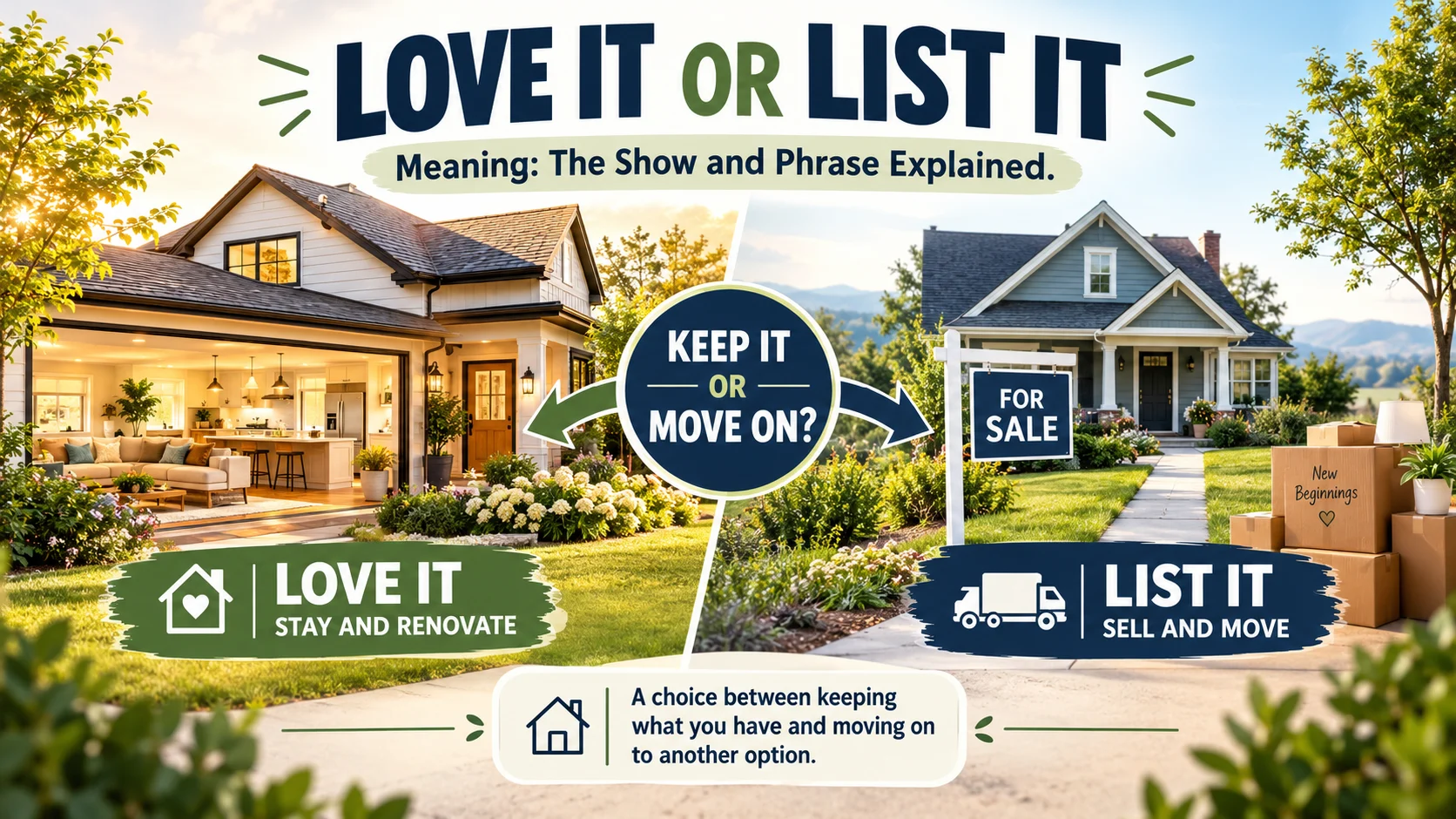
Love It or List It is a phrase that presents two choices: keep something you love or let it go in favor of another option. It is best known as the title of an HGTV home renovation and real estate show in which homeowners decide whether to stay in their renovated house or sell it and move elsewhere. More generally, the phrase describes choosing between keeping something and moving on.
The Love It or List It meaning centers on a simple but important decision: should you keep what you already have, or should you move on to something better suited to your needs? The phrase is widely recognized as the title of a popular home renovation and real estate television show. However, its meaning also makes sense in everyday conversations about houses, relationships with possessions, personal preferences, and difficult choices.
On the television show, homeowners face a familiar problem. Their current house may have sentimental value, a convenient location, or a beautiful backyard, but it might lack enough space, storage, or modern features. Meanwhile, a new property could offer a fresh start. Therefore, they must decide whether to love their improved home or list it for sale.
The expression is memorable because it turns a complicated decision into two clear options. Rather than continuing to debate the advantages and disadvantages, someone must consider what matters most and choose a direction.
In this guide, you’ll learn what Love It or List It means, how the HGTV show works, what the title means in real estate, and how to use the phrase naturally. Additionally, you’ll discover practical examples, similar expressions, common mistakes, and answers to frequently asked questions.
Love It or List It
| Meaning | Context | Primary Platforms | Example | Tone |
|---|---|---|---|---|
| Keep something or let it go | Everyday decisions | Conversations and social media | “Love it or list it?” | Direct |
| Renovate a home or sell it | Real estate | HGTV and home improvement media | “Should we love it or list it?” | Practical |
| Choose between two alternatives | Personal preferences | Everyday English | “Try the new design, then love it or list it.” | Casual |
| Decide whether something still meets your needs | Lifestyle and possessions | Blogs and conversations | “This old sofa needs a love-it-or-list-it decision.” | Playful |
| The title of a television series | Entertainment | HGTV and streaming services | “We watched Love It or List It last night.” | Informative |
What Does Love It or List It Mean?
Love It or List It means choosing between keeping something because you like it and letting it go in favor of another option. The expression is especially associated with homes, but its underlying idea can apply to many situations.
The phrase contains two important parts: love it and list it.
1. What Does “Love It” Mean?
The words love it mean that you like something very much, feel attached to it, or want to keep it.
In the context of a house, loving it means deciding that the property is still right for you. Perhaps the home has a wonderful location, enough sentimental value, or a layout that works after renovation.
For example:
- “We love the neighborhood, so we want to stay.”
- “The renovated kitchen convinced us to love it.”
- “I love this house because it feels like home.”
In each example, the speaker expresses a positive connection with something.
2. What Does “List It” Mean?
In real estate, list it means putting a property up for sale, usually with the help of a real estate agent.
When homeowners decide to list their house, they prepare to sell it and consider moving to another property.
For example:
- “The house needs more repairs than we expected, so we might list it.”
- “If we find a larger home, we’ll list this one.”
- “They decided to list it after comparing their options.”
Consequently, the expression contrasts staying with selling.
3. What Does the Whole Phrase Mean?
When combined, the two parts create a straightforward question: should you keep what you have, or should you move on?
The answer depends on your needs, budget, priorities, and circumstances. For homeowners, location, renovation costs, family size, and the housing market may all influence the decision.
Outside real estate, the phrase can be used humorously to describe deciding whether to keep an old phone, replace a piece of furniture, or move on from an outdated idea.
What Is Love It or List It on HGTV?
Love It or List It is a home renovation and real estate reality television series associated with HGTV. The show follows homeowners who are unhappy with aspects of their current houses and must decide whether to stay after a renovation or sell and move to another property.
The program combines interior design, home improvement, property hunting, and a friendly competition between its experts.
In the show’s format, the designer works to improve the homeowners’ existing property. At the same time, the real estate agent searches for alternative homes that could better meet their needs.
As the episode progresses, viewers see both possibilities develop. The renovation may solve problems with the current house, while the alternative properties may offer more space, a different layout, or features the homeowners have been missing.
Ultimately, the homeowners choose between staying in their improved home and listing it for sale.
For viewers, this format offers more than attractive room transformations. It also explores the emotional and financial questions that come with deciding whether a house is still the right place to live.
Who Hosts Love It or List It?
The show’s hosts have changed over its long run.
David Visentin, a real estate agent, has been a central figure in the series. He presents alternative properties and tries to show homeowners what they could gain by moving.
Page Turner joined the renewed version of the series as the designer, taking over the renovation role previously held by Hilary Farr. Turner focuses on improving the homeowners’ existing houses and demonstrating how thoughtful design can address their frustrations.
Hilary Farr was the longtime designer and co-host for many seasons. Her work helped establish the show’s familiar contrast between renovating a current home and moving to a new one.
The hosts contribute different professional perspectives. While the designer highlights the potential of the existing property, the real estate agent introduces alternatives that might better suit the homeowners’ changing needs.
Their contrasting approaches create the central question of every episode: is the current house worth improving, or is it time for a fresh start?
How Does Love It or List It Work?
Although individual episodes feature different households and challenges, the basic concept follows a recognizable pattern.
Step 1: Homeowners Explain Their Problems
Each episode begins with homeowners describing what no longer works in their current house.
For example, a growing family might need another bedroom. Alternatively, a couple may want a more functional kitchen, additional storage, or a better layout for entertaining guests.
These concerns establish what the renovation and property search must address.
Step 2: The Designer Plans a Renovation
Next, the designer develops a plan to improve the existing home.
The proposed changes may involve opening up living spaces, updating an outdated kitchen, improving storage, or making rooms more practical. However, the available budget and the home’s structure can affect what is possible.
The goal is to demonstrate that the current house can still meet the homeowners’ needs.
Step 3: The Real Estate Agent Searches for Another Home
Meanwhile, the real estate agent looks for alternative properties.
These homes typically reflect the homeowners’ wish list, including their preferred location, price range, number of bedrooms, and desired features.
As a result, the homeowners can compare the potential of their renovated house with the advantages of moving.
Step 4: Both Options Are Revealed
As the episode approaches its conclusion, the homeowners see the results of the renovation and consider the alternative properties.
This stage often highlights the trade-offs involved. The renovated house may preserve a beloved location, while another property might offer a better layout or additional space.
Neither option is automatically the best choice for every family.
Step 5: The Homeowners Make Their Decision
Finally, the homeowners decide whether to stay in the improved house or list it for sale and move.
That final choice gives the series its name. It also demonstrates why the phrase works so well as a general expression: sometimes, keeping something familiar is best, while other situations call for change.
Love It or List It Meaning in Everyday English
Although the title is closely associated with television, the expression can also be used informally in everyday English.
In this context, it describes evaluating something and deciding whether it deserves to stay in your life, home, routine, or collection.
For example, imagine that you have an old sofa. It is comfortable, but its fabric is worn, and it no longer matches your living room. You might jokingly ask yourself, “Love it or list it?”
Here, list it suggests selling or letting go of the sofa, while love it means keeping it because you still enjoy it.
The same idea can apply to a variety of situations:
- Furniture: Keep an old table or sell it.
- Technology: Continue using an older phone or replace it.
- Clothing: Keep a favorite jacket or donate it.
- Home design: Renovate an existing room or redesign the space completely.
- Personal projects: Continue developing an idea or move on to something new.
Nevertheless, the phrase is not a universal replacement for every expression about making a decision. Its natural meaning is strongest when the options involve keeping something or letting it go.
Love It or List It Examples in Sentences
These examples demonstrate how the phrase works in different contexts.
Example 1: Buying or Selling a House
“We love our neighborhood, but our house feels too small. It’s time to decide whether to love it or list it.”
Meaning: The homeowners must choose between staying in their current property and selling it to find a better fit.
Example 2: Home Renovation
“After seeing the new kitchen, my parents finally decided to love it or list it.”
Meaning: The renovation helped them reconsider whether they wanted to stay in the house or sell it.
Example 3: Furniture
“This old dining table has seen better days. Should we repair it or list it online?”
Meaning: The speaker is considering whether to keep the table or sell it. The example uses the real estate-related word list more broadly.
Example 4: A Personal Purchase
“I’ve had this exercise bike for two years, but I barely use it. It’s a love-it-or-list-it situation.”
Meaning: The speaker must decide whether the bike is worth keeping or should be sold.
Example 5: A Home Office
“We could renovate the spare bedroom into an office, or we could move to a house with a dedicated workspace.”
Meaning: The speaker is comparing the benefits of improving an existing space with the possibility of moving.
Example 6: Watching Television
“My favorite part of Love It or List It is seeing how the homeowners choose between the renovation and the new property.”
Meaning: The speaker is discussing the HGTV series.
Example 7: A Kitchen Makeover
“The kitchen looks completely different now. I think the owners will love it rather than list it.”
Meaning: The speaker believes the renovation may persuade the homeowners to stay.
Example 8: A Rental Property
“Our apartment is convenient, but the rent keeps increasing. We need to decide whether to renew the lease or move.”
Meaning: The speaker faces a similar keep-or-leave decision, even though selling a property is not involved.
Real-Life Situations Where the Phrase Makes Sense
The phrase becomes easier to understand when you consider the kinds of decisions it represents.
When You Love Your Home but Need More Space
A family may adore its home because it is close to schools, friends, and familiar places. However, a growing family can make the existing layout feel cramped.
In this situation, renovating may provide the extra space they need. On the other hand, moving might be more practical if the property cannot accommodate their requirements.
When Renovation Costs Keep Increasing
Sometimes, homeowners discover that improving an old property costs more than expected.
Although they may want to preserve the house, structural problems, outdated systems, or expensive repairs can change their plans. Therefore, comparing renovation costs with the cost of moving becomes important.
When Your Lifestyle Changes
A home that worked perfectly for a young couple might become less suitable after they have children. Similarly, empty nesters may decide that a large house requires more maintenance than they want.
As their priorities change, the choice between keeping a property and finding a new one may become more appealing.
When You Want a Fresh Start
Sometimes, the decision is emotional rather than financial.
A person might associate a home with happy memories but still want a different environment. In that case, selling the property can represent a new chapter rather than a rejection of the past.
Love It or List It vs. Similar Expressions
Several English expressions communicate the idea of choosing between alternatives. However, each one has a slightly different emphasis.
| Expression | Meaning | Example |
|---|---|---|
| Love it or list it | Keep something or put it up for sale | “Should we love it or list it?” |
| Keep it or leave it | Retain something or walk away | “If the deal doesn’t work, keep it or leave it.” |
| Stay or go | Remain in a situation or leave | “It’s time to decide whether to stay or go.” |
| Buy or sell | Purchase something or sell what you own | “Should we buy or sell this property?” |
| Make or break | Determine success or failure | “This decision could make or break the project.” |
| Take it or leave it | Accept an offer as it stands or reject it | “That’s my final price; take it or leave it.” |
| Fix it or replace it | Repair something or get another one | “We need to fix it or replace it.” |
| Move on | Leave the past behind and pursue something new | “Sometimes, it’s better to move on.” |
The closest alternatives are keep it or leave it and stay or go. Even so, love it or list it has a distinctive connection to homes, renovation, and real estate decisions.
Love It or List It vs. Flip or Flop
These two HGTV titles both involve property renovation, but their central concepts differ.
Love It or List It focuses on homeowners deciding whether to stay in a renovated home or sell it and move elsewhere.
Flip or Flop focuses on the process of buying properties, renovating them, and selling them, often with the aim of making a profit.
Therefore, the key difference is the decision being explored. One centers on a homeowner’s choice between staying and moving, while the other centers on renovating properties for resale.
Is Love It or List It a Literal or Figurative Phrase?
The answer depends on how someone uses it.
When referring to the television series, Love It or List It is a proper title. The words describe the show’s central decision.
In casual conversation, however, the phrase can be figurative. Someone might use it to describe deciding whether to keep a possession, update a room, or move on from an old idea.
The word list is literal when someone actually puts a property up for sale. In a playful expression about a jacket or an old laptop, it may instead mean selling or getting rid of that item.
For example, “I need to love it or list it” could mean that the speaker must finally decide whether an item is worth keeping.
Advantages and Disadvantages of the Love It or List It Approach
The keep-or-sell approach can help people clarify their priorities. Nevertheless, the decision deserves more thought than the catchy phrase might suggest.
Advantages
1. It simplifies a complicated decision.
The phrase encourages people to compare two clear options rather than endlessly postponing a choice.
2. It highlights personal priorities.
Homeowners can consider whether location, space, comfort, and familiarity matter most to them.
3. It encourages practical comparisons.
Comparing renovation plans with alternative properties can reveal advantages that were not obvious at first.
4. It makes room for change.
Sometimes, people become attached to a home or possession even when it no longer meets their needs. Considering another option can help them move forward.
Disadvantages
1. It can make the choice seem too simple.
In reality, homeowners may have other options, such as renovating gradually, renting out their property, or moving to a smaller home.
2. Financial costs can be unpredictable.
Renovation budgets, transaction expenses, mortgage rates, and property values may affect the decision.
3. Emotional attachments can complicate the process.
A house may hold important family memories, making it difficult to judge the decision on practical factors alone.
4. The best option may not be immediately obvious.
A renovation can reveal unexpected problems, while a new property may have drawbacks that are not obvious during a viewing.
Ultimately, the phrase is a useful starting point, but a real decision should account for finances, lifestyle, and long-term needs.
Common Mistakes When Understanding Love It or List It
Avoid these mistakes to understand and use the phrase correctly.
Mistake 1: Thinking It Only Means Loving or Hating Something
The expression is not simply about whether you like an object. In the television show’s context, it specifically contrasts staying in a renovated home with listing it for sale.
Mistake 2: Assuming “List” Means Making a Shopping List
In real estate, list means placing a property on the market for sale. Although the word can refer to writing items down in other contexts, that is not its meaning in the show’s title.
Mistake 3: Assuming Everyone Must Sell Their House
The title presents two possible outcomes, but it does not mean that selling is always the better option. Homeowners may decide that their improved property suits them perfectly.
Mistake 4: Using It for Every Decision
You can use the phrase playfully in other situations, but it is most natural when the choice involves keeping something or letting it go.
For example, “Love it or list it” works well for an old sofa. However, it would sound unusual when choosing between two completely unrelated dinner options.
Mistake 5: Confusing the Show With a General Expression
When the title appears in italics or in a discussion about HGTV, it usually refers to the television program. In a casual sentence about selling a possession, it may be a figurative use of the expression.
Context makes the intended meaning clear.
How to Decide Whether to Love It or List It in Real Life
If you’re facing a similar decision about your home, consider these practical steps.
Step 1: Identify the real problem.
Write down what bothers you about your current home. Is it the location, lack of storage, limited space, or outdated design?
Step 2: Separate fixable problems from major limitations.
A small kitchen may benefit from a renovation, while a location that no longer suits your commute may be harder to change.
Step 3: Compare the total costs.
Estimate renovation expenses and compare them with the costs of selling, purchasing another property, and moving.
Step 4: Consider your future needs.
Think about family size, work arrangements, accessibility, maintenance, and how long you expect to stay.
Step 5: Explore alternatives.
You do not have to choose between a complete renovation and an immediate sale. Smaller improvements or a phased renovation may also work.
Step 6: Make an informed decision.
Once you understand your priorities and the realistic costs, you can decide whether staying or moving makes more sense.
This process reflects the central idea of Love It or List It: choose the option that best supports your life rather than making a decision based only on appearance or emotion.
Practice Exercises: Love It or List It Meaning
Test your understanding with these short questions.
Exercise 1: Choose the Correct Meaning
Question: What does Love It or List It generally suggest?
A. Buying something without checking its price
B. Choosing whether to keep something or let it go
C. Making a list of favorite things
D. Repairing every item you own
Answer: B. The phrase suggests choosing between keeping something and letting it go or selling it.
Exercise 2: Fill in the Blank
Question: In real estate, to “list” a house means to put it up for ______.
Answer: Sale.
Exercise 3: Identify the Context
Question: “We love our neighborhood, but our home is too small. We might need to love it or list it.”
Is this sentence about a television show or a real-life decision?
Answer: It describes a real-life decision using the phrase’s central idea.
Exercise 4: True or False
Question: Love It or List It is the title of a home renovation and real estate television series.
Answer: True.
Exercise 5: Write Your Own Example
Question: Write a sentence using love it or list it to describe an item you own.
Sample Answer: “My old bicycle needs repairs, so it’s time to love it or list it.”
Frequently Asked Questions
1. What does Love It or List It mean?
Love It or List It means choosing between keeping something you like and letting it go in favor of another option. It is particularly associated with deciding whether to stay in a renovated home or sell it and move.
2. Is Love It or List It a TV show?
Yes. Love It or List It is a home renovation and real estate reality series associated with HGTV. It follows homeowners as they consider staying in their improved house or moving to a different property.
3. Who hosts Love It or List It?
David Visentin is the show’s longtime real estate agent and co-host. Page Turner joined the renewed series as the designer, replacing longtime designer and co-host Hilary Farr.
4. What happens on Love It or List It?
A designer renovates the homeowners’ current property while a real estate agent searches for alternative homes. At the end, the homeowners decide whether to stay in their improved house or list it for sale.
5. What does “list it” mean in real estate?
To list a property means to put it on the market for sale, typically with the assistance of a real estate agent.
6. Is Love It or List It a slang phrase?
It can be used informally as a playful expression about deciding whether to keep or discard something. However, it is best known as the title of the HGTV television series.
7. Can you use Love It or List It outside real estate?
Yes. In casual conversation, someone might use it to describe deciding whether to keep an old phone, sell a piece of furniture, or move on from something that no longer meets their needs.
8. What is the difference between Love It or List It and Flip or Flop?
Love It or List It centers on homeowners choosing whether to stay or move. Flip or Flop focuses on buying, renovating, and selling properties, often for a profit.
9. Is Love It or List It about buying a new house?
Finding another home is part of the show’s format, but the central question is whether the homeowners should remain in their renovated house or sell it and move to a different property.
10. Why is Love It or List It such a memorable phrase?
The expression is memorable because it uses two short, contrasting choices to summarize a complicated decision. In addition, its connection to home renovation makes it relatable to people who have struggled with whether to improve their current home or move.
11. Does “love it or list it” mean the same as “keep it or sell it”?
The expressions are similar, particularly in real estate. However, love it or list it emphasizes the emotional appeal of keeping something as well as the practical decision to sell it.
12. What is the main lesson of Love It or List It?
The central idea is that the best choice depends on your needs, priorities, and circumstances. A renovated home may be the right answer for one family, while moving to a different property may make more sense for another.
Conclusion
The Love It or List It meaning comes down to a choice between keeping something you value and letting it go for a potentially better alternative. The phrase is best known as the title of HGTV’s home renovation and real estate series, where homeowners decide whether to remain in their renovated house or sell it and move.
Beyond television, the expression can describe everyday decisions about possessions, home improvements, and situations that no longer meet your needs. It encourages people to compare their options, identify their priorities, and consider whether change would improve their circumstances.
Ultimately, love it or list it is more than a catchy title. It captures a familiar question: should you improve what you already have, or is it time to move forward? The best answer depends on your goals, practical needs, financial situation, and personal preferences.