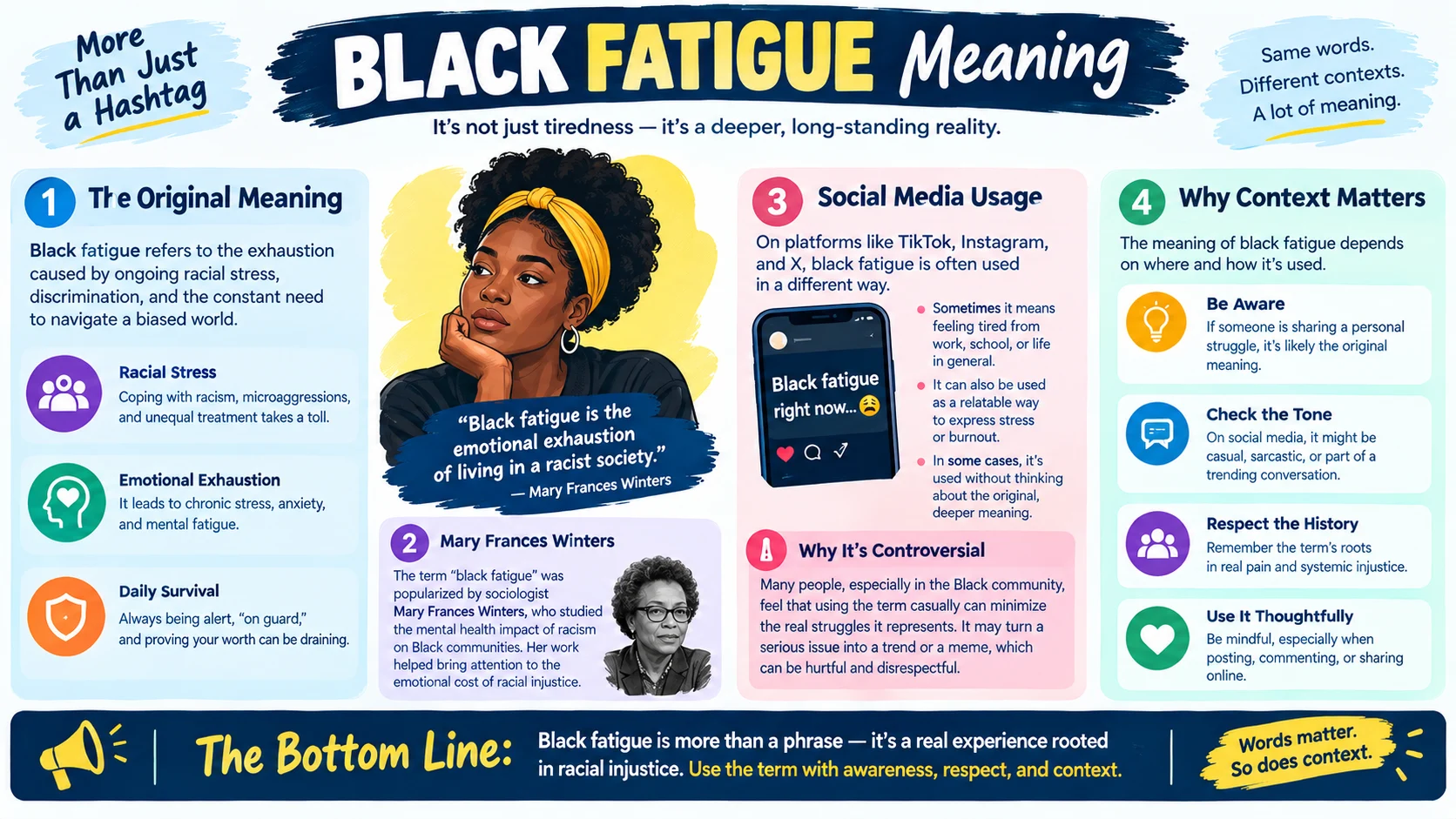
black fatigue meaning refers primarily to the physical, mental, and emotional exhaustion some Black people experience from repeated racism, discrimination, microaggressions, and racial injustice. The phrase also has a newer, disputed social media usage, so context is essential.
black fatigue meaning depends heavily on context, because the phrase now carries more than one interpretation online. Originally, it described the exhaustion associated with repeatedly experiencing racism, discrimination, racial stress, and the burden of responding to inequality. Mary Frances Winters developed the concept in her 2020 work Black Fatigue: How Racism Erodes the Mind, Body, and Spirit.
However, social media changed the conversation. During 2025, another usage became visible on platforms such as TikTok, X, and Instagram. In that context, some people began using the phrase to describe frustration with what they considered negative behavior within Black communities. Others criticized that usage as racist or as a distortion of the original concept.
Therefore, anyone searching for the phrase should avoid assuming that every post means the same thing. A serious discussion about racial stress is very different from a provocative comment about Black people. The surrounding words, speaker, platform, and subject of the conversation all matter.
This guide explains both meanings clearly. It also covers social media context, conversational examples, potential misunderstandings, appropriate responses, and the safest way to interpret the phrase when you encounter it online.
QUICK ANSWER BOX
| Meaning | Context | Primary Platforms | Example | Tone |
| Exhaustion connected to racism and racial stress | Social, cultural, workplace, academic | Articles, social media, discussions | “The constant pressure is exhausting.” | Serious |
| A controversial online expression about frustration with Black people or perceived community behavior | Internet discourse and political commentary | TikTok, X, Instagram | “People are debating this phrase again.” | Controversial |
| A broader description of emotional weariness surrounding repeated racial issues | Casual discussion | Texting and social platforms | “I need a break from these discussions.” | Reflective |
The original concept is associated with racial stress and the cumulative effects of discrimination. The newer online usage is disputed and should not automatically be treated as an equivalent definition.
What Does black Fatigue Mean?
At its core, the phrase describes fatigue connected with racial experiences. In the original framework developed by Mary Frances Winters, that fatigue can be physical, emotional, mental, and spiritual. It can emerge from repeated exposure to racism, inequity, microaggressions, and the ongoing effort required to navigate those experiences.
The phrase became especially visible after Winters published her book in 2020. Her work connected racial inequality with cumulative exhaustion rather than treating individual incidents as isolated events.
The original concept
The original concept focuses on what repeated racial stress can do to a person over time. For example, someone may become exhausted from constantly dealing with discrimination at work, explaining racial issues to others, witnessing racial violence, or managing everyday situations where racial stereotypes affect how they are perceived.
The important point is cumulative pressure. One uncomfortable interaction may not explain the entire experience. Instead, repeated incidents can create a continuing sense of strain.
The American Heart Association has discussed the concept in connection with chronic stress associated with racism and discrimination. Its coverage also notes that racism can have broader effects on health.
Why the word fatigue matters
“Fatigue” is stronger than simply saying someone is annoyed.
It suggests accumulated exhaustion. Someone experiencing this kind of racial fatigue may feel mentally drained, emotionally overwhelmed, or tired of repeatedly confronting the same patterns.
That distinction matters because casual internet users sometimes interpret the phrase as simple frustration. In its original context, the concept is much deeper.
Is it an official medical diagnosis?
No. The phrase is not a standalone medical diagnosis.
It is a social, cultural, and psychological concept used to discuss the effects of racial stress. Research has increasingly examined the phenomenon and its relationship to coping, emotional strain, and experiences of racism. A 2026 qualitative study, for example, describes the concept as chronic exhaustion connected with coping with and resisting anti Black racism.
Contextual Dynamics and Nuances of the Term
Understanding black fatigue’s meaning requires more than memorizing one definition. The phrase has developed different layers, and those layers can conflict.
Cultural context
In cultural discussions, the phrase may describe exhaustion caused by repeatedly confronting racial inequality.
Someone might use it while discussing workplace discrimination, social injustice, media coverage, or the emotional burden of explaining racism.
The meaning is therefore connected to lived experience rather than ordinary physical tiredness.
Workplace context
The concept can also appear in conversations about professional life.
For example, a Black employee may feel pressure to explain racial issues to colleagues. They may also feel responsible for educating others about discrimination while continuing to perform their normal job.
That additional emotional labor can contribute to exhaustion.
The original literature specifically discusses racism, organizations, and leadership. Winters argues that organizations have responsibilities when systemic inequality affects employees.
Social media context
Social media adds another layer.
A person may use the phrase after spending hours reading arguments about race. Another person may use it while discussing personal experiences with discrimination. Yet another account may use the same phrase sarcastically or provocatively.
Consequently, the surrounding post matters more than the phrase alone.
Political context
The term became especially contentious online during 2025.
Some accounts began using it to express frustration with Black people or behavior associated with particular Black communities. Critics argued that this represented a major departure from the original concept. Reporting and online documentation show that the phrase became a subject of intense debate on TikTok, X, and other platforms.
That newer usage should therefore be described as a contested social media usage, rather than presenting it as the universally accepted definition.
Why context changes everything
Consider these two statements:
“I am exhausted from constantly dealing with racism.”
Here, the speaker is discussing racial stress.
Now consider:
“I have black fatigue because I am tired of Black people.”
That statement uses the phrase differently. It targets a racial group rather than describing exhaustion caused by discrimination.
The wording around the phrase therefore determines whether the speaker is discussing a social experience or making a racial generalization.
Real Life Conversation Examples Using black fatigue meaning
The following examples demonstrate how people might encounter the phrase without endorsing stereotypes or inflammatory interpretations.
Example 1: Discussing workplace stress
Alex: “I have been dealing with subtle comments at work all month.”
Jordan: “That sounds exhausting.”
Alex: “Yeah. I understand the idea behind Black fatigue now. It is tiring having to decide whether to speak up every time.”
Meaning: Here, the speaker uses the concept to describe cumulative emotional exhaustion associated with repeated racial experiences.
Example 2: Taking a social media break
Maya: “Why did you disappear from Instagram?”
Chris: “The constant arguments about racism were getting to me.”
Maya: “I get that. Sometimes you need to log off.”
Meaning: The discussion centers on emotional exhaustion from repeatedly consuming stressful racial content.
Example 3: Workplace education
Manager: “Would you like to discuss what happened during the meeting?”
Employee: “Not today. I have already explained this issue several times.”
Manager: “Understood. We can revisit it when you are ready.”
Meaning: The example illustrates why repeatedly explaining discrimination can become emotionally draining.
Example 4: Encountering the phrase online
Sam: “I saw someone comment ‘black fatigue’ under that video.”
Taylor: “What did they mean?”
Sam: “It depends on the post. Some people use the phrase to discuss racial exhaustion, while others use it in a controversial way.”
Meaning: This response recognizes the phrase’s multiple online contexts without assuming one interpretation.
Example 5: Asking for clarification
Jamie: “What does ‘black fatigue’ mean here?”
Riley: “Can you show me the full comment?”
Jamie: “Sure.”
Riley: “The surrounding sentence makes the meaning much clearer.”
Meaning: Asking for context is often the safest approach when a phrase has competing interpretations.
Platform Specific Breakdown
The phrase does not function identically across every social platform. Platform culture influences how quickly a controversial expression spreads and how much context survives.
How It Is Used on Snapchat
Snapchat conversations are often private, temporary, and highly informal. A person may encounter the phrase in a direct message, private story, screenshot, or conversation.
Because Snapchat content can disappear quickly, context may be incomplete.
For example, someone could send a screenshot with only the phrase visible. Without the original post, it may be impossible to determine whether the sender is discussing racial exhaustion, reacting to a trend, or repeating someone else’s language.
The safest response is simple:
“What do you mean by that?”
This avoids accidentally agreeing with an interpretation you have not understood.
The Role of black fatigue meaning on TikTok
TikTok played an important role in the phrase’s renewed visibility during 2025. Viral videos, reaction clips, stitches, and comment sections helped expose audiences to competing definitions.
TikTok also encourages short statements. That creates a problem when a complicated social concept gets reduced to two or three words.
A creator may post a controversial claim. Thousands of users then repeat the phrase without understanding its historical context.
Consequently, TikTok users should examine the original video, caption, comments, and speaker’s explanation before deciding what the phrase means.
Instagram and Texting Dynamics
Instagram often blends serious discussions with memes, reels, screenshots, and short comments. As a result, a phrase can move rapidly between educational content and provocative commentary.
In texting, the meaning can be even harder to determine.
Tone disappears when communication is short. A friend might use the phrase seriously, sarcastically, or while quoting something they saw online.
Therefore, context questions are useful:
- “What do you mean by that?”
- “Are you talking about racial stress?”
- “Are you referring to the trend going around?”
- “Where did you see that phrase?”
These questions reduce misunderstandings without escalating the conversation.
Alternative Meanings and NLP Variations of the Phrase
Language changes through repetition. Online communities can also reshape established terms.
That is particularly important here because the phrase has developed competing interpretations.
Racial exhaustion
The original interpretation centers on exhaustion connected with racism and racial inequality.
Related concepts include racial stress, discrimination fatigue, emotional exhaustion, racial trauma, microaggression related stress, and the psychological burden of racism.
These expressions overlap, but they are not always exact synonyms.
Activism fatigue
Someone may feel tired after repeatedly participating in protests, advocacy campaigns, educational discussions, or political debates.
That experience can overlap with racial exhaustion. However, activism fatigue focuses more specifically on the demands of activism.
Racial battle fatigue
Racial battle fatigue is another related concept used in scholarship and discussions of race based stress.
It often emphasizes the psychological and physiological strain associated with repeatedly confronting racial discrimination.
Therefore, it should not automatically be treated as a perfect replacement for the phrase discussed in this article.
Online controversy
A second online usage developed during the 2025 social media controversy. Some users employed the phrase to describe being tired of perceived negative behavior associated with Black people or Black communities.
This interpretation is controversial because it shifts the target of the fatigue from racism experienced by Black people toward frustration directed at Black people.
That difference is substantial.
Why NLP systems may struggle with the phrase
Search engines and language models encounter phrases through many contexts.
One article may discuss Winters and racial stress. Another may discuss a TikTok controversy. A third may repeat a definition from a user generated website.
Consequently, automated systems can encounter conflicting signals.
A reliable interpretation should prioritize authoritative context, publication date, speaker intent, and the surrounding language rather than treating every online definition as equally credible.
Misinterpretations: When NOT to Use black fatigue meaning
There are several situations where repeating the phrase without explanation can create unnecessary harm or confusion.
Do not treat every definition as equal
The phrase has an established conceptual history connected to racial exhaustion. Its newer social media usage is contested.
Presenting both as equally established can mislead readers.
Do not generalize about an entire racial group
A statement about one person’s experience should not become a claim about millions of people.
For example, criticism of an individual person’s behavior does not justify describing an entire racial group as inherently problematic.
That distinction is especially important in online discussions.
Do not use the phrase as a medical diagnosis
Avoid statements such as:
“You have black fatigue, so you need treatment.”
That wording turns a social concept into a diagnosis.
Instead, discuss emotional exhaustion, stress, discrimination, or another clearly defined experience when appropriate.
Do not assume the speaker’s intention
A phrase can be quoted without being endorsed.
Someone might write:
“People keep saying ‘black fatigue’ online. What does it mean?”
The speaker is asking about the phrase. They are not necessarily supporting it.
Do not remove the historical context
If you are writing educational content, mention the original meaning and the later controversy.
That approach gives readers enough information to understand why the phrase can provoke such different reactions.
How to Respond in Chat Comfortably
If someone sends the phrase to you, the best response depends on their intention.
If you are genuinely confused
Ask for context.
A simple response works well:
“What do you mean by ‘black fatigue’ here?”
This is neutral and direct.
If the person is discussing racial exhaustion
You can acknowledge their feelings without pretending to know exactly what they experienced.
For example:
“That sounds emotionally exhausting. I can understand why you would need a break.”
This keeps the conversation supportive.
If someone uses the phrase to make racial generalizations
You can challenge the wording calmly.
For example:
“I think it is worth separating criticism of specific behavior from statements about an entire racial group.”
This focuses on the argument rather than attacking the person.
If someone sends a viral post
Ask where the phrase came from.
You could say:
“I have seen different definitions online. What did the original post say?”
That response is especially useful because viral posts often remove context.
If you do not want to debate
You can set a boundary.
For example:
“I do not really want to argue about race online. I am going to leave this conversation here.”
You do not have to participate in every internet debate.
A useful response guide
| Situation | Comfortable response |
| You do not understand the phrase | “What do you mean by it here?” |
| Someone describes racial exhaustion | “That sounds really draining.” |
| Someone shares a viral post | “What was the original context?” |
| Someone makes a broad racial claim | “Could we focus on specific behavior instead?” |
| You want to leave the debate | “I would rather not argue about this online.” |
| You want more information | “Where did you first see the phrase?” |
FAQs
What does black fatigue mean in simple words?
In its original context, it describes deep physical, mental, emotional, or spiritual exhaustion connected with repeated experiences of racism and racial inequality. The phrase later developed a controversial second usage online.
Is the phrase considered slang?
It can appear in slang like online conversations, but it is more accurately described as a social and cultural expression. The original concept comes from serious discussions of racism and its effects.
Who popularized the original concept?
Mary Frances Winters popularized the modern concept through her 2020 book Black Fatigue: How Racism Erodes the Mind, Body, and Spirit. Her earlier writing also addressed racism, organizations, and leadership.
Why is the phrase controversial online?
The controversy comes from competing definitions. The original concept describes exhaustion experienced by Black people in relation to racism. A newer social media usage describes frustration directed toward Black people or perceived behavior within Black communities.
Is black fatigue a medical condition?
No. It is not a standalone medical diagnosis. It is a social and psychological concept used to describe the effects of racial stress and discrimination.
Why might someone use the phrase on TikTok?
A creator might use it while discussing racial exhaustion, social issues, workplace experiences, or current online debates. However, some viral content has used the expression in a different and controversial way.
Should I use the phrase casually?
Generally, caution is wise. Because the phrase has serious historical and contemporary associations, using it casually can create confusion or unintentionally communicate a racial stereotype.
What should I do if I see the phrase in a comment?
Read the surrounding comment, caption, and original post. If the intention remains unclear, ask the person what they mean rather than guessing.
Can the phrase refer to emotional exhaustion from racism?
Yes. That is the original and well documented conceptual use. Winters describes the experience as physical, mental, and emotional exhaustion associated with persistent racial inequity.
Is the newer online definition universally accepted?
No. The newer definition is highly contested. Some users promote it as criticism of behavior, while others argue that it is an anti Black reframing of a term originally describing the effects of racism.
Conclusion
Understanding black fatigue’s meaning requires more than copying the first definition that appears in a search result. The phrase has a documented history connected to the exhaustion Black people can experience from racism, discrimination, inequality, and repeated racial stress. Mary Frances Winters helped establish that modern framework through her 2020 work.
However, online language changes quickly. During 2025, the phrase gained another controversial interpretation across social media. That newer usage has generated substantial disagreement because it shifts the phrase toward criticism of Black people rather than exhaustion caused by racism.
Therefore, context is the key. Look at who is speaking, what they are discussing, where the phrase appears, and what the surrounding words communicate. Most importantly, avoid turning a complicated social concept into a blanket statement about an entire racial group.
Files, images, and data analysis are unavailable until usage resets at 8:33 PM. Continue chatting with text only, or upgrade for more access.