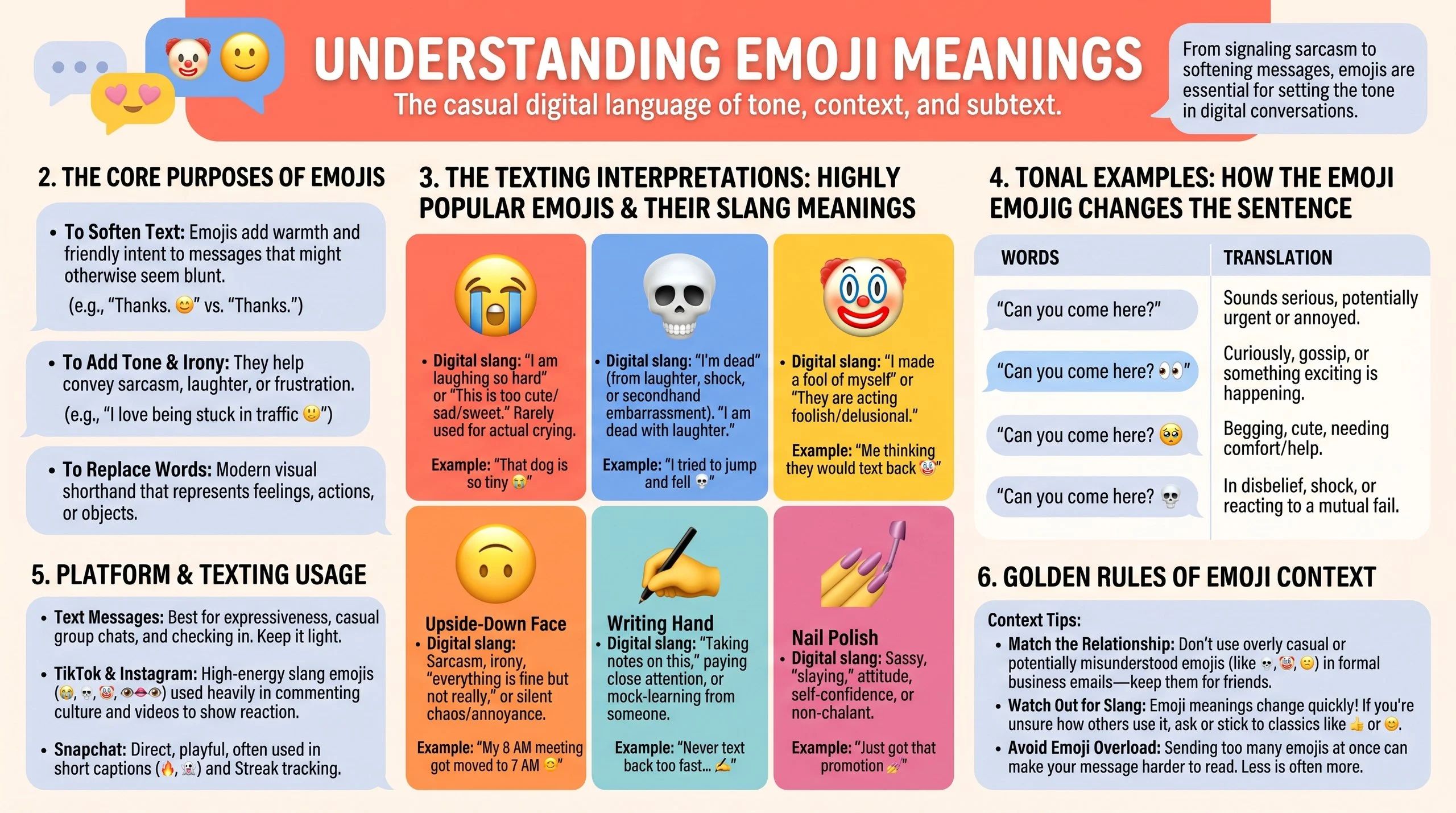
Emoji meaning refers to the idea, emotion, reaction, or message an emoji communicates in digital conversation. Its interpretation depends on the symbol, context, relationship, platform, culture, and surrounding words. The same emoji can express different feelings.
emoji meaning can completely change how a text message feels. A simple smile can sound friendly, sarcastic, awkward, or genuinely warm depending on the conversation. Likewise, a red heart may show love, appreciation, friendship, or strong support.
Today, people use emojis across texting, social media, dating apps, workplace chats, comments, and group conversations. Therefore, understanding them requires more than memorizing a dictionary style definition.
An emoji works like a visual layer of language. It can soften a sentence, emphasize a reaction, replace a word, or add humor. However, interpretation is rarely universal.
For example, someone replying with 😂 may be genuinely laughing. They may also be reacting to an absurd situation. Meanwhile, 😭 can represent sadness, laughter, emotional overwhelm, or dramatic amusement.
This guide explains how people interpret emojis in modern American digital communication. It covers context, tone, platforms, common misunderstandings, conversation examples, and practical ways to choose the right symbol.
Quick Answer Box
| Meaning | Context | Primary Platforms | Example | Tone |
| Emotion or reaction | Texting and conversation | iMessage, WhatsApp, Messenger | That was so funny 😂 | Playful |
| Affection | Relationships and friendships | Instagram, Snapchat, texting | Love you ❤️ | Warm |
| Approval | Comments and messages | TikTok, Instagram, Discord | This is perfect 🔥 | Positive |
| Surprise | Unexpected news | Texting and social media | Wait, what? 😳 | Shocked |
| Humor | Casual conversation | TikTok, Snapchat, texting | I cannot believe you did that 😂 | Funny |
What Does Emoji Mean?
The phrase emoji meaning describes what a particular emoji communicates within a digital conversation. It can represent an emotion, object, action, reaction, idea, relationship, or social signal.
The word emoji comes from Japanese. It combines characters associated with pictures and characters. Despite the connection to Japanese digital culture, emojis have become a global communication system.
Unlike ordinary words, emojis communicate visually. Therefore, they can add emotional information that plain text sometimes lacks.
Consider the sentence:
Okay.
Now compare it with:
Okay 😊
The first version may feel neutral or even cold. The second version usually feels friendlier.
However, context matters more than the symbol alone.
Someone writing:
Great job 👍
may sound encouraging. In another conversation, the same emoji could feel dismissive.
Why Emojis Became So Important
Digital communication removes many physical signals found in face to face conversations. You cannot hear someone’s voice or see their facial expression in a normal text message.
Emojis help fill that gap.
They can communicate:
- Happiness
- Excitement
- Affection
- Humor
- Surprise
- Confusion
- Embarrassment
- Agreement
- Frustration
- Sympathy
- Celebration
Furthermore, emojis can make short messages feel less abrupt.
For example:
Thanks.
and
Thanks 😊
contain the same basic information. Yet the emotional impression can differ.
Emoji Interpretation Is Contextual
There is rarely one permanent interpretation for every emoji.
The sender’s age, relationship with the recipient, platform, culture, and previous conversation can all influence the message.
For example, a teenager may use 💀 to mean that something is extremely funny. A different person may interpret the same symbol literally as death.
Consequently, understanding emojis requires social context rather than simple memorization.
Contextual Dynamics and Nuances of the Term
An emoji can communicate more than its official name suggests. In everyday communication, people frequently assign new meanings to familiar symbols.
This happens because internet language evolves quickly.
Literal Versus Social Meaning
Some emojis have a straightforward literal meaning.
🍎 can represent an apple.
🚗 can represent a car.
☀️ can represent the sun.
However, many popular emojis develop social meanings.
For example, 💀 often means something like “That was incredibly funny” in casual online conversation. It does not necessarily refer to death.
Similarly, 🔥 often means something is impressive, attractive, exciting, or excellent.
Tone Can Change the Message
Emoji meaning depends heavily on tone.
Compare these examples:
- Sure.
- Sure 🙂
- Sure 😭
- Sure 🙄
The word remains unchanged, yet each version suggests a different emotional response.
The smiling emoji can soften the sentence. The crying emoji may create playful exaggeration. The eye rolling emoji can suggest annoyance or sarcasm.
Therefore, an emoji can function almost like a vocal tone in spoken conversation.
Relationship Matters
A heart emoji from a close friend may communicate affection or appreciation.
The same heart from a romantic partner may carry a deeper emotional meaning.
Meanwhile, receiving ❤️ from a manager could simply indicate warmth or approval.
The relationship changes the interpretation.
Age and Online Culture Matter
Different generations may use the same symbols differently.
Younger internet users often repurpose emojis as slang. Older users may prefer their more literal meanings.
For example, 😂 traditionally communicates laughter. Yet some younger users may use it less frequently because other symbols, such as 😭 or 💀, can express intense amusement.
These patterns change over time. Therefore, emoji interpretations should not be treated as permanent rules.
Real Life Conversation Examples Using emoji meaning
The following examples show how context can influence interpretation.
Example 1: Friendly Appreciation
Alex: Thanks for helping me with that project!
Jordan: Of course! 😊
Here, the emoji adds warmth. It makes the response feel friendly rather than strictly functional.
Example 2: Playful Humor
Maya: I studied for five hours and still forgot everything.
Chris: 😭
Here, the crying emoji probably does not indicate serious sadness. Instead, it expresses humorous emotional exaggeration.
Example 3: Romantic Interest
Sam: Had a really good time tonight ❤️
Taylor: Me too ❤️
In this setting, the heart communicates affection. The relationship and conversation determine whether the emotion is romantic or simply warm.
Example 4: Sarcasm
Alex: I forgot my keys again.
Jordan: Amazing work 🙄
The emoji signals irony. Without it, the sentence could appear genuinely positive.
Example 5: Excitement
Mia: Concert tickets are booked!
Noah: LET’S GO 🔥
The emoji reinforces excitement and celebration. It adds energy to the message.
Platform Specific Breakdown
Emoji use changes across social platforms because every community develops its own communication habits.
How It Is Used on Snapchat
Snapchat conversations often use emojis to communicate friendship, reactions, attraction, humor, and social status.
The platform also has system generated friend emojis. These can indicate interaction patterns between users.
However, manually sent emojis can carry different meanings.
For example:
❤️ may communicate affection.
😂 may communicate laughter.
🔥 may show excitement or approval.
👀 may indicate curiosity or interest.
When someone sends 👀 after a message, they may be saying that they noticed something interesting. They could also be hinting that they want more information.
Context determines the difference.
The Role of emoji meaning on TikTok
TikTok has helped accelerate the evolution of emoji slang.
Users often combine emojis with captions, comments, sounds, memes, and trending expressions. As a result, symbols can gain meanings that differ from their literal descriptions.
For example, users may write:
This is sending me 😭
Here, 😭 generally communicates intense laughter or emotional amusement.
Another common pattern is:
Bro really thought he ate 💀
The skull often signals that the situation is extremely funny or embarrassing.
TikTok also encourages visual combinations.
🔥 may suggest something impressive.
👀 may suggest curiosity.
💅 may communicate confidence or playful attitude.
✨ may emphasize excitement, beauty, or a dramatic presentation.
Because trends change quickly, TikTok interpretations can evolve faster than traditional language.
Instagram and Texting Dynamics
Instagram comments often use emojis as compact reactions.
A user might comment:
🔥🔥🔥
to show strong approval.
Another might use:
😭😭
to react dramatically to something funny or emotionally intense.
Texting works somewhat differently because the relationship between two people matters more.
A single ❤️ from a partner can feel intimate. A heart from a friend may simply communicate appreciation.
Furthermore, punctuation and emoji combinations can change the mood.
For example:
Okay 😊
feels different from:
Okay 🙂.
And:
Okay 🙃
may imply frustration or awkwardness.
Alternative Meanings and NLP Variations of the Phrase
From a language perspective, emojis function as multimodal communication. They combine visual symbols with written language.
A useful way to understand them is to group their meanings into semantic categories.
| Category | Common Examples | Typical Function |
| Emotion | 😀 😭 😍 😡 | Express feelings |
| Affection | ❤️ 🥰 💕 | Show warmth or love |
| Humor | 😂 💀 🤣 | Signal amusement |
| Approval | 👍 🔥 💯 | Show agreement |
| Surprise | 😳 😮 🤯 | Show shock |
| Uncertainty | 🤔 😬 | Show hesitation |
| Celebration | 🎉 🥳 🥂 | Mark good news |
| Attention | 👀 👁️ | Signal interest |
| Confidence | 😎 💅 | Show attitude |
| Sadness | 😢 💔 | Express emotional pain |
Emojis as Emotional Modifiers
An emoji can modify the emotional interpretation of a sentence.
For example:
You did that.
sounds neutral.
You did that 😂
sounds amused.
You did that 😳
sounds surprised.
You did that 😡
sounds angry.
The written words remain identical. The emoji changes the emotional frame.
Emojis as Standalone Responses
People sometimes reply using only an emoji.
For example:
😭
😂
👀
❤️
👍
These responses can replace complete sentences.
However, standalone emojis can be more ambiguous than emoji supported text.
For example, 👍 can mean “yes,” “okay,” “sounds good,” “I understand,” or “conversation finished.”
Misinterpretations: When NOT to Use emoji meaning
Understanding emoji meaning also means knowing when an emoji could create confusion.
Avoid Ambiguous Emojis in Serious Messages
If you are discussing grief, conflict, workplace problems, or sensitive news, choose symbols carefully.
A playful emoji can make a serious message appear insensitive.
For example:
I am sorry for your loss 😂
would obviously communicate the wrong emotion.
A simple:
I am so sorry for your loss ❤️
may be more appropriate when the relationship makes that warmth suitable.
Be Careful With Workplace Communication
Professional communication requires extra awareness.
A smile emoji may be completely appropriate in a friendly team chat. However, excessive emojis can look informal in a formal email.
For example:
Thanks for sending the report. 😊
may work with a familiar colleague.
For a formal client message, plain language may be safer.
Do Not Assume Everyone Shares Your Interpretation
This is one of the biggest rules.
If an emoji has a popular slang meaning among your friends, do not assume everyone knows it.
Older relatives, international coworkers, teachers, clients, and unfamiliar contacts may interpret the symbol differently.
Avoid Overusing Emojis
More emojis do not automatically create more emotion.
Consider:
Thank you 😊❤️🥰😭🔥✨💯
That may feel excessive in a professional conversation.
Instead, choose one or two symbols that actually match your intended tone.
How to Respond in Chat Comfortably
When someone sends an emoji, respond based on the emotion behind the message rather than the symbol alone.
If Someone Sends a Heart
You can respond with:
❤️
Aww, thank you!
Right back at you ❤️
That means a lot.
The best response depends on your relationship.
If Someone Sends 😂
You can answer with:
I knew you would laugh 😂
I am actually crying 😂
Glad someone appreciates my humor.
This keeps the conversation natural.
If Someone Sends 👀
You might respond with:
What? 👀
I see you noticed.
Okay, now I am curious too.
Say it. 😂
The symbol often invites a follow up.
If Someone Sends 💀
A playful response can match the same energy:
You are done 😭
I cannot be with you.
That took me out too.
The goal is not to decode every symbol like a formal vocabulary test. Instead, match the conversational energy.
FAQs
What is emoji meaning in texting?
Emoji meaning in texting refers to the emotion, reaction, attitude, or idea communicated through a visual symbol. The intended interpretation depends on context, relationship, platform, and surrounding words.
Why do emojis have different meanings?
Emojis develop different meanings because internet communities create slang and new communication habits. Cultural differences, age groups, memes, and social platforms can also influence interpretation.
What does 😂 usually mean?
😂 usually communicates laughter or amusement. However, people sometimes use it to soften an awkward moment, react to an absurd situation, or exaggerate how funny something feels.
What does 😭 mean in texting?
😭 traditionally represents crying or sadness. Online, however, it frequently expresses intense laughter, emotional overwhelm, embarrassment, excitement, or dramatic amusement.
Why do people use 💀 to mean funny?
The skull can represent the idea that something was so funny or absurd that the person is figuratively “dead.” This is common in casual online slang.
What does 👀 mean in a message?
👀 often signals curiosity, attention, interest, or the feeling that someone is watching what happens next. It can also suggest that the sender noticed something interesting.
Can an emoji change the tone of a sentence?
Yes. An emoji can make a sentence warmer, funnier, more sarcastic, more affectionate, or more dramatic. Therefore, even a short symbol can significantly alter how text feels.
Are emojis appropriate at work?
They can be appropriate in casual workplace chats, especially among familiar coworkers. However, formal emails, sensitive conversations, and client communication often require more restraint.
Why does the same emoji feel different from different people?
Relationships influence interpretation. A heart from a romantic partner can feel intimate, while the same heart from a friend may simply show appreciation.
Should I use emojis when I am unsure about the tone?
Use them carefully. If your message is sensitive or potentially ambiguous, clear words are usually safer. One well chosen emoji can help, but too many can create confusion.
Conclusion
emoji meaning has become an important part of modern digital communication. Emojis do more than decorate messages. They can communicate emotion, soften language, create humor, signal sarcasm, show affection, and replace entire phrases.
However, no emoji has a single interpretation in every situation. Context, relationship, culture, age, platform, and surrounding words all matter.
The smartest approach is simple: read the conversation first, then interpret the symbol. If you are sending an emoji, choose one that supports the feeling you actually want to communicate.
Ultimately, emojis work best when they make your message clearer rather than more confusing. Use them naturally, match the tone, and remember that one well chosen symbol can sometimes say more than a full sentence.