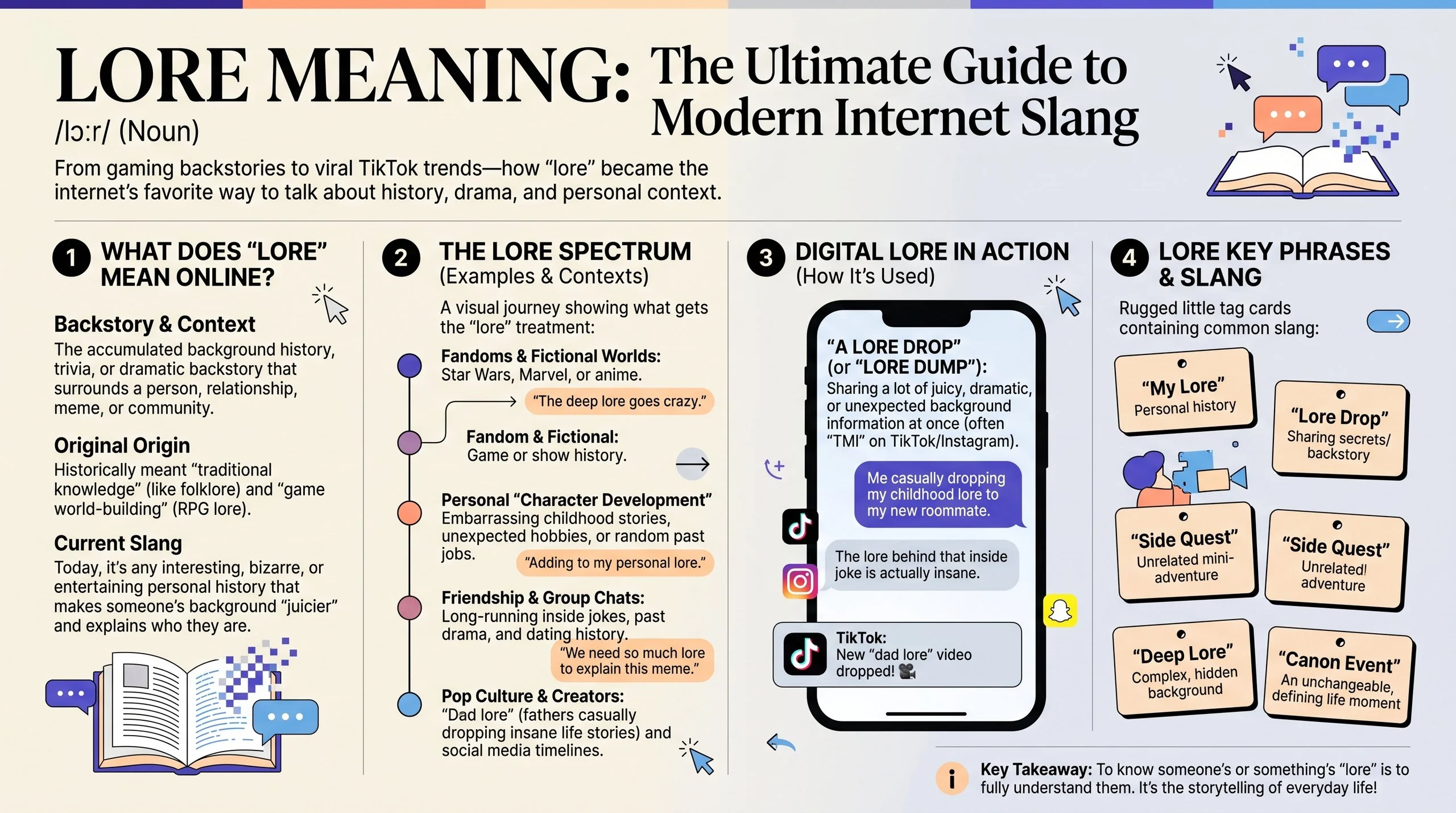
Lore meaning refers to the background stories, facts, experiences, jokes, or history connected to a person, group, fictional world, or online community. Online, people often ask for the “lore” behind a story they find interesting.
Lore meaning has become increasingly common in everyday internet conversations, especially when people want to know the backstory behind a person, event, joke, character, or online situation. The word can sound mysterious at first. However, its basic idea is simple: lore is the collection of stories and information that explains how something came to be.
You may see someone comment, “What is the lore here?” They usually want more context. For example, a friend might post a strange photo, and another person asks for the lore. They are asking what happened before the photo was taken.
The term also appears frequently in gaming, fandoms, TikTok communities, memes, social media posts, and group chats. Therefore, understanding it can make online conversations much easier to follow.
Importantly, lore does not always mean a serious historical story. It can describe something completely ordinary. A funny friendship story, an embarrassing school incident, or a complicated workplace story can all become personal lore.
Quick Answer Box
| Meaning | Context | Primary Platforms | Example | Tone |
| Background story or history behind something | Internet conversations, fandoms, friendships, memes | TikTok, Snapchat, Instagram, Reddit, Discord, texting | “Wait, what’s the lore?” | Curious, casual, playful |
What Does lore meaning Mean?
The simplest definition is the background information or story behind a person, event, character, community, or situation.
Traditional dictionaries define “lore” as knowledge or stories passed down within a particular group or connected with a particular subject. Historically, the word has been associated with learning, tradition, and accumulated knowledge.
Modern internet culture has expanded that idea.
Today, people use “lore” for almost any collection of stories that helps explain a situation. The information may come from years of history or from something that happened five minutes ago.
For example:
“I need the lore behind this photo.”
This means:
“I need to know what happened before this photo.”
Another example is:
“There is so much lore in this friend group.”
Here, the speaker means that the group has many shared stories, inside jokes, memorable incidents, and pieces of history.
The Traditional Meaning of Lore
The word has a long history in English. Traditionally, lore referred to knowledge, especially knowledge preserved through teaching, tradition, or storytelling.
Folklore provides a useful example. Folk stories, beliefs, customs, legends, and traditions form a body of knowledge associated with a culture or community.
Modern online usage keeps the same basic concept while making it more flexible.
Instead of describing centuries of cultural history, someone might now describe three years of friendship as “lore.”
The Internet Expanded the Concept
Social media encourages people to share fragments of their lives.
A creator might post a mysterious picture without explanation. Followers then ask for the backstory. Someone may reply, “We need the lore.”
The word works because it turns ordinary background information into something that feels like a story worth exploring.
Consequently, the term can sound humorous even when the subject is mundane.
Lore Versus Backstory
“Lore” and “backstory” overlap, but they are not always identical.
Backstory usually explains what happened before the current situation. Lore can be broader. It may include facts, traditions, recurring jokes, relationships, events, theories, and accumulated history.
For example, a fictional character’s childhood can be part of the character’s backstory. However, the complete history of the fictional universe may be its lore.
In online conversation, people often use the words interchangeably.
Contextual Dynamics and Nuances of the Term
The meaning changes slightly depending on the situation.
Someone saying “Tell me the lore” may genuinely want information. Another person may say it jokingly because a situation looks unnecessarily complicated.
Therefore, context matters.
Personal Lore
Personal lore consists of memorable events from someone’s life.
Examples include:
- How two friends met
- A strange first date
- An embarrassing school incident
- A memorable travel disaster
- An unusual workplace story
- A long running family joke
For example:
“You cannot mention that restaurant without telling the lore.”
The speaker assumes that a larger story exists.
Friend Group Lore
Friend groups often develop shared histories.
One person may mention a name, place, photo, or event that means nothing to outsiders. Friends immediately understand the reference because they know the history behind it.
Someone outside the group may then ask:
“Okay, I need the lore.”
This is a friendly request for context.
Fandom Lore
Fandom communities use the term extensively.
Fans may discuss the history of characters, fictional worlds, relationships, events, theories, and hidden details. A complicated fictional universe can contain years of material.
For example:
“I started watching the series, but I do not understand the lore yet.”
Here, the person means the larger fictional history and interconnected details.
Meme Lore
Memes often have their own histories.
A particular image may become popular because of an earlier event. New users may see the image without knowing why it matters.
They might ask:
“What is the lore behind this meme?”
The answer provides the cultural context needed to understand the joke.
Community Lore
Online communities also create shared histories.
Gaming groups, Discord servers, fandoms, sports communities, and social media groups can develop recurring references. Over time, those references become part of the community’s shared lore.
Thus, lore can function almost like informal cultural memory.
Real Life Conversation Examples Using lore meaning
The word works naturally in casual conversations when people want background information. The following examples show how the term can appear without sounding forced.
Example 1: A Mysterious Instagram Photo
Mia: Why are you standing outside a hotel at 3 a.m.?
Jordan: Long story.
Mia: No, you cannot post that and refuse to explain. Give me the lore.
Jordan: Fine. My cousin missed his flight, and we ended up driving across the state.
Here, “the lore” means the story behind the unusual photograph.
Example 2: A Strange Friendship
Alex: How do you two even know each other?
Sam: We worked together years ago.
Alex: There has to be more to that story.
Sam: There is definitely lore.
Alex: Okay, tell me everything.
The phrase adds a playful tone to a request for background information.
Example 3: A Group Chat
Taylor: Who is this person everyone keeps mentioning?
Chris: You do not know them?
Taylor: Nope.
Chris: Wow. You missed years of lore.
Taylor: Catch me up.
The term refers to the group’s accumulated history.
Example 4: A Fictional Universe
Nina: Why does everyone keep talking about that character?
Leo: You need to know the lore first.
Nina: Is it complicated?
Leo: Extremely. There are several seasons of history behind it.
Here, the word describes fictional background information.
Example 5: A Viral Post
Ava: I keep seeing this video everywhere.
Ben: Do you know the story behind it?
Ava: No.
Ben: Search the creator’s older posts. The lore is wild.
The word signals that earlier events explain the current viral moment.
Platform Specific Breakdown
Different online platforms give the word slightly different shades of meaning. The basic idea remains the same, but community habits influence how people use it.
How It Is Used on Snapchat
Snapchat conversations often involve friends who already share personal history.
A person may send a photograph with little explanation. The recipient may recognize that something unusual happened and ask for the story.
For example:
“Okay, what’s the lore behind this?”
On Snapchat, the expression usually feels personal and conversational.
It can also appear when friends reference old memories.
Someone might send an old photograph and write:
“The lore behind this night is unbelievable.”
The phrase creates curiosity without explaining everything immediately.
Snapchat also favors short messages. Therefore, “lore” provides a compact way to request a longer explanation.
The Role of lore meaning on TikTok
TikTok has helped popularize many internet expressions because users constantly build stories around creators, trends, memes, and recurring characters.
A creator might mention an old event without explaining it. Viewers who already know the history understand the reference. New viewers may comment:
“Can someone explain the lore?”
The expression can also describe creator history.
For instance, followers may know that a creator once worked at a particular job, had a specific friendship, or experienced an unusual event. New viewers encounter the story later and need context.
TikTok comments can therefore turn individual events into shared community knowledge.
The term may also appear in videos titled around a person’s “lore.” In these cases, the creator summarizes earlier events that explain their current identity, relationships, humor, or content.
Instagram and Texting Dynamics
Instagram uses the term in a similar way.
A carousel of old photographs may contain years of friendship history. A follower might comment:
“I need the lore.”
Texting works similarly.
Friends often use the term because it makes a request for background information sound lighter. Instead of saying, “Please explain the complete history of this situation,” they can simply ask for “the lore.”
This is especially useful when the story is complicated.
The expression also works well with humor:
“There is too much lore to explain over text.”
That sentence suggests that the situation has a long history.
Alternative Meanings and NLP Variations of the Phrase
Understanding related expressions makes online conversations easier to interpret.
| Expression | Typical Meaning | Tone |
| The lore | The background story | Casual |
| Tell me the lore | Explain what happened | Curious |
| What is the lore? | What is the backstory? | Casual |
| I need the lore | I want the missing context | Playful |
| Lore drop | A new piece of background information | Internet casual |
| Deep lore | Detailed or obscure background information | Playful |
| Personal lore | Stories from someone’s life | Casual |
| Friend group lore | Shared history among friends | Casual |
| Character lore | Background information about a character | Fandom |
| Community lore | Shared history within a group | Online community |
What Does “Deep Lore” Mean?
“Deep lore” usually refers to obscure or detailed background information.
For example, a video game might contain obvious story elements that every player understands. However, hidden documents, old events, side characters, and subtle references may form the deeper lore.
Online users also apply this idea humorously to real life.
Someone might say:
“You are getting into the deep lore now.”
That usually means the conversation has moved beyond basic facts into obscure details.
What Is a “Lore Drop”?
A lore drop happens when someone suddenly reveals background information.
For example:
“Wait, you used to live in Japan? That is a major lore drop.”
The speaker has learned a new fact that changes their understanding of the person.
The phrase often creates a playful sense of discovery.
Personal Lore Versus Fictional Lore
Personal lore concerns real people and their experiences.
Fictional lore concerns invented characters, worlds, histories, and events.
However, internet culture often uses the same vocabulary for both.
That flexibility is one reason the term has become so useful online.
Misinterpretations: When NOT to Use lore meaning
Although the word is common online, it does not fit every situation.
Do Not Use It in Highly Formal Writing
In a formal report, “background,” “history,” “context,” or “development” may be clearer.
For example, instead of writing:
“The report examines the company’s lore.”
A professional document would normally say:
“The report examines the company’s history and development.”
The informal term can sound playful or conversational.
Do Not Assume Everyone Knows Internet Slang
Some audiences may not understand the modern usage.
If you are speaking with someone unfamiliar with online terminology, use a clearer expression such as “background story” or “context.”
Do Not Confuse Lore With a Simple Fact
Lore usually suggests accumulated context or a story.
A single isolated fact does not necessarily qualify.
For example:
“She was born in Chicago.”
That is a fact.
However:
“She moved to Chicago after a series of unusual events that changed her career.”
That broader story could become part of her personal lore.
Do Not Use It to Reveal Private Information
The casual nature of the word does not make personal information public.
If someone has not shared a story publicly, avoid treating their private experiences as entertainment.
This matters particularly on social platforms, where a request for “the lore” can encourage people to reveal information about relationships, workplaces, or family situations.
How to Respond in Chat Comfortably
When someone asks you for the lore, your response depends on how much context you want to provide.
If You Want to Explain Everything
You can say:
“Okay, here is the full story.”
This works when the person genuinely wants details.
If the Story Is Long
Try:
“It is a long story, but here is the short version.”
This lets you provide the essential context first.
If You Prefer Not to Share
You can say:
“Haha, that is a story for another day.”
Or:
“I would rather keep that one private.”
Both responses acknowledge the question without revealing personal information.
If You Are Confused by the Reference
Ask:
“What part do you mean?”
Or:
“Which story are you talking about?”
This avoids pretending to understand something you have not seen.
If Someone Gives You a Lore Dump
A “lore dump” can contain a large amount of background information at once.
You might respond:
“Okay, that makes so much more sense now.”
Or:
“I finally understand what everyone was talking about.”
These responses show that you understand the context.
FAQs
What is lore meaning in texting?
In texting, lore meaning usually refers to the backstory or history behind a person, event, joke, relationship, or situation. Someone asking for the lore wants additional context.
What does “what’s the lore?” mean?
It usually means “What happened?” or “What is the backstory?” The question often appears when someone sees an unusual photo, reference, relationship, or situation.
Is lore slang?
The word itself is not originally slang. It is an established English word. However, its modern use on social media has developed into an informal internet expression.
What does “give me the lore” mean?
It means “Tell me the story behind this.” The expression normally has a casual, curious, or playful tone.
Why do people say “I need the lore”?
People use the phrase when they want missing context. It often appears after someone shares something mysterious, surprising, funny, or confusing.
What does “deep lore” mean?
“Deep lore” means detailed, obscure, or less widely known background information. It can describe fictional worlds or real life situations.
What is a lore drop?
A lore drop is a sudden revelation of background information. Someone might reveal an unexpected personal story and call it a lore drop.
Can lore describe a real person?
Yes. Online users frequently use the term for a person’s history, memorable experiences, friendships, habits, and stories.
Is lore appropriate in professional communication?
Usually, it is better suited to casual conversation. In professional communication, terms such as “background,” “history,” “context,” or “previous events” are generally clearer.
What is the difference between lore and backstory?
Backstory usually focuses on events that happened before the current situation. Lore can cover a wider collection of history, knowledge, traditions, facts, stories, and references.
Conclusion
The modern use of lore meaning reflects a broader change in online communication. People increasingly use compact words to describe complex social ideas.
Lore captures more than a simple fact. It suggests history, context, relationships, memorable events, and the stories that connect them.
On social media, the word can describe almost anything with an interesting backstory. A creator can have lore. A friendship can have lore. A meme can have lore. A fictional universe can have extensive lore.
The expression also works because it creates curiosity. When someone says, “I need the lore,” they are asking for the missing pieces that make a situation understandable.
Furthermore, the word can make ordinary stories sound playful. A complicated friendship history becomes “friend group lore.” An unexpected personal fact becomes a “lore drop.” A particularly obscure detail becomes “deep lore.”
However, context remains important. The expression works naturally in casual conversations, social media comments, fandom discussions, gaming communities, and texting. Formal communication usually benefits from clearer terms such as “background,” “history,” and “context.”
Ultimately, understanding this internet expression is less about memorizing slang and more about recognizing how language evolves. Modern online communities continually adapt traditional words for new social situations.
Once you understand that idea, phrases such as “What is the lore?” become easy to interpret. They are simply asking for the story behind the story.