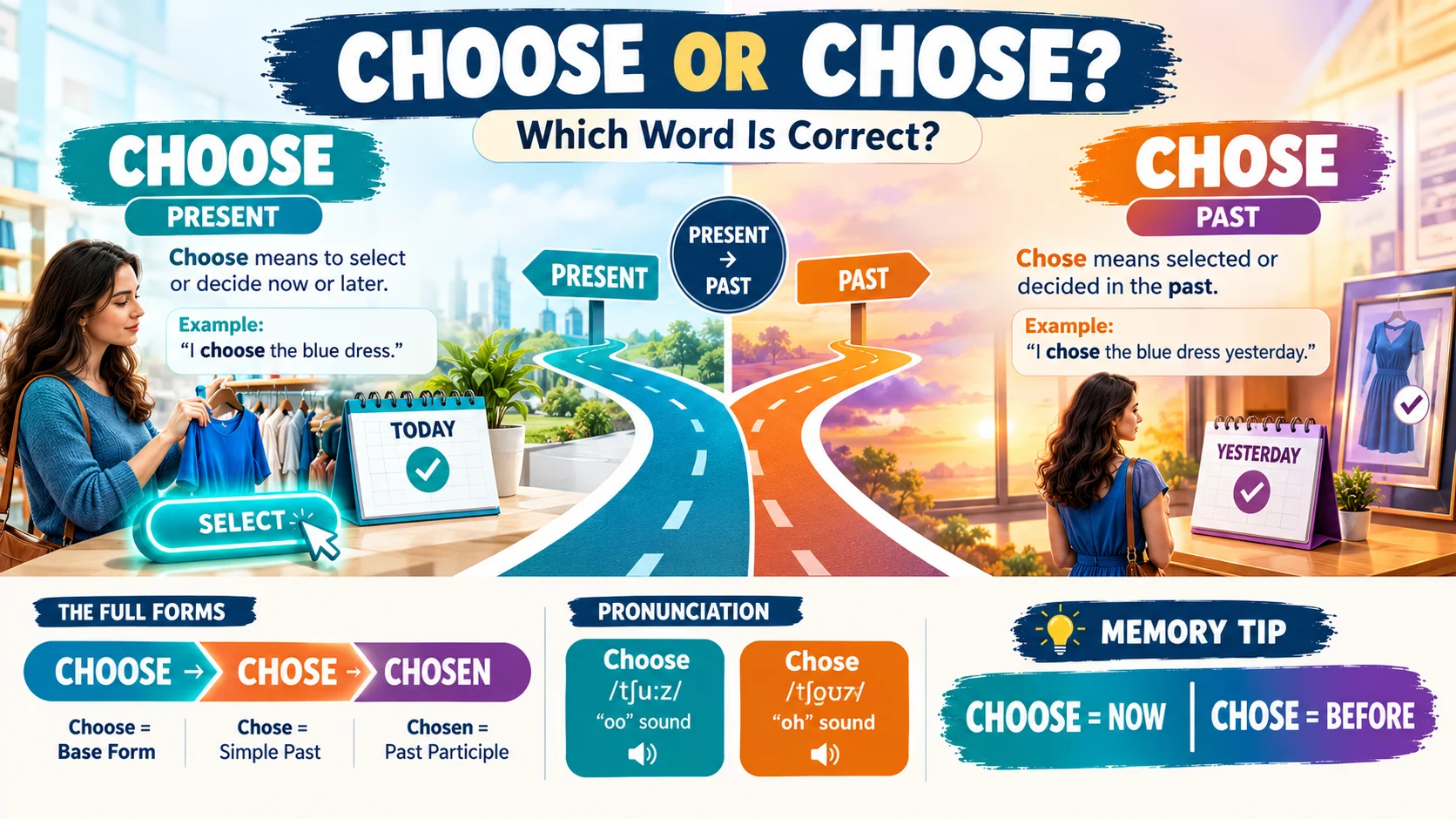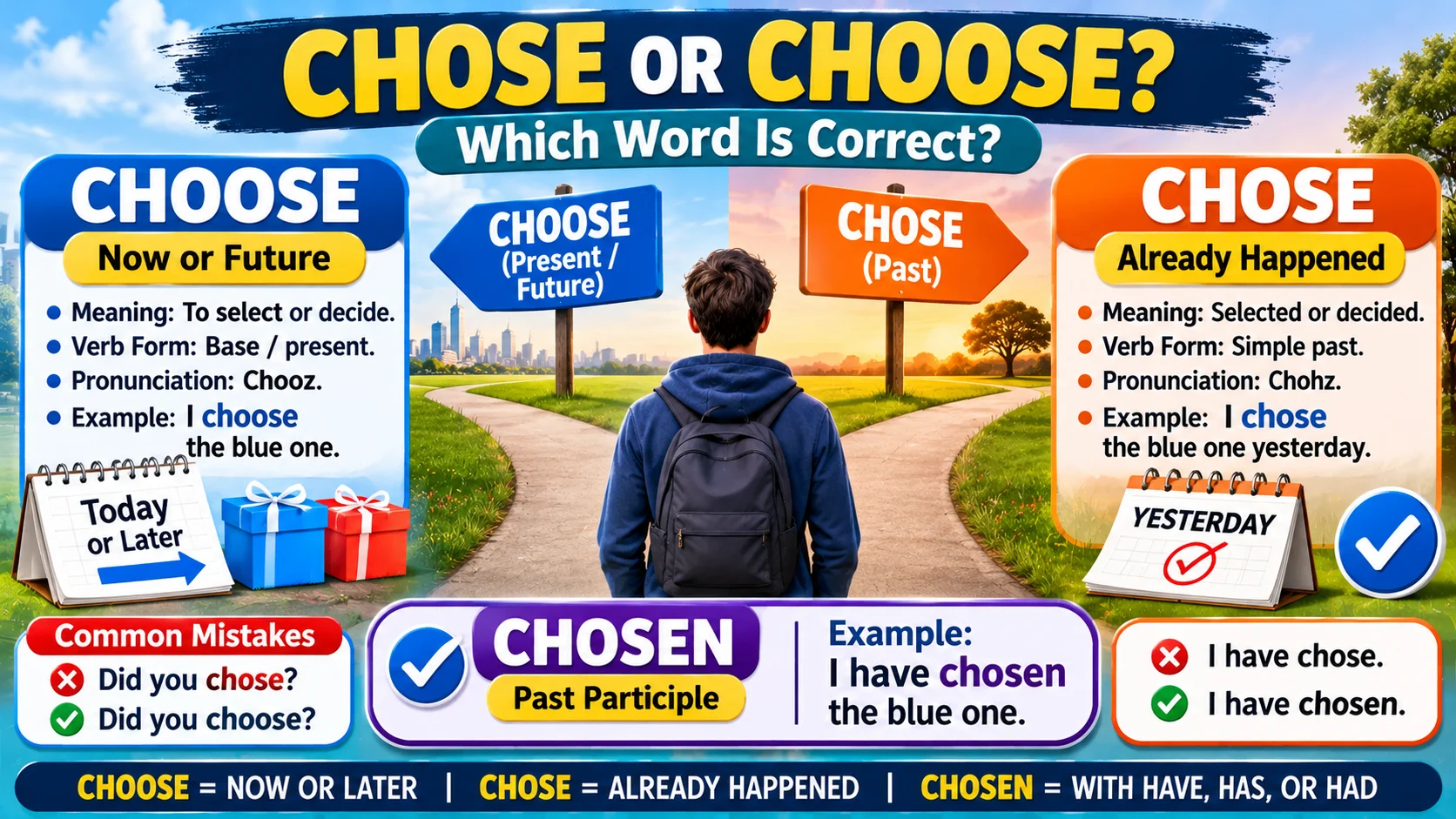
Chose and choose are both correct forms of the same verb, but they have different uses. Choose is the present-tense form, meaning to select or make a decision, while chose is its simple past-tense form. For example, “I choose coffee every morning” describes a present habit, whereas “I chose coffee yesterday” describes a past decision.
Have you ever stopped while writing and wondered whether to use chose or choose? These two words look almost identical, sound slightly different, and share the same basic meaning. However, using the wrong form can change the tense of your sentence and make your writing grammatically incorrect.
Both words come from the verb choose, which means to select something from two or more options. The main difference is time. Choose describes a present or future decision, while chose refers to a decision that happened in the past. Therefore, understanding their different forms can help you write clearer sentences and avoid common grammar mistakes.
Although the distinction seems simple, many English speakers still confuse these words, especially when writing quickly, sending text messages, or creating professional content. In this guide, you’ll learn the difference between chose and choose, their definitions, pronunciation, grammar rules, everyday examples, and common mistakes. By the end, you’ll know exactly which word to use in any situation.
Chose vs. Choose
| Comparison | Choose | Chose |
|---|---|---|
| Part of speech | Verb | Verb |
| Verb form | Base form / present tense | Simple past tense |
| Meaning | To select or decide | Selected or decided |
| Pronunciation | /tʃuːz/ (chooz) | /tʃoʊz/ (chohz) |
| Time | Present or future | Past |
| Example | I choose the blue shirt. | I chose the blue shirt yesterday. |
| Correct usage | I will choose later. | I chose yesterday. |
What Does Choose Mean?
Choose is the base form of the verb that means to select, pick, or decide between different possibilities. It describes the act of making a decision.
People use this word when discussing preferences, opportunities, plans, decisions, and everyday selections.
For example:
- I choose healthy food whenever possible.
- You can choose any seat you like.
- We need to choose a new team leader.
- They choose their vacation destinations carefully.
- I will choose my favorite movie tonight.
In these examples, the word refers to a current decision, a general habit, or a future selection.
Moreover, choose appears in several common grammatical structures:
- Present simple: I choose my clothes carefully.
- Future with will: I will choose a different option.
- After modal verbs: You should choose wisely.
- After to: I want to choose my own path.
Remember that choose is also the form used after auxiliary verbs such as do, does, and did.
For instance, “Did you choose this color?” is correct, not “Did you chose this color?”
What Does Chose Mean?
Chose is the simple past-tense form of choose. It describes a selection or decision that already happened.
Whenever you talk about something you selected yesterday, last week, or at another completed point in the past, you should generally use chose.
For example:
- I chose the red dress for the party.
- She chose a different career.
- We chose the best restaurant in town.
- They chose him as their captain.
- He chose to study engineering.
Here, each decision happened before the present moment.
Additionally, chose is commonly used in stories, personal experiences, conversations, and descriptions of past events.
Consider these examples:
- Last year, I chose a new school.
- She chose to leave the company.
- My parents chose our family vacation destination.
- He chose the wrong answer during the test.
The key is simple: if the selection already happened, chose is usually the correct word.
Chose or Choose: What Is the Main Difference?
The main difference between these words is their verb tense.
Choose refers to selecting something in the present or making a selection in the future. On the other hand, chose describes a selection that happened in the past.
Compare these sentences:
- I choose this phone because it has a better camera.
- I chose this phone because it had a better camera.
The first sentence describes a present decision or preference. However, the second sentence describes a decision made earlier.
Here is another comparison:
- Present: She chooses her clothes every morning.
- Past: She chose her clothes yesterday.
- Future: She will choose her clothes tomorrow.
Notice that the word changes according to the time of the action.
Therefore, remembering the timeline is the easiest way to distinguish the two forms.
Chose vs. Choose vs. Chosen
English learners sometimes confuse three forms of the same verb: choose, chose, and chosen.
Although they share a meaning, each form has a different grammatical function.
| Word | Verb Form | Example |
|---|---|---|
| Choose | Base / present | I choose my own clothes. |
| Chose | Simple past | I chose these shoes yesterday. |
| Chosen | Past participle | I have chosen these shoes. |
1. Choose
Use choose for present decisions, future selections, and after modal verbs.
Example: You should choose a better option.
2. Chose
Use chose when describing a completed past decision.
Example: She chose the blue car last month.
3. Chosen
Use chosen with helping verbs such as have, has, and had. It can also function as an adjective.
Examples:
- I have chosen my favorite subject.
- She has chosen a new apartment.
- They had chosen their destination before leaving.
Consequently, these three forms should not be used interchangeably.
When to Use Choose
Use choose in the following situations.
Present Decisions
When someone is selecting something now or expressing a current preference, use choose.
Examples:
- I choose the healthier option.
- We choose our own goals.
- She chooses her outfits carefully.
Future Decisions
Use choose after will, shall, and other future constructions that take the base verb.
Examples:
- I will choose a winner tomorrow.
- They will choose their new manager next week.
- You can choose your preferred color later.
After Modal Verbs
Modal verbs such as can, could, should, must, and might are followed by the base form of the verb.
Examples:
- You should choose carefully.
- I can choose either option.
- We must choose a suitable location.
Giving Advice
Choose is also useful when recommending that someone make a particular decision.
Examples:
- Choose your friends wisely.
- Always choose quality over quantity.
- Choose what makes you happy.
When to Use Chose
Use chose when discussing a completed action in the past.
Past Decisions
Examples:
- I chose the wrong answer.
- She chose a beautiful wedding dress.
- We chose this house two years ago.
Personal Experiences
Examples:
- I chose to follow my dreams.
- He chose a different path in life.
- They chose to move to another city.
Past Events and Stories
Examples:
- The teacher chose three students for the competition.
- My brother chose the movie last night.
- She chose the blue notebook during her shopping trip.
In each example, the decision took place in the past. Therefore, chose is the appropriate form.
30+ Examples of Chose and Choose in Sentences
The following examples show how both words work in everyday American English.
Choose Examples
- I choose happiness over unnecessary stress.
- You can choose any book from the shelf.
- We choose our own future.
- She always chooses comfortable shoes.
- They choose different destinations every summer.
- I will choose a new laptop next month.
- You should choose your words carefully.
- He can choose between two options.
- Please choose your favorite color.
- Students choose their subjects before the semester begins.
- I choose to spend my weekends with family.
- We must choose the right person for this job.
- You may choose whichever option you prefer.
- My parents let me choose my own clothes.
- Did you choose a name for your new puppy?
Chose Examples
- I chose the black jacket yesterday.
- She chose to study medicine.
- They chose a beautiful location for their wedding.
- We chose the cheaper hotel.
- He chose the wrong answer.
- My sister chose a different career.
- I chose this restaurant for its excellent food.
- The committee chose a new president.
- She chose to stay at home.
- We chose the blue curtains for our living room.
- He chose his words carefully.
- They chose to accept the offer.
- My parents chose our vacation destination.
- I chose the right moment to speak.
- She chose a red dress for the event.
Choose vs. Chose in Paired Sentences
| Choose (Present/Future) | Chose (Past) |
|---|---|
| I choose tea every morning. | I chose coffee yesterday. |
| She chooses her own clothes. | She chose that dress last week. |
| We choose our team members. | We chose our team members yesterday. |
| He will choose a college. | He chose a college last year. |
| You should choose wisely. | You chose wisely last time. |
Common Mistakes When Using Chose and Choose
Even experienced writers sometimes confuse these words. However, a few simple rules can prevent most errors.
Mistake 1: Using Chose for a Present Decision
Incorrect: I chose the blue one every time.
Correct: I choose the blue one every time.
Why? The sentence describes a regular habit, so the present-tense form is appropriate.
Mistake 2: Using Choose for a Completed Past Action
Incorrect: She choose the red dress yesterday.
Correct: She chose the red dress yesterday.
Why? The word yesterday indicates a completed past action.
Mistake 3: Using Chose After Did
Incorrect: Did you chose this option?
Correct: Did you choose this option?
Why? The auxiliary verb did already indicates the past tense. Therefore, the main verb must remain in its base form.
Mistake 4: Confusing Chose With Chosen
Incorrect: I have chose my favorite song.
Correct: I have chosen my favorite song.
Why? The present perfect tense requires the past participle chosen, not the simple past form chose.
Mistake 5: Using Chose After Will
Incorrect: I will chose a different option.
Correct: I will choose a different option.
Why? The modal auxiliary will takes the base form of the verb.
Chose or Choose in Different Contexts
The correct word can become easier to identify when you understand the context.
In Text Messages
Both words are common in casual conversations.
Examples:
- “You can choose the movie tonight.”
- “I chose the wrong restaurant.”
- “Have you chosen your outfit yet?”
In School and Academic Writing
Students should use the correct tense when explaining decisions or discussing research.
Examples:
- “The researchers chose three participants.”
- “Students can choose their preferred subjects.”
- “The committee will choose the final candidate.”
In Professional Communication
Both forms appear in emails, reports, meetings, and workplace discussions.
Examples:
- “We chose the most cost-effective solution.”
- “Please choose your preferred meeting time.”
- “The company chose a new marketing strategy.”
In Social Media Captions
These words can also describe personal preferences and decisions.
Examples:
- “I choose peace over drama.”
- “Chose happiness and never looked back.”
- “Choose your own adventure.”
Chose or Choose: Related Comparisons
Understanding similar verb forms can improve your overall grammar.
| Word Comparison | Main Difference |
|---|---|
| Lose or Loose | Lose means to misplace; loose means not tight. |
| Than or Then | Than makes comparisons; then refers to time or sequence. |
| Affect or Effect | Affect is usually a verb; effect is usually a noun. |
| Advice or Advise | Advice is a noun; advise is a verb. |
| Lay or Lie | Lay means to put something down; lie means to recline. |
| Saw or Seen | Saw is simple past; seen is a past participle. |
| Bring or Brought | Bring is the base form; brought is the past tense and past participle. |
Advantages and Disadvantages of Understanding Chose vs. Choose
Knowing the difference between these words helps you communicate more accurately.
Advantages
- Better grammar: You can use the correct verb tense.
- Clearer communication: Readers can understand when a decision happened.
- Professional writing: Correct word choices improve emails, reports, and articles.
- Improved confidence: You can write without repeatedly questioning these words.
- Better language skills: Learning verb forms strengthens your understanding of English grammar.
Disadvantages of Confusing Them
- Grammar errors: Incorrect forms can weaken your writing.
- Unclear timelines: Readers may misunderstand when an action occurred.
- Poor readability: Repeated mistakes can distract readers.
- Professional impression: Frequent grammar errors may affect how others view your writing.
Exercises: Chose or Choose?
Test your understanding by filling in each blank with the correct word.
Exercise 1: Fill in the Blanks
- I always _____ healthy meals.
- She _____ the blue dress yesterday.
- You should _____ your friends carefully.
- We _____ this hotel last summer.
- Did you _____ the right answer?
- He will _____ a new career.
- They _____ to stay at home last night.
- Please _____ your favorite option.
- My brother _____ the black car last week.
- I _____ to be happy every day.
Exercise 2: Choose the Correct Sentence
1. Which sentence is correct?
A. I chose my favorite color every day.
B. I choose my favorite color every day.
2. Which sentence is correct?
A. She chose the red shoes yesterday.
B. She choose the red shoes yesterday.
3. Which sentence is correct?
A. Did you chose this book?
B. Did you choose this book?
4. Which sentence is correct?
A. I will choose the winner.
B. I will chose the winner.
5. Which sentence is correct?
A. He has chose a new car.
B. He has chosen a new car.
Answers
Exercise 1:
- Choose
- Chose
- Choose
- Chose
- Choose
- Choose
- Chose
- Choose
- Chose
- Choose
Exercise 2:
- B — I choose my favorite color every day.
- A — She chose the red shoes yesterday.
- B — Did you choose this book?
- A — I will choose the winner.
- B — He has chosen a new car.
Frequently Asked Questions
1. Is it chose or choose?
Both words are correct, but they have different grammatical uses. Choose is the present-tense or base form, whereas chose is the simple past-tense form.
2. What is the difference between chose and choose?
Choose means to select something in the present or future, while chose means that someone selected something in the past.
3. Is chose past tense or present tense?
Chose is the simple past-tense form of the verb choose. For example, “I chose the blue shirt yesterday.”
4. Is choose past tense?
No. Choose is the base form of the verb and is used in the present tense and certain future constructions. Its simple past form is chose.
5. Is it I chose or I choose?
Both are grammatically correct. Use “I choose” for a present decision or habit, and “I chose” when referring to a decision made in the past.
6. Is it did you choose or did you chose?
“Did you choose?” is correct because the auxiliary verb did already indicates the past tense. Therefore, the main verb must remain in its base form.
7. Is it I have chose or I have chosen?
“I have chosen” is correct. The present perfect tense requires the past participle chosen, not chose.
8. What is the third form of choose?
The third form, or past participle, of choose is chosen. The three principal forms are choose, chose, and chosen.
9. How do you pronounce chose and choose?
Choose is pronounced /tʃuːz/ (chooz), while chose is pronounced /tʃoʊz/ (chohz). The main difference is the vowel sound.
10. Is chose a real English word?
Yes. Chose is a standard English verb form and the simple past tense of choose. It is not a misspelling.
11. Can I use choose when talking about yesterday?
Generally, no. Use chose for a completed past decision. However, choose can appear in a sentence about yesterday when it follows an auxiliary verb such as did: “Did you choose yesterday?”
12. What is the difference between chose and chosen?
Chose is the simple past form, while chosen is the past participle. For example, “I chose this book” and “I have chosen this book” are both correct.
Key Takeaways: Chose or Choose
Here are the most important points to remember:
- Choose is the base form and is used for present and future decisions.
- Chose is the simple past form and describes completed past decisions.
- Chosen is the past participle and usually follows have, has, or had.
- Use “Did you choose?” rather than “Did you chose?”
- Use “I have chosen” rather than “I have chose.”
Easy Memory Trick: Remember that choose = now or later, while chose = already happened.
Conclusion
Understanding the difference between chose or choose is simple once you remember their verb tenses. Both words describe the act of making a selection, but they refer to different times. Use choose when discussing present habits, current decisions, or future selections. On the other hand, use chose when describing a decision that has already happened.
Additionally, remember that chosen is the past participle used with helping verbs such as have, has, and had. By practicing these forms and paying attention to time-related words, you can avoid common grammar mistakes and improve your everyday writing.
Ultimately, the easiest rule is this: Choose now, chose before, and chosen with have, has, or had.