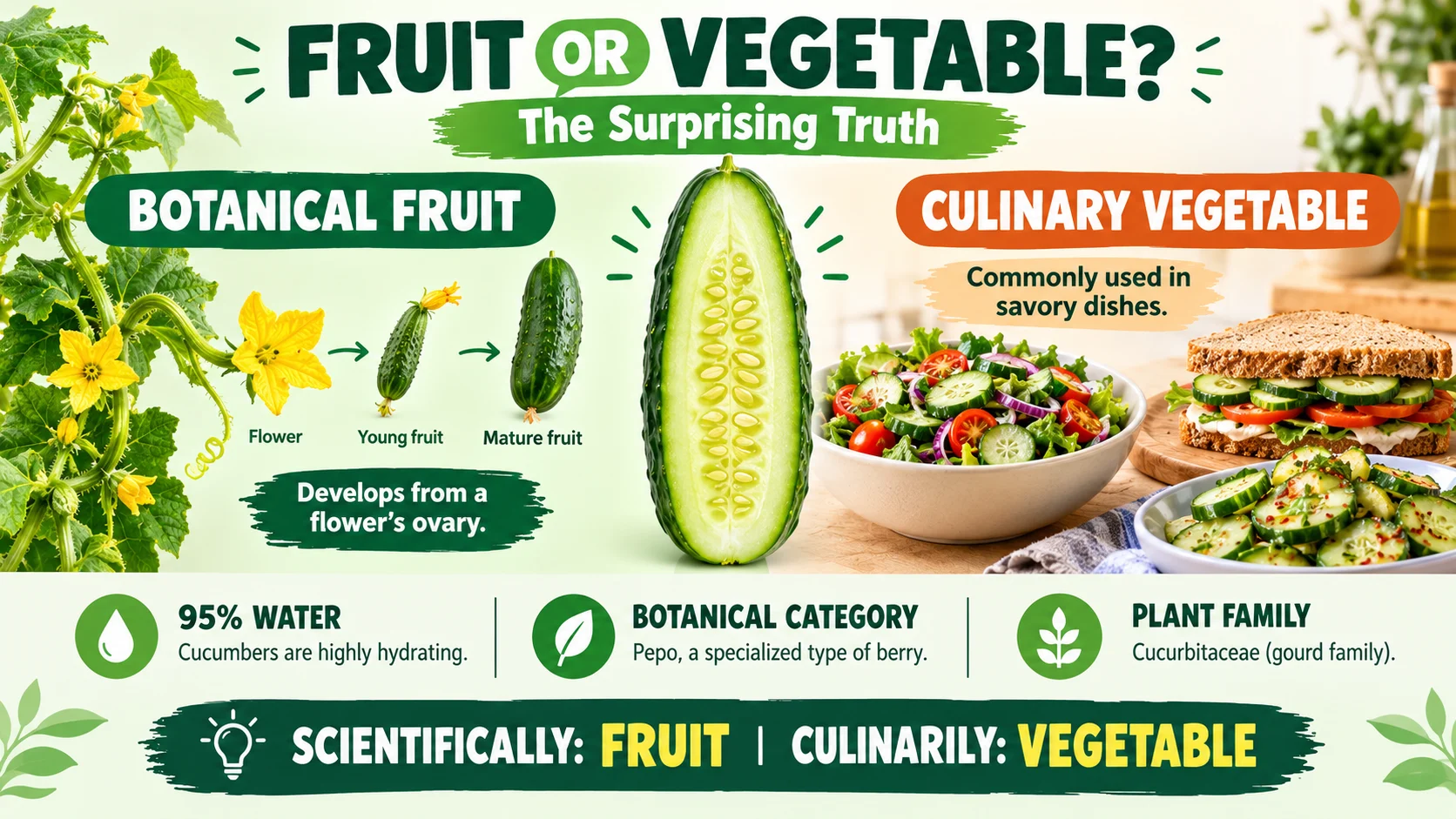
A cucumber is botanically a fruit because it develops from the flower of a cucumber plant and contains seeds. However, people generally classify it as a vegetable in cooking because of its mild, refreshing flavor and use in savory dishes, salads, and sandwiches. Therefore, a cucumber is scientifically a fruit but culinarily a vegetable.
Is a cucumber a fruit or vegetable? This common food question has a surprising answer because a cucumber belongs to both categories, depending on how you classify it. Although most people think of cucumbers as vegetables, science tells a different story. Botanically, a cucumber is a fruit because it grows from a flower and contains seeds inside.
However, its classification in the kitchen is quite different. People usually add cucumbers to salads, sandwiches, wraps, and savory meals rather than sweet desserts. As a result, cooks and food enthusiasts generally treat them as vegetables.
This difference between botanical science and everyday cooking creates confusion for many people. After all, cucumbers look and taste more like vegetables than familiar fruits such as apples, oranges, or bananas.
In this guide, you’ll discover why cucumbers are technically fruits, how scientists classify them, why cooks consider them vegetables, and how they compare with other foods. Additionally, we’ll explore their nutritional benefits, common misconceptions, practical examples, and frequently asked questions to help you understand the answer completely.
Cucumber Classification
| Meaning | Context | Primary Classification | Example | Category |
|---|---|---|---|---|
| Fruit | Botanical science | Fruit | A cucumber develops from a flower | Scientific |
| Vegetable | Cooking | Vegetable | Cucumber in a garden salad | Culinary |
| Seed-bearing structure | Plant biology | Fruit | Seeds inside a cucumber | Reproductive |
| Savory food ingredient | Everyday use | Vegetable | Cucumber sandwich | Culinary |
What Is a Cucumber?
A cucumber is an edible plant product that grows on a creeping or climbing vine. Its scientific name is Cucumis sativus, and it belongs to the Cucurbitaceae family, commonly known as the gourd family.
This plant family also includes watermelons, pumpkins, squash, and muskmelons. Interestingly, many familiar foods in this family are botanically fruits, even though people often prepare them as vegetables.
Cucumbers are usually green, elongated, and filled with soft, watery flesh. Their outer skin may be smooth or slightly bumpy, depending on the variety.
Moreover, cucumbers contain numerous small seeds arranged inside their fleshy center. These seeds play an important role in the plant’s reproductive process.
People grow cucumbers in home gardens, commercial farms, and greenhouses. They are popular worldwide because of their refreshing taste, versatility, and high water content.
Why Is a Cucumber Botanically a Fruit?
According to botanical science, a fruit is the mature structure that develops from the ovary of a flowering plant, usually after fertilization. Its primary biological role is to protect and help distribute seeds.
A cucumber meets this scientific definition.
Here are the main reasons:
1. It Develops From a Flower
Cucumber plants produce yellow flowers before developing edible cucumbers.
After successful pollination and fertilization, the flower’s ovary begins to grow. Eventually, it develops into the cucumber that people harvest and eat.
Therefore, its origin connects it directly to the reproductive structure of the plant.
2. It Contains Seeds
Another important characteristic of botanical fruits is that they generally contain seeds.
A cucumber has several seeds inside its soft central flesh. These seeds can potentially grow into new cucumber plants under suitable conditions.
Consequently, the presence of seeds supports its botanical classification as a fruit.
3. It Develops From the Plant’s Ovary
The ovary is part of a flower’s reproductive structure. After fertilization, it develops into a fruit.
Similarly, the cucumber grows from the flower’s ovary rather than from a leaf, stem, or root.
For this reason, botanists classify cucumbers as fruits.
4. It Belongs to a Fruit-Producing Plant Family
Cucumbers belong to the gourd family, which includes several other botanically classified fruits.
Watermelons, pumpkins, and squash share similar reproductive characteristics.
Thus, cucumber classification follows the same botanical principles used for these plants.
Why Do People Consider Cucumbers Vegetables?
Although cucumbers are fruits scientifically, most people use them as vegetables in everyday cooking.
This happens because culinary classification depends more on flavor, texture, and food preparation than on plant biology.
Here are the main reasons.
1. They Have a Mild, Non-Sweet Flavor
Many familiar fruits taste sweet because they contain natural sugars. However, cucumbers have a mild, refreshing flavor with very little natural sugar.
Their taste works particularly well in savory recipes.
For example, people commonly combine cucumbers with tomatoes, onions, lettuce, cheese, and herbs.
2. They Are Used in Savory Dishes
Cucumbers appear in many meals that people traditionally classify as vegetable-based dishes.
Common examples include:
- Fresh garden salads
- Cucumber sandwiches
- Vegetable wraps
- Greek salad
- Tzatziki sauce
- Pickle preparations
- Cold soups
- Vegetable platters
Because of these familiar uses, most cooks treat cucumbers as vegetables.
3. They Are Not Commonly Used in Sweet Desserts
Apples, strawberries, peaches, and mangoes frequently appear in desserts and sweet dishes.
In contrast, cucumbers rarely serve as the main ingredient in traditional fruit pies, cakes, or sweet desserts.
Nevertheless, creative recipes sometimes use cucumbers in smoothies, chilled drinks, and fruit combinations.
4. Their Culinary Role Matters More Than Their Scientific Classification
In a kitchen, people generally classify food according to how they prepare and serve it.
For instance, tomatoes, eggplants, peppers, and zucchini are also botanical fruits. However, cooks usually use them as vegetables.
Similarly, cucumbers are fruits in botanical science but vegetables in culinary practice.
Fruit vs. Vegetable: What Is the Difference?
The difference between fruits and vegetables depends on whether you’re using a scientific or culinary definition.
Botanical Definition of a Fruit
A botanical fruit develops from the ovary of a flowering plant and typically contains seeds.
Its biological purpose is to help protect and distribute those seeds.
Examples include:
- Cucumbers
- Tomatoes
- Peppers
- Eggplants
- Pumpkins
- Watermelons
- Apples
- Oranges
Culinary Definition of a Vegetable
A vegetable is a broad culinary category that includes edible parts of plants.
These parts may include roots, stems, leaves, flowers, and certain fruits.
Examples include:
- Carrots (roots)
- Celery (stems)
- Spinach (leaves)
- Broccoli (flowering structures)
- Potatoes (modified underground stems)
- Cucumbers (botanical fruits used as vegetables)
Therefore, the two classifications describe food from different perspectives.
Is a Cucumber a Fruit or Vegetable in Cooking?
In cooking, a cucumber is generally considered a vegetable.
Its mild taste, crisp texture, and refreshing qualities make it suitable for savory dishes. Furthermore, it pairs well with ingredients such as lettuce, tomatoes, onions, garlic, yogurt, and herbs.
For example, a traditional cucumber salad combines sliced cucumbers with vinegar, salt, pepper, and fresh herbs.
Similarly, cucumber slices are popular sandwich fillings and burger toppings.
However, culinary classifications are not strict scientific rules. You can use cucumbers in sweet or savory recipes depending on your preferences.
The important distinction is that cooking classifies cucumbers by their culinary use, while botany classifies them by how they develop on the plant.
Is a Cucumber a Berry?
Interestingly, a cucumber is also classified as a type of berry in botanical terminology.
More specifically, it belongs to a fruit category called a pepo.
A pepo is a specialized type of berry that develops from an inferior ovary and usually has a relatively firm outer rind with a fleshy interior.
Cucumbers, pumpkins, watermelons, and many other members of the gourd family belong to this category.
Although the word berry usually makes people think of strawberries, blueberries, and raspberries, botanical terminology works differently.
In fact, strawberries are not true botanical berries, while cucumbers are.
This is another example of how scientific classifications can differ from everyday language.
Nutritional Value of Cucumbers
Cucumbers are popular partly because they provide hydration and contain relatively few calories.
According to standard USDA food composition data, a 100-gram serving of raw cucumber with peel contains approximately:
| Nutrient | Amount per 100 g |
|---|---|
| Calories | 15 kcal |
| Water | 95.2 g |
| Carbohydrates | 3.63 g |
| Natural sugars | 1.67 g |
| Dietary fiber | 0.5 g |
| Protein | 0.65 g |
| Fat | 0.11 g |
| Potassium | 147 mg |
| Vitamin C | 2.8 mg |
| Vitamin K | 16.4 mcg |
Values are approximate and can vary depending on variety, growing conditions, and preparation.
1. Supports Hydration
Cucumbers contain approximately 95% water.
Therefore, eating them can contribute to your daily fluid intake, particularly during hot weather.
However, they should complement rather than replace drinking water.
2. Provides Vitamin K
Vitamin K supports normal blood clotting and plays a role in bone health.
Cucumber flesh and peel provide a small amount of this nutrient.
3. Contains Antioxidants
Cucumbers contain several plant compounds, including flavonoids and other antioxidant substances.
These compounds help protect cells against oxidative damage.
Nevertheless, cucumbers should be considered one part of a balanced diet rather than a treatment for disease.
4. Offers a Low-Calorie Food Option
Raw cucumbers contain relatively few calories.
Consequently, they can be a convenient addition to meals and snacks for people who want refreshing, nutrient-containing foods.
5. Contributes to Fiber Intake
Cucumbers provide a small amount of dietary fiber, especially when eaten with their skin.
Fiber supports normal digestion and contributes to a balanced eating pattern.
Different Types of Cucumbers
Not all cucumbers look or taste exactly the same. Several varieties are grown for fresh eating, pickling, and commercial food production.
1. English Cucumbers
English cucumbers are generally long, slender, and relatively smooth.
They often have smaller seeds and thinner skin than traditional slicing varieties.
People commonly use them in salads, sandwiches, and fresh vegetable dishes.
2. American Slicing Cucumbers
These are common grocery-store cucumbers.
They usually have thicker, darker green skin and a slightly larger seed cavity.
Their versatility makes them suitable for salads, sandwiches, and everyday meals.
3. Pickling Cucumbers
Pickling cucumbers are generally shorter and firmer.
Their texture makes them particularly suitable for preserving in vinegar or brine.
For example, many traditional dill pickles are made using pickling cucumber varieties.
4. Persian Cucumbers
Persian cucumbers are usually small, crisp, and relatively thin-skinned.
They are popular for fresh snacks, salads, and Mediterranean-style dishes.
5. Lemon Cucumbers
Lemon cucumbers are round or oval and often turn yellow when mature.
Despite their name, they do not taste like lemons. Their flavor is mild and refreshing.
Is a Pickle a Fruit or Vegetable?
A pickle made from a cucumber is botanically derived from a fruit.
Pickling changes the cucumber’s flavor, texture, and preservation characteristics, but it does not change its botanical origin.
The cucumber remains a fruit because it originally developed from the flower’s ovary.
However, pickles are generally treated as vegetables in cooking.
People commonly serve them alongside burgers, sandwiches, grilled foods, and savory snacks.
Therefore, a cucumber pickle is botanically a preserved fruit but culinarily a vegetable-based food.
Is a Cucumber Healthier Than Other Fruits and Vegetables?
There is no single answer because different fruits and vegetables provide different nutrients.
Cucumbers are particularly useful for hydration because of their high water content. However, they generally contain fewer calories and less fiber than many other produce options.
Consider these comparisons:
| Food | Botanical Classification | Main Nutritional Feature |
|---|---|---|
| Cucumber | Fruit | High water content |
| Tomato | Fruit | Lycopene and vitamin C |
| Carrot | Root vegetable | Beta-carotene |
| Spinach | Leaf vegetable | Vitamin K and folate |
| Broccoli | Flowering vegetable | Fiber and vitamin C |
| Watermelon | Fruit | High water content and lycopene |
Rather than choosing one food as universally healthier, include a variety of colorful fruits and vegetables in your meals.
Advantages and Disadvantages of Eating Cucumbers
Cucumbers offer several nutritional advantages, although they also have some limitations.
Advantages
- High water content: They contribute to daily hydration.
- Low in calories: They make a light and refreshing snack.
- Versatile ingredient: You can use them in salads, sandwiches, and drinks.
- Contains useful nutrients: They provide vitamin K, potassium, and small amounts of other nutrients.
- Easy to prepare: Most varieties can be washed, sliced, and eaten raw.
- Plant-based food: They fit into vegetarian and vegan eating patterns.
Disadvantages
- Relatively low in protein: Cucumbers are not a significant protein source.
- Limited calorie content: They cannot provide enough energy as a complete meal.
- May cause digestive discomfort: Some people experience bloating or indigestion after eating cucumbers.
- Short storage life: Fresh cucumbers can become soft or spoil if stored improperly.
- Some varieties have bitter compounds: Cucurbitacins can cause bitterness, especially in certain stressed or poorly bred plants.
If a cucumber tastes unusually bitter, avoid eating it. High cucurbitacin levels can cause illness.
Common Misconceptions About Cucumber Classification
Several misunderstandings make the fruit-versus-vegetable debate confusing.
Misconception 1: All Fruits Taste Sweet
This is incorrect.
Botanical fruits do not have to taste sweet. Cucumbers, tomatoes, peppers, and eggplants are all examples of fruits that commonly appear in savory meals.
Misconception 2: All Vegetables Grow Underground
Vegetables can come from different parts of plants.
For example, spinach comes from leaves, celery from stems, and carrots from roots.
Meanwhile, cucumbers grow from flowers and are classified as fruits.
Misconception 3: Seeds Automatically Make Something a Fruit
Seeds alone do not provide the complete scientific definition.
A botanical fruit develops from the ovary of a flower. Its relationship to the flower’s reproductive structure is the important factor.
Misconception 4: Cooking Changes a Fruit Into a Vegetable
Cooking does not change a food’s botanical classification.
Whether you eat a cucumber raw, roasted, pickled, or cooked, it remains botanically a fruit.
Misconception 5: Cucumbers and Zucchini Have Different Botanical Rules
Cucumbers and zucchini belong to the same plant family.
Both are botanical fruits, although people commonly use them as vegetables.
How to Use Cucumbers in Everyday Meals
Cucumbers are easy to incorporate into a balanced eating routine.
Here are some practical ideas.
1. Fresh Cucumber Salad
Combine sliced cucumbers with tomatoes, onions, lemon juice, and a little salt.
This simple dish works well as a side with lunch or dinner.
2. Cucumber Sandwiches
Place thin cucumber slices between pieces of bread with cream cheese, herbs, or your preferred spread.
The result is a light and refreshing sandwich.
3. Cucumber Water
Add cucumber slices to a jug of cold water.
For extra flavor, include lemon, mint, or fresh herbs.
4. Yogurt and Cucumber Dip
Mix grated cucumber with plain yogurt, garlic, lemon juice, and herbs.
This combination creates a refreshing dip commonly associated with Mediterranean and Middle Eastern cuisine.
5. Pickled Cucumbers
Preserve cucumber slices in vinegar or a suitable brine with spices.
Depending on the preparation method, you can enjoy homemade pickles with sandwiches and other savory dishes.
Cucumber vs. Other Foods: Fruit or Vegetable?
Cucumbers are not the only foods that confuse people. Several familiar kitchen ingredients have different scientific and culinary classifications.
Cucumber vs. Tomato
Both cucumbers and tomatoes are botanical fruits.
However, people commonly use both in salads, sandwiches, sauces, and savory recipes.
Cucumber vs. Zucchini
Both belong to the gourd family and develop from flowers.
Nevertheless, cucumbers are often eaten raw, while zucchini is frequently cooked.
Cucumber vs. Pumpkin
Pumpkins and cucumbers belong to the same botanical family.
Both are fruits, although pumpkin is commonly prepared as a vegetable in savory recipes and desserts.
Cucumber vs. Watermelon
Watermelons and cucumbers share the Cucurbitaceae family.
Both are botanical fruits and contain a high proportion of water.
However, watermelon is usually eaten as a sweet fruit, while cucumber is generally served as a vegetable.
Cucumber vs. Eggplant
Eggplants are also botanical fruits because they develop from flowers and contain seeds.
In the kitchen, however, eggplants are treated as vegetables because of their savory culinary uses.
When Should You Call a Cucumber a Fruit or Vegetable?
The correct term depends on the situation.
| Situation | Best Term | Reason |
|---|---|---|
| Biology class | Fruit | Develops from a flower’s ovary |
| Botanical research | Fruit | Contains seeds and develops from a flower |
| Grocery shopping | Vegetable | Common culinary classification |
| Cooking a salad | Vegetable | Used in savory dishes |
| Plant science discussion | Fruit | Scientific classification |
| Everyday conversation | Vegetable | Common usage |
For example, if a science teacher asks whether a cucumber is a fruit, the correct answer is yes.
On the other hand, if a chef asks you to prepare a vegetable salad, including cucumber makes perfect culinary sense.
Common Mistakes When Explaining Cucumber Classification
Even though the answer is simple, people sometimes explain it incorrectly.
Avoid these mistakes:
- Saying cucumbers are only vegetables: This ignores their botanical classification.
- Calling them sweet fruits: Botanical fruits do not need to taste sweet.
- Confusing seeds with the entire definition: Fruit development from a flower’s ovary is essential.
- Assuming cooking changes their scientific identity: Preparation does not change botanical classification.
- Comparing botanical and culinary definitions as if they were identical: These systems classify foods differently.
- Calling every seed-bearing plant part a fruit: The botanical origin of the structure matters.
Understanding these distinctions makes the answer much easier to explain.
Test Your Knowledge: Is a Cucumber a Fruit or Vegetable?
Try these short questions to check what you’ve learned.
Question 1: What is a cucumber botanically?
A. Root
B. Fruit
C. Leaf
D. Stem
Question 2: Why is a cucumber classified as a fruit?
- A. It tastes sweet
- B. It grows underground
- C. It develops from a flower’s ovary
- D. It contains no seeds
Question 3: How do cooks generally classify cucumbers?
A. Fruits
B. Vegetables
C. Grains
D. Nuts
Question 4: What is the botanical fruit category of a cucumber?
A. Drupe
B. Pome
C. Pepo
D. Aggregate fruit
Question 5: Does pickling change a cucumber’s botanical classification?
A. Yes
B. No
Answers and Explanations
- B. Fruit: A cucumber develops from a flowering plant’s ovary.
- C. It develops from a flower’s ovary: This is the main botanical reason.
- B. Vegetables: Its flavor and common culinary uses place it in the vegetable category.
- C. Pepo: Cucumbers are a specialized type of berry called a pepo.
- B. No: Pickling changes its preparation and preservation, not its botanical origin.
Key Takeaways and Summary
Here are the most important facts to remember:
- A cucumber is botanically a fruit.
- It develops from the ovary of a cucumber flower.
- Its seeds support its reproductive role.
- Cucumbers belong to the Cucurbitaceae or gourd family.
- Botanically, a cucumber is a type of berry called a pepo.
- In cooking, people generally classify cucumbers as vegetables.
- Its mild flavor and savory uses explain its culinary classification.
- Pickling does not change its botanical identity.
- Cucumbers contain approximately 95% water.
- They provide a small amount of several useful nutrients.
FAQs
1. Is a cucumber technically a fruit?
Yes. A cucumber is technically a fruit because it develops from the ovary of a flowering plant and contains seeds.
2. Why do people think cucumbers are vegetables?
People generally consider cucumbers vegetables because they have a mild, refreshing flavor and are commonly used in savory dishes, salads, and sandwiches.
3. Is a cucumber a fruit or vegetable according to science?
According to botanical science, a cucumber is a fruit. Its development from a flower’s ovary determines its classification.
4. Is cucumber a fruit like a tomato?
Yes. Both cucumbers and tomatoes are botanical fruits because they develop from flowers and contain seeds. However, cooks generally use both as vegetables.
5. Is a cucumber a berry?
Yes. Botanically, cucumbers are classified as pepos, a specialized type of berry with a fleshy interior and relatively firm outer rind.
6. Is a pickle a fruit or vegetable?
A pickle made from a cucumber is botanically derived from a fruit. However, people generally classify pickles as vegetables in everyday cooking.
7. Does a cucumber have seeds?
Yes. Cucumbers contain small seeds inside their fleshy center. These seeds can develop into new cucumber plants under suitable conditions.
8. Is a cucumber healthier than a tomato?
Neither is universally healthier. Cucumbers provide plenty of water, while tomatoes offer nutrients such as lycopene and vitamin C. Both can contribute to a balanced diet.
9. Can cucumbers be used in fruit salads?
Yes. Although they are usually treated as vegetables, cucumbers can be included in fruit salads, smoothies, and refreshing drinks.
10. Are cucumbers part of the gourd family?
Yes. Cucumbers belong to the Cucurbitaceae family, which also includes pumpkins, watermelons, squash, and muskmelons.
11. Is cucumber a vegetable in the United States?
In everyday American cooking and grocery shopping, cucumbers are generally considered vegetables. Botanically, however, they are fruits.
12. Do cucumbers count toward your daily fruit or vegetable intake?
Cucumbers can contribute to your daily vegetable intake under common dietary guidance. Their botanical classification does not prevent people from counting them as vegetables in nutrition planning.
Conclusion
So, is a cucumber a fruit or vegetable? The answer depends on the classification system you use. Botanically, a cucumber is a fruit because it develops from a flower’s ovary and contains seeds. However, in everyday cooking, it is considered a vegetable because of its mild flavor and common use in savory dishes.
Interestingly, cucumbers are also a specialized botanical berry known as a pepo. This makes them even more fascinating than they first appear.
The next time someone asks whether a cucumber is a fruit or vegetable, you can confidently explain both answers. It is scientifically a fruit and practically a vegetable. Both classifications are correct in their respective contexts.