Yes or no tarot is a simple tarot reading method that helps you explore a question when you’re looking for a clear direction. Instead of interpreting a long spread of cards, you draw one or more cards and consider whether their traditional symbolism leans toward yes, no, or maybe.
People use this approach for questions about relationships, work, personal goals, and everyday choices. For example, you might ask whether you’re ready to start something new, whether a conversation deserves another chance, or whether you should reconsider a current plan.
However, tarot doesn’t provide scientifically verified predictions about the future. Its value comes from symbolism, personal reflection, and the questions it encourages you to ask yourself.
In this guide, you’ll learn how yes-or-no tarot works, which cards traditionally suggest positive or challenging outcomes, how reversed cards affect interpretations, and how to conduct a simple reading yourself. You’ll also find sample questions, common mistakes, and practical ways to interpret an uncertain result.
Whether you’re a complete beginner or already familiar with tarot, the goal is simple: use the cards as a tool for reflection while keeping your decisions grounded in real-world information.
What Is Yes or No Tarot?
Yes or no tarot is a simplified form of tarot reading designed to explore a question with a short answer. Rather than interpreting a large spread, the reader usually draws one card and considers its traditional symbolism.
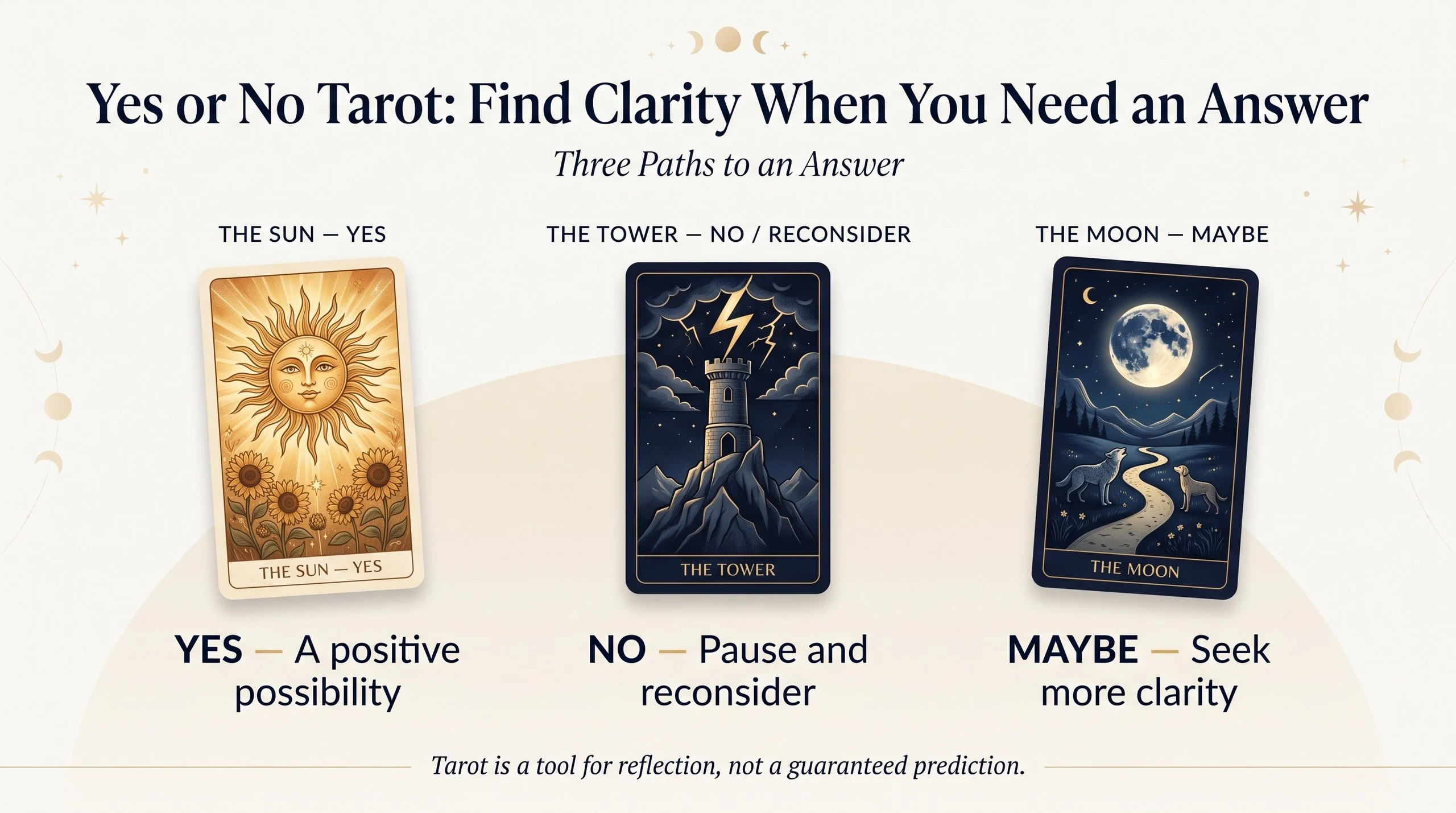
For example, The Sun is commonly associated with optimism, success, and clarity. Therefore, many readers interpret it as a positive sign when using a yes-or-no method.
In contrast, The Tower represents disruption, sudden change, or the collapse of an unstable situation. A reader might interpret it as a warning to reconsider a plan rather than a straightforward yes.
Nevertheless, tarot meanings aren’t universal rules. Different readers use different systems, and the same card can mean different things depending on the question and surrounding circumstances.
How Does a Yes or No Tarot Reading Work?
A basic reading follows three steps:
- Ask a clear question. Choose something specific that can reasonably be explored through a yes-or-no format.
- Draw a tarot card. Shuffle the deck while focusing on your question, then select one card.
- Interpret the symbolism. Consider the card’s traditional meaning and how it relates to your situation.
Some readers assign each card a yes, no, or maybe category before beginning. Others interpret the card intuitively.
Either method can work as a personal reflection exercise. However, neither guarantees that the resulting answer accurately predicts an event.
Can You Use Yes or No Tarot Without a Physical Deck?
Yes. You can use a digital tarot deck, an online reading, or a set of written card meanings.
A physical deck isn’t essential because the important part is how you reflect on the card and your question.
Still, if you’re learning tarot, studying the traditional meanings can help you develop a more consistent interpretation instead of relying on whichever answer you prefer.
What Does Yes or No Tarot Mean?
| Meaning | Context | Primary Platforms | Example | Tone |
|---|---|---|---|---|
| A simplified tarot reading for exploring a yes-or-no question | Relationships, work, personal goals, and everyday choices | Tarot apps, websites, physical decks, social media | Asking, “Should I explore this opportunity?” | Reflective and intuitive |
Quick answer: Yes or no tarot uses one or more tarot cards to explore whether a situation leans toward yes, no, or maybe. Readers interpret traditional card symbolism to reflect on a question, but the result should not be treated as a guaranteed prediction.
How to Perform a Yes or No Tarot Reading
You don’t need advanced tarot knowledge to begin. A simple process can help you focus your question and consider the meaning of the card you draw.
Step 1: Choose One Clear Question
Start with a question that has a meaningful yes-or-no structure.
For example, “Would applying for this position support my career goals?” is more useful than asking, “What will happen to my entire future?”
The first question gives you a specific issue to reflect on. By comparison, the second covers too many possibilities for a single card to address meaningfully.
Try to avoid combining several questions into one reading. If you’re asking about a relationship, for instance, focus on one concern rather than asking about love, commitment, marriage, and the future all at once.
Step 2: Settle Your Attention
Take a few slow breaths and read your question again. The purpose isn’t to achieve a special state or prove that the cards can access hidden information.
Instead, a brief pause can help you notice what you’re actually concerned about.
If you’re feeling overwhelmed, consider writing the question down before drawing a card. This small step can make your interpretation more focused.
Step 3: Shuffle and Draw
Shuffle your deck in whichever way feels comfortable. Then draw one card.
Some readers choose a card from the top of the deck, while others spread the cards out and select one. Neither approach has been scientifically established as more accurate.
For a beginner, the simplest method is often the easiest to repeat consistently.
Step 4: Interpret the Card
Look at the card’s traditional meaning before deciding whether it suggests yes, no, or maybe.
For example, The Star is commonly associated with hope and renewal. In a question about pursuing a meaningful goal, it might encourage you to remain optimistic while making a practical plan.
However, the same card doesn’t guarantee success. It can also invite you to consider what would make your goal achievable.
Step 5: Turn the Answer Into Reflection
After interpreting the card, ask yourself what the symbolism brings to mind.
If you draw a card associated with uncertainty, consider which facts you still need. Likewise, a card associated with confidence might encourage you to recognize an opportunity you have been hesitant to pursue.
The most useful reading doesn’t end with a label. Instead, it helps you identify a thoughtful next step.
Yes or No Tarot Card Meanings
Tarot contains 78 cards divided into the Major Arcana and Minor Arcana. Their meanings vary according to tradition, so readers don’t always assign identical yes-or-no answers.
The following interpretations offer a practical starting point for beginners.
Cards Commonly Read as Yes
These cards generally carry positive or forward-moving symbolism.
| Tarot Card | Traditional Themes | Possible Yes-or-No Interpretation |
|---|---|---|
| The Sun | Joy, clarity, confidence | Strong yes |
| The Star | Hope, renewal, inspiration | Yes |
| The World | Completion, achievement, fulfillment | Yes |
| The Magician | Initiative, skill, resourcefulness | Yes, with action |
| The Empress | Growth, nurturing, abundance | Yes, where growth is appropriate |
| The Chariot | Determination, progress, control | Yes, with discipline |
| Ace of Cups | Emotional beginnings, openness | Yes for emotional possibilities |
| Ace of Pentacles | Practical opportunities, stability | Yes for grounded beginnings |
| Six of Wands | Recognition, progress, confidence | Generally yes |
| Ten of Cups | Emotional harmony, shared happiness | Generally yes |
These are common interpretive conventions rather than fixed rules. For instance, The Chariot can suggest success through discipline, but it may also highlight the need to regain control before proceeding.
Cards Commonly Read as No
Some cards carry themes of obstacles, conflict, instability, or disappointment. Consequently, many readers interpret them as a no or a reason to pause.
| Tarot Card | Traditional Themes | Possible Yes-or-No Interpretation |
|---|---|---|
| The Tower | Disruption, sudden change | No, or reconsider your approach |
| Three of Swords | Heartbreak, painful truth | Often no in emotional questions |
| Five of Pentacles | Hardship, insecurity | Caution or no |
| Ten of Swords | Endings, exhaustion | No, or let the situation end |
| Five of Wands | Competition, disagreement | Not yet, or expect friction |
| Seven of Swords | Secrecy, strategy, avoidance | Be cautious and seek clarity |
| The Devil | Attachment, temptation, unhealthy patterns | Reconsider the choice |
| Five of Cups | Regret, disappointment | A pause may be helpful |
| Nine of Swords | Worry, distress, overthinking | Address the concern first |
A challenging card doesn’t necessarily mean that something bad will happen. Rather, it may provide a symbolic prompt to examine risks, expectations, or unresolved issues.
Cards That May Mean Maybe
Some cards emphasize uncertainty, timing, balance, or the need for additional information.
| Tarot Card | Traditional Themes | Possible Yes-or-No Interpretation |
|---|---|---|
| The Moon | Uncertainty, intuition, unclear information | Maybe; seek clarity |
| The High Priestess | Inner reflection, hidden information | Wait and observe |
| The Hanged Man | Pause, changed perspective | Not yet |
| Two of Swords | Indecision, competing choices | Decide after reviewing the facts |
| Seven of Cups | Possibilities, imagination, confusion | Narrow your options |
| Temperance | Balance, patience, moderation | Possibly, with balance |
| Wheel of Fortune | Change, cycles, shifting circumstances | Uncertain; circumstances matter |
| Four of Swords | Rest, recovery, reflection | Wait before acting |
A maybe answer can be especially useful when you’re rushing toward a decision. Instead of forcing a yes or no, consider whether you need more time, clearer information, or a different approach.
What Do Upright and Reversed Cards Mean?
In tarot, a card appears upright when its image faces the usual direction. A reversed card appears upside down relative to the reader.
Some tarot readers use reversals to add nuance, while others read every card upright. Either method is acceptable within its chosen interpretive system.
Upright Card Interpretations
An upright card is often read through its familiar traditional themes.
For example, The Sun upright commonly represents joy, confidence, openness, and success. In a yes-or-no reading, those themes may support a positive interpretation.
Nevertheless, the card’s meaning should still relate to the question. The Sun might suggest a promising opportunity, but it doesn’t establish that a particular job offer will arrive.
Reversed Card Interpretations
A reversed card may suggest blocked energy, delays, an internal struggle, or an expression of the card’s themes that needs attention.
For example, The Sun reversed might invite you to examine unrealistic expectations or temporary discouragement. Some readers interpret it as a weaker yes, while others read it as a reason to pause.
There is no single reversal system that every tarot reader follows.
Should Beginners Use Reversed Cards?
Beginners may find it easier to start with upright cards. This approach reduces the number of interpretations they need to learn.
Once you’re comfortable with the basic meanings, you can introduce reversals if they add useful detail to your readings.
The key is consistency. Decide how you want to interpret reversed cards before drawing one, rather than changing your rules to obtain the answer you prefer.
Yes or No Tarot for Love and Relationships
Love questions are among the most common reasons people turn to tarot. A reading can provide a way to reflect on attraction, communication, emotional needs, and relationship expectations.
However, tarot cannot reliably reveal another person’s private thoughts or guarantee what they will do.
Does Someone Have Feelings for Me?
You might draw the Two of Cups, a card commonly associated with mutual connection, partnership, and emotional exchange.
A reader could interpret it as a positive symbol for connection. Still, the card cannot confirm another person’s feelings.
Instead, consider how the person communicates, whether their actions match their words, and whether the interest appears mutual.
Will My Ex Come Back?
A card associated with nostalgia or reconciliation might bring up thoughts about an old relationship. Nevertheless, it cannot establish whether your ex intends to return.
Before making a decision, consider why the relationship ended and whether anything has genuinely changed.
If you want reconciliation, honest communication and mutual willingness matter more than a symbolic prediction.
Should I Start a New Relationship?
A positive card may encourage you to remain open to new connections. Even so, you should consider your readiness, boundaries, and compatibility with the other person.
For example, The Fool can symbolize new beginnings. That doesn’t mean you should ignore warning signs or rush into a relationship without getting to know someone.
Love-reading takeaway: Use tarot to reflect on your own feelings and choices, not to claim certainty about someone else’s intentions.
Yes or No Tarot for Career and Money
Questions about work and money can involve uncertainty, so it’s understandable that people seek a simple answer.
Tarot can provide a structured way to think through your goals. However, financial and career decisions require practical information as well.
Should I Apply for a Job?
A card associated with confidence or initiative may encourage you to explore the opportunity.
Nevertheless, look at the job description, your qualifications, the salary, and the potential for growth. Applying is often a low-risk way to learn more about a role.
Rather than treating the card as permission, use it as a prompt to consider what you have to gain.
Should I Start a Business?
The Magician is commonly linked with resourcefulness, skills, and taking initiative. Some readers interpret it as an encouraging card for entrepreneurship.
Even so, a business requires planning, research, money management, and an understanding of customer needs.
Before investing, examine your budget and test whether people actually want the product or service you’re considering.
Will I Become Successful?
Success depends on many factors, including your decisions, circumstances, skills, and opportunities.
A positive tarot card may encourage you to think about your ambitions. However, it cannot guarantee a specific outcome.
Define what success means to you, identify realistic milestones, and review your progress regularly. That process gives you something concrete to act on.
Should I Make a Financial Decision?
Don’t use a tarot reading as the sole basis for investing, borrowing, gambling, or making another significant financial decision.
Instead, review the risks, compare alternatives, and seek qualified financial advice when appropriate. The cards can serve as a reflection exercise, but they cannot replace financial analysis.
How to Ask Better Yes or No Tarot Questions
The wording of a question influences how useful the reading feels.
Broad questions often produce broad interpretations. In contrast, a focused question gives you a specific issue to consider.
Examples of Useful Questions
- Should I explore this new opportunity?
- Am I ready to have an honest conversation?
- Would additional preparation help me pursue this goal?
- Is there information I need before making this decision?
- Should I reconsider my current approach?
- What should I think about before taking the next step?
Notice that these questions leave room for reflection. They don’t require the cards to reveal another person’s private thoughts or predict a precise future event.
Questions to Reconsider
Questions such as “Will I definitely become rich?” or “Is this person secretly thinking about me?” ask for certainty that a tarot reading cannot establish.
Similarly, repeatedly asking whether a relationship will work out can increase anxiety instead of providing clarity.
Try reframing the question around your own choices. For example, replace “Will my relationship last forever?” with “What can I do to build a healthier relationship?”
This shift makes the reading more practical and keeps your attention on things you can influence.
One-Card, Three-Card, and Other Simple Spreads
You can use different spreads depending on how much reflection you want.
The One-Card Spread
This is the easiest approach for beginners. Draw one card and interpret its main themes in relation to your question.
A one-card reading works best when your question is focused and you don’t need a lengthy interpretation.
The Three-Card Spread
If one card feels too limiting, draw three cards and assign each a clear purpose.
For example:
- Current situation: What factors are affecting the decision?
- Challenge: What should I consider carefully?
- Next step: What action might be useful?
This spread doesn’t need to predict the future. Instead, it helps you examine a decision from several angles.
The Yes, No, or Maybe System
Some readers create three categories before beginning a reading. Positive cards suggest yes, challenging cards suggest no, and ambiguous cards suggest maybe or not yet.
This system is simple, but the categories are subjective. Therefore, create a consistent set of rules rather than deciding the meaning after seeing the card.
Common Yes or No Tarot Mistakes
Asking the Same Question Repeatedly
Drawing card after card until you receive the answer you want can create confusion.
Instead, record the first interpretation and give yourself time to consider it. If new information arises later, you can revisit the decision for practical reasons rather than simply seeking reassurance.
Treating Every Card as a Prediction
Tarot symbolism is open to interpretation. The Sun doesn’t guarantee success, and The Tower doesn’t prove that disaster is coming.
Consider the card a prompt for reflection, not evidence that an event will happen.
Ignoring Real-World Information
A card might suggest that an opportunity feels promising. Nevertheless, you still need to check the details.
For a job, review the contract. For a relationship, consider communication and mutual respect. For a financial choice, understand the risks.
Letting Fear Control the Reading
A challenging card can feel unsettling, especially when your question matters deeply.
However, one card cannot establish that something terrible will happen. Pause, review the traditional symbolism, and avoid making a major decision solely because the image frightened you.
Using Tarot to Replace Professional Advice
Tarot isn’t a substitute for medical care, legal advice, or qualified financial guidance.
When a decision has serious consequences, consult an appropriate professional and rely on relevant evidence.
Is Yes or No Tarot Accurate?
The answer depends on what you mean by accurate.
Tarot cards have traditional symbolic meanings, and readers can apply those meanings consistently within a chosen system. However, there is no strong scientific evidence that tarot can reliably predict future events or reveal hidden facts through supernatural means.
A reading may still feel personally meaningful. The images can help you consider feelings, identify assumptions, and explore alternatives that you hadn’t previously considered.
For example, drawing a card associated with patience might prompt you to recognize that you’re rushing a decision. The usefulness comes from the reflection itself, not proof that the card knows what will happen.
It’s also worth remembering that people naturally notice interpretations that match their experiences. As a result, a reading can feel especially accurate even when its message is broad.
Use tarot with curiosity rather than certainty. That way, you can appreciate its symbolic value without giving up your own judgment.
Frequently Asked Questions
Can I do a yes or no tarot reading for free?
Yes. You can use a deck you already own, a digital deck, or a free online tarot resource. You don’t need to pay for a reading to explore the cards’ traditional meanings.
How many cards should I draw?
One card is usually enough for a simple yes-or-no reading. If you need to examine the situation more carefully, a three-card spread can help you explore the circumstances, challenges, and possible next steps.
Which tarot card means yes?
The Sun is commonly interpreted as a strong positive card. The Star, The World, and The Magician may also suggest favorable possibilities, depending on the question and the reader’s system.
Which tarot card means no?
Cards such as The Tower, Three of Swords, and Ten of Swords may suggest obstacles, painful change, or endings. However, their meanings depend on context and should not automatically be treated as predictions of bad events.
What does a maybe card mean?
A maybe interpretation usually points toward uncertainty, missing information, competing options, or a need for patience. Cards such as The Moon, Two of Swords, and The Hanged Man are often read this way.
Should I read reversed cards?
You can, but you don’t have to. Beginners may prefer upright cards while learning traditional meanings. If you introduce reversals later, establish a consistent interpretation system.
Can tarot tell me if someone loves me?
Tarot cannot verify another person’s private feelings. You can use a reading to explore your own emotions and relationship expectations, but direct communication and observable behavior provide more reliable information.
Can I ask the same question every day?
You can, but repeatedly drawing cards for the same issue may increase confusion or anxiety. Consider giving yourself time to reflect and gathering new information before revisiting the question.
Is online yes or no tarot reliable?
Online tarot tools can provide a convenient way to explore card symbolism. However, their answers are not scientifically verified predictions, and different tools may interpret the same card differently.
Can I use tarot for important life decisions?
You can use it as a reflection exercise, but don’t let it replace evidence, professional guidance, or your own judgment. For major decisions, examine the real-world consequences and available alternatives.
Conclusion
Yes or no tarot offers a simple way to explore a question through the traditional symbolism of tarot cards. By drawing one card, considering its meaning, and connecting it to your situation, you can create a moment for reflection when a decision feels uncertain.
The Sun may symbolize optimism, The Moon may highlight uncertainty, and The Tower may invite you to reconsider an unstable situation. However, none of these cards guarantees a particular outcome.
Start with a clear question, use a consistent interpretation method, and avoid repeatedly drawing cards to force a preferred answer. Most importantly, combine any insight you gain with real-world evidence and thoughtful decision-making.
The best yes or no tarot reading isn’t necessarily the one that gives you the answer you hoped for. It’s the one that helps you think more clearly about what matters and what you can do next.