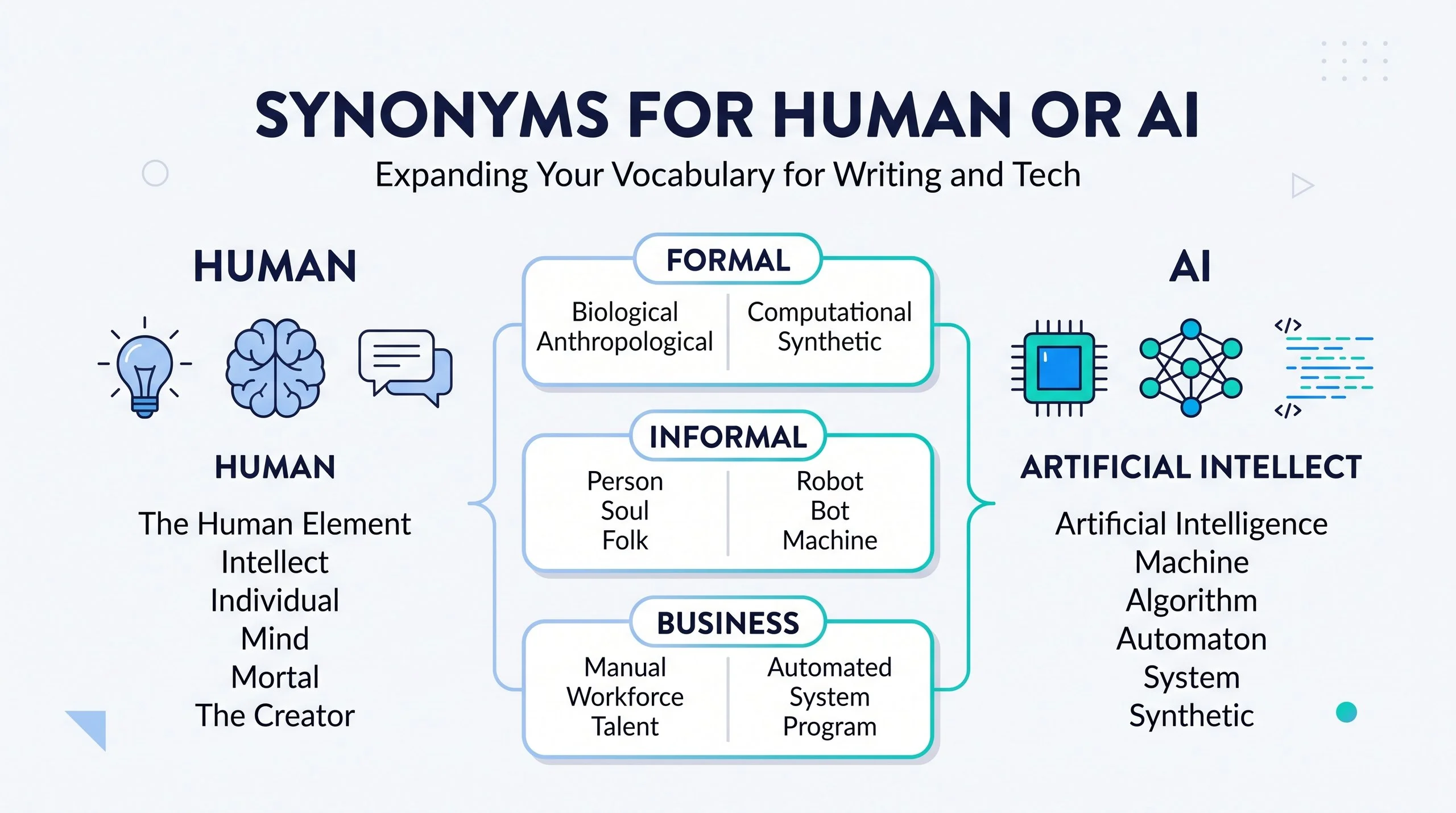
Understanding the difference between human or AI systems is crucial as artificial intelligence becomes deeply integrated into everyday life, workplace tools, and creative industries. While both humans and AI can solve complex problems, process information, and generate creative outputs, they operate on completely different fundamental principles. One relies on biological cognition and lived experience, while the other relies on statistical calculations and computational data processing.
What Is the Difference Between Human and AI?
The core difference between human or AI systems comes down to origin, consciousness, and processing style. Humans possess biological consciousness, emotional intuition, adaptability, and self-awareness based on real-world experiences. AI systems are mathematical software models that process massive datasets using algorithms to recognize patterns, generate text, or perform automated tasks without true understanding or feelings.
Understanding Human Intelligence vs. Artificial Intelligence
To compare the two accurately, it helps to define what drives each system at a foundational level.
What Is Human Intelligence?
Human intelligence refers to the mental capacity to learn from experience, adapt to novel situations, understand complex abstract concepts, apply reason, and use knowledge to manipulate one’s environment. It combines cognitive functions with emotional depth, moral reasoning, sensory perception, and self-directed motivation.
What Is Artificial Intelligence?
Artificial intelligence (AI) refers to computer systems designed to perform tasks that traditionally required human cognitive ability—such as speech recognition, decision-making, visual perception, and language translation. Modern AI models, including Large Language Models (LLMs) and neural networks, process vast amounts of training data to identify statistical patterns and generate probabilistic outputs.
Core Differences Compared
| Characteristic | Human Intelligence | Artificial Intelligence |
| Origin | Organic biological brain (neurons and synapses) | Digital software algorithms running on computer hardware |
| Learning Style | Experiential, intuitive, contextual, low-data requirement | Data-driven, statistical, pattern-matching, high-data requirement |
| Consciousness & Emotion | Genuine self-awareness, feelings, and empathy | Simulated responses without inner experience or feeling |
| Adaptability | High ability to handle unexpected, totally new scenarios | Restricted to training data scope and programmed parameters |
| Energy Efficiency | Operates on ~20 watts of power (human metabolism) | Requires massive electrical power and server infrastructure |
| Processing Speed | Slower at raw mathematical calculations | Microsecond speed for large-scale data calculations |
Key Areas of Difference Explained
1. Consciousness and Self-Awareness
Humans possess subjective experiences (qualia), self-awareness, and personal identity. When a person feels happy, sad, or tired, it reflects real physiological and psychological states.
In contrast, AI models have no consciousness, feelings, or personal awareness. An AI generating a sympathetic message is not feeling sympathy; it is selecting words that statistically fit the context based on its training data.
2. Learning and Data Requirements
Humans can learn complex concepts from very few examples. A child often needs to see a cat only a few times to recognize cats for the rest of their life, even in cartoon forms or unfamiliar environments.
AI systems require thousands or millions of labeled images or text examples to achieve high accuracy. While an AI can process millions of documents in seconds—something impossible for a human—it lacks the human ability to intuitively understand new concepts instantly with minimal data.
3. Adaptability and Common Sense
Human intelligence excels at general adaptability. A human faced with an entirely unfamiliar problem uses background knowledge, common sense, lateral thinking, and trial-and-error to find a workable solution.
AI excels at specialized tasks (narrow AI). However, when presented with a scenario completely outside its training parameters, AI can experience “hallucinations” or break down entirely because it lacks true common-sense understanding of how the physical world works.
4. Creativity and Originality
Human creativity stems from emotions, personal life history, cultural context, and spontaneous inspiration. Humans invent entirely new artistic movements, musical styles, and scientific theories out of novel ideas and lived struggles.
AI creativity is generative and recombinative. It creates new images, code, or text by analyzing millions of existing human-created works and predicting what elements belong together based on prompts.
How Humans and AI Complement Each Other
Rather than viewing the relationship strictly as a competition, modern industries increasingly rely on a hybrid approach where human intuition guides AI processing power:
- In Healthcare: AI algorithms scan medical imaging in seconds to flag potential abnormalities, while human physicians evaluate the patient’s full medical history, emotional state, and personal preferences to determine the treatment plan.
- In Software Engineering: AI tools write boilerplate code quickly, allowing human developers to focus on high-level system architecture, security strategies, and user experience design.
- In Writing and Content Creation: AI assists with rapid data synthesis, outlining, and structural drafting, while human editors refine tone, verify facts, inject personal experience, and ensure emotional resonance.
FAQs
Can AI replace human intelligence entirely?
No. While AI can automate many repetitive, data-heavy, and pattern-based tasks, it cannot replace human emotional intelligence, genuine creativity, moral reasoning, physical dexterity in unstructured environments, or self-directed judgment.
Does AI actually “think” like a human?
No. AI does not think in the biological sense. It processes inputs through mathematical operations, statistical probability, and neural layer transformations to produce relevant outputs based on past data patterns.
What can humans do that AI cannot?
Humans can feel genuine emotions, build meaningful interpersonal relationships based on empathy, apply physical common sense, make moral decisions with true responsibility, and adapt instantly to completely novel situations without prior training data.
What can AI do better than humans?
AI can process massive datasets in seconds, execute complex mathematical calculations at incredible speeds, operate 24/7 without fatigue, and spot subtle statistical patterns across millions of records that humans would miss.
Conclusion
The fundamental difference between human or AI systems lies in the distinction between living consciousness and programmatic calculation. Humans bring emotional awareness, moral responsibility, adaptability, and deep context to problem-solving. AI brings unmatched speed, data handling, and pattern processing. Understanding these differences allows us to use AI tools effectively while continuing to value the unique qualities that make human thought irreplaceable.