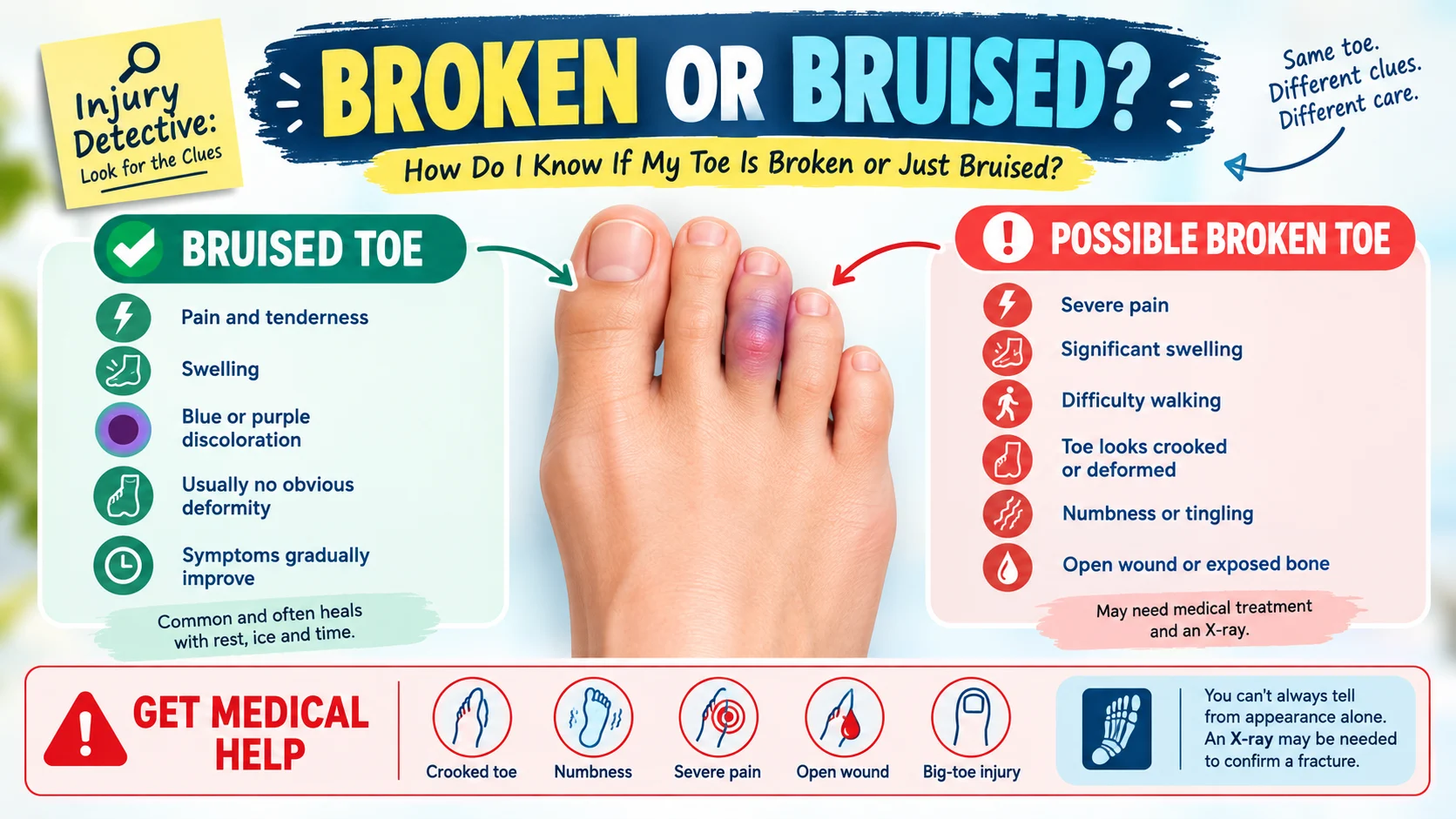
How do I know if my toe is broken or just bruised? A broken or bruised toe can cause similar symptoms, including pain, swelling, tenderness, bruising, and difficulty walking. However, a toe that looks crooked or deformed, causes severe pain, becomes numb or discolored, or has an open wound may indicate a more serious injury and needs medical assessment. An X-ray may be needed to confirm a fracture.
How do I know if my toe is broken or just bruised? After stubbing your toe against furniture, dropping something on it, or twisting it during sports, it can be difficult to tell the difference. Both injuries can cause pain, swelling, tenderness, and discoloration. Therefore, appearance alone does not always tell you whether a bone is actually fractured.
A bruised toe usually involves damage to soft tissues and tiny blood vessels. On the other hand, a broken toe means that one of the toe bones has fractured. Interestingly, the two injuries can look very similar, and even a broken toe may not appear obviously deformed.
Fortunately, most uncomplicated injuries improve with simple care. However, certain warning signs require medical attention. For example, severe pain, numbness, an unusual angle, an open wound, or a badly injured big toe deserves professional evaluation.
This guide explains the main differences between a bruised and broken toe, what symptoms to watch for, when an X-ray may be necessary, what you can do at home, and when you should seek urgent care.
How Do I Know If My Toe Is Broken or Just Bruised?
The short answer is that you cannot always tell at home with certainty.
A bruised toe and a fractured toe can both become painful, swollen, and blue or purple. Likewise, difficulty walking can happen with either injury. Because the symptoms overlap, a medical examination may be necessary when the diagnosis is uncertain.
A fracture is more concerning when the toe:
- Looks crooked or points at an unusual angle
- Has severe or worsening pain
- Becomes numb or tingly
- Looks unusually pale, blue, or gray
- Has an open wound
- Has exposed bone
- Makes walking extremely difficult
- Involves the big toe after significant trauma
A normal-looking toe, however, does not guarantee that the bone is intact. Some fractures do not cause obvious deformity.
In fact, uncomplicated fractures of smaller toes are often treated similarly to bruises when the toe remains properly aligned.
Broken Toe vs. Bruised Toe: Quick Comparison
| Sign | Bruised Toe | Broken Toe |
|---|---|---|
| Pain | Usually present | Usually present and may be intense |
| Swelling | Common | Common |
| Bruising | Common | Common |
| Tenderness | Common | Common |
| Difficulty walking | Possible | Common |
| Toe looks crooked | Unusual | Possible |
| Numbness or tingling | Less typical | Concerning sign |
| Open wound | Usually absent | May occur with severe fracture |
| Blood under toenail | Possible | Possible |
| X-ray | Usually unnecessary | May be needed |
| Recovery | Usually improves gradually | Often takes around 4–6 weeks for uncomplicated fractures |
Symptoms overlap considerably, so this table should not be used as a substitute for medical assessment.
What Does a Bruised Toe Feel Like?
A bruised toe can be surprisingly painful.
When your toe receives a direct impact, small blood vessels and soft tissues underneath the skin can become damaged. As a result, blood may collect beneath the skin and produce a blue, purple, red, or dark appearance.
Common symptoms include:
- Tenderness
- Swelling
- Mild to moderate pain
- Bruising or discoloration
- Pain when wearing shoes
- Pain when pressing the injured area
- Temporary difficulty walking
The pain may be strongest shortly after the injury. However, it should generally begin to settle as the tissue recovers.
A bruise can also appear under the toenail. In some cases, the nail may become dark because blood has collected underneath it.
Therefore, a dark toenail does not automatically mean that the toe is broken.
What Does a Broken Toe Feel Like?
A broken toe can produce many of the same symptoms as a bruise.
Typical signs include:
- Pain
- Swelling
- Tenderness
- Bruising
- Difficulty walking
- Pain when putting pressure on the foot
- Discoloration beneath the toenail
- Reduced movement because of pain
Some fractures are especially painful when you try to walk or move the affected toe.
Additionally, the toe may appear shorter, crooked, or positioned differently from the opposite foot if the fracture has displaced the bone.
However, not every fracture produces visible deformity. Consequently, you should not assume that a straight-looking toe is definitely unbroken.
Signs That May Suggest Your Toe Is Broken
Certain symptoms make a fracture more likely or indicate that the injury needs professional assessment.
1. Severe Pain
Intense pain immediately after an injury can occur with a fracture. Nevertheless, pain level alone cannot prove that the bone is broken.
A badly bruised toe can also hurt considerably.
If your pain is severe or is getting worse rather than improving, seek medical advice.
2. Significant Swelling
Swelling is common after both bruises and fractures.
However, substantial swelling combined with severe tenderness or difficulty walking deserves attention, particularly if the symptoms are not improving.
3. The Toe Looks Crooked
A toe that points in an unusual direction may indicate that the bone has shifted.
This is one of the more important warning signs.
Do not attempt to force a visibly crooked toe back into position yourself. Instead, get medical attention.
4. You Cannot Walk Normally
If putting weight on the foot is extremely painful or you cannot walk, the injury may be more significant.
Still, difficulty walking does not automatically mean that the toe is fractured. Severe bruising can temporarily make walking painful as well.
5. Numbness or Tingling
Numbness, tingling, or loss of sensation is a warning sign.
Therefore, do not simply wait for these symptoms to disappear after a significant injury. Seek prompt medical assessment.
6. An Open Wound
An open cut near an injured toe can increase concern for a more serious injury.
If you can see bone through the wound, seek emergency medical care.
7. A Badly Injured Big Toe
The big toe plays an important role in balance and walking.
Consequently, injuries involving the big toe may require different evaluation and treatment than uncomplicated injuries to smaller toes.
Can You Break a Toe Without Bruising?
Yes.
Although bruising is common with toe fractures, it does not have to appear.
A fracture can occur without obvious skin discoloration, particularly during the early stages after an injury.
Likewise, a person may have significant bruising without having a fracture.
For that reason, bruising should be treated as one symptom rather than proof of either diagnosis.
Can You Walk on a Broken Toe?
Sometimes, yes.
Being able to walk does not necessarily mean that your toe is not broken. Some uncomplicated toe fractures still allow a person to walk, although doing so may be painful.
At the same time, forcing yourself to walk normally when it hurts can increase discomfort.
Instead, reduce walking and standing during the first few days, wear comfortable supportive footwear, and allow pain to guide your activity.
If you cannot walk at all, or walking causes severe pain, seek medical advice.
Can You Move a Broken Toe?
You may still be able to move a fractured toe.
Therefore, movement alone cannot rule out a fracture.
Pain may limit movement, but some small fractures do not completely prevent movement.
Similarly, a badly bruised toe may become difficult to move because of swelling and pain.
If movement is severely restricted, painful, or accompanied by deformity, professional assessment is appropriate.
How Is a Broken Toe Diagnosed?
A healthcare professional can examine the toe for:
- Tenderness
- Swelling
- Alignment
- Movement
- Circulation
- Sensation
- Signs of a more serious injury
An X-ray can identify many fractures.
However, not every uncomplicated toe injury needs an X-ray. For example, some healthcare services may avoid imaging when a smaller toe is properly aligned and there are no signs of complications because treatment may be similar whether the toe is bruised or fractured.
The decision depends on the injured toe, the mechanism of injury, symptoms, alignment, and clinical findings.
What Should I Do Immediately After Injuring My Toe?
During the first few days, focus on protecting the injury and controlling pain and swelling.
Rest
Reduce activities that increase pain.
In particular, avoid unnecessary walking, running, jumping, and sports immediately after the injury.
Ice
Use a cold pack or ice pack wrapped in a towel for about 15–20 minutes at a time.
You can repeat this every few hours during the first couple of days.
Never place ice directly against your skin because it can cause skin injury.
Elevate Your Foot
When possible, raise your foot on cushions or another support.
Elevation can help reduce swelling, especially during the first few days.
Wear Supportive Shoes
Choose wide, comfortable shoes with a firm or stiff sole.
Avoid tight, narrow, or pointed footwear because it can put additional pressure on the injured toe.
Should You Buddy-Tape a Broken Toe?
For some uncomplicated fractures of smaller toes, healthcare professionals may recommend buddy taping.
This means gently securing the injured toe to the neighboring toe, usually with padding between them.
However, do not automatically buddy-tape every injured toe.
You should not do this if the toe is visibly deformed or if the injury involves the big toe without professional advice. NHS guidance specifically advises against strapping a toe that points at an unusual angle or a big toe injury without medical advice.
If taping causes numbness, increasing pain, color changes, or discomfort, remove it and seek medical advice.
What Pain Relief Can You Use?
Common over-the-counter pain relievers may help with pain.
Options can include:
- Acetaminophen/paracetamol
- Ibuprofen, when appropriate
However, the safest option depends on your age, medical history, allergies, other medications, kidney or stomach problems, and other factors.
Therefore, follow the product instructions and ask a pharmacist or healthcare professional if you are unsure which medicine is appropriate for you. NHS guidance lists paracetamol and ibuprofen among options for uncomplicated broken-toe pain.
When Should I Go to Urgent Care?
Seek urgent medical attention if your injured toe:
- Is pointing at an odd angle
- Looks severely deformed
- Has an open wound
- Has exposed bone
- Becomes numb or tingly
- Becomes unusually pale, blue, or cold
- Causes severe pain
- Is associated with significant difficulty walking
- Was badly injured, especially if it is the big toe
These signs can indicate a more serious fracture, circulation problem, nerve problem, or other injury.
If there is heavy bleeding, exposed bone, major deformity, or another serious emergency, seek emergency medical care immediately.
When Should You See a Doctor Even If It Is Not an Emergency?
You do not necessarily need emergency care for every painful toe.
Nevertheless, arrange medical evaluation if symptoms are not improving as expected.
For example, NHS guidance recommends seeking medical advice if pain and swelling have not started to improve about five days after the injury, if walking remains painful around six weeks later, or if you have diabetes and injure your toe.
You should also seek advice if:
- Pain continues to worsen
- Swelling keeps increasing
- You cannot return to normal activities
- The toe remains very tender
- You develop numbness
- The toe changes color unexpectedly
- You are unsure whether the injury is serious
How Long Does a Broken Toe Take to Heal?
Many uncomplicated broken toes heal in approximately 4 to 6 weeks.
However, recovery varies depending on the location and severity of the fracture.
Pain and swelling can sometimes continue after the bone has healed. Some people experience mild symptoms for several additional weeks or months.
Therefore, do not judge healing solely by whether the toe still looks slightly swollen.
Instead, consider whether pain and function are steadily improving.
How Long Does a Bruised Toe Take to Heal?
A simple bruise often improves gradually as the damaged soft tissue recovers.
The exact timeframe depends on the severity of the impact.
Generally, pain and swelling should trend downward rather than continuously worsen.
If the toe is not improving, or if new symptoms appear, consider getting it assessed rather than assuming it is only a bruise.
Broken Toe or Bruised Toe: What Should You Do?
| Situation | What to Do |
|---|---|
| Mild pain and bruising | Rest, ice, elevate, and monitor |
| Mild swelling | Reduce activity and use supportive footwear |
| Severe pain | Seek medical assessment |
| Toe is crooked | Seek urgent medical care |
| Numb or tingling toe | Seek urgent medical assessment |
| Open wound | Get prompt medical attention |
| Big toe injury | Consider professional assessment |
| Symptoms not improving | Contact a healthcare professional |
| Unsure whether it is broken | Get medical advice rather than guessing |
Common Mistakes After a Toe Injury
Trying to Straighten the Toe
Do not force a crooked toe back into place.
This can potentially worsen the injury.
Putting Ice Directly on the Skin
Always wrap an ice pack in a towel or cloth.
Direct ice exposure can damage the skin.
Wearing Tight Shoes
Narrow shoes can increase pressure on a swollen toe.
Instead, choose footwear that gives the toes plenty of room.
Returning to Sports Too Quickly
Pain may improve before the toe is ready for high-impact activity.
Therefore, return to running, jumping, and contact sports gradually and follow medical advice when a fracture has been diagnosed. NHS guidance advises avoiding sports such as football, rugby, or hockey for about six weeks or until pain has settled after a broken toe.
Assuming You Cannot Have a Fracture Because You Can Walk
Walking ability does not completely rule out a fracture.
Some toe fractures are compatible with walking.
How to Tell if the Toenail Is Injured
A hard impact can cause blood to collect beneath the toenail.
This may make the nail appear:
- Dark red
- Purple
- Blue
- Brown
- Black
A damaged nail can occur with both bruising and fractures.
Consequently, nail discoloration alone cannot tell you whether the underlying bone is broken.
If the nail is severely damaged, loose, or associated with significant pain or an open wound, have the injury evaluated.
Does Bruising Mean the Bone Is Broken?
No.
Bruising means that small blood vessels have been damaged and blood has collected under or within the skin.
A fracture can cause bruising, but bruising can also happen without a fracture.
Therefore, bruising is not a reliable test for a broken toe.
The same principle applies to swelling.
Does Severe Swelling Mean a Broken Toe?
Not necessarily.
Swelling occurs as part of the body’s response to injury.
A significant bruise can produce considerable swelling, while a fracture can sometimes cause only moderate swelling.
As a result, swelling should be considered alongside pain, alignment, movement, sensation, and the way the injury occurred.
What If I Stubbed My Toe Very Hard?
A hard impact can cause anything from a simple bruise to a fracture or dislocation.
If you stubbed your toe and it immediately became painful and swollen, start by protecting it from further impact.
Then use ice wrapped in a towel for short periods and elevate your foot.
If the toe looks crooked, becomes numb, or causes severe pain, seek medical assessment rather than trying to manage it yourself.
What If Something Heavy Fell on My Toe?
Dropping a heavy object on the toe is a common way to sustain a fracture.
The injury can cause swelling, bruising, tenderness, difficulty walking, and sometimes bleeding or discoloration under the toenail.
If the impact was substantial, particularly if it involved the big toe, consider professional evaluation.
Meanwhile, protect the toe, reduce activity, elevate the foot, and use wrapped ice to help with swelling.
What If My Toe Is Blue or Purple?
A blue or purple toe after an impact may simply reflect bruising.
However, not every color change should be dismissed as a bruise.
If the toe is unusually blue, gray, pale, cold, numb, or tingling, seek prompt medical attention because these signs can indicate a circulation or nerve problem.
What If My Toe Is Still Swollen After a Few Weeks?
Some swelling can persist after a toe injury, including after a fracture.
In some cases, mild pain and swelling may last for several months even after the main injury has healed.
However, persistent or worsening symptoms deserve medical review.
In particular, contact a healthcare professional if the swelling is not gradually improving, the pain is increasing, or you still cannot walk normally.
Can a Broken Toe Heal on Its Own?
Many uncomplicated toe fractures heal without surgery.
For example, smaller toe fractures that remain properly aligned can often be managed with protection, supportive footwear, pain control, and sometimes buddy taping.
More complicated fractures may require additional treatment.
Therefore, the phrase “it will heal on its own” should not be interpreted as “every broken toe can safely be ignored.”
Alignment, location, severity, and associated injuries matter.
Advantages and Disadvantages of Getting a Medical Assessment
Advantages
- Confirms whether a significant fracture is present
- Checks toe alignment
- Identifies possible complications
- Helps determine appropriate treatment
- Provides guidance for returning to activity
Possible Downsides
- An uncomplicated injury may not require an X-ray
- Medical visits can take time and cost money
- Some straightforward toe injuries receive the same basic treatment whether bruised or fractured
Healthcare professionals therefore consider the clinical situation before deciding whether imaging is necessary.
Myths About Broken and Bruised Toes
Myth 1: “If I Can Walk, It Isn’t Broken.”
False.
Some people can walk with a toe fracture.
Myth 2: “A Black Toenail Means the Toe Is Broken.”
False.
Blood beneath the nail can occur after a direct impact even without a fracture.
Myth 3: “A Broken Toe Always Looks Crooked.”
False.
Some fractures remain aligned and may look relatively normal.
Myth 4: “Every Broken Toe Needs Surgery.”
False.
Many uncomplicated toe fractures heal without surgery.
Myth 5: “I Should Straighten a Crooked Toe Myself.”
False.
A visibly deformed toe should be assessed by a healthcare professional.
When Can You Return to Normal Activities?
Your return should depend on symptoms and the type of injury.
Walking may gradually become easier as pain decreases. However, running, jumping, and contact sports place greater stress on the toe.
Consequently, return to demanding activities gradually.
A useful general principle is that you should not push through significant pain. Some clinical guidance recommends returning to normal activity when you can walk normally without pain or limping.
If you have a confirmed fracture, follow the specific instructions provided by your healthcare professional.
Exercises and Answers
Question 1
Can you have a broken toe without bruising?
Answer: Yes. Bruising is common but does not have to occur with every fracture.
Question 2
Does being able to walk rule out a broken toe?
Answer: No. Some uncomplicated toe fractures still allow walking.
Question 3
What is more concerning: bruising or a crooked toe?
Answer: A crooked or deformed toe is more concerning because it may indicate displaced bone or another significant injury.
Question 4
Should you put ice directly on a broken or bruised toe?
Answer: No. Wrap the cold pack in a towel or cloth first.
Question 5
How long can a broken toe take to heal?
Answer: Many uncomplicated broken toes heal in around four to six weeks, although symptoms can last longer.
Related Comparisons
Broken Toe vs. Sprained Toe
A broken toe involves a fracture of bone.
A sprained toe involves injury to ligaments.
Unfortunately, both can cause pain, swelling, and difficulty walking. Therefore, symptoms alone may not always identify the exact injury.
Broken Toe vs. Dislocated Toe
A fracture involves broken bone.
A dislocation occurs when a joint moves out of its normal position.
A visibly misshapen toe can occur with either injury, so professional assessment is important.
Bruised Toe vs. Sprained Toe
A bruise mainly involves soft-tissue and blood-vessel damage.
A sprain involves stretched or torn ligaments.
Both can cause tenderness and swelling, so the mechanism of injury and physical examination can help distinguish them.
FAQs
1. How can I tell if my toe is broken without an X-ray?
You cannot reliably confirm a fracture at home. Severe pain, deformity, significant swelling, difficulty walking, numbness, or an unusual toe position can increase concern, but only a healthcare assessment and, when appropriate, imaging can confirm the injury.
2. Can a bruised toe hurt more than a broken toe?
Yes. Pain intensity does not reliably distinguish a bruise from a fracture.
3. Can you walk with a broken toe?
Yes. Some people can walk with an uncomplicated fracture, although it may be painful.
4. Should I tape my injured toe?
Buddy taping may be recommended for some uncomplicated smaller-toe injuries. However, it should not be used to force a deformed toe into position, and big-toe injuries require different consideration.
5. How long does a broken toe take to heal?
Many uncomplicated broken toes heal within about four to six weeks. However, swelling, stiffness, or occasional discomfort can persist longer.
6. When should I worry about a bruised toe?
Seek medical advice if pain is severe, symptoms are worsening, the toe becomes numb or unusually discolored, it looks deformed, or the injury involves an open wound.
7. Is a black toenail a sign of a broken toe?
Not necessarily. Trauma can cause bleeding beneath the toenail with or without a fracture.
8. Should I go to the emergency room for a broken toe?
Not every broken toe requires emergency care. However, an exposed bone, major deformity, numbness, severe pain, or a badly injured big toe requires urgent medical assessment.
9. What should I wear with an injured toe?
Wide, comfortable footwear with a supportive or stiff sole can reduce pressure and protect the toe. Avoid tight or pointed shoes.
10. What if my toe still hurts weeks later?
Some discomfort can continue during recovery. Nevertheless, persistent or worsening pain should be evaluated, particularly if it interferes with normal walking or activities.
Key Takeaway & Summary
A broken toe and a bruised toe can look remarkably similar. Both injuries may cause pain, swelling, tenderness, bruising, and difficulty walking.
The most concerning signs include a toe that is crooked or deformed, severe pain, numbness or tingling, unusual color or coldness, an open wound, or exposed bone.
If the injury is mild and the toe remains properly aligned, rest, elevation, wrapped ice, and comfortable supportive footwear can often help while symptoms settle. However, do not try to straighten a deformed toe yourself.
Most uncomplicated broken toes heal in approximately four to six weeks, although recovery varies and some symptoms can last longer.
Most importantly, you do not have to diagnose the injury yourself. When you are uncertain, especially after a significant injury, a healthcare professional can determine whether further assessment or an X-ray is appropriate.
Conclusion
Knowing how to tell if your toe is broken or just bruised can help you make a safer decision after an injury. Unfortunately, there is no reliable home test that can always distinguish the two because bruises and fractures can produce many of the same symptoms.
A mildly painful, swollen, bruised toe that remains properly aligned may improve with rest, ice, elevation, and supportive footwear. However, a crooked toe, severe pain, numbness, unusual discoloration, open wound, or exposed bone should not be ignored.
Ultimately, the safest approach is to focus on the warning signs rather than trying to diagnose the injury based on bruising alone. If your symptoms are severe, worsening, or not improving as expected, seek professional medical advice. That way, a potentially significant fracture or other injury can receive the appropriate care.