Finding the right synonyms for include can instantly elevate your writing, making descriptions of lists, collections, and structural components far more vivid. Writers often rely on this common verb out of habit, but varying your vocabulary keeps readers engaged. Exploring precise alternatives allows you to tailor your tone precisely to your narrative, whether you are drafting a legal contract, a research paper, or a casual email. This guide breaks down top alternatives, clarifies their core meanings, and highlights how to use them effectively.
Best Synonyms for Include
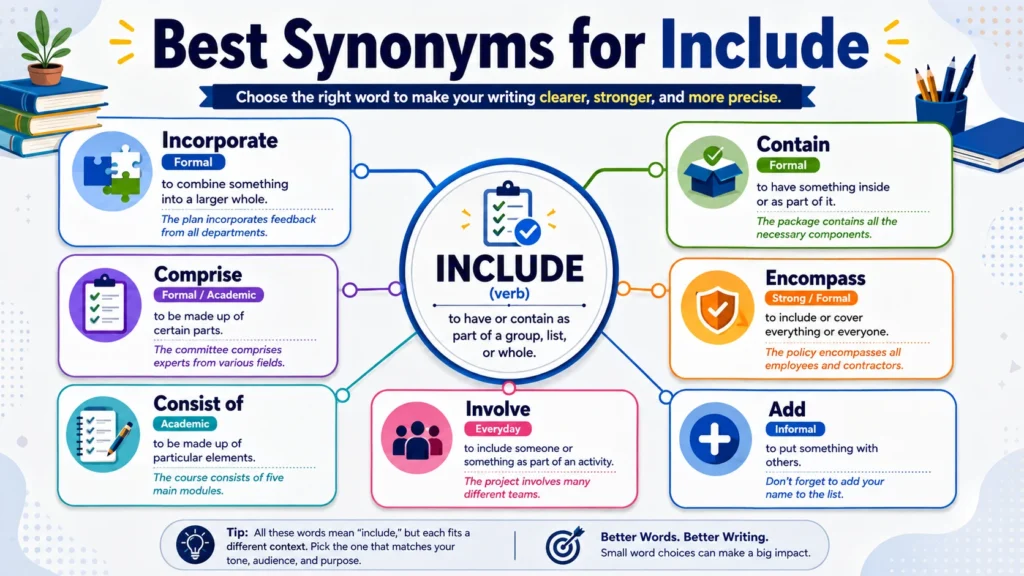
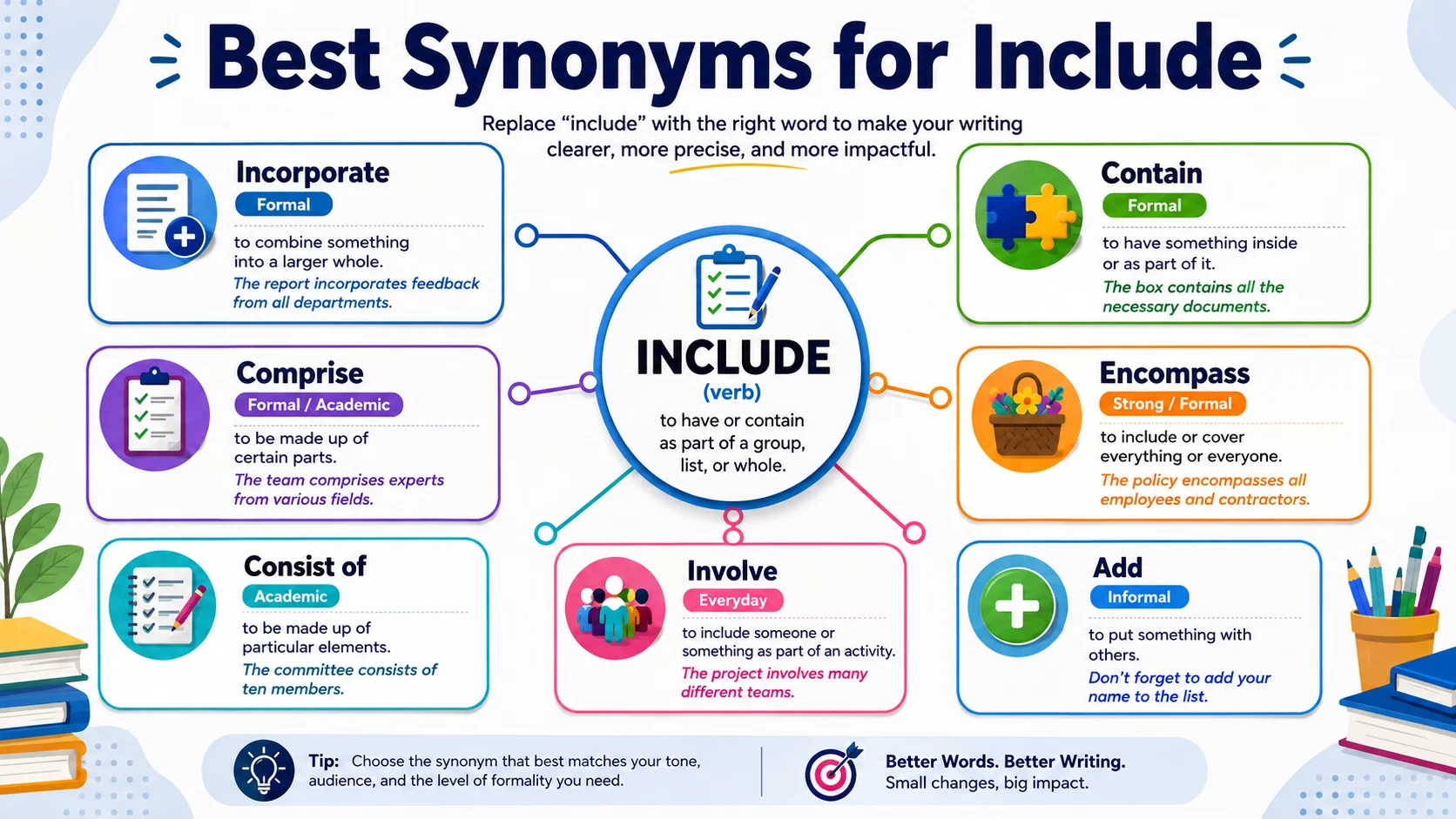
Writers seeking fast alternatives can rely on terms like incorporate, comprise, contain, encompass, and involve. Each option brings a distinct shade of meaning, helping you adjust the tone or context of your sentence.
What Does Include Mean?
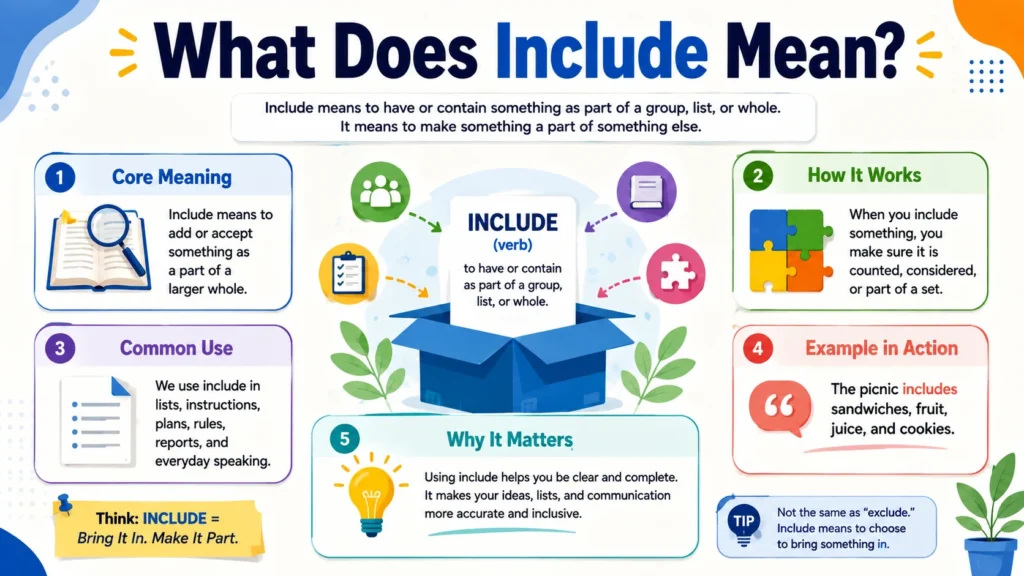
The verb include describes the act of making someone or something part of a larger group, whole, or set. It signifies containment, integration, or the presence of elements within a specific framework.
Core Meaning and Grammar of Include
Grammatically, include functions as a transitive verb taking a direct object. Because it applies to everything from adding items to a grocery list to listing clauses in a treaty, choosing a more specific synonym sharpens your meaning and removes ambiguity.
Best Synonyms for Include in Context
Context dictates which alternative works best. A legal document requires a different descriptor than an artistic collection or a casual social invitation. Grouping these choices by application ensures your writing hits the right register.
Common Synonyms for Include
Everyday conversations and general writing benefit from accessible yet expressive terms. These options fit seamlessly into casual storytelling and everyday communication.
- Contain: Have something inside or hold as part of a whole.
- Comprise: Consist of or be made up of.
- Involve: Have or include as a necessary part or consequence.
- Cover: Deal with or treat a subject or range of items.
- Embrace: Include or contain something as part of a broad scope.
Formal Synonyms for Academic and Professional Writing
Professional settings, legal contracts, and academic essays demand a polished vocabulary. These formal alternatives maintain a refined tone while describing structural composition or official incorporation.
- Incorporate: Take in or contain something as part of a whole; combine.
- Encompass: Surround and hold within or include comprehensively.
- Constitutes: Be a part of a whole or make up an element.
- Subsume: Include or absorb something in something else.
- Articulate: Express clearly, though often used to state required inclusions.
Informal Synonyms for Casual Conversations
Casual dialogue thrives on color and energy. When chatting with friends or writing relaxed blog content, these informal terms capture attention naturally.
- Pack in: Fit a large number of items into a space.
- Throw in: Add something extra as a bonus or inclusion.
- Toss in: Include something casually into a mix or list.
- Build in: Make a feature an integral part of something.
- Tack on: Attach or add something supplementary at the end.
Strong Synonyms for Maximum Impact
Sometimes standard verbs fall short. High-intensity situations require words that convey absolute totality, comprehensive scope, or deep integration.
- Encompass: Cover an exhaustive range of elements completely.
- Embrace: Hold within a vast and welcoming scope.
- Comprise: Form the entirety or fundamental makeup of a structure.
- Incorporate: Seamlessly blend multiple elements into a unified whole.
- Integrate: Combine one thing with another so that they become whole.
Mild Synonyms for Subtle Emphasis
Not every situation calls for comprehensive integration or formal incorporation. Mild alternatives offer gentle descriptions of loose association or minor additions.
- Mention: Refer to a subject briefly without deep inclusion.
- Note: Draw attention to a specific detail within a text.
- List: Record items sequentially in a simple catalog.
- Adjoin: Be next to or joined to something.
- Reference: Mention or allude to a source or element.
Popular Synonyms for Include by Usage Context
| Context | Best Synonym | Example Usage |
| Legal & Contracts | Incorporate | The agreement will incorporate all prior amendments. |
| Research & Studies | Comprise | The sample group will comprise diverse demographics. |
| Lists & Inventories | Contain | The archive contains hundreds of historical documents. |
| General Scope | Encompass | The syllabus will encompass modern history topics. |
Another Word for Include in Sentence Examples
Seeing words in action clarifies proper placement. Here are examples using different alternatives:
- Incorporate: The architect plans to incorporate sustainable materials into the design.
- Encompass: The national park boundaries encompass thousands of acres of forest.
- Comprise: Seven distinct chapters comprise the introductory textbook.
- Involve: The project will involve extensive community outreach efforts.
Comparing Key Synonyms for Include
Choosing between words like incorporate, comprise, and encompass depends on nuance. Incorporate implies blending parts into a whole, comprise indicates what a whole is made of, and encompass suggests surrounding or covering a wide domain.
Words Similar to Include
While these terms share a related semantic field, they do not mean exact replication. They describe related concepts involving association, addition, or clustering.
- Add: Join something to something else so as to increase size.
- Attach: Fasten or join one thing to another.
- Adjoin: Be next to or joined to.
- Associate: Connect someone or something with another in the mind.
Antonyms and Opposites of Include
Understanding the inverse clarifies the core definition. The direct opposites describe exclusion, omission, or separation.
- Exclude: Deny someone access to or bar someone from a place, group, or privilege.
- Omit: Leave out or exclude someone or something, either intentionally or forgetfully.
- Eliminate: Completely remove or get rid of something.
- Bar: Prohibit or prevent someone from doing something.
- Omit: Fail to include or mention.
How to Choose the Right Synonym for Include
Select your word by analyzing your audience, medium, and emotional goal. Legal papers require formal precision like incorporate, while general articles benefit from verbs like contain or cover. Always read your sentence aloud to check flow.
Common Mistakes When Using Synonyms for Include
Writers often misuse comprise by writing “is comprised of,” which is traditionally considered nonstandard (use “comprises” or “is composed of” instead). Another error involves confusing physical containment with conceptual inclusion.
Quick Reference Synonym List for Include
- Incorporate
- Comprise
- Contain
- Encompass
- Involve
- Cover
- Embrace
- Integrate
- Consist
- Subsume
FAQs
What is the best synonym for include?
Incorporate and contain rank among the most versatile and impactful alternatives depending on whether you mean adding elements or holding them.
What is another word for include?
Another strong alternative is encompass, which fits broad scopes and comprehensive collections.
What is a formal synonym for include?
Incorporate or comprise serve as excellent formal choices for professional, legal, or academic writing.
What is an informal synonym for include?
Throw in or tack on serve as easygoing alternatives for everyday speech.
What is a stronger word for include?
Encompass or integrate elevate the intensity to show total coverage or seamless blending.
What is a milder word for include?
Mention or note offer a softer touch of light reference.
What words are similar to include?
Add, attach, and associate share close semantic territory without being exact synonyms.
What is the opposite of include?
Exclude and omit represent the primary antonyms.
How do I choose the right synonym for include?
Match the degree of integration, formality, and context to your specific writing tone.
Conclusion
Mastering synonyms for include gives you creative control over your descriptions. Swapping out repetitive verbs keeps readers engaged and your prose sharp. Practice applying these alternatives in your daily writing to build a more dynamic vocabulary.