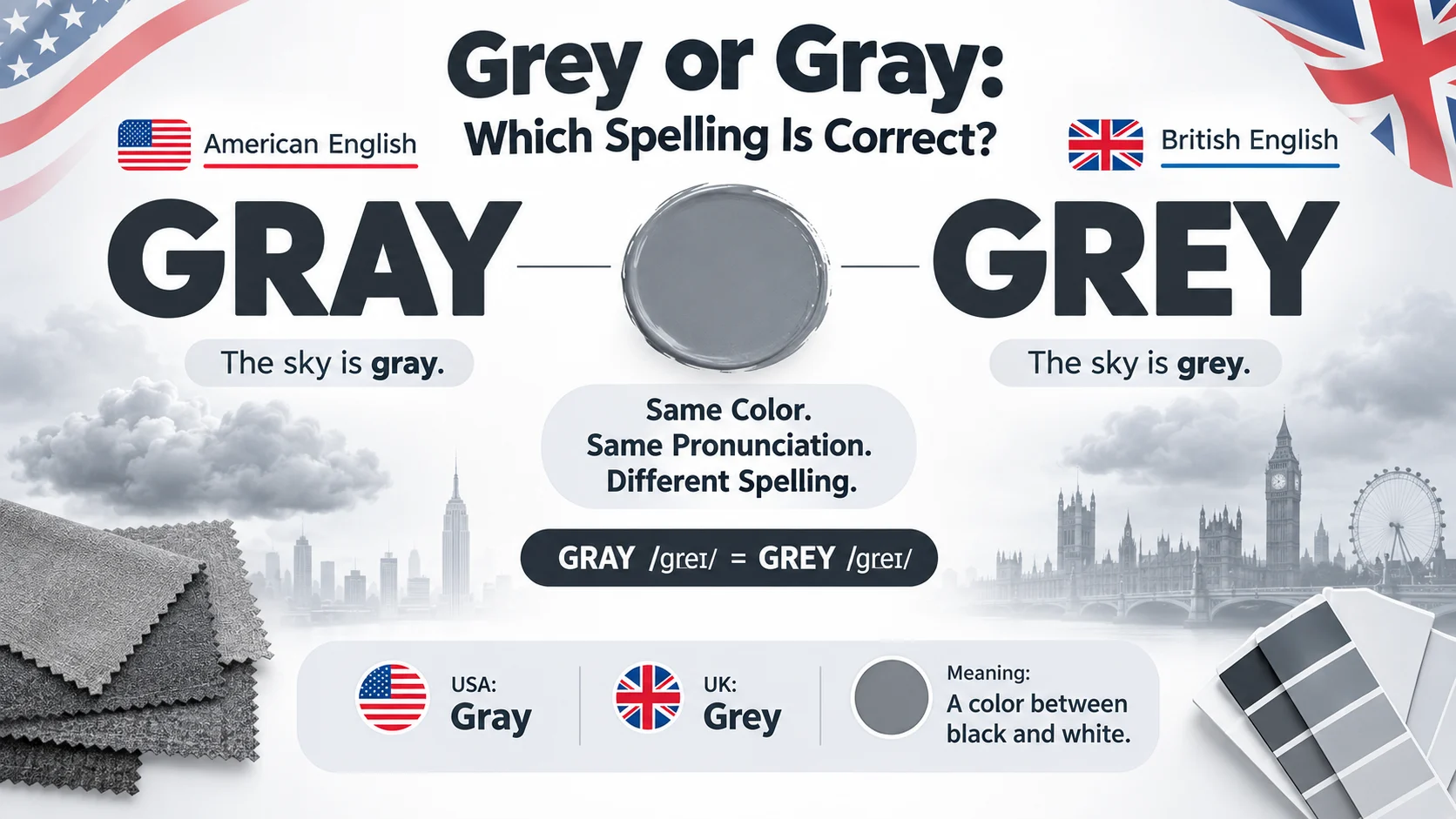
Grey or gray are two correct spellings of the same color. However, gray is the standard spelling in American English, while grey is more common in British English. Both words describe a color between black and white, and neither spelling is inherently incorrect. For American audiences, use gray; for British audiences, use grey.
Have you ever wondered whether to write grey or gray when describing a cloudy sky, a favorite sweater, or a shade of paint? Both spellings are correct, but the preferred version depends mainly on the variety of English you use. Although the difference is only one letter, choosing the appropriate spelling can make your writing more consistent and professional.
In American English, gray is the standard spelling used in schools, newspapers, books, and most professional writing. By contrast, British English generally favors grey, which is also common in several other English-speaking countries. Nevertheless, these preferences are not absolute rules for every writer or publication.
Furthermore, the difference extends beyond spelling consistency. Writers may encounter either version in brand names, proper nouns, literary works, and established expressions. For example, the American spelling appears in Gray’s Anatomy, while Grey’s Anatomy is the title of the well-known television drama. These names follow their own established spellings.
In this guide, you’ll discover the difference between grey and gray, learn which spelling American English requires, and explore examples from everyday writing. You’ll also find pronunciation guidance, regional comparisons, common mistakes, practice exercises, and practical tips for choosing the right version every time.
Grey vs. Gray
| Meaning | Context | Primary Platforms | Example | Tone |
|---|---|---|---|---|
| Gray | American English spelling | US schools, newspapers, websites | The sky looks gray. | Standard |
| Grey | British English spelling | UK publications, British schools | The sky looks grey. | Standard |
| Gray or grey | International communication | Global websites, books | She wore a gray coat. | Neutral |
| Gray/grey | Figurative expression | Everyday and professional writing | The situation isn’t black and white; it is a gray area. | Informal or analytical |
What Is the Difference Between Grey and Gray?
The primary difference between grey and gray is regional spelling preference, not meaning or pronunciation.
Both words function as adjectives and nouns. As adjectives, they describe a color between black and white. As nouns, they refer to the color itself.
For example:
- Gray: He bought a gray jacket.
- Grey: He bought a grey jacket.
Both sentences communicate exactly the same thing. However, the first follows standard American spelling, whereas the second follows the more common British spelling.
Additionally, either word can describe hair, clouds, animals, clothing, buildings, and other objects. Both spellings also appear in figurative expressions, such as gray area or grey area, which describe situations that are unclear or difficult to categorize.
The important distinction is therefore consistency. If you’re writing for an American audience, choose gray throughout your article. Similarly, when writing for a British audience, grey is generally the better option.
Is Gray or Grey Correct in American English?
Gray is the correct standard spelling in American English.
American dictionaries, educational materials, and professional style guides generally prefer gray. Consequently, students and writers in the United States should use this spelling unless they are reproducing an official name, title, quotation, or other established wording.
Consider these examples:
- The walls are painted light gray.
- My grandfather’s hair has turned gray.
- A gray cat was sitting beside the window.
- The weather remained gray all afternoon.
- The company uses gray in its logo.
In each sentence, gray follows the usual American spelling convention.
However, seeing grey in American writing does not automatically mean the writer has made a mistake. A person may be referring to a British publication, a character’s name, a company, or a specific title that uses that spelling.
For ordinary American prose, though, gray is the preferred choice. Using it consistently helps your writing match readers’ expectations.
Is Grey or Gray Correct in British English?
Grey is the more common standard spelling in British English.
British writers generally use grey in school assignments, books, newspapers, and everyday communication. The word has the same meaning and pronunciation as the American version.
Here are a few British English examples:
- She wore a grey scarf.
- The sky turned grey before the rain.
- His grey hair made him look distinguished.
- They painted the bedroom grey.
- A grey squirrel climbed the tree.
Although grey is the usual British choice, gray can still appear in British writing. For instance, an American product name or a quoted passage might retain its original spelling.
Therefore, the distinction is a convention rather than a difference in meaning. Both forms are accepted English spellings, but regional preference determines which one usually sounds appropriate in context.
Grey or Gray: American vs. British English
The following comparison makes the difference easy to remember.
| Feature | American English | British English |
|---|---|---|
| Preferred spelling | Gray | Grey |
| Meaning | Color between black and white | Color between black and white |
| Pronunciation | Same standard pronunciation | Same standard pronunciation |
| Hair color | Gray hair | Grey hair |
| Weather | Gray clouds | Grey clouds |
| Clothing | Gray trousers | Grey trousers |
| Figurative phrase | Gray area | Grey area |
| General writing preference | Gray | Grey |
As the table shows, the difference concerns spelling rather than grammar or definition.
Moreover, the distinction follows a familiar pattern in English. American and British English often preserve different spellings for words with identical meanings. Examples include color/colour, favorite/favourite, and center/centre.
Nevertheless, not every spelling difference follows a perfectly predictable rule. That’s why learning the conventional form of each word is useful.
Why Do Grey and Gray Have Different Spellings?
The two spellings developed through the history of the English language. Their variation is older than modern American and British spelling conventions.
Historically, English inherited and adapted spellings from earlier forms of the language, while dictionaries, publishers, and educational systems gradually helped establish regional preferences. Over time, gray became the dominant American form, whereas grey remained more common in Britain.
American spelling standardization is often associated with Noah Webster, the American lexicographer who promoted simplified and more consistent spelling conventions. However, the history of gray and grey is more complicated than a single reform or individual decision.
Both spellings existed before modern English spelling became standardized. Their continued use reflects the broader development of regional English varieties.
Today, neither form is universally superior. Instead, each belongs to a well-established spelling tradition.
How to Use Gray and Grey in a Sentence
Understanding the regional preference is only the first step. You should also know how these words function in different contexts.
1. Describing a Color
The most common use refers to a neutral color between black and white.
Examples:
- The living room has gray walls.
- She chose a grey dress for the event.
- The puppy has soft gray fur.
- He prefers grey furniture over bright colors.
In American writing, use gray in these examples. For British readers, grey is generally preferred.
2. Describing Hair
Both spellings describe hair that has lost some of its natural pigment, often because of aging or other biological factors.
Examples:
- My father has gray hair.
- Her grey hair looks beautiful.
- He started noticing gray strands in his twenties.
- The character was an elderly man with a long grey beard.
Although the spelling varies, the meaning remains unchanged.
3. Describing Weather
Writers often use the word to describe cloudy skies or dull weather.
Examples:
- A gray sky covered the city.
- The morning looked grey and gloomy.
- Dark gray clouds gathered over the hills.
- It was a cold, grey afternoon.
Additionally, this usage can create a particular mood in descriptive writing. Gray or grey skies may suggest sadness, uncertainty, calmness, or a lack of brightness.
4. Describing Animals
Many animals have gray or grey fur, feathers, or skin.
Examples:
- A gray wolf crossed the trail.
- The grey squirrel climbed the fence.
- We saw a gray rabbit near the garden.
- A grey whale surfaced beside the boat.
Again, choose the spelling that matches your audience or the style of the publication.
5. Describing Something Figuratively
The word also appears in expressions that do not refer to color.
For example, a gray area is a situation where the rules, facts, or distinctions are unclear.
- The policy leaves a gray area.
- There is a grey area between personal advice and professional guidance.
- The decision isn’t entirely black and white.
- The legal question falls into a gray area.
In American English, gray area is the usual form. In British English, grey area is more common.
Is It Gray Area or Grey Area?
Both gray area and grey area are correct.
The expression describes a situation that is ambiguous, uncertain, or not clearly defined. It often appears in discussions about rules, ethics, law, business decisions, and personal relationships.
For example:
- American English: The new policy creates a gray area.
- British English: The new policy creates a grey area.
Neither sentence is incorrect.
The phrase is especially useful when a situation cannot easily be classified as right or wrong, permitted or prohibited, or clearly belonging to one category.
For instance, a workplace rule might not explain whether employees can use company equipment for a minor personal task. That uncertainty could be described as a gray area in American English.
However, the phrase does not mean that every uncertain situation is necessarily illegal or unethical. It simply indicates that the boundaries are not clear.
Is It Gray Hair or Grey Hair?
Both forms are correct, and the choice depends on the variety of English.
In the United States, gray hair is the standard spelling. In Britain, grey hair is more common.
Examples:
- My grandmother has beautiful gray hair.
- My grandfather’s grey hair has become noticeably lighter.
- She noticed her first gray hairs last year.
- The actor wore a grey wig for the role.
Interestingly, people sometimes use going gray or going grey to describe the process of hair becoming gray with age.
Both expressions are natural in their respective spelling traditions.
Gray vs. Grey: Pronunciation
Despite their different spellings, gray and grey are generally pronounced the same way in standard American and British English.
Both typically rhyme with words such as day, say, and play. The difference appears in writing, not in the normal pronunciation of the color word.
For example:
- Gray rhymes with day.
- Grey rhymes with day.
- Gray and grey sound alike in ordinary speech.
Therefore, you don’t need to learn two different pronunciations. Instead, focus on choosing the spelling appropriate for your audience.
Regional accents can affect the precise sound of English vowels, but the spelling difference itself does not establish a separate pronunciation.
Common Expressions With Gray or Grey
The word appears in several familiar expressions. Learning these phrases will help you use it naturally.
1. Gray Area or Grey Area
A situation that is unclear or difficult to classify.
Example: The contract contains a gray area that needs clarification.
2. Gray Matter or Grey Matter
The term for a type of brain tissue. It is also used informally to refer to intelligence or mental ability.
Example: Solving puzzles gives your gray matter a workout.
The spelling of the anatomical term can vary by regional convention, although scientific publications may follow their own terminology and style requirements.
3. Gray Market or Grey Market
A market involving genuine goods sold through distribution channels not authorized by the manufacturer. The exact legal implications depend on the circumstances and jurisdiction.
Example: The company investigated products being sold through the gray market.
4. Gray Literature or Grey Literature
Research, reports, and other materials produced outside conventional commercial publishing channels, such as certain government reports or organizational documents.
Example: The researcher reviewed grey literature alongside academic studies.
5. Gray Out or Grey Out
A phrase that may describe something becoming visually dim or less distinct. In software interfaces, a control may be grayed out to show that it is unavailable.
Example: The application grays out the button when the required information is missing.
In American usage, grayed out is the usual spelling. British writers may prefer greyed out, depending on their style.
Gray vs. Grey: Common Mistakes to Avoid
Although the spelling difference is straightforward, a few mistakes can make writing inconsistent.
Mistake 1: Assuming Grey Is Always Incorrect
Some American writers believe that grey is a misspelling. In reality, it is a standard spelling in British English and other varieties that favor it.
Better approach: Use gray for ordinary American prose, but retain grey in names, titles, and quotations when appropriate.
Mistake 2: Assuming Gray Is Incorrect in British English
The reverse assumption is also misleading. Although grey is the preferred British form, gray is not universally invalid in British contexts.
Better approach: Follow the publication’s style guide and preserve established spellings when necessary.
Mistake 3: Switching Between Both Spellings
Using gray in one paragraph and grey in the next can make an article look poorly edited when there is no reason for the variation.
Better approach: Select one regional standard and use it consistently throughout the document.
Mistake 4: Changing a Proper Name
Names and titles do not always follow the regional spelling preference.
For example, the television series Grey’s Anatomy retains Grey in its official title, including when discussed by an American writer.
Better approach: Check the established spelling of proper nouns instead of automatically changing the letters.
Mistake 5: Believing the Words Have Different Meanings
There is no general difference in meaning between the color words gray and grey.
Better approach: Remember that the choice is primarily regional. Context may affect the meaning of a phrase, but the final letter does not normally change the color’s definition.
How to Remember the Difference
If you frequently confuse these spellings, a simple memory trick can help.
Gray = America. Grey = Britain.
The word America contains the letter a, and the standard American spelling is gray. Meanwhile, grey is the form commonly used in British English.
This is only a memory aid, not a historical explanation of why the spellings developed.
You can also remember the rule through these examples:
- Writing for a US school assignment? Use gray.
- Writing for a British publication? Use grey.
- Quoting an official title? Preserve the original spelling.
- Writing for an international audience? Choose a consistent style and follow your publication’s preference.
Ultimately, consistency matters more than treating one spelling as universally correct.
Grey or Gray in American Writing: Practical Tips
For writers who publish online, spelling consistency can improve readability and editorial quality.
First, identify your primary audience. If your website targets American readers, use gray in titles, headings, body text, image descriptions, and examples unless an exception applies.
Next, check your existing content. A spelling checker may flag words based on its language settings, so make sure your editor is configured for American or British English as appropriate.
Additionally, use a search function to locate both gray and grey in a long document. This makes it easier to find accidental inconsistencies.
For example, an American article might contain the following sentence:
The grey clouds made the gray building look darker.
Although readers can understand it, the sentence uses two regional forms without a clear reason. A consistent American version would be:
The gray clouds made the gray building look darker.
Finally, avoid changing spelling inside official titles, product names, quotations, or brand names merely to match the rest of your article. Accuracy takes priority over uniformity in these cases.
Grey or Gray: Which One Should You Use?
The simplest rule is to match your spelling to your audience.
Choose gray when writing for American readers, including most US school assignments, business documents, websites, and general articles.
Choose grey when writing for British readers or following a British English style guide.
For international publications, either form can work. However, the editorial team should choose one version and apply it consistently.
There are also situations in which neither regional preference should override an established name. If a product, character, book, film, or organization uses Grey or Gray as part of its official name, preserve that spelling.
Ultimately, the correct choice is not about one version being better than the other. Instead, it is about understanding the conventions of the English variety you are using.
Grey or Gray: Examples in American and British English
The following examples show how the same sentence changes according to regional spelling.
| American English | British English |
|---|---|
| The sky is gray today. | The sky is grey today. |
| He has gray hair. | He has grey hair. |
| She bought a gray sweater. | She bought a grey jumper. |
| A gray cat slept on the sofa. | A grey cat slept on the sofa. |
| The report identifies a gray area. | The report identifies a grey area. |
| The clouds turned dark gray. | The clouds turned dark grey. |
| The old building has gray walls. | The old building has grey walls. |
| The button is grayed out. | The button is greyed out. |
Notice that some examples contain additional vocabulary differences, such as sweater and jumper. Those differences are separate from the spelling of the color word.
Nevertheless, the examples demonstrate a useful principle: regional consistency helps your writing sound natural to its intended audience.
Related Comparisons: Other American and British Spellings
If you are learning the difference between American and British English, the following pairs are worth remembering.
| American English | British English |
|---|---|
| Color | Colour |
| Favorite | Favourite |
| Honor | Honour |
| Center | Centre |
| Theater | Theatre |
| Analyze | Analyse |
| Organize | Organise |
| Traveling | Travelling |
| Check | Cheque (for certain financial uses) |
| Gray | Grey |
These pairs do not all follow exactly the same rule. For instance, check and cheque can have different meanings depending on context, while gray and grey refer to the same color.
Similarly, some British publications accept forms ending in -ize, even though -ise is widely used. Therefore, consult the relevant style guide when a particular spelling matters.
Practice Exercises: Gray or Grey?
Test your understanding with these short exercises.
Exercise 1: Choose the American Spelling
Complete each sentence with gray or grey.
- The American flag does not contain the color _____.
- My grandfather has _____ hair.
- The weather looks _____ this morning.
- She bought a _____ coat for winter.
- The new policy creates a _____ area.
Exercise 2: Choose the British Spelling
Complete each sentence with the spelling generally preferred in British English.
- The sky became _____ before the storm.
- He has short _____ hair.
- She wore a _____ dress to dinner.
- A _____ squirrel ran up the tree.
- The rules leave a _____ area.
Exercise 3: Identify the Correct Rule
Choose the best answer for each question.
- Which spelling is standard in American English?
- A. Grey
- B. Gray
- Which spelling is more common in British English?
- A. Gray
- B. Grey
- Do gray and grey normally have different meanings?
- A. Yes
- B. No
- Should you automatically change Grey’s Anatomy to Gray’s Anatomy when writing for Americans?
- A. Yes
- B. No
- What should you prioritize in a document using American English?
- A. Consistent use of gray
- B. Randomly alternating between gray and grey
Exercise Answers
- Exercise 1: 1. gray, 2. gray, 3. gray, 4. gray, 5. gray.
- Exercise 2: 1. grey, 2. grey, 3. grey, 4. grey, 5. grey.
- Exercise 3: 1. B, 2. B, 3. B, 4. B, 5. A.
These answers follow the usual regional conventions. Remember, however, that official names and titles should retain their established spelling.
Frequently Asked Questions
1. Is it grey or gray?
Both spellings are correct. However, gray is standard in American English, while grey is more common in British English.
2. Is gray American or British?
Gray is primarily the American spelling. It is the preferred form in most US educational, professional, and general writing.
3. Is grey British or American?
Grey is primarily the British spelling. It is widely used in the United Kingdom and in many publications following British English conventions.
4. Do gray and grey mean the same thing?
Yes. Both words describe the same color, and their ordinary meanings do not differ based on the spelling.
5. How do you spell gray in the United States?
Spell it gray, with an a. This is the standard form in American English.
6. How do you spell grey in the United Kingdom?
Spell it grey, with an e. This is the form generally preferred in British English.
7. Is gray hair or grey hair correct?
Both are correct. American writers generally use gray hair, while British writers usually prefer grey hair.
8. Is it a gray area or a grey area?
Both forms are accepted. Use gray area in American English and grey area in British English.
9. Why do Americans spell it gray?
The spelling developed through the history of English and became established as the standard American form. American dictionaries and educational conventions reinforce its use today.
10. Why do British people spell it grey?
The spelling grey remained the conventional form in British English as regional spelling traditions developed. It continues to be the standard preference in much British writing.
11. Is one spelling more correct than the other?
Neither is universally more correct. Each is appropriate within its regional spelling tradition, although a particular publication may require one form.
12. Can I use both grey and gray in the same article?
You generally should not alternate between them without a clear reason. Choose one regional convention and maintain it throughout your article, except when preserving official names, titles, or quotations.
13. Are grey and gray pronounced differently?
No, they are generally pronounced identically. Both rhyme with day in standard pronunciation.
14. Which spelling should I use for an American SEO article?
Use gray throughout ordinary article text, headings, and examples. If your intended audience is American, this spelling best matches the usual regional convention.
15. Does grey mean something different in British slang?
Not inherently. In both varieties of English, the color word can appear in figurative expressions. The intended meaning depends on the phrase and context, not simply on whether the word ends in e or a.
Grey or Gray
- Gray is the standard spelling in American English.
- Grey is the more common spelling in British English.
- Both words have the same meaning and are generally pronounced alike.
- Expressions such as gray area and grey area follow the same regional preferences.
- Proper names and official titles should retain their established spelling.
- Consistency is more important than treating one spelling as universally correct.
Conclusion
When deciding between grey or gray, remember that both spellings are correct, but they belong to different regional preferences. American English generally uses gray, whereas British English usually favors grey. Regardless of the spelling, both words describe the same color and carry the same basic meaning.
For American readers, choose gray in articles, school assignments, emails, and professional documents. Meanwhile, use grey when following British English conventions or a publication’s preferred style. Additionally, preserve the original spelling of official names, titles, and quotations instead of changing them automatically.
Ultimately, the easiest way to avoid confusion is to identify your audience and remain consistent. Once you remember gray for American English and grey for British English, choosing the right spelling becomes simple.