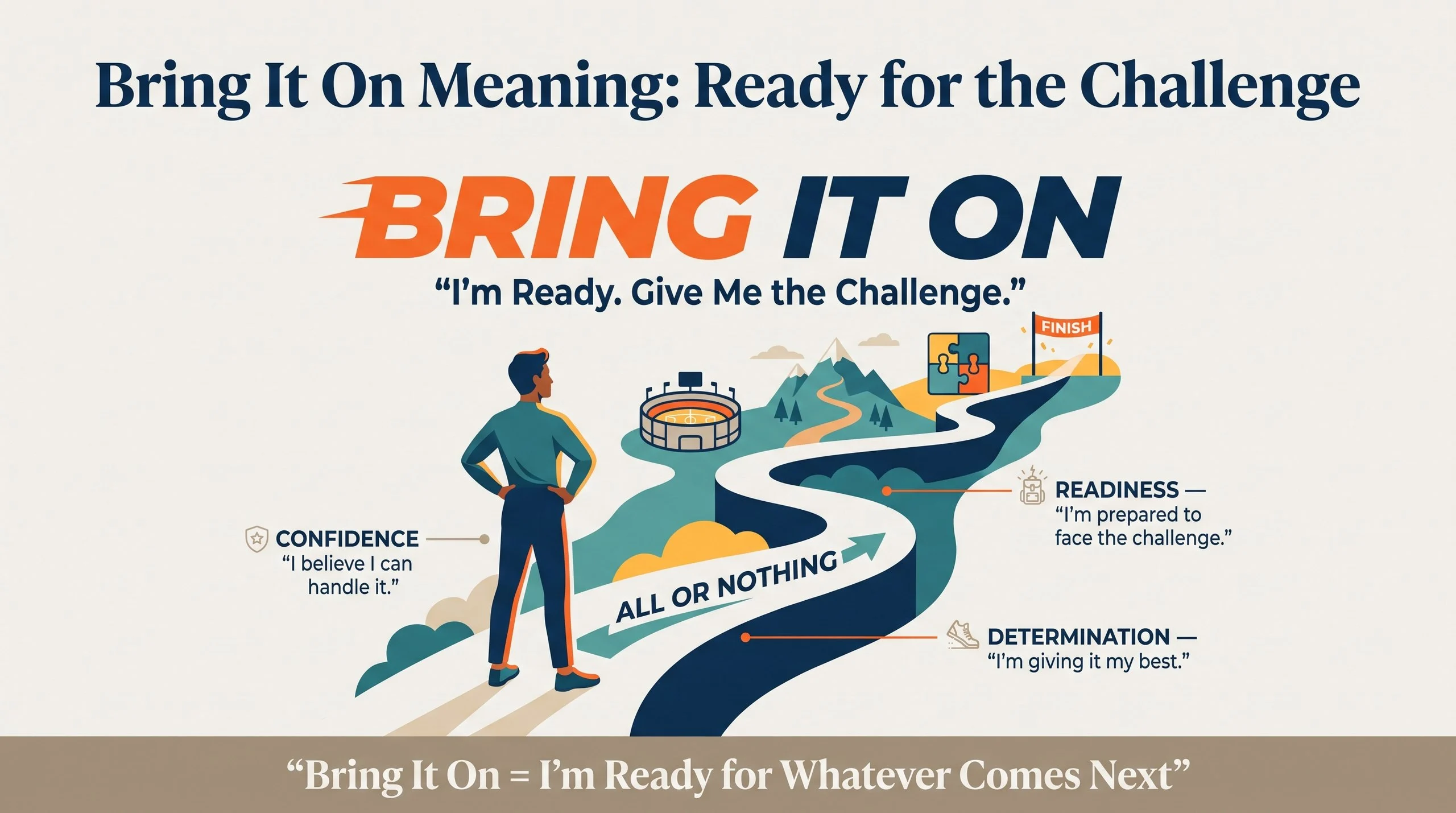
“Bring it on” is an informal expression used to show confidence, readiness, or willingness to face a challenge. It can mean “I am ready,” “I am not afraid,” or “Go ahead and give me your best.” When someone says “bring it on” in an all-or-nothing situation, they are often expressing a bold willingness to give the challenge everything they have.
The phrase bring it on is a popular expression people use when they are ready to face a challenge. It communicates confidence, determination, and sometimes a playful desire for competition. When paired with the idea of all or nothing, the message becomes even stronger: the person is willing to give the situation their full effort rather than holding back.
You might hear someone say, “Bring it on!” before a sports match, a difficult competition, a debate, or a demanding task. In a playful conversation, the phrase can simply mean, “I’m ready.” In a more serious situation, it can communicate courage and determination.
The expression can also sound confrontational. Its meaning depends heavily on tone and context. A smiling friend might use it jokingly, while an opponent could use the same words as a challenge.
Understanding bring it on is useful because the phrase appears frequently in movies, sports conversations, social media posts, gaming, and everyday English. It is short, energetic, and easy to adapt to different situations.
| Meaning | Context | Primary Platforms | Example | Tone |
|---|---|---|---|---|
| A confident way to say you are ready for a challenge | Competition, arguments, sports, challenges, casual conversation | Text, TikTok, Instagram, gaming, everyday speech | “You think you can beat me? Bring it on!” | Confident, bold, challenging |
What Does “Bring It On” Mean?
Bring it on means “I’m ready for it,” “Give me the challenge,” or “I am not afraid.”
The phrase is usually used when someone believes they can handle whatever comes next.
For example:
“You think this exam is difficult? Bring it on!”
The speaker is saying that they are ready to face the difficult exam.
Another example is:
“Another tough opponent? Bring it on!”
Here, the person welcomes the competition instead of avoiding it.
The phrase often carries a confident attitude. Depending on the situation, it can communicate:
- Confidence
- Readiness
- Determination
- Courage
- Competitive energy
- Defiance
- Playful excitement
What Does “All or Nothing” Mean?
All or nothing describes a situation where there are only two possible outcomes or where someone chooses to give everything rather than settle for a partial effort.
For example:
“It’s all or nothing for us.”
This means the speaker sees the situation as requiring complete commitment.
Another example:
“I’m going all in. It’s all or nothing.”
The person is emphasizing total effort or commitment.
The phrase can describe sports, business, relationships, competitions, personal goals, and many other situations.
“Bring It On” and “All or Nothing” Together
Although bring it on and all or nothing have different meanings, they can work together naturally.
Bring it on focuses on facing a challenge.
All or nothing focuses on total commitment or high stakes.
Together, they can communicate an attitude like:
“I’m ready to face this challenge, and I’m giving it everything I’ve got.”
For example:
“It’s all or nothing now. Bring it on.”
This sentence suggests determination and readiness.
Another example:
“We have one chance left. Bring it on.”
The speaker is prepared to give their full effort.
Why Do People Say “Bring It On”?
People use the phrase because it quickly communicates confidence.
Instead of saying:
“I am prepared to deal with whatever challenge comes next.”
someone can simply say:
“Bring it on.”
The shorter expression sounds more energetic and natural in casual conversation.
It can also create a competitive atmosphere. For example, two friends might challenge each other to a video game.
Friend 1: “I beat you three times yesterday.”
Friend 2: “Bring it on.”
The response means:
“I’m ready to compete again.”
Is “Bring It On” Positive or Negative?
Usually, bring it on is neither strictly positive nor negative. Its meaning depends on context and tone.
Positive or Confident Use
Someone may say:
“Bring it on! I’m ready for the marathon.”
Here, the phrase expresses excitement and determination.
Playful Use
A friend might say:
“You want to challenge me to karaoke? Bring it on!”
This sounds humorous and competitive.
Confrontational Use
Someone could also say:
“You want to argue? Bring it on.”
In this case, the phrase sounds more aggressive.
Therefore, facial expressions, voice, and surrounding words can completely change how the expression feels.
Bring It On in Sports
Sports provide one of the clearest contexts for bring it on.
Athletes and fans may use the expression before a difficult match or competition.
Examples include:
- “The championship starts tomorrow. Bring it on.”
- “We’re facing the strongest team in the league. Bring it on.”
- “Another tough round? Bring it on.”
- “Rain or heat, bring it on.”
In sports, the phrase usually communicates confidence and competitive energy.
It can also be used by fans.
“Our team is ready for the finals. Bring it on!”
Here, the speaker expresses excitement about the upcoming competition.
Bring It On in Gaming
Gamers often use bring it on when challenging another player.
For example:
“You think you can beat me? Bring it on.”
The phrase can indicate that the speaker welcomes a difficult match.
It can also appear in gaming chats and social posts:
- “New boss battle? Bring it on.”
- “Hard mode activated. Bring it on.”
- “Final round. Bring it on.”
- “Who’s challenging me next? Bring it on.”
The phrase fits gaming because it naturally communicates challenge and confidence.
Bring It On in School
Students can use bring it on when discussing tests, competitions, presentations, or other challenges.
For example:
“We have three exams next week. Bring it on.”
This could be serious or humorous depending on the student’s attitude.
Another example:
“The debate competition is tomorrow. Bring it on!”
Here, the speaker is showing confidence in their preparation.
However, saying bring it on does not necessarily mean someone expects the challenge to be easy. It often means they are willing to face it despite its difficulty.
Bring It On at Work
The phrase can also appear in informal workplace conversations.
For example:
“The new project will be challenging, but bring it on.”
This communicates enthusiasm and confidence.
However, bring it on is informal. It may not fit a highly formal business document or professional presentation.
In a formal setting, alternatives might include:
- “I’m ready for the challenge.”
- “We are prepared.”
- “We welcome the opportunity.”
- “We are ready to move forward.”
For casual workplace conversations, however, bring it on can sound perfectly natural.
Bring It On in Relationships
The expression can appear in romantic relationships, but the meaning depends on the situation.
A couple might jokingly compete over something:
“You think you can beat me at bowling? Bring it on.”
Here, the phrase is playful.
A partner might also use it when facing a difficult situation together:
“Whatever happens next, bring it on. We’ll handle it together.”
This version communicates resilience rather than competition.
However, the phrase can sound confrontational if used during an argument.
“You want to break up? Bring it on.”
In this context, the expression sounds defensive or challenging.
Bring It On in Text Messages
In text messages, bring it on is usually short, confident, and casual.
Someone might text:
- “You ready for tonight? Bring it on!”
- “Round two? Bring it on 😂”
- “Final exam tomorrow. Bring it on.”
- “You want a rematch? Bring it on.”
- “All or nothing now. Bring it on.”
Emojis can soften or intensify the expression.
For example:
“Bring it on 😂”
usually sounds playful.
Meanwhile:
“Bring it on 😤”
can sound more intense or competitive.
Bring It On on Social Media
Social media users often use the phrase as a caption when announcing a challenge, goal, event, or competition.
Examples:
- “New chapter. Bring it on.”
- “Marathon training starts today. Bring it on.”
- “Final exam week. Bring it on.”
- “New adventure ahead. Bring it on.”
- “One last chance. All or nothing. Bring it on.”
The expression works well in captions because it is brief and energetic.
It can also create a motivational tone without requiring a long explanation.
Examples of “Bring It On”
Here are natural examples in different situations.
1. For Competition
- “You want a rematch? Bring it on.”
- “The final round is here. Bring it on.”
- “Think your team can beat ours? Bring it on.”
- “I’m ready for the competition. Bring it on.”
2. For Challenges
- “This project looks difficult, but bring it on.”
- “Another long day? Bring it on.”
- “Whatever challenge comes next, bring it on.”
- “I’m prepared for the hardest part. Bring it on.”
3. For Motivation
- “New goals, new challenges. Bring it on.”
- “I’m ready for whatever this year brings. Bring it on.”
- “Time to step outside my comfort zone. Bring it on.”
- “It’s time to give this dream everything I’ve got. Bring it on.”
4. For Humor
- “Another meeting? Bring it on. 😂”
- “You want to challenge me to a pizza-eating contest? Bring it on.”
- “Three cups of coffee later, I’m ready. Bring it on.”
- “Laundry day again? Bring it on.”
What Does “Bring It On” Mean From a Girl?
If a girl says bring it on, the phrase generally means she is ready to face a challenge.
The exact meaning depends on the situation.
For example:
“You think you can beat me at tennis? Bring it on.”
This is clearly competitive.
Meanwhile:
“You want to plan the biggest surprise party ever? Bring it on!”
This sounds enthusiastic.
The phrase itself does not automatically have a romantic meaning.
Context matters more than the speaker’s gender.
What Does “Bring It On” Mean From a Guy?
If a guy says bring it on, he is usually expressing confidence, readiness, or willingness to compete.
For example:
“You think this level is impossible? Bring it on.”
The speaker is saying that he is ready to attempt the challenge.
Again, the phrase does not automatically indicate anger or romantic interest. Tone and context determine its meaning.
“Bring It On” vs. “I’m Ready”
These phrases are similar, but they have different energy.
| Bring It On | I’m Ready |
|---|---|
| Informal | Neutral |
| Energetic | Calm |
| Often competitive | Usually straightforward |
| Can sound challenging | Usually sounds cooperative |
| “Give me the challenge.” | “I am prepared.” |
For example:
“I’m ready for the test.”
sounds calm and practical.
“Bring it on!”
sounds more bold and enthusiastic.
“Bring It On” vs. “Come At Me”
These expressions can both communicate confidence, but come at me is generally more confrontational.
Bring it on can be playful or motivational.
Come at me often sounds like a direct challenge.
For example:
“You think you can beat me? Bring it on.”
This could be playful.
“Come at me.”
This can sound more aggressive.
As a result, bring it on is usually more versatile.
“Bring It On” vs. “All In”
All in means committing completely to something.
Bring it on means being ready to face a challenge.
They can appear together:
“I’m all in. Bring it on.”
This means:
“I’m fully committed, and I’m ready for whatever comes next.”
The two expressions therefore complement each other but are not exact synonyms.
“All or Nothing” vs. “Go All In”
These expressions are also related.
All or nothing emphasizes the stakes or possible outcomes.
Go all in emphasizes the decision to commit fully.
For example:
“This is an all-or-nothing situation.”
This focuses on the result.
“I’m going all in.”
This focuses on the person’s commitment.
Adding bring it on creates a strong motivational statement:
“I’m going all in. Bring it on.”
Is “Bring It On” an Idiom?
Yes. Bring it on is commonly treated as an idiomatic expression.
Its meaning cannot always be understood literally.
Someone saying “bring it on” is not usually asking another person to physically bring an object.
Instead, they are communicating readiness to face a challenge.
Is “Bring It On” Slang?
Bring it on is informal and conversational, but it is better described as an idiomatic expression than as purely slang.
It is widely understood in everyday English.
You can hear it in:
- Conversations
- Movies
- Sports
- Gaming
- Social media
- Text messages
- Informal workplace discussions
Because it is informal, choose a more neutral expression in highly formal writing.
Common Mistakes When Using “Bring It On”
Mistake 1: Taking It Literally
The phrase usually does not mean someone should physically bring an object.
Better understanding: It means “give me the challenge” or “I’m ready.”
Mistake 2: Assuming It Always Sounds Friendly
Tone matters.
A cheerful “bring it on!” can sound playful.
A shouted “bring it on!” can sound confrontational.
Mistake 3: Using It in Formal Writing
The expression is casual.
For formal writing, use phrases such as:
- “We are prepared.”
- “We welcome the challenge.”
- “We are ready to proceed.”
Mistake 4: Assuming It Means “All or Nothing”
The phrases are related but not identical.
Bring it on means you are ready to face something.
All or nothing means there is little or no middle ground.
Advantages and Disadvantages of Using the Phrase
| Advantages | Disadvantages |
|---|---|
| Sounds confident | Can sound confrontational |
| Short and memorable | Informal |
| Works well in casual conversation | Tone can be misunderstood in text |
| Fits sports and competitions | May sound overly dramatic in serious situations |
| Expresses readiness quickly | Not ideal for formal writing |
The phrase works best when the situation is casual, energetic, or competitive.
Practice Exercise
Choose the best interpretation of bring it on in each sentence.
1. “The final match starts tomorrow. Bring it on!”
A. I’m afraid to compete.
B. I’m ready for the competition.
C. I want to cancel the match.
2. “You want a rematch? Bring it on.”
A. I’m ready to compete again.
B. I don’t want to play.
C. I’m leaving.
3. “We have a huge project ahead, but bring it on.”
A. I’m ready to face the challenge.
B. I refuse to work.
C. The project is finished.
4. “Bring it on! I finally finished my training.”
A. I’m prepared for the challenge.
B. I need more training.
C. I want to quit.
Answers
1. B — The speaker is confidently welcoming the competition.
2. A — The speaker accepts the challenge of another match.
3. A — The phrase expresses readiness for a difficult task.
4. A — The speaker believes they are prepared.
Frequently Asked Questions
What does “bring it on” mean?
Bring it on means “I’m ready for the challenge” or “give me your best.” It expresses confidence, determination, or willingness to face something difficult.
Is “bring it on” positive?
It can be positive, especially when someone uses it to express excitement or confidence. However, it can also sound confrontational depending on tone.
What does “all or nothing” mean?
All or nothing describes a situation involving complete commitment or extreme outcomes, with little room for a middle option.
Does “bring it on” mean “all or nothing”?
Not exactly. Bring it on means you are ready to face a challenge. All or nothing emphasizes complete commitment or high stakes.
Is “bring it on” slang?
It is an informal idiomatic expression commonly used in everyday speech, sports, social media, and casual conversations.
Can I use “bring it on” in a text?
Yes. It works very naturally in casual text messages, especially when discussing challenges, games, competitions, or exciting events.
Can “bring it on” be romantic?
It can appear in a romantic conversation, but the phrase itself is not specifically romantic. Its meaning depends on the surrounding conversation.
Is “bring it on” rude?
Not necessarily. It can be playful, motivational, confident, or confrontational. The speaker’s tone and situation determine how it sounds.
What is another way to say “bring it on”?
Depending on the context, you can say “I’m ready,” “let’s do it,” “I’m up for it,” “give me your best,” “I’m ready for the challenge,” or “let’s go.”
What does “bring it on” mean in sports?
In sports, it usually means “I’m ready to compete.” It can express confidence before a match, game, or difficult round.
Key Takeaway & Summary
Bring it on is a confident expression meaning “I’m ready for the challenge.” It can be used for competitions, difficult tasks, sports, gaming, personal goals, and playful challenges.
The phrase all or nothing is related but has a different focus. It describes complete commitment or a situation with high stakes. Together, the expressions can create a powerful motivational message:
“It’s all or nothing. Bring it on.”
That statement essentially means:
“I’m giving this everything I have, and I’m ready to face whatever comes next.”
Conclusion
The phrase bring it on is a short but powerful way to communicate confidence and readiness. Whether you’re preparing for a competition, facing a difficult project, entering a new chapter, or simply joking with friends, it tells others that you’re willing to accept the challenge.
Its meaning becomes especially strong when paired with all or nothing. While bring it on welcomes the challenge, all or nothing emphasizes complete commitment. Together, they create a bold attitude of determination.
Still, context matters. In a friendly conversation, the phrase can sound playful and exciting. During an argument, however, it may sound confrontational. Using the right tone ensures that your message matches your intention.
Ultimately, bring it on means you’re ready. Whatever comes next, you’re prepared to face it.