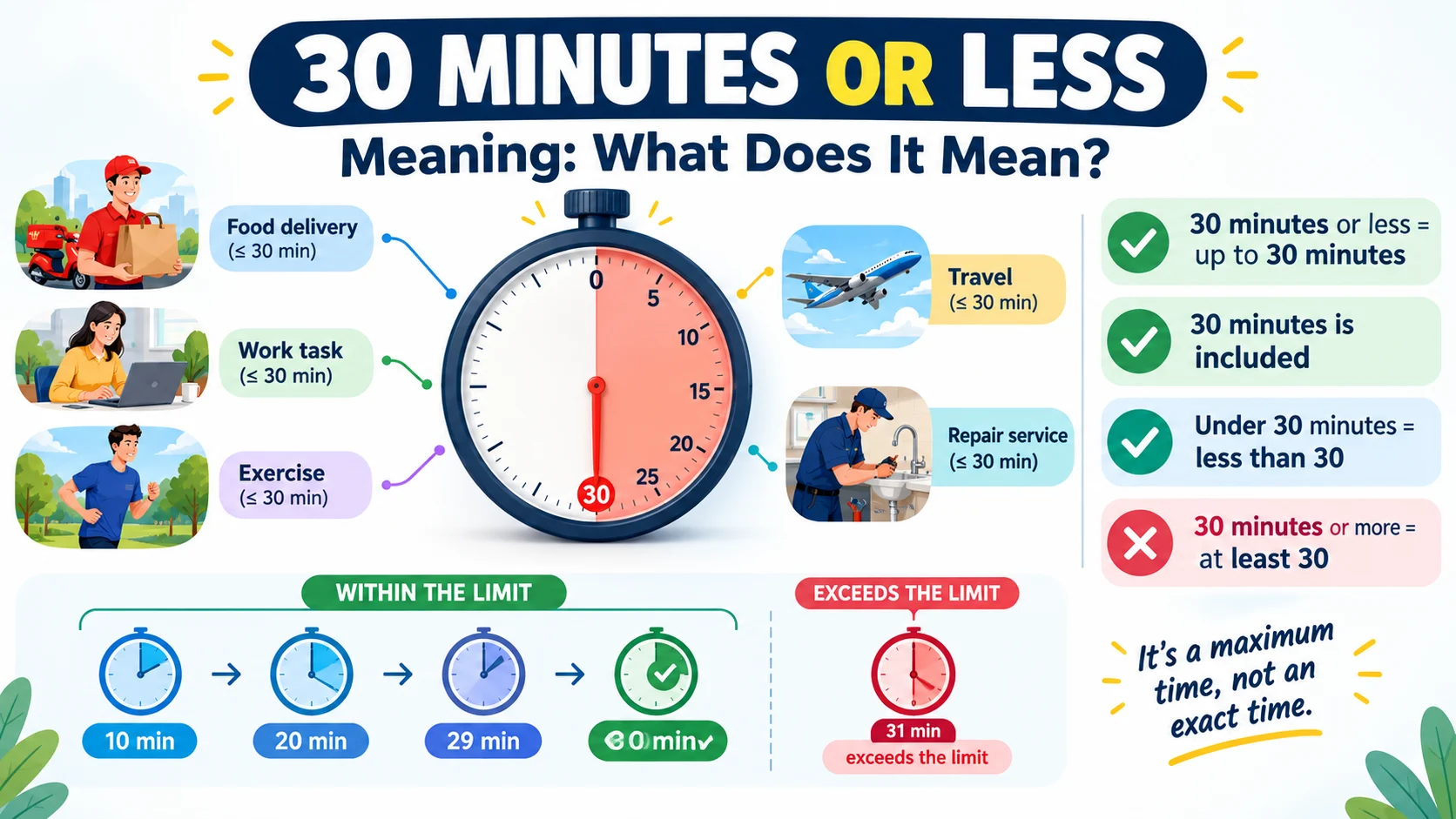
30 minutes or less means within 30 minutes or in a maximum of 30 minutes. The phrase sets a time limit and indicates that something should happen, arrive, or be completed no later than 30 minutes from the relevant starting point. For example, “Your order will arrive in 30 minutes or less” means the expected delivery time is 30 minutes or shorter.
The 30 minutes or less meaning is simple: something will happen within a maximum period of 30 minutes. People use this phrase when they want to communicate a clear time limit, estimated duration, delivery window, or completion period. For instance, a restaurant might say that an order will be ready in 30 minutes or less, meaning customers should expect it within half an hour.
In everyday English, the phrase appears in many situations. You might hear it when discussing food delivery, travel, work tasks, appointments, customer service, exercise, or entertainment. Because the wording establishes an upper limit, it usually suggests that the actual time could be shorter.
Moreover, “30 minutes or less” is different from saying “about 30 minutes.” The first phrase emphasizes a maximum limit, while the second gives an approximate duration. Therefore, understanding this small distinction can help you interpret schedules, promises, advertisements, and everyday conversations more accurately.
This guide explains what 30 minutes or less means, how to use it correctly, what “less” means in this expression, and how it compares with similar phrases such as “under 30 minutes” and “within 30 minutes.”
What Does 30 Minutes or Less Mean?
30 minutes or less means 30 minutes or any amount of time shorter than 30 minutes.
In other words, the maximum time is 30 minutes.
For example:
“The repair should take 30 minutes or less.”
This means the repair could take:
- 10 minutes
- 15 minutes
- 20 minutes
- 25 minutes
- 30 minutes
However, it should not normally take more than 30 minutes if the statement is being used as a firm time limit.
The phrase is therefore useful when someone wants to establish an upper boundary without promising an exact duration.
Simple Definition
30 minutes or less = no more than 30 minutes.
That is the easiest way to remember it.
What Does “Or Less” Mean?
The key part of the expression is “or less.”
The phrase “or less” means the stated amount is the maximum, while a smaller amount is also acceptable or possible.
For example:
- “It takes 10 minutes or less.”
- “The task should take an hour or less.”
- “The video is five minutes or less.”
- “The wait time is 30 minutes or less.”
Consequently, “30 minutes or less” does not necessarily mean exactly 30 minutes.
Instead, it means 30 minutes at most.
If a delivery arrives after 12 minutes, it still fits the phrase. Likewise, if it arrives after 29 minutes, it also fits. However, a 35-minute delivery would exceed the stated limit.
Is 30 Minutes or Less Exactly 30 Minutes?
No. 30 minutes or less does not mean exactly 30 minutes.
The phrase includes 30 minutes and every shorter duration.
For example:
| Time | Fits “30 minutes or less”? |
|---|---|
| 5 minutes | Yes |
| 10 minutes | Yes |
| 15 minutes | Yes |
| 20 minutes | Yes |
| 25 minutes | Yes |
| 30 minutes | Yes |
| 31 minutes | No |
| 40 minutes | No |
| 1 hour | No |
Therefore, if someone tells you that something will take “30 minutes or less,” you should understand 30 minutes as the maximum stated duration.
30 Minutes or Less vs. 30 Minutes
These expressions can communicate slightly different ideas.
“30 Minutes”
The phrase 30 minutes can simply state a duration.
For example:
“The meeting will take 30 minutes.”
This normally suggests an expected or planned duration of exactly 30 minutes.
“30 Minutes or Less”
By contrast:
“The meeting will take 30 minutes or less.”
This allows the meeting to finish earlier.
It could take 20 minutes, 25 minutes, or exactly 30 minutes. Therefore, the second phrase gives more flexibility.
30 Minutes or Less vs. Under 30 Minutes
These expressions are very similar, although their mathematical interpretation can differ slightly.
Under 30 Minutes
Under 30 minutes generally means less than 30 minutes.
So, strictly speaking, exactly 30 minutes would not qualify.
30 Minutes or Less
30 minutes or less includes exactly 30 minutes.
Therefore:
- 29 minutes → both expressions work.
- 30 minutes → “30 minutes or less” works.
- 30 minutes → “under 30 minutes” does not strictly work.
This distinction is small, but it matters when a precise time limit is involved.
30 Minutes or Less vs. Within 30 Minutes
The phrase within 30 minutes is also closely related.
Generally, “within 30 minutes” means something will happen no later than 30 minutes after a particular starting point.
For example:
“Please call me within 30 minutes.”
This means the call should happen before or by the 30-minute limit.
Similarly:
“The technician will arrive within 30 minutes.”
This establishes a maximum expected waiting period.
Therefore, within 30 minutes and 30 minutes or less often communicate nearly the same practical idea.
However, the grammatical structure is different.
- 30 minutes or less describes the maximum duration.
- Within 30 minutes describes when an event should happen.
Common Uses of 30 Minutes or Less
The phrase appears in many everyday situations.
Food Delivery
Restaurants and delivery services often use time-based language.
“Your pizza will arrive in 30 minutes or less.”
Here, the phrase tells the customer the expected maximum delivery period.
Work
A manager might say:
“This should take 30 minutes or less.”
The statement suggests that the task is relatively quick.
Customer Service
A support representative could say:
“We’ll get back to you in 30 minutes or less.”
In this case, the phrase communicates an expected response window.
Travel
Someone might say:
“The airport is 30 minutes or less from here.”
This usually means the journey is expected to take no more than about half an hour under the relevant conditions.
Exercise
A fitness plan might advertise:
“Get a full workout in 30 minutes or less.”
Here, the phrase emphasizes efficiency.
Entertainment
A website might describe a video as:
“A quick lesson you can watch in 30 minutes or less.”
The wording tells readers that the content should fit within a short time period.
Examples of 30 Minutes or Less in Sentences
Here are natural examples from different contexts.
- “The repair should be finished in 30 minutes or less.”
- “Your food will be delivered in 30 minutes or less.”
- “The meeting should take 30 minutes or less.”
- “I can finish this assignment in 30 minutes or less.”
- “The workout takes 30 minutes or less.”
- “The technician should arrive within 30 minutes.”
- “The movie review can be read in 30 minutes or less.”
- “The drive usually takes 30 minutes or less.”
- “This recipe can be prepared in 30 minutes or less.”
- “You can complete the application in 30 minutes or less.”
Each sentence communicates a maximum or expected duration.
30 Minutes or Less in Conversation
In casual conversation, people often use the phrase to reassure someone that something will not take very long.
For example:
Person A: “How long will this take?”
Person B: “Thirty minutes or less.”
Here, Person B is saying that the task should be completed within half an hour.
Similarly:
Person A: “How long until you get here?”
Person B: “Probably 30 minutes or less.”
The speaker is giving an estimated maximum rather than an exact arrival time.
Because traffic, delays, and other circumstances can change the actual duration, the phrase may sometimes be an estimate rather than a guarantee.
Why Do People Say 30 Minutes or Less?
People use 30 minutes or less because it sounds concise and gives listeners a clear expectation.
First, it establishes a maximum. Instead of giving a vague answer such as “soon,” the speaker provides a measurable time frame.
Second, it communicates flexibility. Something might take 15 minutes, but saying “30 minutes or less” allows room for variation.
Additionally, the phrase can sound reassuring in customer-facing situations. A business may use it to emphasize speed and convenience.
For example:
“Fast service in 30 minutes or less.”
The emphasis is not necessarily on completing the task in exactly 30 minutes. Rather, the message highlights that customers should not expect a long wait.
Is “30 Minutes or Less” Correct English?
Yes. “30 minutes or less” is standard and widely understood English.
The expression is grammatically natural when referring to a duration.
For example:
“The job should take 30 minutes or less.”
This sentence is clear and correct.
However, you should pay attention to the context. If you are describing a countable number of individual items rather than an amount of time, fewer may be more appropriate.
For example:
“The meeting will take 30 minutes or less.”
But:
“There are 30 minutes or fewer available.”
The second sentence is unusual in everyday English, and most speakers would naturally restructure it. Therefore, less is the normal choice when discussing a period of time.
Why Is It “Less” Instead of “Fewer”?
This question often causes confusion.
In traditional grammar, fewer is generally associated with countable nouns, while less is generally associated with uncountable amounts.
For example:
- fewer books
- fewer people
- fewer cars
- less water
- less time
- less money
Because time is generally treated as an amount or duration, “30 minutes or less” is the natural expression.
Although “minutes” can be counted individually, the phrase refers to a duration of time, not a collection of separate objects.
Therefore, saying:
“The task takes 30 minutes or less.”
is natural and standard.
Formal vs. Informal Use
The phrase works in both formal and informal communication.
Informal
“I’ll be there in 30 minutes or less.”
Professional
“The installation should be completed within 30 minutes or less.”
The second example is more formal, although “within 30 minutes or less” can be stylistically redundant because “within 30 minutes” already establishes a maximum.
A cleaner professional version would be:
“The installation should be completed within 30 minutes.”
Thus, context determines the best wording.
Common Mistakes With 30 Minutes or Less
Although the phrase is simple, several mistakes are common.
Mistake 1: Thinking It Means Exactly 30 Minutes
“30 minutes or less” does not mean exactly 30 minutes.
It means 30 minutes at most.
Mistake 2: Assuming It Means Less Than 30 Only
Strictly speaking, 30 itself is included.
Therefore, exactly 30 minutes qualifies.
Mistake 3: Confusing It With “Under 30 Minutes”
“Under 30 minutes” technically excludes exactly 30 minutes.
By contrast, “30 minutes or less” includes it.
Mistake 4: Treating an Estimate as a Guarantee
A company may say “30 minutes or less” as an expected service time. However, real-world circumstances can sometimes cause delays.
Consequently, always consider whether the statement is a promise, estimate, or general description.
Mistake 5: Using “Fewer” Automatically
Because “minutes” is countable, some writers incorrectly assume “fewer” must always be used.
However, when talking about duration, “30 minutes or less” is the natural construction.
Synonyms and Alternative Phrases
Several expressions can communicate a similar idea.
| Phrase | Meaning |
|---|---|
| 30 minutes or less | Maximum of 30 minutes |
| Within 30 minutes | No later than 30 minutes |
| No more than 30 minutes | Maximum of 30 minutes |
| Up to 30 minutes | Maximum possible duration |
| In 30 minutes or less | Completed within 30 minutes |
| Under 30 minutes | Less than 30 minutes |
| In less than 30 minutes | Completion before 30 minutes |
| At most 30 minutes | Maximum of 30 minutes |
These alternatives are useful because they allow you to choose wording based on tone and context.
Which Phrase Should You Use?
Choose 30 minutes or less when you want to emphasize a maximum duration.
Use within 30 minutes when you are focusing on the deadline for an event.
Choose under 30 minutes when you specifically mean a duration shorter than 30 minutes.
Use no more than 30 minutes when you want especially clear or formal wording.
For example:
- Casual: “I’ll finish it in 30 minutes or less.”
- Professional: “The task will be completed within 30 minutes.”
- Precise: “The process takes no more than 30 minutes.”
- Informal: “It should be done in under 30 minutes.”
30 Minutes or Less: Meaning in Advertising
Businesses frequently use short-duration phrases in advertising.
A restaurant might advertise:
“Fresh meals delivered in 30 minutes or less.”
A fitness program could say:
“Get stronger with workouts of 30 minutes or less.”
Similarly, a service provider might promote:
“Quick repairs in 30 minutes or less.”
In these examples, the phrase emphasizes convenience and speed.
However, readers should distinguish between marketing language and a guaranteed service promise. Actual times can depend on traffic, workload, availability, preparation, and other circumstances.
Real-Life Scenarios
Scenario 1: Restaurant
You order dinner and the restaurant says:
“Your order should arrive in 30 minutes or less.”
The expected delivery time is therefore between now and 30 minutes.
Scenario 2: Repair Shop
A technician says:
“I can fix that in 30 minutes or less.”
The technician expects the repair to take no more than half an hour.
Scenario 3: Homework
A student says:
“I’ll finish this worksheet in 30 minutes or less.”
The student expects to complete the worksheet within that period.
Scenario 4: Appointment
A receptionist says:
“Your wait should be 30 minutes or less.”
The customer should expect to wait no longer than approximately half an hour.
Scenario 5: Travel
A friend says:
“I’ll reach your house in 30 minutes or less.”
The friend expects the journey to take a maximum of about 30 minutes.
Is 30 Minutes or Less a Promise?
Not always.
The meaning depends on who says it and how the phrase is being used.
If a company explicitly guarantees a service within 30 minutes, then the statement may function as a promise or service commitment.
On the other hand, if a friend says, “I’ll be there in 30 minutes or less,” they may simply be giving an estimate.
Therefore, context matters.
Traffic, weather, technical problems, workload, and unexpected delays can all affect actual timing.
How to Use 30 Minutes or Less Correctly
Follow these simple guidelines:
- Use it when 30 minutes is the maximum expected duration.
- Remember that exactly 30 minutes is included.
- Use “under 30 minutes” when you mean strictly less than 30 minutes.
- Use “within 30 minutes” when describing a deadline or arrival window.
- Consider whether the time is an estimate or a guarantee.
- Avoid adding unnecessary words that make the sentence repetitive.
For example:
Correct:
“The task should take 30 minutes or less.”
Also correct:
“The technician will arrive within 30 minutes.”
Different meaning:
“The task should take under 30 minutes.”
Related Phrases
The expression belongs to a broader group of phrases that communicate limits or deadlines.
30 Minutes or More
This means at least 30 minutes.
For example:
“The process may take 30 minutes or more.”
This suggests that 30 minutes is the minimum rather than the maximum.
30 Minutes or Less
This means at most 30 minutes.
Therefore, it represents the opposite limit.
More Than 30 Minutes
This means a duration greater than 30 minutes.
Less Than 30 Minutes
This means a duration below 30 minutes.
Exactly 30 Minutes
This means the duration is precisely 30 minutes.
30 Minutes or Less vs. 30 Minutes or More
These phrases create opposite meanings.
| Phrase | Meaning |
|---|---|
| 30 minutes or less | Maximum of 30 minutes |
| 30 minutes or more | Minimum of 30 minutes |
| Less than 30 minutes | Below 30 minutes |
| More than 30 minutes | Above 30 minutes |
| Exactly 30 minutes | Precisely 30 minutes |
A simple way to remember the difference is:
Less = maximum limit.
More = minimum limit.
What Does 30 Minutes or Less Mean in Texting?
In texting, people often shorten the idea without changing its meaning.
For example:
- “30 mins or less”
- “30 min max”
- “Should be 30 mins tops”
- “Less than 30”
- “Be there in 30”
The phrase “30 mins or less” is common in casual digital communication.
Meanwhile, “30 min max” is even more informal and directly communicates the maximum duration.
What Does “30 Minutes or Less” Mean on a Menu?
When a recipe, meal service, or restaurant uses 30 minutes or less, it usually refers to preparation or delivery time.
For example:
“Dinner ready in 30 minutes or less.”
This means the meal should be ready within a maximum of 30 minutes.
Similarly:
“Easy recipes you can make in 30 minutes or less.”
This tells readers that the preparation and cooking process should fit within that approximate time limit.
What Does “30 Minutes or Less” Mean in a Job?
At work, the phrase can describe an expected task duration.
For example:
“This report should take 30 minutes or less.”
The speaker expects the employee to complete the task within half an hour.
However, the exact meaning can depend on workplace expectations. A manager may be giving a rough estimate, while another manager may be setting a strict deadline.
Therefore, if the timing is important, clarification can help.
Practice: Choose the Correct Phrase
Choose the best option for each sentence.
1. The delivery should arrive ___.
A. 30 minutes or less
B. 30 minutes or more
Answer: A
The sentence suggests a maximum waiting period.
2. The repair may take ___ because the problem is complicated.
A. 30 minutes or less
B. 30 minutes or more
Answer: B
The phrase suggests that 30 minutes is the minimum expected duration.
3. Please call me ___.
A. within 30 minutes
B. more than 30 minutes
Answer: A
The intended meaning is that the call should happen before the 30-minute limit.
4. The meeting lasted ___.
A. exactly 30 minutes
B. 30 minutes or less
Answer: Either can work depending on the intended meaning.
“Exactly 30 minutes” gives a precise duration, while “30 minutes or less” gives a maximum.
Key Takeaway & Summary
The phrase 30 minutes or less means no more than 30 minutes. It includes every duration from a shorter period up to exactly 30 minutes.
The expression is commonly used for delivery times, tasks, appointments, travel, workouts, recipes, and other activities. Furthermore, it provides a clear maximum without requiring an exact duration.
Remember these three points:
- 30 minutes or less = up to 30 minutes
- Under 30 minutes = less than 30 minutes
- 30 minutes or more = at least 30 minutes
Once you understand this distinction, the phrase becomes easy to interpret and use.
Frequently Asked Questions
What does 30 minutes or less mean?
It means 30 minutes at most. The actual duration can be shorter than 30 minutes or exactly 30 minutes.
Does 30 minutes or less include 30 minutes?
Yes. Exactly 30 minutes is included because “or less” establishes 30 minutes as the maximum.
Is 30 minutes or less the same as under 30 minutes?
Not exactly. “30 minutes or less” includes exactly 30 minutes, while “under 30 minutes” technically means less than 30 minutes.
What is another way to say 30 minutes or less?
You can say within 30 minutes, no more than 30 minutes, up to 30 minutes, or at most 30 minutes.
Is 30 minutes or less grammatically correct?
Yes. It is a common and natural English expression for describing a maximum duration.
Why do we use “less” instead of “fewer”?
The phrase refers to an amount or duration of time, so “less” is the natural choice.
Does 30 minutes or less mean exactly half an hour?
Not necessarily. It means a maximum of half an hour, so the actual time could be shorter.
Can I use 30 minutes or less in formal writing?
Yes. The phrase is grammatically correct in both formal and informal writing. However, “within 30 minutes” or “no more than 30 minutes” may sound more polished in some professional contexts.
What does 30 minutes or less mean in delivery?
It means the expected delivery time is no longer than 30 minutes from the relevant starting point.
What does 30 minutes or less mean in a recipe?
It generally means the recipe should take no more than 30 minutes to prepare, cook, or complete, depending on what the recipe specifies.
Conclusion
The 30 minutes or less meaning is straightforward: something should take no more than 30 minutes. The phrase allows for any shorter duration while still including exactly 30 minutes.
Moreover, understanding the difference between “30 minutes or less,” “under 30 minutes,” and “30 minutes or more” can prevent confusion when discussing deadlines, deliveries, appointments, recipes, or everyday tasks. In particular, remember that 30 minutes or less includes 30 minutes, while “under 30 minutes” does not.
Ultimately, when someone says something will happen in 30 minutes or less, they are giving you a maximum time limit. Once you recognize that simple boundary, you can easily understand and use the expression in both casual and professional English.