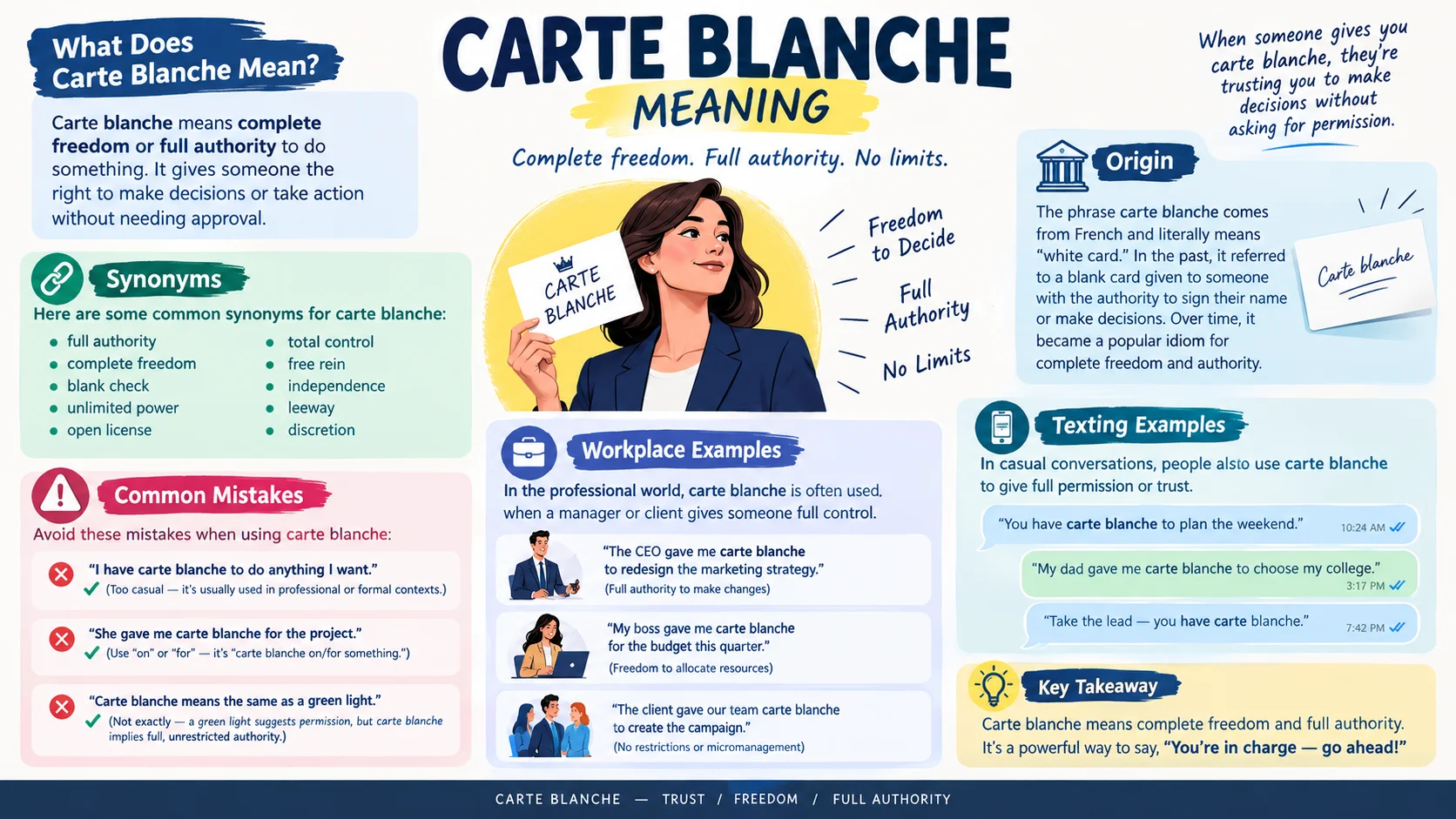
Carte blanche meaning: complete freedom, authority, or permission to act as you choose without needing further approval. The phrase comes from French and literally means “white card.” In English, it usually describes unrestricted decision making.
The carte blanche meaning is complete freedom to make decisions or take action without needing additional approval. The phrase often describes a person who receives broad authority over a project, situation, creative decision, or personal choice.
Although it sounds formal, the expression appears in many everyday situations. For example, a manager may give an employee complete creative freedom. A friend may tell you to choose the restaurant, activity, or travel plan without restrictions. Likewise, someone discussing a movie director might say the director was given total creative freedom.
However, the phrase has an important nuance. It does not simply mean “freedom.” It usually suggests that someone has been given full permission or unrestricted authority.
The expression comes from French. Its literal sense is “white card,” referring historically to a blank document that could be filled in according to the holder’s needs. Over time, English adopted the expression to describe unrestricted authority.
Today, the phrase works well in business writing, journalism, entertainment, conversation, and online communication. It can sound polished and sophisticated, although simpler alternatives often feel more natural in casual texting.
Quick Answer Box
| Meaning | Context | Primary Platforms | Example | Tone |
| Complete freedom or authority | Decisions, projects, creative work | Texting, Instagram, TikTok, Snapchat, business communication | “They gave her carte blanche to redesign the website.” | Formal, confident, sophisticated |
What Does carte blanche mean?
The carte blanche meaning centers on unrestricted freedom or authority. When someone gives another person carte blanche, they allow that person to make decisions without placing significant limitations on those decisions.
For example, imagine a company hiring a designer for a new office. The owner says, “You have carte blanche with the interior.” This means the designer can make the major design choices independently.
The phrase can also describe personal permission.
A parent might tell an adult child, “You have carte blanche when choosing the vacation.” In this context, the person can decide where to go, what to do, and how to organize the trip.
Literal and Figurative Meaning
The literal French expression refers to a “white card.” The figurative English meaning developed around the idea of a blank authorization that leaves details open.
Consequently, the modern expression carries the idea of unrestricted discretion.
It is important to understand that carte blanche does not necessarily mean that every possible action is legal, ethical, or consequence free. Instead, it means the person has been given broad permission within the relevant situation.
For example:
“The director was given carte blanche to cast the movie.”
This does not mean the director can ignore every law or contract. It means the director has broad authority over casting decisions.
Is It French or English?
The phrase originated in French, but English speakers commonly use it as an established loan phrase.
You do not need to translate it when using it in an English sentence. Most educated English readers recognize the expression from context.
The pronunciation is commonly approximated as kart blahnsh in English.
Is Carte Blanche One Word?
No. The standard expression consists of two words: carte blanche.
The spelling should remain separate when used in English.
It is also important to preserve the spelling of blanche. Writing “cart blanche” or “carte blanch” is incorrect in standard English.
Common Synonyms
Several alternatives can express a similar idea:
| Alternative | Meaning | Best Context |
| Complete freedom | No meaningful restrictions | Everyday conversation |
| Full authority | Broad decision making power | Business |
| Free rein | Freedom to act independently | General English |
| Full discretion | Freedom to decide | Professional writing |
| Unlimited freedom | Very broad choice | General discussion |
| Total control | Strong decision making power | Projects or operations |
| Open choice | Freedom to select | Casual contexts |
| Unrestricted authority | Broad permission | Formal writing |
However, these expressions are not always perfect replacements. Free rein, for example, emphasizes freedom to act, while full authority emphasizes power to make decisions.
Contextual Dynamics & Nuances of the Term
Understanding the carte blanche meaning requires more than memorizing “complete freedom.” Context determines what kind of freedom the speaker intends.
Creative Context
Creative work is one of the most common settings.
A filmmaker may receive complete artistic freedom from a studio. A novelist may receive broad freedom from an editor. A graphic designer may receive permission to develop a campaign without following a strict visual template.
For example:
“The artist was given carte blanche for the album cover.”
Here, the expression emphasizes creative independence.
Workplace Context
In business, the phrase usually refers to decision making authority.
A company executive might tell a project manager that they have complete freedom to organize a team. Similarly, a startup founder might give a marketing consultant broad authority over a campaign.
The phrase sounds more formal than “do whatever you want.” Therefore, it can fit professional communication when used naturally.
Personal Context
People also use the expression in personal situations.
For instance:
“You have carte blanche to pick the restaurant tonight.”
The speaker gives the other person a complete choice.
Still, this usage can sound playful because the expression is more sophisticated than ordinary casual speech.
Political and Public Contexts
Journalists often use the phrase when describing powerful individuals or organizations.
For example:
“The board gave the CEO carte blanche to restructure the company.”
The sentence suggests extensive authority.
However, writers sometimes use the expression critically. Giving someone unrestricted authority can create risks, especially when oversight disappears.
Positive and Negative Nuances
The phrase itself is neutral.
Its emotional meaning depends on context.
| Context | Possible Impression |
| Creative project | Freedom and trust |
| Workplace | Authority and responsibility |
| Personal decision | Generosity and flexibility |
| Political decision | Extensive power |
| Risky situation | Lack of oversight |
| Artistic experiment | Independence |
Therefore, carte blanche can sound positive, neutral, or concerning.
Real Life Conversation Examples Using carte blanche meaning
The phrase can sound natural in conversation when the situation involves broad permission.
Example 1: Choosing Dinner
Alex: You pick the restaurant tonight.
Jordan: Seriously?
Alex: Yep. You have carte blanche.
Here, the speaker gives Jordan complete freedom to choose the restaurant. The phrase adds a playful, slightly sophisticated tone.
Example 2: Creative Project
Maya: What style does the client want for the campaign?
Chris: Surprisingly, they gave us carte blanche.
Maya: So we can finally experiment?
Chris: Exactly.
In this conversation, the phrase means the creative team has broad freedom.
Example 3: Workplace Decision
Manager: I want you to lead the redesign.
Employee: Are there specific guidelines?
Manager: Not really. You have carte blanche within the budget.
Here, the expression means the employee can make most design decisions independently.
Example 4: Vacation Planning
Sam: Where should we go this weekend?
Taylor: I honestly do not care.
Sam: So I have carte blanche?
Taylor: Absolutely. Surprise me.
This example shows a casual and humorous use.
Example 5: Social Media Content
Creator: Does the brand want a specific style?
Manager: No. They gave you carte blanche.
Creator: Perfect. I already have three ideas.
The phrase works because the creator receives broad creative authority.
Platform Specific Breakdown
Online communication has changed how people encounter sophisticated expressions. However, the meaning remains stable even when the tone becomes more casual.
How It Is Used on Snapchat
Snapchat conversations tend to favor short and informal language. Therefore, carte blanche may appear as a playful expression rather than a formal statement.
For example:
“You choose. Carte blanche 😂”
The speaker means, “You have complete freedom to decide.”
Another example might be:
“You have carte blanche for tonight’s plans.”
This could mean the recipient gets to decide what happens.
However, many Snapchat users would simply say:
“Your choice.”
or:
“You decide.”
So the French expression can add personality, but it is not necessary for basic communication.
The Role of carte blanche on TikTok
TikTok content often uses language in exaggerated, humorous, or dramatic ways.
A creator might say:
“My editor has carte blanche and honestly I am scared.”
Here, the phrase creates a humorous contrast. The creator has effectively given the editor complete creative freedom.
Similarly, a fashion creator might say:
“I gave her carte blanche with my outfit.”
The meaning remains straightforward. The stylist received full creative control.
TikTok captions may also use the expression to make ordinary freedom sound dramatic.
For example:
“He gave me carte blanche at the bookstore.”
The implied meaning is that the speaker could choose whatever they wanted.
Instagram and Texting Dynamics
Instagram captions can use the phrase to create an elegant or sophisticated tone.
For example:
“A blank canvas and carte blanche.”
This could accompany an art, fashion, travel, or interior design post.
In texting, the expression usually works best when both people understand the phrase.
For a casual audience, “You have free rein” or “Your choice” may communicate the same idea more quickly.
Alternative Meanings & NLP Variations of the Phrase
Natural language processing systems may connect carte blanche with several related concepts.
The strongest semantic relationships include:
complete freedom, unrestricted authority, full permission, free rein, full discretion, broad authority, creative freedom, independent decision making, unlimited choice, and total control.
However, these concepts are related rather than identical.
Carte Blanche vs Free Rein
These phrases overlap significantly.
“Free rein” usually means freedom to act or develop something without excessive control.
“Carte blanche” more strongly suggests that someone has been explicitly given permission or authority.
Compare:
“The artist had free rein over the design.”
This emphasizes creative freedom.
“The artist was given carte blanche over the design.”
This emphasizes the authority granted to the artist.
Carte Blanche vs Full Authority
“Full authority” sounds more direct and professional.
For example:
“She has full authority over the department.”
This clearly describes formal power.
By comparison:
“She has carte blanche with the department.”
This sounds broader and somewhat more expressive.
Carte Blanche vs Do Whatever You Want
These expressions can communicate similar ideas, but their tones differ dramatically.
“Do whatever you want” is extremely casual. Depending on context, it can also sound annoyed or dismissive.
“Carte blanche” sounds more polished and intentional.
Carte Blanche vs Creative Freedom
Creative freedom focuses specifically on artistic or imaginative decisions.
Carte blanche has a broader meaning.
Therefore, creative freedom can be a type of carte blanche, but carte blanche is not limited to creative situations.
Misinterpretations: When NOT to Use carte blanche
The expression is useful, but it does not belong in every situation.
Do Not Use It When You Mean Simple Permission
If someone asks whether they can borrow your pen, saying:
“You have carte blanche.”
would sound unnecessarily dramatic.
Simply say:
“Sure, go ahead.”
Do Not Assume It Means No Consequences
This is one of the most important distinctions.
Giving someone broad authority does not automatically remove responsibility.
For example:
“The manager gave her carte blanche to negotiate.”
This means she can negotiate freely. It does not mean she can violate laws, contracts, or company policies.
Do Not Use It as a Universal Synonym for Freedom
Freedom can refer to many things.
A person may have freedom of speech, freedom of movement, or personal independence. Carte blanche usually involves permission or authority to make choices.
Therefore, the phrase is narrower than the general word “freedom.”
Avoid It in Very Basic Communication
If your audience includes beginner English learners, a simpler phrase may be clearer.
Instead of:
“You have carte blanche.”
consider:
“You can decide everything.”
The second sentence communicates the idea immediately.
Avoid Forced Slang Usage
Despite appearing online, this phrase is not traditional internet slang.
It is a French expression used in English.
Using it repeatedly in casual posts can make your writing sound unnatural. Instead, use it when the context benefits from a polished or playful expression.
How to Respond in Chat Comfortably
If someone uses the phrase with you, the correct response depends on what they mean.
If They Give You Full Choice
You can respond:
“Nice, I’ll take it.”
Or:
“Perfect. I know exactly what I want.”
If You Want to Clarify
Try:
“So I can choose anything?”
This works especially well when the phrase appears in a workplace or project discussion.
If You Want a Funny Reply
You could say:
“Dangerous decision. I have ideas.”
Another option is:
“You really should not give me that much power.”
These responses recognize the broad freedom while keeping the conversation light.
If You Want to Sound Professional
Try:
“Thanks for the flexibility. I’ll make the decision based on the project goals.”
This response works well in business communication.
If You Do Not Want the Responsibility
You can politely say:
“I appreciate the freedom, but could you give me a few parameters?”
That response is useful because unlimited choice can sometimes make a task harder.
If Someone Says “You Have Carte Blanche”
You can interpret it as:
“You have broad freedom to decide what happens next.”
However, check the surrounding context. The speaker may mean complete creative freedom, broad professional authority, or simply permission to choose.
FAQs
What is the carte blanche meaning in simple English?
It means complete freedom or permission to make decisions without significant restrictions. In simple English, you can often replace it with “you can decide” or “you have full freedom.”
Is carte blanche a slang term?
No. It is not technically slang. It is a French expression that English speakers use as a loan phrase. Online users may use it casually, but its linguistic category remains different from internet slang.
What does carte blanche mean in texting?
In texting, it usually means “you have complete freedom to choose.” The tone can be playful, especially when someone gives another person control over plans, food, entertainment, or creative choices.
What does carte blanche mean in a relationship?
It can mean giving a partner broad freedom to make a particular decision. However, it does not automatically mean unlimited permission in every area of the relationship.
Is carte blanche formal?
It is generally more sophisticated and formal sounding than “do whatever you want.” Still, people can use it casually when they want to sound playful, witty, or slightly dramatic.
What is another word for carte blanche?
Useful alternatives include complete freedom, free rein, full authority, full discretion, unrestricted permission, and creative freedom. The best substitute depends on the situation.
What does it mean when a boss gives you carte blanche?
It usually means your boss gives you broad authority to make decisions within the relevant project or responsibility. The exact limits still depend on company policies, budgets, and other requirements.
Can I use carte blanche in an email?
Yes. It can work well in professional emails when discussing creative freedom, decision making, or delegated authority. However, use simpler language when clarity matters more than style.
Is carte blanche positive or negative?
The phrase itself is neutral. It can sound positive when someone receives trust and creative freedom. However, it can sound negative when unrestricted authority creates concerns about oversight or accountability.
How do you pronounce carte blanche?
In common English pronunciation, it is approximately kart blahnsh. The pronunciation reflects its French origin, although English speakers may pronounce it with slight variation.
Conclusion
The carte blanche meaning is best understood as complete freedom, broad authority, or unrestricted permission within a particular situation. Although the expression comes from French, English speakers have used it for generations in professional, creative, literary, and everyday contexts.
Today, the phrase can also appear in texting and social media. However, it is not technically internet slang. Instead, online communication gives the traditional expression new casual and humorous applications.
The key is context. Use carte blanche when someone has genuine freedom to decide or act. For simple conversations, phrases such as “your choice,” “full freedom,” or “you decide” may sound more natural. For polished writing, professional discussions, creative projects, and playful captions, the expression can add precision and personality.
Files, images, and data analysis are unavailable until usage resets at 8:33 PM. Continue chatting with text only, or upgrade for more access.