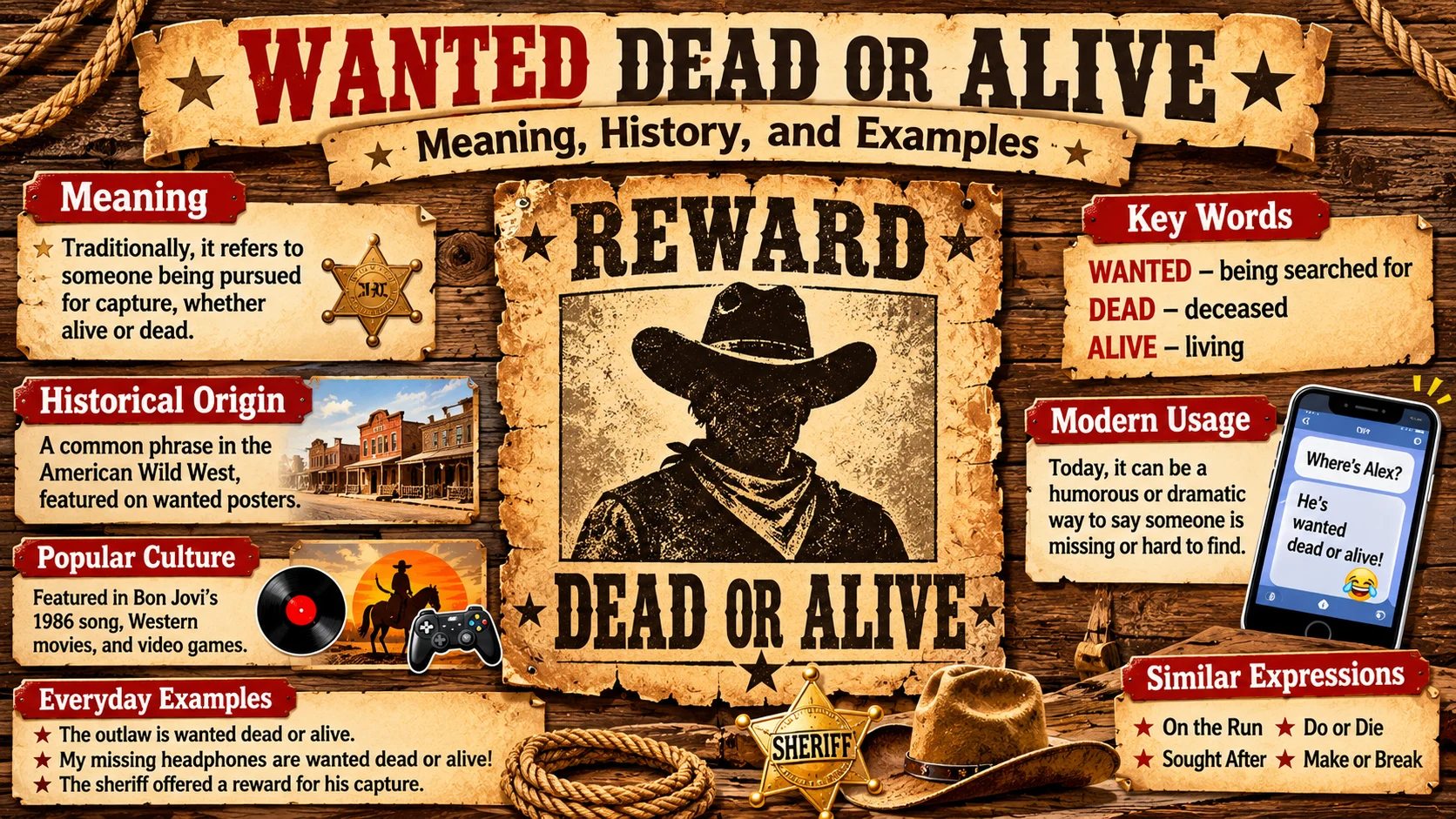
Wanted dead or alive is a phrase traditionally used on wanted posters to indicate that a person should be captured, whether dead or alive. Historically associated with the American Wild West, the expression referred to people being pursued by law enforcement or bounty hunters. Today, it can also describe someone who is being searched for urgently or dramatically, often in movies, songs, and popular culture.
Have you ever seen an old Western movie featuring a poster that says “WANTED: DEAD OR ALIVE”? This famous expression has become one of the most recognizable phrases associated with the American Wild West. The wanted dead or alive meaning refers to a person being sought by authorities or bounty hunters, with the notice indicating that the person can be captured either dead or alive.
Historically, wanted posters displayed the names and descriptions of people accused of crimes. In some cases, they also offered financial rewards for information leading to their capture. Therefore, the phrase became closely connected with outlaws, sheriffs, law enforcement, and the adventurous atmosphere of Western stories.
However, the expression is no longer limited to historical posters. Today, people recognize it through movies, television, music, video games, and everyday conversations. It can even be used humorously when someone is difficult to find or has disappeared without telling anyone where they are going.
In this guide, you’ll discover what wanted dead or alive means, where the expression originated, how it became popular, and how people use it in different situations. You’ll also explore real-life examples, related expressions, common misunderstandings, and frequently asked questions.
What Does Wanted Dead or Alive Mean?
The expression wanted dead or alive means that someone is being sought by authorities or another pursuing party, and the person may be captured regardless of whether they are alive or dead.
The phrase traditionally appeared on public notices and wanted posters. These posters identified individuals who were accused of crimes or were wanted for questioning or capture. Depending on the circumstances, a reward might be offered to anyone who helped locate or apprehend the person.
The expression has two important parts:
- Wanted: Someone is being actively searched for by authorities, investigators, or another person.
- Dead or alive: The person can be brought back either deceased or alive.
Together, these words communicate that the search or capture is the primary objective, regardless of the person’s condition.
For example, imagine an old Western movie in which a sheriff places a poster outside a saloon. The poster displays a criminal’s photograph and the words “WANTED DEAD OR ALIVE.” This means the authorities are looking for that individual and will accept either outcome under the terms of the notice.
Nevertheless, the phrase can have a figurative meaning in modern conversation. Someone might jokingly say, “You’re wanted dead or alive!” when friends are desperately trying to find a person who has stopped answering their messages.
Wanted Dead or Alive Meaning in Simple Words
In simple English, wanted dead or alive means that someone must be found and captured, whether that person is alive or dead.
It is an expression of pursuit, urgency, and determination.
Consider these simple explanations:
- Someone is being searched for.
- Authorities want to capture a particular person.
- A reward may be offered for capturing the person.
- The search does not depend on whether the person is alive.
- The expression can describe a serious pursuit or a humorous search.
For instance:
“That outlaw is wanted dead or alive.”
This sentence means that the outlaw is being pursued and authorities want to capture him, regardless of whether he is alive or dead.
In everyday speech, however, the expression does not always involve an actual criminal or dangerous situation.
Origin and History of Wanted Dead or Alive
The expression became especially recognizable through the history and popular mythology of the American Wild West.
During the nineteenth century, law enforcement agencies, local authorities, and private organizations sometimes circulated notices seeking individuals accused of crimes. These notices helped communicate descriptions and identifying information to the public.
In places where law enforcement had limited resources, locating suspected criminals could be difficult. Consequently, wanted notices helped spread information beyond the immediate area where a crime had occurred.
Some notices offered financial rewards for information or assistance leading to an individual’s arrest or capture. Such rewards encouraged members of the public, including professional bounty hunters, to help locate wanted individuals.
The words “dead or alive” indicated that the person was being sought regardless of their condition when found. However, the wording and conditions of historical rewards varied. It should not be interpreted as a universal legal authorization to kill someone.
The Role of Wanted Posters
Wanted posters played an important role in the public image of the American frontier.
They commonly included details such as:
- The wanted person’s name or alias.
- A physical description.
- The alleged offense.
- A photograph or illustration, when available.
- A reward amount, if offered.
- Information about the authority or organization seeking the individual.
Additionally, these posters helped create a recognizable visual style that continues to appear in Western entertainment.
The Wild West Connection
The American Wild West became strongly associated with cowboys, sheriffs, outlaws, horseback pursuits, saloons, and frontier towns.
As Western stories became popular in books, films, and television, wanted posters became a familiar storytelling element. The words “wanted dead or alive” helped audiences immediately understand that a particular character was being hunted.
Although popular Western stories sometimes exaggerate historical events, they helped establish the phrase as a lasting part of American cultural imagery.
Is Wanted Dead or Alive an Idiom?
Yes, wanted dead or alive can function as an idiomatic expression in modern English.
An idiom is a group of words whose meaning is understood as a familiar expression rather than simply through its individual words.
The phrase originally had a relatively direct meaning in wanted notices. However, popular culture has expanded its use beyond its historical setting.
For example:
“My brother is wanted dead or alive because he borrowed everyone’s money.”
This sentence is probably humorous rather than a genuine criminal notice. It suggests that the speaker’s brother is being searched for because of something he has done.
Similarly, someone might say:
“The missing dog is wanted dead or alive.”
In this situation, the speaker is using the dramatic expression to emphasize the urgency of finding the animal. However, the intended outcome would naturally be to find the dog alive.
Wanted Dead or Alive Meaning in Modern Slang
In modern informal language, wanted dead or alive can be used humorously or dramatically to describe someone who is difficult to locate.
It is not necessarily a fixed internet slang term. Instead, it is a familiar historical expression that people adapt for jokes, captions, conversations, and entertainment.
For example:
- “My roommate is wanted dead or alive for eating my pizza.”
- “That missing phone is wanted dead or alive.”
- “The person who took my charger is wanted dead or alive.”
- “Our friend disappeared before paying the restaurant bill. Wanted dead or alive!”
In these examples, the phrase exaggerates the speaker’s frustration or determination to find someone.
Furthermore, social media users may use the expression as a caption for a missing item, an absent friend, or a playful challenge.
Wanted Dead or Alive in Popular Culture
The expression has remained popular because it frequently appears in entertainment.
Its association with Western history makes it useful for stories about crime, adventure, danger, and pursuit. Meanwhile, modern references have introduced the phrase to audiences who may never have seen an actual historical wanted poster.
Wanted Dead or Alive by Bon Jovi
One of the best-known modern references is “Wanted Dead or Alive,” a song by the American rock band Bon Jovi, released on its 1986 album Slippery When Wet.
The song uses Western imagery to explore life on the road, fame, loneliness, and the demanding lifestyle of a traveling performer.
Its title draws on the familiar language of wanted posters. However, the song uses the expression metaphorically rather than describing a straightforward criminal pursuit.
This musical reference helped keep the phrase recognizable across generations.
Movies and Television
Western films and television shows frequently use wanted posters to establish a character’s reputation or introduce a dangerous situation.
A poster displaying “WANTED DEAD OR ALIVE” can communicate several things immediately:
- A character is being pursued.
- Authorities consider the person important to capture.
- A reward may be involved.
- The character may be an outlaw or fugitive.
- A confrontation could occur.
Consequently, filmmakers often use the expression to create suspense and establish the setting.
Video Games
The phrase also appears in games featuring Western settings, criminal investigations, and bounty-hunting missions.
For example, a player might encounter a wanted notice describing a fugitive and offering a reward for their capture.
In such games, the expression helps establish the mission’s objective and adds historical atmosphere.
Real-Life Examples of Wanted Dead or Alive
Understanding the expression becomes easier when you see how it works in different situations.
Historical Example
“The sheriff placed a wanted dead or alive poster outside the town hall.”
Meaning: The sheriff publicly announced that authorities were searching for a particular individual.
Western Movie Example
“The notorious outlaw was wanted dead or alive throughout the territory.”
Meaning: The outlaw was being pursued by authorities, who wanted to capture him regardless of his condition.
Funny Conversation Example
“My little brother is wanted dead or alive for hiding the television remote.”
Meaning: The speaker is jokingly expressing frustration and wants to find the person responsible.
Missing Person Example
“The family searched everywhere for their missing relative, joking that he was wanted dead or alive.”
Meaning: The expression emphasizes how urgently they want to locate the missing person. In a genuine missing-person situation, the priority is, of course, finding them safely.
Workplace Example
“The manager jokingly announced that the employee who misplaced the office keys was wanted dead or alive.”
Meaning: The manager humorously wants to identify the person responsible for losing the keys.
Social Media Example
“Whoever borrowed my headphones without asking is wanted dead or alive!”
Meaning: The person is using exaggerated humor to express annoyance and locate the missing headphones.
How to Use Wanted Dead or Alive in a Sentence
The expression can appear in different types of sentences, depending on whether the speaker is discussing history, entertainment, or an everyday situation.
Here are some natural examples:
- The outlaw was wanted dead or alive by the local sheriff.
- A wanted dead or alive poster appeared on the saloon door.
- The bounty hunter accepted the job to find the fugitive.
- The famous criminal was wanted dead or alive across several states.
- My missing wallet is wanted dead or alive!
- The sheriff offered a reward for the outlaw’s capture.
- Everyone was looking for the missing team captain.
- The movie featured a classic wanted dead or alive notice.
- That old Western poster used the famous expression.
- The missing dog was wanted dead or alive, preferably alive!
- His disappearance turned into a family joke.
- The song uses the phrase as a metaphor for a restless lifestyle.
Short Dialogue Examples
Dialogue: Friends
Alex: “Have you seen my headphones?”
Chris: “No. Why?”
Alex: “Whoever took them is wanted dead or alive!”
Meaning: Alex is jokingly expressing frustration because the headphones are missing.
Dialogue: Western Town
Sheriff: “Have you seen this man?”
Resident: “Yes, I saw him near the river yesterday.”
Sheriff: “He’s wanted dead or alive. We need to find him.”
Meaning: The sheriff is searching for a person who is being pursued by authorities.
Dialogue: Family
Mom: “Where is your brother?”
Daughter: “Nobody knows. He’s wanted dead or alive for missing dinner again!”
Meaning: The daughter is humorously describing her brother’s absence.
Different Contexts and Tones of Wanted Dead or Alive
The meaning of this expression can change depending on the situation and the speaker’s intention.
Serious and Historical
In historical contexts, the phrase refers to an actual pursuit or capture notice.
Example: “The outlaw was wanted dead or alive.”
Tone: Serious, historical, and authoritative.
Dramatic and Cinematic
In movies and fictional stories, the expression creates suspense and suggests danger.
Example: “The criminal is wanted dead or alive across the country.”
Tone: Dramatic, intense, and suspenseful.
Humorous and Playful
In everyday conversations, people sometimes exaggerate their frustration by using the expression jokingly.
Example: “My sister is wanted dead or alive for stealing my favorite sweater.”
Tone: Funny, sarcastic, and playful.
Determined and Urgent
The phrase can also emphasize a strong desire to locate someone or something.
Example: “That missing document is wanted dead or alive before the meeting!”
Tone: Urgent and determined.
Synonyms and Similar Expressions
Although no single expression matches every meaning of wanted dead or alive, several phrases communicate similar ideas.
| Expression | Meaning | Context |
|---|---|---|
| Wanted | Sought by authorities or another party | Legal and general |
| On the run | Escaping from authorities | Crime and fiction |
| Fugitive | A person escaping custody or law enforcement | Legal |
| On someone’s trail | Actively searching for someone | Informal |
| Sought after | Desired or actively searched for | General |
| Do or die | A situation involving extremely high stakes | Motivational |
| Make-or-break | A situation that determines success or failure | Everyday use |
| Dead or alive | Regardless of whether someone is living or deceased | General and historical |
| Missing | Unable to be located | Everyday use |
| Bounty hunter target | A person being pursued for a reward | Western and crime stories |
Wanted vs. Wanted Dead or Alive
- Wanted simply means that someone is being searched for or is desired by another person or authority.
- Wanted dead or alive is more specific. It traditionally indicates that the person being pursued may be captured regardless of whether they are alive or dead.
Example:
- “The police want to question the suspect.”
- “The outlaw is wanted dead or alive.”
The second sentence communicates a more dramatic and historically specific form of pursuit.
Wanted Dead or Alive vs. Do or Die
These expressions may sound similarly dramatic, but they have different meanings.
Wanted dead or alive describes someone being pursued, traditionally for capture.
Do or die describes a situation in which someone must succeed or face serious consequences.
For example:
- “The outlaw was wanted dead or alive.”
- “Tomorrow’s championship is a do-or-die match.”
The first concerns pursuit, while the second emphasizes high stakes.
Common Situations Where People Use the Phrase
The expression works in several settings, although its tone should match the situation.
Movies and entertainment: Writers use it to create suspense around criminals, fugitives, and bounty hunters.
Social media: Users may turn it into a funny caption about a missing friend or stolen possession.
Everyday conversations: Friends and family members can use it as an exaggerated joke.
Historical discussions: Teachers and writers use it when explaining frontier law enforcement and old Western culture.
Music: Artists may use it symbolically to explore freedom, danger, identity, or life on the road.
Games: Developers use the expression in fictional missions involving wanted characters and bounty hunting.
Common Mistakes When Understanding Wanted Dead or Alive
Although the expression seems straightforward, people sometimes misunderstand its meaning.
Assuming It Always Describes a Criminal
The phrase is historically associated with people pursued by authorities. Nevertheless, modern speakers can use it jokingly for someone who is missing or difficult to find.
Thinking It Always Means Someone Will Be Killed
The phrase does not automatically mean that someone has been legally sentenced to death. It traditionally describes the terms of a pursuit or reward notice. The historical and legal circumstances varied.
Confusing It With Do or Die
Both expressions sound dramatic, but they communicate different ideas. One describes a person being pursued, while the other describes a high-pressure situation.
Treating Every Use as Serious
When someone says, “My brother is wanted dead or alive for eating my cookies,” the statement is probably humorous. Context determines whether the expression is literal, historical, fictional, or playful.
Assuming It Is Only Used in Western Movies
The phrase originated in a historical context associated with wanted notices, but it continues to appear in music, gaming, social media, and ordinary conversations.
Advantages and Disadvantages of Using Wanted Dead or Alive
Like other dramatic expressions, this phrase can be effective when used in the right context.
Advantages
- Creates strong imagery: It immediately brings wanted posters and Western stories to mind.
- Communicates urgency: The expression suggests that someone is determined to find a person.
- Adds humor: It can make ordinary complaints sound exaggerated and entertaining.
- Works in storytelling: Writers can use it to create suspense and establish a character’s reputation.
- Has cultural recognition: Many people recognize the expression from movies, music, and popular culture.
Disadvantages
- Can sound threatening: Without context, the words may appear aggressive.
- May cause confusion: Some readers might interpret a humorous statement literally.
- Can be inappropriate: It is not suitable for every professional or sensitive situation.
- Sounds dramatic: Using it for minor situations may seem exaggerated.
- Has historical associations: The phrase may not communicate the intended meaning in formal writing.
Is Wanted Dead or Alive Still Used Today?
Yes, the expression remains recognizable in modern English.
Although people do not generally use it for everyday official announcements, it continues to appear in entertainment, jokes, captions, and cultural references.
For example, someone might post a picture of a missing pet with a playful caption saying, “Wanted dead or alive: Last seen stealing food from the kitchen.”
Similarly, a person might jokingly describe a friend who has disappeared from a group chat as being wanted dead or alive.
However, in genuine missing-person situations, it is better to use clear and respectful language, such as “missing person” or “please help us find them.”
The phrase remains useful because it combines historical imagery with a memorable sense of urgency.
Practice Exercises: Wanted Dead or Alive
Test your understanding of the expression with these short exercises.
Fill in the Blanks
Complete each sentence using the correct expression.
- The sheriff placed a ______ poster outside the courthouse.
- The outlaw was wanted ______ or alive.
- My brother is wanted dead or alive for hiding my ______.
- The bounty hunter received a reward for capturing the ______.
- The phrase is strongly associated with the American ______ West.
Multiple-Choice Questions
What does wanted dead or alive traditionally mean?
A. Someone is looking for a job.
B. Someone is being pursued for capture, regardless of whether they are alive or dead.
C. Someone wants to travel.
D. Someone is looking for a new home.
Which historical setting is strongly associated with the phrase?
A. Ancient Greece
B. Victorian England
C. The American Wild West
D. Modern Hollywood
Which situation demonstrates a humorous use of the expression?
A. A sheriff searches for an outlaw.
B. A student studies for an examination.
C. A friend jokes that someone who borrowed their phone is wanted dead or alive.
D. A teacher explains grammar.
What does the word wanted mean in the expression?
A. Desired or sought.
B. Forgotten.
C. Celebrated.
D. Protected.
Which expression describes a high-stakes situation requiring success?
A. On the run.
B. Do or die.
C. Wanted poster.
D. Sought after.
Answers and Explanations
Fill in the blanks:
- Wanted
- Dead
- Remote
- Fugitive
- Wild
Multiple-choice answers:
- B — The expression traditionally describes a person being pursued for capture, dead or alive.
- C — The American Wild West is strongly associated with wanted posters.
- C — This example uses the expression as a humorous exaggeration.
- A — Wanted means desired or actively sought.
- B — Do or die describes a high-pressure situation with serious consequences.
Frequently Asked Questions
What does wanted dead or alive mean in simple English?
It means that someone is being searched for and can be captured whether they are alive or dead. The expression is traditionally associated with wanted posters and the American Wild West.
Is wanted dead or alive a threat?
Not necessarily. Historically, it appeared on notices seeking the capture of particular individuals. However, people may also use it jokingly in everyday conversations. The speaker’s intention and surrounding context determine whether it sounds threatening or playful.
Where did the phrase wanted dead or alive originate?
The expression is strongly associated with historical wanted notices and bounty-hunting practices in the American frontier. It became especially recognizable through Western stories, films, and popular culture.
What does wanted dead or alive mean in slang?
In informal speech, it can humorously describe someone who is difficult to find. For example, “My roommate is wanted dead or alive for taking my charger” exaggerates the speaker’s frustration.
Is wanted dead or alive an idiom?
Yes, it can function as an idiomatic expression. Although it originated in the context of wanted notices, modern speakers also use it figuratively and humorously.
What is the difference between wanted and wanted dead or alive?
Wanted means someone is being searched for or desired. Wanted dead or alive traditionally means that a person is being pursued for capture regardless of whether they are alive or dead.
What does wanted dead or alive mean in a Western movie?
In a Western movie, the expression usually appears on a poster announcing that a criminal or outlaw is being pursued. It may also indicate that a reward is available for capturing the person.
What is a bounty hunter?
A bounty hunter is someone who seeks to capture individuals in exchange for a financial reward, subject to applicable laws. Bounty hunters are frequently featured in Western stories and crime entertainment.
Is wanted dead or alive the same as do or die?
No. Wanted dead or alive traditionally describes a person being pursued for capture. Do or die describes a situation in which someone must succeed or face serious consequences.
What does wanted dead or alive mean in a song?
The phrase can have a metaphorical meaning in music. For example, Bon Jovi’s song uses Western imagery to explore life on the road, freedom, fame, and the challenges of being a traveling performer.
Can I use wanted dead or alive as a joke?
Yes. People sometimes use it humorously when looking for a missing friend, lost possession, or someone who has disappeared. However, consider your audience because the wording can sound aggressive without a clear humorous context.
Is wanted dead or alive grammatically correct?
Yes. It is a grammatically recognizable expression traditionally used in notices seeking someone’s capture. It can also appear in informal sentences and creative writing.
Key Takeaways: Wanted Dead or Alive Meaning
The expression wanted dead or alive has a long association with American frontier history and the famous wanted posters of the Wild West. Traditionally, it meant that authorities or bounty hunters were searching for someone who could be captured regardless of whether they were alive or dead.
Today, the phrase has a broader cultural presence. It appears in Western movies, music, video games, social media, and everyday conversations. Depending on the situation, it can communicate urgency, danger, determination, or humor.
Remember these important points:
- The phrase traditionally describes someone being pursued for capture.
- It is strongly associated with the American Wild West.
- Historical wanted posters sometimes included financial rewards.
- Modern speakers can use it as a humorous expression.
- Its meaning depends on the context.
- It is not automatically a legal authorization to kill someone.
Ultimately, wanted dead or alive is a memorable expression that connects historical law enforcement language with modern entertainment and everyday English.
Conclusion
Understanding the wanted dead or alive meaning helps explain one of the most recognizable expressions associated with American Western culture. Originally, the phrase appeared on notices seeking the capture of people accused of crimes, with the wording indicating that they could be brought in alive or dead.
Over time, however, its meaning expanded beyond historical wanted posters. Today, people recognize it through Western movies, popular music, video games, and humorous everyday conversations. While it can communicate a serious pursuit, it can also add dramatic or playful emphasis when someone is difficult to find.
Whether you encounter it in a classic Western film, a Bon Jovi song, or a funny social media caption, remember that context determines its intended meaning. In short, wanted dead or alive describes a determined search for someone, traditionally regardless of their condition when captured.