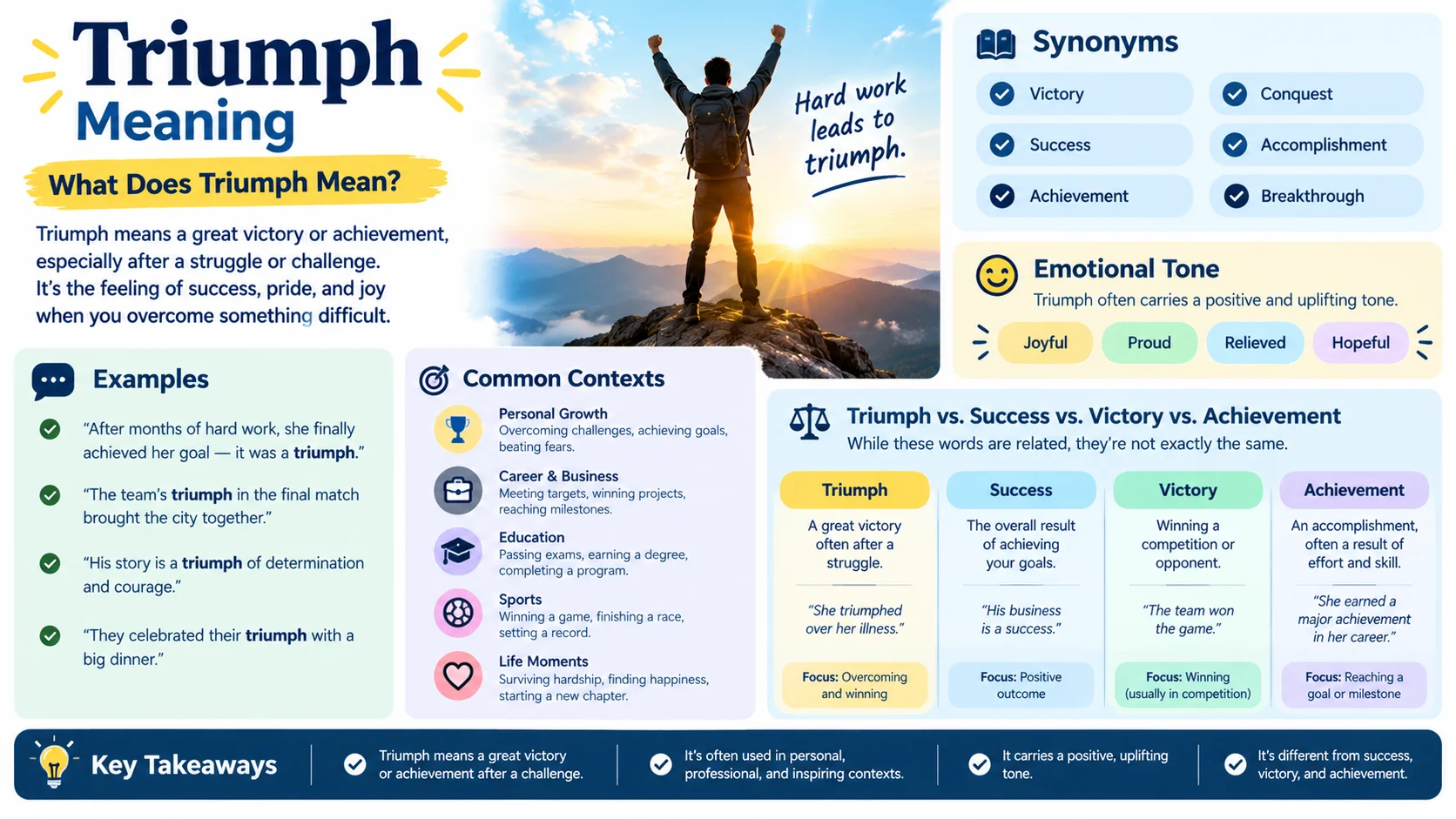
Triumph meaning refers to a major victory, success, or achievement, especially after difficulty or struggle. It can describe winning, overcoming an obstacle, or experiencing a powerful feeling of success and accomplishment.
Triumph meaning is easiest to understand as a strong form of success or victory that often follows effort, struggle, competition, or an important challenge. For example, someone who finally graduates after years of hard work can describe that achievement as a triumph.
However, the word carries more emotional weight than simple success. It often suggests that something difficult was overcome. Therefore, saying “Her recovery was a triumph” communicates more than “Her recovery was successful.” It highlights the challenge, effort, and emotional importance behind the result.
In American English, people use the word in everyday conversation, writing, speeches, social media captions, sports discussions, professional communication, and personal storytelling. It can sound formal, inspirational, dramatic, or celebratory depending on context.
This guide explains the definition, history, emotional tone, conversational uses, related expressions, common mistakes, and practical examples. It also shows how the term can appear across modern digital platforms.
Quick Answer Box
| Category | Answer |
| Meaning | A major victory, success, or achievement |
| Context | Personal goals, sports, work, education, competition, difficult situations |
| Primary Platforms | Instagram, TikTok, Snapchat, texting, blogs, professional writing |
| Example | “Finishing the marathon was a triumph.” |
| Tone | Positive, celebratory, powerful, sometimes formal |
What Does triumph Mean?
The triumph meaning centers on victory, achievement, or successful completion of something difficult. The word usually suggests more than an ordinary positive result.
For example, completing a challenging degree can be called a triumph. Winning an important championship can also be described as a triumph. Likewise, overcoming a serious personal obstacle may represent a triumph.
The word can function as both a noun and a verb.
| Form | Meaning | Example |
| Noun | A great victory or achievement | “The victory was a triumph.” |
| Verb | To succeed or win | “She triumphed over adversity.” |
| Related adjective | Connected with victory | “The team enjoyed a triumphant return.” |
As a noun, triumph identifies the achievement itself. As a verb, it describes the act of succeeding.
The term can also describe emotional satisfaction. Someone may feel triumphant after accomplishing something that once seemed impossible.
The Historical Origin
The English word comes through Latin triumphus, referring to a formal celebration of victory. The Latin term is associated with the ancient Roman triumph, a ceremonial procession honoring a victorious military commander.
The history helps explain why the modern word can feel grand or dramatic. Over time, its meaning expanded beyond military victory. Today, people can describe academic achievements, personal breakthroughs, business accomplishments, athletic wins, and other major successes as triumphs.
Therefore, modern usage does not require an actual competition. A person can triumph over fear, uncertainty, failure, or hardship.
Triumph Compared With Simple Success
Success and triumph overlap, but they do not always create the same impression.
Success can describe almost any favorable result. Triumph usually suggests a stronger achievement, especially when the result required determination or overcame opposition.
| Word | Strength | Typical Impression |
| Success | Moderate | A desired result was achieved |
| Victory | Strong | Someone won against competition or opposition |
| Triumph | Very strong | A meaningful victory after challenge |
| Achievement | Neutral to strong | Something important was accomplished |
| Breakthrough | Strong | A major obstacle or limitation was overcome |
Consequently, calling something a triumph adds emotional significance.
Contextual Dynamics and Nuances of the Term
The exact interpretation changes according to context. A sports writer may use the word for a championship victory. A student may use it for graduation. A friend may use it humorously after completing a small task.
Personal Achievement
Personal achievements are one of the most natural contexts.
Someone might say, “Getting my first apartment felt like a triumph.” The statement suggests independence, effort, and emotional satisfaction.
Similarly, finishing a difficult project can feel like a personal victory. The word works particularly well when the speaker wants to emphasize the journey.
Sports and Competition
Sports journalism frequently uses triumph to describe major victories.
For example, a headline might describe a team’s championship as a remarkable triumph. The word works well because sports naturally involve competition, pressure, preparation, and winning.
However, it can sound exaggerated when used for every minor win. Saying that someone’s team had a “triumph” after winning a casual practice game may sound intentionally dramatic.
Education
Academic accomplishments can also qualify.
A student might describe graduating after overcoming financial or academic difficulties as a triumph. In this context, the word emphasizes persistence rather than merely receiving a certificate.
Professional Life
Businesses and professionals may use the term in speeches, reports, presentations, and promotional writing.
For example, a company could describe a successful product launch as a triumph. Yet professional writers should use the word carefully because excessive praise can make a statement sound promotional.
Emotional Context
The term often carries a feeling of pride and relief.
It can suggest that the person did not simply succeed. Instead, they succeeded despite something that made the achievement meaningful.
| Context | Likely Emotional Effect |
| Graduation | Pride |
| Championship | Excitement |
| Recovery | Relief and hope |
| Career achievement | Confidence |
| Personal goal | Satisfaction |
| Overcoming failure | Determination |
Real Life Conversation Examples Using triumph meaning
The following examples show how the word can appear naturally in conversations.
Conversation One: Graduation
Maya: I finally finished my degree.
Jordan: That is huge. You worked so hard for it.
Maya: Honestly, it feels like a triumph after everything that happened.
Jordan: You absolutely earned that feeling.
Here, the word emphasizes the difficulty of reaching graduation.
Conversation Two: Sports
Alex: Did you watch the final game?
Sam: Yes. That comeback was unbelievable.
Alex: The whole thing felt like a triumph.
Sam: Especially after they were behind for most of the game.
In this situation, the word highlights the dramatic comeback.
Conversation Three: Work
Nina: The presentation went better than I expected.
Chris: I knew you would nail it.
Nina: After all those revisions, it felt like a small triumph.
Chris: Definitely. You survived the presentation marathon.
Here, the expression sounds natural and slightly humorous.
Conversation Four: Personal Goal
Evan: I ran my first five kilometer race today.
Leo: Seriously? Nice!
Evan: I wanted to quit halfway through, but finishing felt like a triumph.
Leo: That makes the finish even better.
The word emphasizes perseverance rather than competition.
Conversation Five: Everyday Humor
Sara: I finally fixed the printer.
Emma: Wait, you actually fixed it?
Sara: Somehow, yes. Today is a triumph.
Emma: Someone alert the entire office.
This example uses the word playfully. The achievement is small, but the dramatic language creates humor.
Platform Specific Breakdown
Digital platforms often favor short, emotional language. However, the word is not internet slang in the strict linguistic sense. It is a standard English word that can gain different tones online.
How It Is Used on Snapchat
Snapchat messages are usually brief, casual, and personal.
Someone might send a photo after finishing a difficult assignment with the caption “Tiny triumph today.” The phrase works because it turns an ordinary achievement into a celebratory moment.
Another person might jokingly write “Triumph achieved” after cleaning their room or finally replying to overdue messages.
The platform context makes the expression feel more playful than formal.
The Role of triumph meaning on TikTok
TikTok often uses emotional language alongside storytelling.
Creators may describe a difficult experience and frame the final result as a triumph. This can appear in videos about fitness, education, career progress, personal development, or overcoming setbacks.
For example, a creator might post a before and after video showing months of training. The caption could say, “Not perfection. Just a triumph.”
The word works especially well when a creator wants to compress a long story into a powerful emotional idea.
Instagram and Texting Dynamics
Instagram captions often favor concise emotional statements.
Examples include:
“Small steps. Big triumph.”
“Today feels like a triumph.”
“From struggle to triumph.”
Texting tends to be more casual. A friend might say, “That exam was brutal, but I survived. Major triumph.”
Therefore, punctuation, surrounding words, emojis, and context can change the perceived tone.
| Platform | Typical Style | Example |
| Snapchat | Casual and playful | “Tiny triumph today.” |
| TikTok | Story driven | “From setback to triumph.” |
| Inspirational | “A hard earned triumph.” | |
| Texting | Casual and emotional | “That was a triumph.” |
| Professional | “A meaningful professional triumph.” |
Alternative Meanings and NLP Variations of the Phrase
Natural language processing systems need to understand that the concept can appear in many forms.
Common semantic variations include victory, success, achievement, accomplishment, win, breakthrough, conquest, milestone, accomplishment, and overcoming adversity.
However, these terms are not always interchangeable.
Triumph and Victory
Victory usually means winning against an opponent or competing side.
Triumph can describe the same event, but it often carries stronger emotional significance.
For example, “The team secured a victory” sounds factual. “The team celebrated a triumph” sounds more emotional and dramatic.
Triumph and Achievement
Achievement focuses on accomplishing something worthwhile.
Triumph focuses more strongly on the difficulty, victory, or emotional importance surrounding the accomplishment.
Triumph and Breakthrough
A breakthrough usually involves discovering, achieving, or reaching something that was previously difficult or impossible.
A triumph may follow that breakthrough, but the concepts are not identical.
Triumph and Milestone
A milestone marks meaningful progress.
A triumph describes a successful outcome or victory. Therefore, a milestone does not always imply that a struggle has been overcome.
| Expression | Core Idea | Emotional Weight |
| Success | Desired result | Medium |
| Achievement | Important accomplishment | Medium |
| Victory | Winning | Strong |
| Breakthrough | Major progress | Strong |
| Milestone | Significant stage | Moderate |
| Triumph | Meaningful victory | Very strong |
Misinterpretations: When NOT to Use triumph meaning
Although the word is positive, it is not appropriate for every successful event.
Using overly dramatic language for a minor situation can make the speaker sound sarcastic or theatrical.
For example, saying “My triumph was finding a parking space” may be funny if parking was extremely difficult. In a formal report, however, the same statement would probably sound inappropriate.
Avoid It When the Result Is Ordinary
If something happens routinely, a simpler word usually works better.
Instead of calling every completed task a triumph, use success, completion, result, or achievement.
Avoid It When You Want Neutral Language
Formal reports often benefit from precise language.
For example, “The project reached its target” is more neutral than “The project achieved a spectacular triumph.”
Avoid It When the Outcome Is Still Uncertain
Triumph implies success. Therefore, using it before an outcome is known can create confusion.
Say “We hope this becomes a success” when the result remains uncertain.
Avoid Unintentionally Insensitive Comparisons
Context matters when discussing serious personal experiences.
Calling another person’s hardship a “triumph” without knowing how they feel can sound dismissive. It is better to let the person define their own experience.
How to Respond in Chat Comfortably
If someone uses the word in a message, your response should match their emotional tone.
When Someone Shares a Personal Triumph
You can respond warmly.
“Honestly, I’m so happy for you.”
“You worked for this. Enjoy the moment.”
“That is a huge accomplishment.”
When Someone Uses It Humorously
Match the playful energy.
“Historic moment.”
“Someone alert the newspapers.”
“Legendary behavior.”
When Someone Uses It in a Serious Context
Keep your response sincere.
“You should be proud of yourself.”
“That sounds like it took a lot of determination.”
“I’m glad things worked out for you.”
When Someone Says It About Your Achievement
You can accept the compliment without sounding overly formal.
“Thank you. It really does feel good.”
“I appreciate that. It was a long journey.”
“Honestly, I’m proud of how far I’ve come.”
The key is to respond to the emotion behind the statement, not just the vocabulary.
FAQs
What does triumph mean in simple English?
It means a major victory or success. It often describes achieving something important after facing difficulty, competition, failure, or another significant challenge.
Is triumph positive or negative?
Triumph is normally positive. It communicates victory, achievement, satisfaction, pride, or relief. However, context can make it sound sarcastic or overly dramatic.
Is triumph the same as success?
Not exactly. Success is a broad term for achieving a desired result. Triumph usually carries stronger emotional meaning and often suggests overcoming a significant challenge.
Can triumph describe a person?
Yes. You can say someone triumphed over a difficult situation. In this construction, triumph works as a verb and emphasizes successful overcoming.
Can I use triumph in a sentence?
Yes. For example, “Completing the project after months of work was a triumph.” The sentence highlights both the achievement and the effort behind it.
Is triumph formal or informal?
The word works in both settings. It can sound formal in professional or literary writing, but people also use it casually and humorously in everyday conversation.
Is triumph an internet slang word?
No. Triumph is a standard English word, not modern internet slang. Social media users may use it creatively, but the underlying vocabulary is much older.
What is another word for triumph?
Depending on context, alternatives include victory, success, achievement, accomplishment, breakthrough, win, and conquest. The best choice depends on the situation and emotional tone.
What is the opposite of triumph?
Common opposites include defeat, failure, loss, disappointment, and setback. The best opposite depends on whether the context involves competition, achievement, or personal progress.
Why does triumph sound stronger than success?
The word often implies more than simply getting a desired result. It can suggest struggle, persistence, opposition, relief, and emotional significance, which gives it greater expressive power.
Conclusion
Understanding the meaning of triumph becomes easier when you focus on the idea of meaningful victory. The word describes more than simply getting a good result. Instead, it often highlights effort, difficulty, persistence, and emotional satisfaction.
Today, the word works across everyday conversation, professional writing, sports coverage, social media, captions, and personal storytelling. On digital platforms, people may also use it humorously for small accomplishments, which gives the expression a playful modern edge.
Still, context matters. A major personal breakthrough may genuinely deserve the word, while an ordinary task may call for something simpler. Ultimately, triumph is strongest when the achievement feels meaningful. Used thoughtfully, it adds confidence, emotion, and a clear sense of accomplishment to your writing and conversations.
Files, images, and data analysis are unavailable until usage resets at 8:33 PM. Continue chatting with text only, or upgrade for more access.