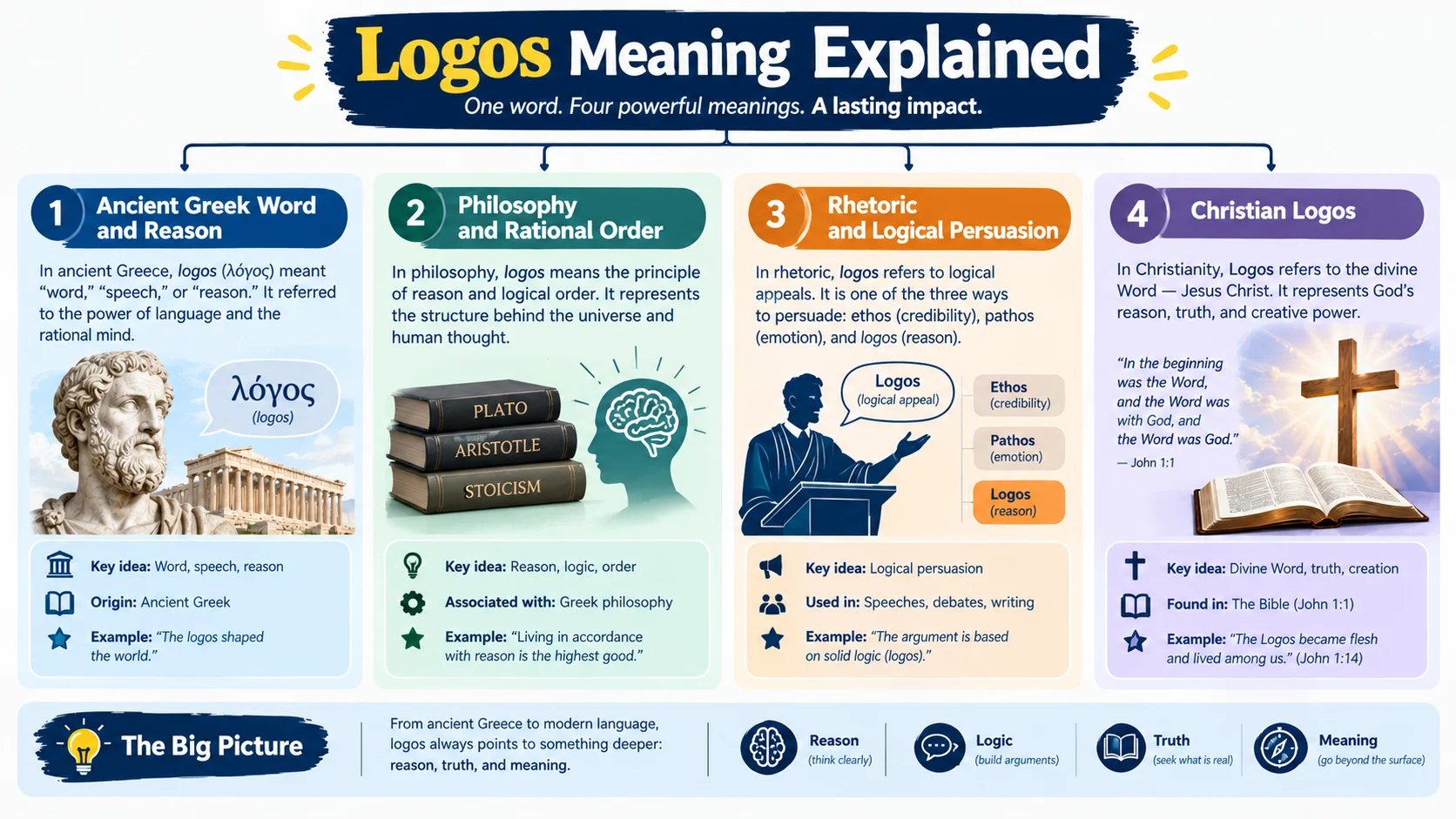
Logos meaning refers to the Greek concept of word, reason, speech, or rational order. In philosophy, logos can mean reason or universal order. In rhetoric, it means logical appeal. In Christianity, Logos refers to Christ as divine Word.
logos meaning can change significantly depending on the context in which you encounter the word. You might see logos in philosophy, religion, rhetoric, literature, psychology, branding, or discussions about language.
At first, the term can feel confusing. After all, the same word can describe rational thought, persuasive reasoning, divine speech, or a symbolic principle of order. However, these meanings share an important connection: logos are closely associated with word, reason, expression, and meaningful order.
The word comes from ancient Greek. Over centuries, philosophers, religious writers, rhetoricians, and scholars developed different uses for it. Consequently, there is no single English translation that captures every sense.
For example, a student studying Aristotle may encounter logos as logical reasoning. A student reading the Gospel of John may encounter Logos as a theological name for Christ. Meanwhile, someone studying persuasive writing may see logos alongside ethos and pathos.
Therefore, understanding context matters more than memorizing one definition.
This guide explains the major meanings, origins, applications, misunderstandings, and modern interpretations of the term. It also shows how to recognize the intended meaning quickly.
Quick Answer Box
| Meaning | Context | Primary Platforms | Example | Tone |
| Word, speech, or reason | Ancient Greek | Academic writing | A discussion of reason and language | Scholarly |
| Rational argument | Rhetoric | Essays, speeches, debates | Evidence supports the claim | Logical |
| Universal order or reason | Philosophy | Philosophy texts | Nature follows an underlying order | Philosophical |
| Divine Word | Christianity | Bible studies, theology | The Word described in John | Religious |
| Symbol or visual identity | Modern branding | Websites, business media | A company logo represents its brand | Commercial |
The key point is simple: logos does not have one universal English equivalent. Its meaning depends on the intellectual, religious, linguistic, or cultural setting.
What Does Logos Mean?
The Greek word logos has a broad semantic range. Common translations include word, speech, statement, account, explanation, reason, argument, principle, and rational order.
That range explains why direct translation can become difficult.
In everyday English, people often reduce logos to “logic.” That connection is understandable, but it is incomplete. The ancient Greek concept could involve language and explanation as well as rational thought.
logos meaning in ancient Greek
In ancient Greek, logos could refer to something spoken or expressed. It could also describe an account, explanation, or rational statement.
For example, giving a logo could involve giving an explanation for something. The word therefore connected language with intelligibility.
This connection became especially important in philosophy. Thinkers began using the term to discuss how humans understand reality and how reality itself might possess an underlying rational structure.
logos meaning in philosophy
Philosophical usage developed across several traditions.
For Heraclitus, logos are associated with an underlying principle or rational order within the changing world. His writings helped establish a powerful philosophical use of the term.
Later thinkers developed the idea in different directions. Stoic philosophy connected logos with rationality and the ordering principle of the cosmos.
Consequently, philosophical discussions of logos can involve both human reasoning and a broader principle of order.
It is important not to treat every philosopher as using the term in exactly the same way. Philosophical vocabulary evolves because different thinkers assign concepts slightly different functions.
logos meaning in rhetoric
In rhetoric, logos refers to an appeal based on reasoning and evidence.
Aristotle famously discussed three major modes of persuasion: logos, ethos, and pathos.
Logos focus on reasoning. Ethos concerns credibility and character. Pathos appeals to emotion.
For example, consider a speaker arguing that a city should improve public transportation. A logos based argument might present ridership statistics, cost comparisons, traffic data, and environmental evidence.
The goal is not simply to sound intelligent. Instead, the speaker creates a persuasive case through reasoning.
logos meaning in Christianity
Christian theology gives the term a particularly important meaning.
The opening of the Gospel of John describes the Logos as existing with God and being divine. The passage then connects the Logos with Jesus Christ.
This theological usage is commonly translated as the Word.
Here, Logos does not merely mean a spoken sentence. It represents a profound theological concept involving divine revelation, creation, and the identity of Christ.
Therefore, the religious meaning should not be confused with the rhetorical meaning.
logos meaning in branding
Modern English creates another potential source of confusion.
People sometimes connect logos with the English word “logo,” meaning a visual symbol or mark used by an organization. The two words have a historical linguistic relationship, but modern branding terminology has its own specific meaning.
A brand logo can communicate identity quickly. For example, a recognizable symbol may help consumers identify a company without reading its name.
However, saying that a company logo literally means “reason” would be inaccurate. Modern “logo” and ancient Greek logos should be distinguished according to context.
From word to reason
One of the most interesting features of the term is the relationship between speech and reason.
Language allows people to explain ideas. Reason allows people to connect ideas. Therefore, a word associated with both expression and rational explanation can naturally develop several related meanings.
That semantic flexibility explains much of the term’s historical importance.
Contextual Dynamics and Nuances of the Term
Understanding the surrounding sentence is the fastest way to identify the intended sense.
- If you see logos beside Aristotle, persuasion, evidence, or argument, rhetoric is probably relevant.
- If you see it beside John, Christ, creation, or theology, the Christian sense is more likely.
- If the discussion includes Heraclitus, Stoicism, nature, or cosmic order, the philosophical sense may be intended.
Academic context
Academic writing often uses logos as a specialized term.
A philosophy professor might use it when discussing rational order. A communication professor may use it when discussing logical persuasion.
Therefore, readers should avoid translating it automatically as “logic.”
Religious context
Religious discussions often capitalize Logos.
Capitalization can signal a theological reference, especially in Christian writing. However, capitalization practices vary across publishers and translations.
Context remains more reliable than capitalization alone.
Persuasive context
In communication studies, logos usually describe reasoning.
Evidence, statistics, examples, comparisons, causal relationships, and carefully structured arguments can all contribute to logos.
However, a logical appeal does not automatically make an argument correct. A person can present weak evidence in a logical looking format.
Consequently, logos should be evaluated for both structure and evidence.
Literary context
Literature can use logos more creatively.
A writer may explore the tension between reason and emotion. Another writer may use the concept to examine language, truth, order, or communication.
In literary criticism, the meaning depends heavily on the author’s argument.
Cultural context
Words acquire new associations as they move between cultures.
A Greek philosophical term can enter Latin, Christian theology, European philosophy, academic English, and modern popular culture. Each stage can add new associations.
That history makes simplistic one word translations risky.
Real-Life Conversation Examples Using logos meaning
Because logos is an academic and philosophical term, it does not usually function like casual internet slang. Still, people can use it naturally when discussing ideas.
Example 1: A philosophy class
Student: “Why does the professor keep mentioning logos?”
Friend: “It depends on the philosopher. Here, they probably mean reason or an underlying rational principle.”
Student: “So it does not simply mean logic?”
Friend: “Right. It can be broader than that.”
Example 2: A debate
Student: “Her argument was convincing.”
Friend: “Was it the evidence or the emotional delivery?”
Student: “Mostly the evidence. The logo was strong.”
Here, the speaker uses the term to describe logical persuasion.
Example 3: A theology discussion
Student: “What does Logos mean in the Gospel of John?”
Friend: “It refers to the divine Word and is connected with Christ.”
Student: “So that is different from the rhetorical meaning?”
Friend: “Exactly. The context changes the meaning.”
Example 4: A writing lesson
Teacher: “Your essay has strong emotional language.”
Student: “Is that a problem?”
Teacher: “Not necessarily. But you also need logos. Add evidence that supports your claims.”
This example demonstrates the relationship between pathos and logos in persuasive writing.
Example 5: A philosophy conversation
- Person A: “I keep hearing that ancient philosophers talked about logos.”
- Person B: “They did, but not always in the same way.”
- Person A: “So I should check which philosopher is being discussed?”
- Person B: “Yes. That is the safest approach.”
This is especially useful because the term has a long intellectual history.
Platform Specific Breakdown
Modern platforms can mention logos in different ways. However, its meaning remains dependent on the surrounding conversation.
Social media users may discuss philosophy, Christianity, debate techniques, or branding within the same platform. Therefore, the platform itself does not determine the definition.
How It Is Used on Snapchat
Snapchat conversations tend to be informal and visual. Someone may mention logos while discussing a class assignment, religious topic, debate, or brand identity.
For example, a student might send a photo of class notes and ask what the word means.
A natural response would be:
“Here, logos means reasoning or a rational argument.”
However, if the screenshot comes from a Bible study, the explanation may need to change.
“Here, Logos refers to the divine Word in Christian theology.”
The same word can therefore require completely different explanations.
The Role of logos meaning on TikTok
TikTok frequently turns academic concepts into short educational content.
Creators may explain rhetoric using the familiar trio of logos, ethos, and pathos. Others may discuss ancient Greek philosophy or Christian theology.
Short videos can simplify complicated concepts. However, simplification can also remove important distinctions.
For example, saying “logos means logic” works as a basic introduction to rhetorical logos. It does not fully explain the ancient Greek concept.
Therefore, viewers should treat short explanations as starting points rather than complete historical definitions.
Instagram and Texting Dynamics
Instagram can present the concept through educational carousels, philosophy posts, religious content, or branding discussions.
Texting creates a different environment. People may use the word while discussing schoolwork or an intellectual topic.
It is less common in casual texting than everyday words such as “logic,” “reason,” or “argument.”
If someone sends you the word without context, the best response is a clarification question:
“Do you mean logos in rhetoric, philosophy, or Christianity?”
That question prevents unnecessary confusion.
Alternative Meanings and NLP Variations of the Phrase
Semantic variation matters because search engines and language models may connect several related concepts to logos.
Common related terms include:
| Term | Typical Meaning | Closest Context |
| Word | Something expressed through language | Language and theology |
| Reason | Rational thought or explanation | Philosophy |
| Logic | Structured reasoning | Rhetoric and philosophy |
| Argument | A reasoned case | Debate |
| Speech | Spoken expression | Ancient Greek usage |
| Account | An explanation or statement | Classical usage |
| Principle | An underlying rule or order | Philosophy |
| Divine Word | The theological Logos | Christianity |
| Logical appeal | Reason based persuasion | Rhetoric |
| Rational order | An ordering principle | Philosophy |
These terms overlap, but they are not perfect substitutes.
For example, “logic” is narrower than every historical use of logos. Similarly, “word” captures one important meaning but misses its philosophical dimensions.
Logos and logic
The connection between the two terms is historically significant. English words related to logic ultimately connect to Greek logos.
Still, modern “logic” usually refers to systems and principles of valid reasoning. Logos can cover a much wider conceptual field.
Logos and ethos
These terms frequently appear together in rhetoric.
Logos concerns reasoning and evidence.
Ethos concerns credibility, character, and authority.
A strong argument may use both. For example, a doctor discussing public health might establish professional credibility while also presenting evidence.
Logos and pathos
Pathos focuses on emotion.
Logos focus on reasoning.
Effective communication often combines both rather than treating them as enemies.
For instance, a charity campaign might use statistics to establish the scale of a problem while using personal stories to create emotional engagement.
Logos and mythos
In broader intellectual discussions, logos can also be contrasted with mythos.
Mythos can involve narrative, symbolic meaning, and traditional stories. Logos tend toward explanation, reason, and structured thought.
The contrast can be useful, but real human communication often combines both.
Misinterpretations: When NOT to Use logos meaning
A major mistake is treating logos as interchangeable with “logic” in every situation.
That shortcut can create inaccurate explanations.
Do not assume it always means logic
In rhetoric, “logical appeal” is a reasonable explanation. In theology, however, Logos has a more specific meaning.
Likewise, in ancient philosophy, the term may involve rational order rather than formal logic.
Do not confuse Logos with a company logo
The English word “logo” refers to a visual identity mark.
Although the terms are historically connected, modern branding uses “logo” in a specific way.
A discussion about Nike’s logo, for example, concerns visual branding rather than philosophical reason.
Do not treat every use as Christian
Christian theology has an important use of Logos, but Christianity does not own the entire concept.
The term existed in Greek language and philosophy before the Christian theological usage became influential.
Therefore, historical context matters.
Do not use the term simply to sound intellectual
Using specialized vocabulary without understanding it can weaken writing.
If “reason,” “evidence,” or “logic” communicates your idea more clearly, use the simpler term.
Good writing values precision over complexity.
Do not assume social media definitions are complete
A viral post may reduce a complicated historical concept to one sentence.
That can help beginners. However, it can also erase important distinctions.
When accuracy matters, consult the surrounding source and identify the field being discussed.
How to Respond in Chat Comfortably
If someone uses logos in a conversation, your response should depend on context.
You do not need to sound overly academic. A simple clarification often works best.
If you do not understand the reference
Try:
“What do you mean by logos here?”
That question is direct and natural.
If you think they mean rhetoric
You could say:
“Do you mean logos as in logical appeal?”
This confirms the interpretation without assuming too much.
If they mean philosophy
Try:
“Are you talking about the philosophical idea of reason or universal order?”
That wording shows awareness while leaving room for clarification.
If they mean Christianity
Try:
“Do you mean Logos as the divine Word in John?”
This works particularly well in theological conversations.
If they are discussing branding
You can ask:
“Do you mean a brand logo or the Greek concept of logos?”
This distinction prevents a very common misunderstanding.
If you want a simple explanation
You can say:
“Basically, it relates to word, reason, or rational explanation, but the exact meaning depends on context.”
That answer works well for general conversations.
FAQs
Logos are not normally classified as internet slang. It is better understood as an ancient Greek term with several specialized modern uses. The following questions address the meanings people most commonly search for.
What is the simplest logo’s meaning?
The simplest explanation is “word, reason, or rational explanation.” However, the best translation depends on context. In rhetoric, it usually concerns logical persuasion. In philosophy, it can involve reason or rational order.
Does logos mean logic?
Not exactly. Logos and logic are historically related, but they are not identical in modern English. “Logic” generally refers to reasoning principles, while logos has a broader semantic range that can include speech, explanation, reason, and order.
What do logos mean in Christianity?
In Christianity, Logos refers especially to the divine Word described in the Gospel of John. Christian theology connects the Logos with Christ. This meaning is distinct from the rhetorical concept of logos as logical persuasion.
Is logos a Greek word?
Yes. Logos is an ancient Greek word with a broad range of meanings. Depending on the period and context, it can refer to speech, word, account, explanation, reason, or rational principle.
What does logos mean in rhetoric?
In rhetoric, logos means an appeal to reason. A speaker uses evidence, facts, examples, statistics, and reasoning to support a position. It is commonly discussed alongside ethos and pathos.
What is the difference between logos, ethos, and pathos?
Logos appeal to reasoning. Ethos appeals to credibility or character. Pathos appeals to emotion. Effective persuasion can combine all three, depending on the audience and purpose.
Are logos used as slang online?
Usually, no. Although social media users may use the term casually while discussing philosophy, rhetoric, religion, or education, logos is not generally considered ordinary internet slang.
Why do logos have so many meanings?
The word developed across different historical and intellectual traditions. Philosophers, rhetoricians, religious writers, and scholars used it in different ways. Consequently, modern translations cannot capture every historical sense with one English word.
Is a logo the same as logos?
No. A modern “logo” is a visual symbol associated with a brand or organization. Although the words are historically related, they have different meanings in contemporary English.
How can I know which meaning is intended?
Look at the surrounding words. Philosophy terms suggest reason or rational order. Debate and persuasion suggest rhetorical logos. Christian theology suggests the divine Word. Branding suggests a visual logo. Context provides the strongest clue.
Conclusion
Understanding logos requires more than memorizing a single definition. The term has traveled across language, philosophy, rhetoric, religion, literature, and modern communication.
Its central ideas often connect language with reason, explanation, expression, and order. However, the exact interpretation depends on context.
In rhetoric, logos help explain rational persuasion. It can describe reason or an underlying order in philosophy. In Christian theology, Logos refers to the divine Word and carries a specific theological meaning.
Therefore, the safest approach is simple: identify the field first, then interpret the term.
The word may look complicated at first. Once you recognize its context, however, its meaning becomes much easier to understand.
Files, images, and data analysis are unavailable until usage resets at 8:33 PM. Continue chatting with text only, or upgrade for more access.