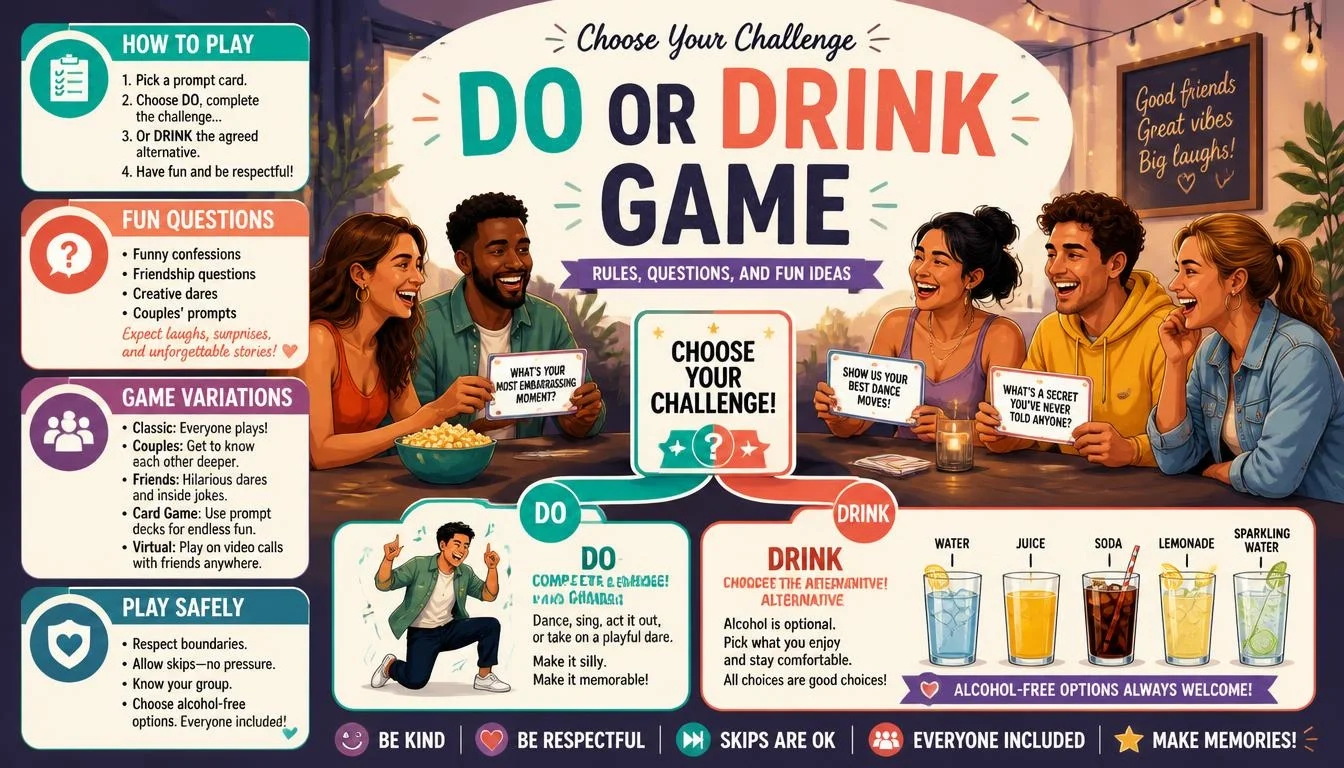
The do or drink game is a party game in which players answer a question, complete a challenge, or take a drink according to the agreed rules. It is commonly played with friends at parties, gatherings, and game nights. Players can customize the questions and challenges to make the game funny, embarrassing, romantic, or competitive. Nonalcoholic drinks and alternative challenges can also be used.
The do or drink game is a fun party activity that challenges players to answer questions or complete tasks instead of choosing the alternative set by the group. It combines funny questions, unexpected challenges, and friendly competition to create memorable moments with friends. Whether you are hosting a party, planning a game night, or looking for an entertaining activity, this game offers plenty of opportunities for laughter.
Unlike traditional question-and-answer games, do or drink gives players a choice. They can complete a challenge, answer honestly, or follow an agreed alternative, such as taking a sip of a beverage. As a result, even simple questions can become exciting when players must decide whether to reveal something embarrassing or try a silly task.
Moreover, the game works in different social settings. Friends can use funny prompts, couples can explore playful questions, and groups can create themed challenges for birthdays or celebrations. You can also replace alcoholic drinks with water, juice, soda, or other nonalcoholic options.
In this guide, you will learn the do or drink game meaning, basic rules, question ideas, popular variations, and practical tips for keeping the experience enjoyable. You will also discover how to customize the game for different groups without making anyone uncomfortable.
What Is the Do or Drink Game?
The do or drink game is an informal party game built around a simple choice: complete an assigned task or follow the alternative drinking rule.
A player might receive a question such as, “Have you ever sent a message to the wrong person?” Depending on the group’s rules, the player can answer honestly or choose the agreed alternative.
Similarly, a challenge might ask someone to perform a silly dance, imitate a celebrity, or tell an embarrassing story. If the player does not want to complete the task, the group follows the alternative established before the game begins.
However, the exact rules vary between groups. Some versions focus on personal questions, while others use physical challenges, funny performances, or relationship-related prompts.
The main idea is to create entertaining choices rather than pressure anyone into participating. Players should always be allowed to skip a question or challenge without being embarrassed or punished.
Do or Drink Game Meaning in Simple Words
In simple terms, do or drink means choosing between completing a task and following a drinking-based alternative.
The word do refers to completing an action, answering a question, or performing a challenge. Meanwhile, drink refers to the alternative specified by the game’s rules.
For example:
- Question: Have you ever pretended to be busy to avoid plans?
- Do: Admit whether you have done it.
- Drink: Choose the alternative if you do not want to answer, according to the group’s rules.
Another example might ask a player to sing a song for 15 seconds. If the player declines, they follow the agreed alternative instead.
Although the game often appears at adult parties, it does not have to involve alcohol. A group can use nonalcoholic beverages or replace the drinking option with another harmless activity.
How to Play the Do or Drink Game
Getting started is simple because you do not need expensive equipment or complicated instructions. Nevertheless, agreeing on the rules beforehand makes the experience smoother.
Step 1: Gather the Players
Invite a group of friends who want to participate. The game works with small groups and larger gatherings, although smaller groups can make conversations more personal.
For a comfortable experience, choose players who enjoy the same general style of humor.
Step 2: Prepare Questions and Challenges
Write questions on slips of paper, prepare a list on a phone, or let players create prompts as they go.
For example, include funny confessions, harmless dares, unusual preferences, and creative challenges. Additionally, prepare easier questions for anyone who prefers a relaxed version.
Step 3: Explain the Rules
Before starting, decide what counts as completing a challenge and what happens when someone skips it.
Players should also agree on boundaries. For instance, avoid challenges involving private messages, unwanted physical contact, dangerous stunts, or revealing another person’s secrets.
Step 4: Choose the First Player
You can select someone randomly, roll a die, or start with the person hosting the game.
Afterward, play can move clockwise around the group.
Step 5: Ask a Question or Give a Challenge
The selected player receives a prompt. They must decide whether to complete the task or use the agreed alternative.
For example, someone might be asked to imitate a famous movie character or share an amusing childhood memory.
Step 6: Continue Around the Group
Once the player finishes or passes, the next person takes a turn. Keep the pace relaxed so everyone has time to respond.
Finally, stop whenever the group wants. The game should remain entertaining rather than become a competition to see who can consume the most alcohol.
Best Do or Drink Game Questions
The best questions are easy to understand, entertaining, and appropriate for the people playing. Therefore, consider your group’s comfort level before choosing a category.
Funny Do or Drink Questions
These prompts encourage laughter without requiring deeply personal answers.
- Have you ever laughed at a joke you did not understand?
- Have you ever waved at someone who was waving at another person?
- Have you ever practiced a conversation before having it?
- Have you ever forgotten someone’s name immediately after meeting them?
- Have you ever sung the wrong lyrics with complete confidence?
- Have you ever pretended to understand a complicated explanation?
- Have you ever tripped over nothing in public?
- Have you ever talked to yourself when nobody was around?
- Have you ever sent a message and immediately regretted it?
- Have you ever made an excuse to leave a social event early?
These questions are suitable for casual game nights because most people can answer them without feeling exposed.
Embarrassing Do or Drink Questions
For groups that enjoy lighthearted confessions, these prompts can make the game more unpredictable.
- What is the most embarrassing thing you have done in public?
- Have you ever mispronounced a common word?
- Have you ever walked into the wrong room by mistake?
- Have you ever had a funny misunderstanding with a stranger?
- Have you ever worn mismatched clothes without noticing?
- Have you ever forgotten why you entered a room?
- Have you ever accidentally called someone by the wrong name?
- Have you ever rehearsed a selfie before taking it?
- Have you ever told a story and forgotten the ending?
- What is the funniest mistake you have made recently?
Remember that embarrassing questions should remain playful. Players should never have to disclose something deeply personal just to participate.
Do or Drink Questions for Friends
Friend groups can use prompts that explore shared memories and everyday habits.
- Who in the group is most likely to arrive late?
- Have you ever forgotten a friend’s birthday?
- What is your funniest memory with this group?
- Have you ever canceled plans because you wanted to stay home?
- Who is most likely to laugh at the wrong moment?
- Have you ever kept a harmless secret from a friend?
- What is the strangest food combination you enjoy?
- Have you ever pretended to like a gift?
- Who would survive the longest on a deserted island?
- What is one funny habit your friends know about you?
These prompts work especially well when players already know each other. In addition, shared memories can make the game more personal without requiring uncomfortable confessions.
Do or Drink Questions for Couples
Couples can use this version to encourage conversation, discover preferences, and share amusing experiences.
- Who made the first move?
- What was your first impression of your partner?
- Who is more likely to forget an anniversary?
- What is your partner’s funniest habit?
- Who takes longer to get ready?
- What is your favorite memory together?
- Who is more likely to plan a surprise date?
- What small thing makes you feel appreciated?
- Who is more likely to fall asleep during a movie?
- What activity would you love to try together?
However, avoid questions designed to provoke jealousy or force someone to reveal private relationship information. A good couples game encourages connection rather than conflict.
Spicy but Respectful Do or Drink Questions
For adults who prefer a flirtier version, use prompts that respect everyone’s comfort and privacy.
- Have you ever had a crush on someone you did not expect?
- What quality do you find most attractive in a person?
- Have you ever flirted without realizing it?
- What is your idea of a perfect date?
- Have you ever been nervous around someone you liked?
- What is the sweetest compliment you have received?
- Have you ever had an awkward romantic moment?
- What makes someone instantly interesting to you?
- Have you ever developed a crush on a fictional character?
- What is one romantic gesture you appreciate?
Before playing a flirtier version, make sure everyone is comfortable with the topic. Nobody should be pressured into revealing intimate details or engaging in unwanted physical contact.
Fun Do or Drink Challenges
Questions are only one part of the game. Physical comedy, creative tasks, and quick performances can make each round more exciting.
Here are 15 challenge ideas:
- Do your best celebrity impression.
- Dance without music for 10 seconds.
- Speak in a funny accent for one round.
- Sing the chorus of a song.
- Make up a short commercial for an ordinary object.
- Describe your day using only three words.
- Act like a robot until your next turn.
- Tell a joke without laughing.
- Draw an animal in 20 seconds.
- Make a dramatic movie-trailer voice.
- Invent a new name for your favorite food.
- Pretend to be a news reporter covering the party.
- Give a harmless object a motivational speech.
- Name five animals in 10 seconds.
- Create a funny handshake with another willing player.
These tasks are designed to be short, accessible, and easy to adapt. If someone dislikes a particular challenge, let them choose another one without penalty.
Do or Drink Game Rules and Variations
Although the basic format stays the same, groups can modify the rules to suit their preferences.
Classic Do or Drink
In the classic format, a player receives a question or challenge and chooses whether to complete it or follow the alternative drinking rule.
The group decides in advance how turns work and whether players can skip prompts. For a safer version, replace alcoholic drinks with nonalcoholic beverages.
Do or Drink Card Game
Prepare a stack of cards containing questions and challenges. Each player draws one card on their turn.
You can divide the deck into categories such as funny, personal, creative, and friendship. Consequently, players can choose the type of experience they want.
Do or Drink for Couples
This variation focuses on shared memories, preferences, and relationship questions.
For example, players might describe their ideal weekend or guess each other’s favorite comfort food. Keep the prompts mutual and respectful so the game does not become an interrogation.
Do or Drink for Friends
This version works well for birthdays, sleepovers, reunions, and casual gatherings.
Include group memories, harmless confessions, and silly performances. Additionally, allow players to write their own prompts to make the game feel more personal.
Nonalcoholic Do or Drink
In this version, everyone uses water, soda, juice, or another nonalcoholic beverage.
Alternatively, replace the drinking option with a simple activity, such as telling a joke, naming a movie, or answering a bonus question. This variation preserves the game’s choice-based format without making alcohol necessary.
Virtual Do or Drink
Friends who cannot meet in person can play over a video call.
One person reads a prompt aloud, and each player answers or completes a challenge on camera if comfortable. Furthermore, an online document or shared note can hold the questions, allowing everyone to contribute.
Do or Drink Game Examples
The following examples show how a round might unfold.
Example 1: A Funny Confession
Prompt: Have you ever pretended to be asleep to avoid a conversation?
Player’s response: “Yes, once when a family member called me late at night!”
Result: The player answers honestly, and the group laughs before moving to the next turn.
Example 2: A Creative Challenge
Prompt: Perform your best dramatic movie scene.
Player’s response: The player delivers an exaggerated speech about losing their favorite sandwich.
Result: The task is completed, and another person takes a turn.
Example 3: A Couples Question
Prompt: Who is more likely to forget where they put their phone?
Player’s response: Both partners point at each other.
Result: The group enjoys the playful disagreement without turning it into an argument.
Example 4: A Nonalcoholic Round
Prompt: Name five countries in 10 seconds.
Player’s response: The player names four countries before time runs out.
Result: The player can choose a bonus question or take a sip of water under the group’s agreed rules.
These examples demonstrate that the game can remain entertaining without requiring alcohol or uncomfortable challenges.
Do or Drink Game vs. Truth or Dare
Although these games share some similarities, their rules and emphasis can differ.
| Feature | Do or Drink Game | Truth or Dare |
|---|---|---|
| Main idea | Complete a task or choose an agreed alternative | Answer honestly or complete a dare |
| Typical prompts | Questions, challenges, and confessions | Personal questions and actions |
| Drinking required | No; it can be adapted | No |
| Best for | Parties and casual gatherings | Friends, couples, and groups |
| Flexibility | Highly customizable | Highly customizable |
| Main appeal | Choices and unexpected reactions | Honesty and creative dares |
Both games encourage interaction. However, do or drink explicitly uses the drinking alternative in its common format, while truth or dare centers on choosing between answering a question and completing an action.
Benefits of Playing the Do or Drink Game
When played respectfully, the game offers several social benefits.
Encourages Conversation
Funny prompts give people something to discuss, especially when a group includes friends who do not know each other very well.
Creates Shared Memories
Unexpected answers and creative performances can become amusing memories that friends discuss later.
Supports Creativity
Players may need to improvise a song, invent a story, or perform a silly character. As a result, the game can encourage spontaneous thinking.
Works in Different Settings
The game can be adapted for birthday parties, game nights, couples’ evenings, and virtual gatherings.
Requires Little Preparation
A host can prepare a list of questions in advance or let players invent prompts during the game. Therefore, expensive equipment is unnecessary.
These benefits depend on how the group plays. The activity should remain optional, inclusive, and comfortable for everyone.
Common Do or Drink Game Mistakes
Even a simple party game can become uncomfortable when the rules are unclear. Avoid these common mistakes to keep the experience enjoyable.
Forcing Players to Participate
Nobody should be required to answer a question or perform a challenge. Always allow a skip option without ridicule.
Choosing Inappropriate Questions
Questions about trauma, finances, medical information, or private relationships can make players uncomfortable. Instead, choose prompts suited to the group.
Ignoring Personal Boundaries
A player might enjoy funny questions but dislike romantic or physical challenges. Ask for consent before introducing a more personal category.
Making Alcohol the Main Objective
The point is entertainment, not consuming large amounts of alcohol. Never pressure anyone to drink, and do not use drinking as a punishment.
Creating Complicated Rules
Too many exceptions can slow the game down. Agree on a few basic rules and explain them before the first round.
Turning Friendly Competition Into Conflict
Avoid using answers to embarrass, expose, or target another player. If a question causes tension, skip it and move forward.
Safety Tips for the Do or Drink Game
A well-planned game respects the comfort and safety of every participant.
- Make participation voluntary. Everyone should be able to pass without explaining why.
- Offer nonalcoholic choices. Water, juice, and soda work just as well for a nonalcoholic version.
- Avoid drinking pressure. Nobody should be encouraged to consume alcohol as a penalty.
- Never drive after drinking. Arrange a sober driver or another safe way home if alcohol is involved.
- Skip dangerous challenges. Avoid stunts, choking challenges, unwanted contact, and tasks involving vehicles or hazardous objects.
- Protect privacy. Do not post recordings, photos, or personal answers without permission.
- Respect age limits. Keep alcohol-free versions available and follow applicable laws.
- Stop when necessary. Anyone who feels uncomfortable should be able to leave the game at any time.
Alcohol can impair judgment and coordination, and consuming more does not make the game better. For that reason, a nonalcoholic version is a practical option for groups that want the same fun without the risks.
How to Make Your Own Do or Drink Questions
Creating a personalized question list can make the game more entertaining because the prompts reflect your group’s interests.
First, choose a theme, such as friendship, funny memories, movies, food, travel, or relationships. Next, write short questions that have clear meanings and do not require lengthy explanations.
For example, a movie-themed round might ask, “Name three superhero movies in 10 seconds.” Meanwhile, a food-themed prompt could ask, “Describe your favorite meal without naming it.”
You can also mix easy and challenging questions. Start with simple prompts to help everyone feel comfortable, then introduce more creative tasks as the group warms up.
Finally, review the list before playing. Remove any prompt that could expose private information, target a participant, or encourage unsafe behavior.
Frequently Asked Questions
What is the do or drink game?
The do or drink game is a party activity where players answer questions or complete challenges, with an agreed drinking-based alternative if they choose not to participate in the task. Alcohol is not required, and groups can use nonalcoholic drinks or other alternatives.
How do you play do or drink?
Players take turns choosing or receiving questions and challenges. Each person completes the task or follows the agreed alternative. The group should establish the rules and boundaries before playing.
Do you need alcohol to play do or drink?
No. Water, soda, juice, or other nonalcoholic beverages can replace alcohol. Players can also use bonus questions or harmless challenges as alternatives.
What are the best do or drink questions?
Funny confessions, friendship memories, silly challenges, and lighthearted preference questions are popular choices. The best prompts fit the group’s comfort level and encourage laughter without pressuring anyone to reveal private information.
Can couples play do or drink?
Yes. Couples can use questions about shared memories, personal preferences, funny habits, and date ideas. However, both partners should agree on the topics and be free to skip uncomfortable questions.
Can you play do or drink online?
Yes. Friends can play through a video call by sharing questions and completing challenges remotely. A shared document or question list can help everyone follow the same rules.
Is do or drink the same as truth or dare?
Not exactly. Both games use questions and challenges, but truth or dare asks players to choose between answering honestly and performing a dare. Do or drink commonly offers a drinking-based alternative instead.
How many people can play do or drink?
There is no fixed player limit. Small groups make personal conversations easier, while larger groups can add more variety and energy. Choose a turn-taking system that allows everyone to participate comfortably.
Is the do or drink game suitable for beginners?
Yes. Beginners can start with easy questions, short challenges, and clear rules. In addition, a nonalcoholic format makes it easy to introduce the game to different groups.
How can you make do or drink more fun?
Mix funny questions with creative challenges, use themed rounds, and let players contribute their own prompts. Most importantly, keep the atmosphere relaxed and make passing an acceptable choice.
Is the do or drink game safe?
It can be played more safely when participation is voluntary, challenges are harmless, and alcohol is not encouraged or required. Players should respect boundaries, avoid dangerous tasks, and arrange safe transportation if alcohol is consumed.
Key Takeaways
- The do or drink game combines questions, challenges, and a choice between completing a task or following an agreed alternative.
- Players can customize the game for friends, couples, parties, and online gatherings.
- Funny questions and creative challenges usually make the game more engaging.
- Alcohol is optional; nonalcoholic beverages and alternative activities work well.
- Clear rules, consent, privacy, and the ability to skip a prompt help everyone enjoy the experience.
Conclusion
The do or drink game is a flexible party activity that turns ordinary questions and simple challenges into opportunities for laughter, conversation, and friendly competition. From funny confessions to creative dares, it can be adapted for friends, couples, family-friendly gatherings, and virtual game nights.
Moreover, you do not need alcohol, expensive equipment, or complicated instructions to enjoy it. A list of interesting prompts, a few willing participants, and clear rules are enough to get started.
Ultimately, the best version of the game is one where everyone feels comfortable participating. Choose entertaining questions, respect personal boundaries, and allow players to pass whenever they want. With these simple guidelines, you can create a fun and memorable game night that brings people together without unnecessary pressure.