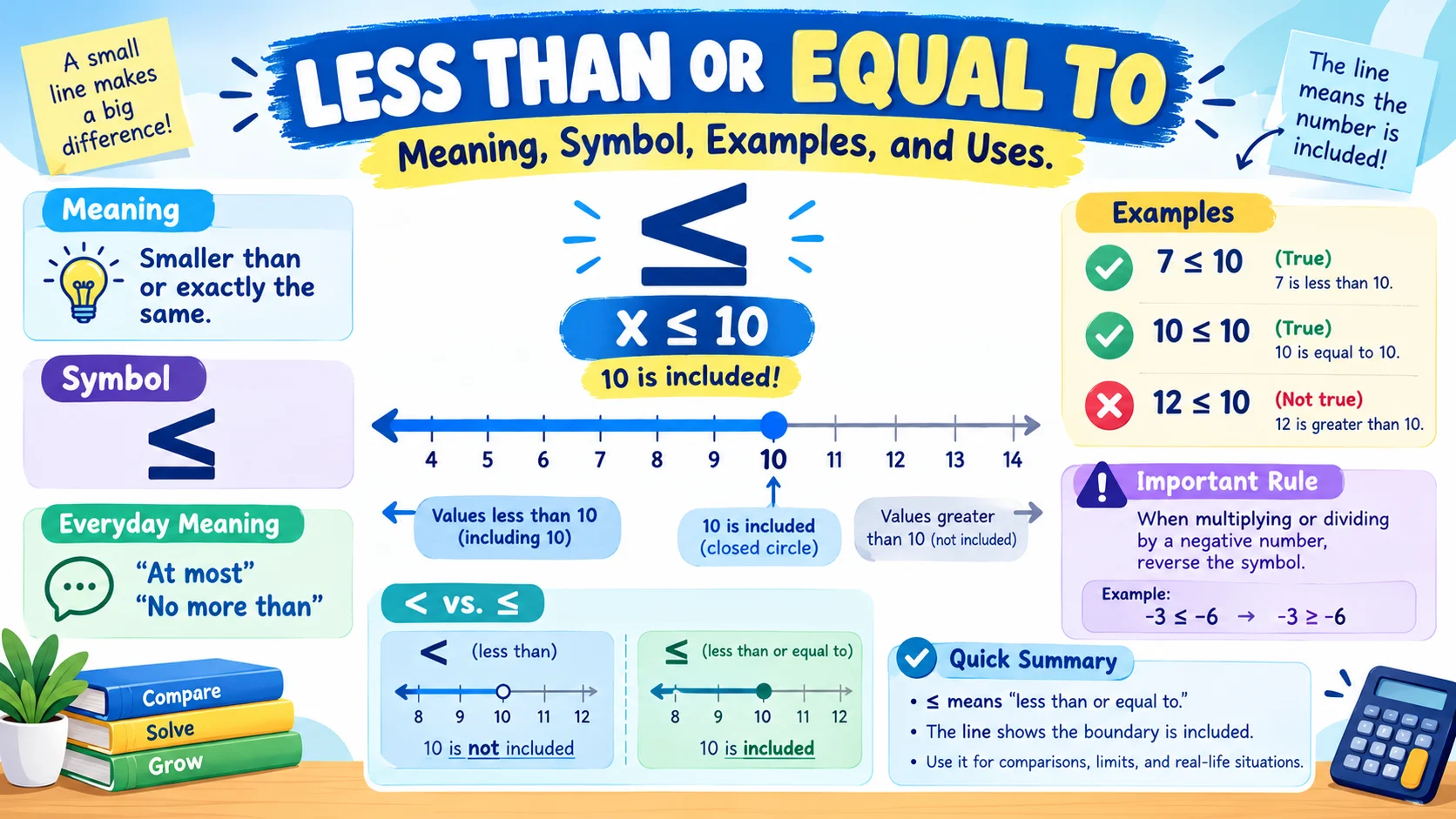
Less than or equal to means that one value is either smaller than another value or exactly the same. Its mathematical symbol is ≤. For example, x ≤ 10 means that x can be any number less than 10 or exactly 10, such as 9, 5, 0, or 10. Therefore, the symbol combines the ideas of “less than” and “equal to.”
The less than or equal to relationship is one of the most important comparison concepts in mathematics. It allows us to show that one number is smaller than another number or that both numbers have the same value. Because the idea appears in basic arithmetic, algebra, statistics, computer programming, inequalities, and everyday measurements, understanding it can make many mathematical problems easier.
At first, the symbol ≤ may look confusing. However, its meaning is quite simple once you understand the two parts that make it up. The < portion means “less than,” while the = portion means “equal to.” Together, they mean “less than or equal to.”
For example, x ≤ 20 tells us that x cannot be greater than 20. The value can be 20, but it can also be 19, 10, 0, or even a negative number. In contrast, a value such as 21 does not satisfy the inequality.
Moreover, this concept is useful far beyond classroom exercises. A store might say that a coupon is available for purchases of $50 or less. A website might allow files that are 10 MB or smaller. Similarly, a teacher might tell students that an assignment must contain 1,000 words or fewer. In each case, the upper limit is included.
This guide explains the less than or equal to meaning in simple language. You will learn its symbol, pronunciation, rules, number-line representation, real-world examples, algebraic applications, common mistakes, and related comparison symbols.
What Does Less Than or Equal To Mean?
Less than or equal to means that the first value must be smaller than or exactly the same as the second value.
The mathematical symbol is:
≤
Consider this example:
5 ≤ 8
This statement is true because 5 is less than 8.
Now consider:
8 ≤ 8
This statement is also true because both numbers are equal.
However:
10 ≤ 8
is false because 10 is greater than 8.
Therefore, the phrase always allows two possibilities:
- The first value is less than the second.
- Both values are equal.
The first possibility is represented by <, while the second possibility is represented by =. Combining them gives ≤.
Simple Definition
A simple definition is:
Less than or equal to means “smaller than or exactly the same as.”
That definition works for both basic arithmetic and more advanced mathematics.
What Is the Symbol for Less Than or Equal To?
The symbol for less than or equal to is:
≤
It contains two visual parts:
- < means less than.
- = means equal to.
When these symbols are combined, they produce ≤.
For example:
x ≤ 15
can be read as:
- “x is less than or equal to 15.”
- “x is at most 15.”
- “x cannot be greater than 15.”
All three statements communicate essentially the same mathematical condition.
What Does the Symbol Look Like?
The symbol resembles a less-than sign with an additional horizontal line underneath it:
≤
The horizontal line is important because it tells us that equality is allowed.
Without the line:
x < 15
means that x must be strictly smaller than 15.
With the line:
x ≤ 15
means that x may be smaller than 15 or exactly 15.
How to Read ≤
There are several natural ways to read the symbol ≤.
For example:
7 ≤ 12
can be read as:
- “Seven is less than or equal to twelve.”
- “Seven is at most twelve.”
- “Seven does not exceed twelve.”
The first version is the standard mathematical reading. However, the other versions can be useful in everyday explanations.
Similarly:
x ≤ 100
can be read as:
- “x is less than or equal to 100.”
- “x is at most 100.”
- “x is no more than 100.”
- “x cannot exceed 100.”
Consequently, recognizing these alternative phrases can help you understand word problems.
Less Than vs. Less Than or Equal To
The difference between < and ≤ is small but extremely important.
| Symbol | Meaning | Is Equality Allowed? | Example |
|---|---|---|---|
| < | Less than | No | 4 < 7 |
| ≤ | Less than or equal to | Yes | 7 ≤ 7 |
| > | Greater than | No | 9 > 4 |
| ≥ | Greater than or equal to | Yes | 9 ≥ 9 |
| = | Equal to | Only equality | 5 = 5 |
The key difference is whether the boundary value is included.
For example:
x < 10
means x can be 9, 8, 7, and so on, but not 10.
By comparison:
x ≤ 10
allows 10.
Therefore, if a question says “10 or less,” you should use ≤, not <.
Why Does ≤ Include the Equal Sign?
The equal sign underneath the less-than sign changes the meaning.
Consider:
x < 10
The statement excludes 10.
Now consider:
x ≤ 10
The statement includes 10.
That additional horizontal line effectively says, “Equality is also allowed.”
For instance:
10 ≤ 10
is true.
On the other hand:
10 < 10
is false.
A number cannot be strictly less than itself. Nevertheless, a number is always equal to itself, so it satisfies a “less than or equal to” comparison.
Examples of Less Than or Equal To
The easiest way to understand less than or equal to is to see it in action.
Example 1
3 ≤ 7
True.
Three is less than seven.
Example 2
7 ≤ 7
True.
Both numbers are equal.
Example 3
9 ≤ 7
False.
Nine is greater than seven.
Example 4
0 ≤ 4
True.
Zero is less than four.
Example 5
-5 ≤ 2
True.
Negative five is less than two.
Example 6
12 ≤ 12
True.
The two values are exactly equal.
Example 7
15 ≤ 10
False.
Fifteen exceeds ten.
Thus, the easiest test is to ask:
“Is the number on the left smaller than or exactly equal to the number on the right?”
If the answer is yes, the statement is true.
Less Than or Equal To on a Number Line
A number line provides a visual way to understand an inequality.
Suppose we have:
x ≤ 5
The solution includes 5 and every number to its left.
You can imagine it like this:
←────────● 5
The closed dot at 5 is important. It shows that 5 is included in the solution.
By contrast:
x < 5
would use an open circle at 5 because 5 is excluded.
Closed Circle vs. Open Circle
For inequalities:
- ≤ uses a closed circle.
- ≥ uses a closed circle.
- < uses an open circle.
- > uses an open circle.
Therefore, whenever you see an inequality containing an equal sign, the boundary value is included.
Less Than or Equal To in Algebra
The symbol ≤ becomes especially useful when solving inequalities.
Consider:
x + 3 ≤ 10
Subtract 3 from both sides:
x ≤ 7
Therefore, every value of x that is 7 or smaller satisfies the inequality.
For example:
- x = 7 works.
- x = 6 works.
- x = 0 works.
- x = -10 works.
- x = 8 does not work.
Another Example
Consider:
2x ≤ 12
Divide both sides by 2:
x ≤ 6
Thus, the solution includes every value less than or equal to 6.
What Happens When You Divide or Multiply by a Negative Number?
This is one of the most important rules involving inequalities.
When you multiply or divide both sides of an inequality by a negative number, you must reverse the inequality symbol.
For example:
-2x ≤ 8
Divide both sides by -2.
Because you are dividing by a negative number, reverse ≤ to ≥:
x ≥ -4
This rule applies to all inequality symbols.
For example:
< becomes >
and
≤ becomes ≥.
Why Does the Symbol Reverse?
Multiplying or dividing by a negative number reverses the order of numbers.
For example:
2 < 5
Multiply both sides by -1:
-2 > -5
The direction changes because -2 is greater than -5.
Consequently, the same principle applies when solving inequalities.
Less Than or Equal To in Word Problems
Many mathematical word problems do not directly use the symbol ≤. Instead, they use phrases that communicate the same idea.
Common expressions include:
- At most
- No more than
- Up to
- Not more than
- Cannot exceed
- Less than or equal to
- A maximum of
- No greater than
- 10 or fewer
- 10 or less
For example:
“A backpack can weigh no more than 20 pounds.”
This translates to:
weight ≤ 20
Another example:
“You can spend up to $100.”
This means:
spending ≤ $100
Similarly:
“The class may have at most 30 students.”
This means:
students ≤ 30
Therefore, recognizing these phrases is essential when converting everyday language into mathematical expressions.
Everyday Examples of Less Than or Equal To
The concept appears in ordinary situations more often than you might realize.
Age Requirements
Suppose an activity says:
Age ≤ 12
Children aged 12 or younger qualify.
Therefore, ages 8, 10, and 12 are included.
Weight Limits
A package might have a maximum weight of 50 pounds.
That can be written as:
Weight ≤ 50 lb
A 50-pound package is acceptable because the limit includes exactly 50 pounds.
Spending Limits
A person may have a budget of $200.
The condition becomes:
Spending ≤ $200
Spending $200 is acceptable, while spending $201 exceeds the limit.
File Sizes
A website might allow files of 25 MB or smaller.
Mathematically:
File size ≤ 25 MB
Thus, a 25 MB file meets the stated limit.
Temperature
Suppose a safety instruction applies when the temperature is 40°F or lower.
The condition can be written:
Temperature ≤ 40°F
Consequently, 40°F is included.
Less Than or Equal To in Statistics
The symbol also appears frequently in statistics.
Suppose a report examines people who are 65 years old or younger.
This can be represented as:
Age ≤ 65
Similarly, researchers may define a group with test scores of 80 or below:
Score ≤ 80
In probability, the notation can describe cumulative events.
For example:
P(X ≤ 5)
means the probability that X is less than or equal to 5.
This distinction matters because the value 5 is included.
Less Than or Equal To in Probability
Probability often uses inequalities to describe ranges of possible outcomes.
Consider:
P(X ≤ 10)
This means:
“The probability that X is less than or equal to 10.”
The possible values may include:
- 10
- 9
- 8
- 7
- and other values below 10
If the variable is discrete, such as the number of defective products, the interpretation is particularly straightforward.
For example:
P(X ≤ 3)
means the probability that X is 3 or less.
Therefore, outcomes such as 0, 1, 2, and 3 are included.
Less Than or Equal To in Geometry
Geometry also uses inequalities to describe measurements and constraints.
For example, suppose the length of a side must not exceed 12 centimeters.
We can write:
L ≤ 12 cm
Similarly, a shape may have an area of 100 square inches or less:
A ≤ 100 in²
These expressions are useful because geometric problems often involve maximum or minimum restrictions.
Less Than or Equal To in Computer Programming
The idea of less than or equal to also appears in programming.
Many programming languages use an operator similar to:
<=
This usually means “less than or equal to.”
For example, a program might check whether a person’s age is 18 or younger.
Conceptually, the condition would be:
age <= 18
The exact programming syntax can vary slightly depending on the language, but the mathematical idea remains the same.
≤ vs. <=
In mathematics, the standard symbol is:
≤
In many programming languages, however, the symbol is written as:
<=
The meaning is generally the same.
The difference exists mainly because ordinary keyboards and programming systems do not always use the single Unicode character ≤.
Less Than or Equal To in Excel and Spreadsheets
Spreadsheet formulas also commonly use <=.
For example, a spreadsheet condition might check whether a value is 100 or less.
The logical test can be expressed as:
A1<=100
This returns TRUE when the value in cell A1 is less than or equal to 100.
It returns FALSE when the value is greater than 100.
Therefore, the same mathematical relationship works in spreadsheets and other digital tools.
Less Than or Equal To in Sets
Inequalities can also describe sets of numbers.
For example:
x ≤ 4
means the set contains every number less than or equal to 4.
In interval notation, the solution over the real numbers is:
(-∞, 4]
The square bracket at 4 shows that 4 is included.
By comparison:
x < 4
would be written:
(-∞, 4)
The parenthesis indicates that 4 is not included.
Thus, brackets and parentheses provide another way to show whether a boundary value belongs to a solution set.
Less Than or Equal To vs. At Most
The phrases less than or equal to and at most usually mean the same thing.
For example:
x ≤ 25
can be described as:
x is at most 25.
If a teacher says:
“You can submit at most three late assignments.”
the mathematical condition is:
late assignments ≤ 3
Three is allowed. Four is not.
Therefore, “at most” is an important phrase to recognize in word problems.
Less Than or Equal To vs. No More Than
No more than also indicates ≤.
For example:
“The box can hold no more than 15 kilograms.”
This means:
Weight ≤ 15 kg
The number 15 is included.
Similarly:
“You may select no more than five options.”
means:
Options ≤ 5
Consequently, the phrases “no more than,” “at most,” and “less than or equal to” can often be translated into the same mathematical symbol.
Less Than or Equal To vs. Less Than
This is one of the most common areas of confusion.
Consider these two statements:
x < 10
and
x ≤ 10
The first means:
x must be smaller than 10.
The second means:
x can be smaller than 10 or exactly 10.
Therefore, the value 10 is the deciding factor.
| Statement | Is 10 Allowed? |
|---|---|
| x < 10 | No |
| x ≤ 10 | Yes |
This distinction becomes especially important when dealing with age limits, weight restrictions, budgets, deadlines, and other boundaries.
Common Mistakes
Mistake 1: Forgetting That Equality Is Included
A common error is assuming:
x ≤ 10
means only numbers below 10.
That is incorrect.
The value 10 is also included.
Mistake 2: Reversing the Symbol
Some learners confuse ≤ with ≥.
Remember:
≤ points toward the smaller side.
≥ means greater than or equal to.
Mistake 3: Ignoring the Boundary
When solving an inequality, always check whether the boundary value is included.
For example:
x ≤ 8
includes 8.
Therefore, the number line needs a closed dot at 8.
Mistake 4: Forgetting to Reverse the Symbol
When multiplying or dividing an inequality by a negative number, the symbol must reverse.
For example:
-x ≤ 5
Multiplying by -1 gives:
x ≥ -5
Not:
x ≤ -5
Mistake 5: Confusing “At Most” With “Less Than”
“At most 20” means:
≤ 20
not:
< 20
Thus, 20 is allowed.
Easy Ways to Remember ≤
Several memory tricks can make the symbol easier to recognize.
Think of the Equal Line
The horizontal line underneath < means equality is allowed.
So:
< = less than
≤ = less than or equal to
Remember “Maximum”
When something has a maximum allowed value, ≤ is often appropriate.
For example:
Maximum weight = 50 kg
becomes:
Weight ≤ 50 kg
Ask One Question
Whenever you see ≤, ask:
“Can the two values be equal?”
The answer is yes.
That quick check can prevent many mistakes.
How to Use Less Than or Equal To Correctly
Follow these simple steps when working with ≤.
Step 1: Identify the Two Values
Look at the expression.
For example:
7 ≤ 12
The values are 7 and 12.
Step 2: Compare Them
Ask whether the first value is smaller than or equal to the second.
Seven is smaller than twelve.
Step 3: Decide Whether the Statement Is True
Because 7 is smaller than 12, the statement is true.
Step 4: Check Equality When Necessary
If both values are the same, the statement is still true.
For example:
12 ≤ 12
is true.
Step 5: Watch for Negative Numbers
When negative numbers appear, remember that numbers farther left on the number line are smaller.
For example:
-8 ≤ -3
is true because -8 is smaller than -3.
Practice Examples With Answers
Try these examples before checking the answers.
Question 1
Is this true or false?
6 ≤ 9
Answer: True.
Six is less than nine.
Question 2
Is this true or false?
10 ≤ 10
Answer: True.
The numbers are equal.
Question 3
Is this true or false?
12 ≤ 8
Answer: False.
Twelve is greater than eight.
Question 4
Solve:
x + 4 ≤ 11
Answer:
Subtract 4 from both sides:
x ≤ 7
Question 5
Solve:
3x ≤ 18
Answer:
Divide by 3:
x ≤ 6
Question 6
Solve:
-2x ≤ 14
Divide by -2 and reverse the symbol:
x ≥ -7
Question 7
Translate into an inequality:
“Your bag can weigh no more than 25 pounds.”
Answer:
Weight ≤ 25 lb
Question 8
Translate into an inequality:
“You must be 16 or younger.”
Answer:
Age ≤ 16
Exercises With Answers
Exercise 1
Write the correct symbol:
4 ___ 9
Answer: 4 < 9
Exercise 2
Write the correct symbol:
8 ___ 8
Answer: 8 ≤ 8
Exercise 3
Write the inequality:
“Five or fewer items.”
Answer: Items ≤ 5
Exercise 4
Solve:
x – 6 ≤ 4
Answer:
x ≤ 10
Exercise 5
Solve:
5x ≤ 25
Answer:
x ≤ 5
Exercise 6
Solve:
-3x ≤ 12
Answer:
x ≥ -4
Exercise 7
Write the inequality:
“A temperature of 32°F or below.”
Answer:
Temperature ≤ 32°F
Exercise 8
Is the following true?
-4 ≤ -7
Answer: False.
Although both numbers are negative, -4 is greater than -7.
Related Comparison Symbols
Understanding ≤ becomes easier when you compare it with other mathematical symbols.
Less Than: <
This means the first value is strictly smaller.
Example:
3 < 7
The values cannot be equal.
Greater Than: >
This means the first value is strictly larger.
Example:
9 > 4
Greater Than or Equal To: ≥
This allows the first value to be larger or equal.
Example:
9 ≥ 9
Equal To: =
This means both values have exactly the same value.
Example:
5 = 5
Not Equal To: ≠
This means the values are different.
Example:
5 ≠ 8
Less Than or Equal To in Real-Life Decisions
The concept is particularly useful whenever a situation has a limit.
Imagine a movie theater that allows children aged 12 and younger to receive a special ticket.
The condition is:
Age ≤ 12
A 12-year-old qualifies.
A 13-year-old does not.
Now imagine a suitcase with a maximum weight of 23 kilograms.
The condition is:
Weight ≤ 23 kg
A suitcase weighing exactly 23 kilograms meets the requirement. However, a suitcase weighing 23.1 kilograms exceeds the limit.
Similarly, a student might have a maximum assignment length of 1,500 words.
That becomes:
Word count ≤ 1,500
The boundary is included, which is precisely what the ≤ symbol communicates.
Why Understanding ≤ Matters
Learning less than or equal to is not just about memorizing a symbol. It builds a foundation for more advanced mathematical reasoning.
First, inequalities help students compare quantities.
Next, they become essential when solving algebraic problems.
Furthermore, inequalities appear in statistics, probability, geometry, calculus, economics, programming, and data analysis.
In everyday life, people also make decisions based on limits and thresholds. Budgets, capacity restrictions, age requirements, weight limits, and performance targets all involve comparisons.
Therefore, understanding ≤ can help you interpret both mathematical statements and practical rules more accurately.
Frequently Asked Questions
What does less than or equal to mean?
Less than or equal to means that one value is either smaller than another value or exactly equal to it. The symbol is ≤.
What is the symbol for less than or equal to?
The standard mathematical symbol is ≤.
Does less than or equal to include the number?
Yes. The equal sign underneath the less-than sign means that the boundary value is included.
For example, x ≤ 10 includes 10.
Is 5 less than or equal to 5?
Yes.
5 ≤ 5 is true because the two values are equal.
Is 6 less than or equal to 5?
No.
6 ≤ 5 is false because 6 is greater than 5.
What does x ≤ 10 mean?
It means that x can be 10 or any value smaller than 10.
What does “at most” mean in math?
“At most” usually means less than or equal to.
For example, “at most 20” means ≤ 20.
What does “no more than” mean?
“No more than” generally means less than or equal to.
For example, “no more than five” means ≤ 5.
What is the difference between < and ≤?
The symbol < excludes equality, while ≤ includes equality.
Thus:
x < 5 does not include 5.
x ≤ 5 does include 5.
What happens to ≤ when you multiply by a negative number?
The inequality symbol reverses.
For example:
-2x ≤ 8
becomes:
x ≥ -4
after dividing by -2.
Is ≤ the same as <=?
Mathematically, they generally represent the same relationship. ≤ is the standard mathematical symbol, while <= is commonly used in programming and digital environments.
How do you show x ≤ 5 on a number line?
Use a closed circle at 5 and shade or extend the line toward the numbers smaller than 5.
Is zero less than or equal to zero?
Yes.
0 ≤ 0 is true because the two values are equal.
Can negative numbers satisfy a less-than-or-equal-to inequality?
Yes. For example:
-10 ≤ -2
is true because -10 is smaller than -2.
Key Takeaways
Here are the most important points to remember:
- ≤ means less than or equal to.
- It allows the first value to be smaller than the second.
- It also allows both values to be exactly equal.
- The equality line is what makes the boundary value included.
- x ≤ 10 means x can be 10 or any number below 10.
- “At most” usually means ≤.
- “No more than” usually means ≤.
- A closed dot represents ≤ on a number line.
- When multiplying or dividing by a negative number, reverse the inequality.
- In programming, <= commonly represents the same idea.
Conclusion
The phrase less than or equal to describes a relationship in which one value is smaller than another value or exactly equal to it. Its standard mathematical symbol, ≤, combines the less-than symbol with an equal sign to show that the boundary value is included.
For example, x ≤ 10 allows 10 and every value below 10. Therefore, 10 satisfies the inequality, while 11 does not. This small distinction is especially important when working with mathematical inequalities, word problems, number lines, statistics, probability, programming, and real-world limits.
Moreover, recognizing phrases such as “at most,” “no more than,” “up to,” and “cannot exceed” can help you identify when ≤ is needed. At the same time, remember that multiplying or dividing an inequality by a negative number reverses its direction.
Ultimately, the easiest way to remember less than or equal to is simple: the first value can be smaller, but it can also be exactly the same. Once that idea is clear, the symbol ≤ becomes much easier to read, use, and apply.