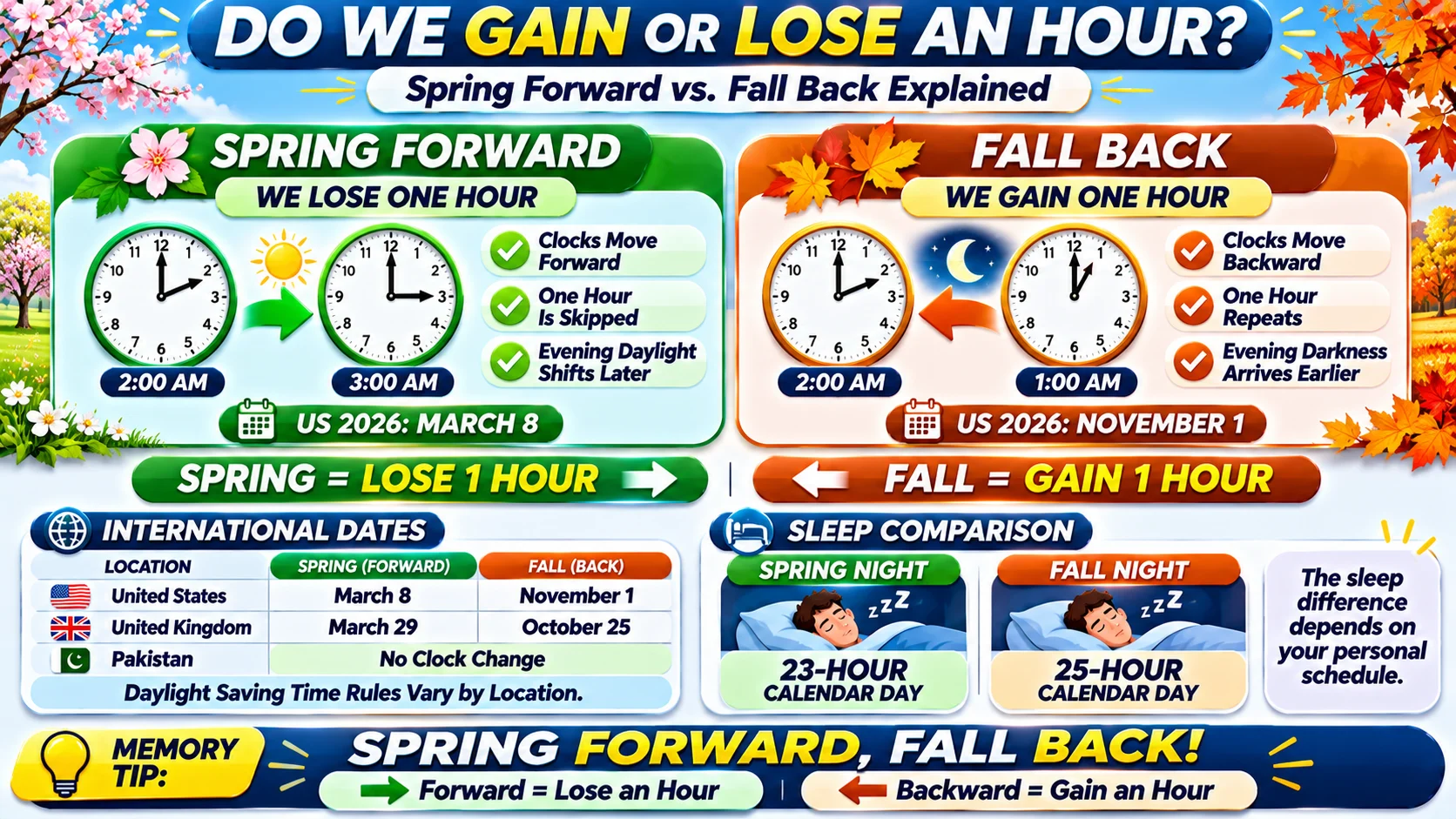
Do we gain or lose an hour? When daylight saving time begins in spring, clocks move forward one hour, so we lose an hour of clock time overnight. When daylight saving time ends in fall, clocks move backward one hour, so we gain an extra hour. Remember the phrase “spring forward, fall back.” In 2026, most of the United States changed clocks on March 8 and November 1.
Have you ever woken up wondering, do we gain or lose an hour when the clocks change? You’re not alone. Every spring and fall, millions of people become confused about whether they should move their clocks forward or backward. Although the adjustment involves only one hour, it can affect sleep schedules, morning routines, travel plans, and daily activities.
The answer depends on the season and whether your country observes daylight saving time. In spring, clocks move forward, meaning one hour is skipped during the overnight transition. Meanwhile, in fall, clocks move backward, repeating an hour and making the night one hour longer. Therefore, remembering the direction of the change can help you understand whether you gain or lose an hour of sleep.
Moreover, daylight saving time doesn’t apply everywhere. Most of the United States and parts of Europe observe seasonal clock changes, while many other countries maintain the same time throughout the year. Consequently, the exact dates and rules depend on your location.
In this guide, you’ll learn when we gain or lose an hour, why daylight saving time exists, and when clocks change in 2026. Additionally, we’ll explore the effects on sleep, common misconceptions, international differences, and simple tricks to remember the time change.
Do We Gain or Lose an Hour When the Clocks Change?
The answer depends on whether clocks are moving forward or backward.
In spring, we lose an hour.
In fall, we gain an hour.
This seasonal adjustment is associated with daylight saving time, often abbreviated as DST.
When daylight saving time begins, clocks move ahead by one hour. For example, in most participating US locations, 2:00 a.m. becomes 3:00 a.m.
Therefore, one hour disappears from the displayed local clock time.
However, when daylight saving time ends, clocks move backward. In most participating US locations, 2:00 a.m. becomes 1:00 a.m.
Consequently, the hour from 1:00 a.m. to 2:00 a.m. occurs twice.
Quick Comparison Table
| Season | Clock Change | Result | Sleep Opportunity |
|---|---|---|---|
| Spring | Forward one hour | Lose an hour | One hour shorter overnight |
| Fall | Backward one hour | Gain an hour | One extra hour overnight |
| Regions without DST | No adjustment | No change | Normal schedule |
Although people often say time is gained or lost, the change affects civil clock time rather than the actual passage of time.
What Does Spring Forward Mean?
Spring forward means moving clocks ahead by one hour when daylight saving time begins.
For example, imagine the clock shows 1:59 a.m.
A moment later, instead of showing 2:00 a.m., it jumps to 3:00 a.m. under typical US transition rules.
As a result, the local clock skips an hour.
Do We Lose an Hour in Spring?
Yes. People in participating regions experience a one-hour reduction in the length of that local calendar day.
For instance, a person who normally sleeps from 11:00 p.m. until 7:00 a.m. might get seven hours instead of eight if their sleep schedule doesn’t change.
However, the exact amount of sleep lost depends on when they go to bed and wake up.
Why Do Clocks Move Forward?
Moving clocks forward shifts an hour of daylight from the early morning to the evening according to the clock.
Consequently, sunsets occur later by local clock time.
This adjustment can make evenings feel brighter and create more opportunities for outdoor activities after work or school.
However, daylight saving time does not actually increase the total amount of sunlight.
It simply changes how daylight aligns with the clock.
What Does Fall Back Mean?
Fall back means moving clocks backward by one hour when daylight saving time ends.
In the United States, the change generally occurs at 2:00 a.m. local daylight time.
At that moment, the clock returns to 1:00 a.m.
Therefore, the hour between 1:00 a.m. and 2:00 a.m. repeats.
Do We Gain an Hour in Fall?
Yes. The overnight clock change creates an additional hour in that local calendar day.
For example, someone who goes to bed at 11:00 p.m. and wakes at 7:00 a.m. may have nine hours available for sleep instead of eight.
Nevertheless, not everyone actually sleeps longer.
Some people wake at their usual biological time, regardless of the clock adjustment.
Why Do Clocks Move Backward?
The fall transition ends the daylight saving period and restores standard time.
As a result, sunrise and sunset occur approximately one hour earlier on the local clock than they would without the adjustment.
Although mornings may become brighter by clock time, evenings also become darker earlier.
Do We Gain or Lose an Hour in 2026?
In most of the United States, the 2026 clock changes occurred on March 8 and November 1.
Meanwhile, the United Kingdom observed its changes on March 29 and October 25.
Daylight Saving Time Dates for 2026
| Location | Spring Change | Fall Change |
|---|---|---|
| Most of the United States | March 8, 2026 | November 1, 2026 |
| United Kingdom | March 29, 2026 | October 25, 2026 |
| Most of Canada observing DST | March 8, 2026 | November 1, 2026 |
| Pakistan | No change | No change |
| Japan | No change | No change |
These dates refer to the 2026 calendar year.
However, regional exceptions exist, and daylight saving regulations may change in future years.
For official US timing information, consult the National Institute of Standards and Technology.
When Did Clocks Go Forward in 2026?
In most US locations observing daylight saving time, clocks moved forward on Sunday, March 8, 2026.
At 2:00 a.m., the local time advanced to 3:00 a.m.
Consequently, the overnight transition skipped one hour.
In the United Kingdom, clocks moved forward on Sunday, March 29, 2026.
There, 1:00 a.m. Greenwich Mean Time became 2:00 a.m. British Summer Time.
Therefore, both countries lost an hour of clock time overnight, although the dates and transition times were different.
When Did Clocks Go Back in 2026?
In most US locations observing daylight saving time, clocks moved backward on Sunday, November 1, 2026.
At 2:00 a.m. daylight time, the clock returned to 1:00 a.m. standard time.
As a result, the hour between 1:00 a.m. and 2:00 a.m. occurred twice.
In the United Kingdom, clocks moved backward on Sunday, October 25, 2026.
At 2:00 a.m. British Summer Time, the clock returned to 1:00 a.m. Greenwich Mean Time.
Consequently, both countries gained an extra hour on their respective transition nights.
For official British clock-change dates, see GOV.UK.
Spring Forward vs. Fall Back
The phrase “spring forward, fall back” is one of the easiest ways to remember the clock changes.
The expression connects the seasons with the direction of the adjustment.
In spring, move forward.
In fall, move backward.
Comparison
| Feature | Spring Forward | Fall Back |
|---|---|---|
| Direction | Forward | Backward |
| Hour change | Lose one | Gain one |
| Purpose | Begin daylight saving time | Return to standard time |
| US transition | 2 a.m. becomes 3 a.m. | 2 a.m. becomes 1 a.m. |
| Evening daylight by the clock | Later | Earlier |
| Typical sleep opportunity | Shorter | Longer |
Although the wording is simple, it accurately describes the seasonal transitions in locations that observe DST.
Why Does Daylight Saving Time Exist?
Daylight saving time is intended to shift an hour of daylight toward the evening during part of the year.
The idea has a long history and has been associated with energy conservation, economic activity, and daylight use.
However, its actual benefits and disadvantages remain subjects of research and public debate.
Making Better Use of Daylight
One major goal is to align more daylight with the hours when people are awake and active.
For example, later evening sunsets may allow additional outdoor recreation after working hours.
Nevertheless, this comes with darker mornings around the spring transition.
Historical Energy Conservation Goals
Daylight saving policies were historically promoted partly as a way to reduce artificial lighting needs.
However, modern research on total energy savings has produced mixed findings.
Factors such as heating, cooling, technology, and regional climate influence the results.
Therefore, daylight saving time should not automatically be assumed to produce major energy savings everywhere.
Economic and Social Considerations
Later evening daylight may influence shopping, tourism, and recreational activities.
Meanwhile, seasonal changes can complicate transport schedules and international communication.
Consequently, different countries have adopted different time policies.
Does Daylight Saving Time Change the Length of the Day?
The clock adjustment changes the length of the local calendar day on the transition date.
However, it does not change the duration of Earth’s rotation or create extra physical time.
Spring Transition
In places observing a one-hour forward change, the local calendar day typically contains 23 hours.
Fall Transition
During a one-hour backward change, the local calendar day typically contains 25 hours.
Ordinary Days
Most other local calendar days contain 24 hours.
Therefore, the expressions “gain an hour” and “lose an hour” refer to local clock-time adjustments.
How Does the Time Change Affect Sleep?
Seasonal clock changes can temporarily affect sleep schedules.
The body’s internal biological clock, called the circadian rhythm, responds partly to light and darkness.
Consequently, moving the clock by an hour may create a mismatch between the time shown on a clock and the body’s usual sleep schedule.
Losing an Hour of Sleep
The spring transition can shorten sleep if people maintain their usual bedtime and wake-up schedule.
For example, someone who needs to wake at the same displayed clock time may have less time available for rest.
Additionally, some people experience temporary sleepiness or difficulty concentrating.
Gaining an Hour of Sleep
The fall transition creates an extra hour overnight.
However, the body’s internal clock may not adjust immediately.
Therefore, some people continue waking at the same biological time and do not obtain the entire extra hour of sleep.
Adjusting Your Routine
Simple habits may make the transition easier.
For example:
- Maintain a consistent sleep schedule.
- Gradually adjust bedtime before the spring change when possible.
- Get appropriate natural light during the morning.
- Avoid unnecessary late-night caffeine.
- Keep your sleeping environment comfortable.
- Allow time to adapt to the new schedule.
Although many people adjust relatively quickly, persistent sleep problems may require professional guidance.
Do We Gain or Lose an Hour of Sleep?
The effect on sleep depends on the direction of the clock change and your actual schedule.
For example, the spring transition usually reduces the available overnight sleep period by one hour when bedtime and waking time remain fixed according to the clock.
Meanwhile, the fall transition creates an opportunity for an additional hour.
However, an extra clock hour does not guarantee additional sleep.
Sleep Example
Suppose your normal sleep schedule is:
Bedtime: 11:00 p.m.
Wake-up time: 7:00 a.m.
Ordinarily, this provides eight hours.
Spring: Approximately seven hours are available across the clock-change night.
Fall: Approximately nine hours are available across the clock-change night.
These examples assume a one-hour clock adjustment occurs during sleep and the person follows the same displayed bedtime and wake-up time.
Do All Countries Change Their Clocks?
No. Many countries do not observe daylight saving time.
Even within countries that use DST, certain regions may follow different rules.
For example, most of the United States changes clocks seasonally.
However, Hawaii and most of Arizona do not observe the practice.
Similarly, Pakistan does not currently use seasonal clock changes.
Therefore, travelers should check the rules of their destination rather than assuming every location changes time on the same date.
Do We Gain or Lose an Hour in the United States?
In most of the United States, clocks move forward in March and backward in November.
Under the current general rules:
- Daylight saving time begins on the second Sunday in March.
- Daylight saving time ends on the first Sunday in November.
However, exceptions exist.
Hawaii and most of Arizona remain on standard time throughout the year.
Additionally, several US territories do not observe daylight saving time.
Consequently, people should confirm local rules before scheduling important appointments or trips.
Do We Gain or Lose an Hour in the United Kingdom?
The United Kingdom changes between Greenwich Mean Time (GMT) and British Summer Time (BST).
In spring, clocks move forward from GMT to BST.
Meanwhile, in autumn, clocks move backward from BST to GMT.
The usual rules are:
- Clocks go forward on the last Sunday in March.
- Clocks go back on the last Sunday in October.
For 2026, these dates were March 29 and October 25.
Therefore, UK residents lost an hour in March and gained it back in October.
Does Pakistan Observe Daylight Saving Time?
Pakistan does not observe daylight saving time in 2026.
Instead, the country uses Pakistan Standard Time (PKT), UTC+5, throughout the year.
Therefore, residents do not move their clocks forward or backward seasonally.
However, international meeting times may still change relative to Pakistan when other countries enter or leave daylight saving time.
For example, the time difference between Pakistan and New York changes during the year because New York observes seasonal clock adjustments.
Consequently, international travelers and remote workers should account for these differences.
How Does Daylight Saving Time Affect International Meetings?
Seasonal time changes can complicate scheduling between different countries.
For example, a person in Pakistan may regularly attend online meetings with colleagues in the United States.
When US clocks move forward or backward, the time difference changes because Pakistan remains on the same standard time.
Therefore, a meeting that previously occurred at one local time in Pakistan may shift by an hour if it is scheduled according to US local time.
Scheduling Tips
Use a reliable time-zone converter before important international meetings.
Additionally, confirm that calendar software recognizes the correct time zone for each participant.
Avoid relying solely on memorized time differences because daylight saving transitions may occur on different dates in different countries.
Do Phones Automatically Change the Time?
Most modern smartphones can adjust automatically for daylight saving time when automatic date, time, and time-zone settings are enabled.
However, automatic adjustment depends on accurate system settings and updated time-zone information.
Smartphones
On an iPhone or Android phone, automatic time settings generally allow the device to follow local time rules.
Nevertheless, users should confirm their settings before traveling.
Computers
Most modern computers also support automatic time-zone adjustments.
However, manually configured clocks may require correction.
Traditional Clocks
Analog watches, wall clocks, and some older appliances usually require manual changes.
Therefore, checking household clocks after the transition can help prevent scheduling mistakes.
Common Mistakes About Gaining or Losing an Hour
Thinking Spring Gives an Extra Hour
This is one of the most common misunderstandings.
However, moving clocks forward skips an hour.
Therefore, spring is associated with losing one hour.
Thinking Fall Removes an Hour
The fall transition actually repeats an hour.
Consequently, the local calendar day becomes longer.
Assuming Every Country Changes Clocks
Many countries keep the same time throughout the year.
Therefore, local rules must be checked.
Believing Daylight Saving Time Creates More Sunlight
Changing clocks does not increase the total sunlight a location receives.
Instead, it shifts the timing of daylight relative to daily schedules.
Forgetting International Time Differences
Countries that change clocks on different dates may have temporarily different time offsets from one another.
Consequently, international meetings require extra attention.
Assuming Everyone Gains More Sleep in Fall
Although the fall transition creates an additional hour, biological sleep patterns do not always change immediately.
Therefore, the extra sleep opportunity may not be fully used.
Easy Tricks to Remember the Time Change
Spring Forward, Fall Back
This is the most familiar memory trick.
Spring = Forward = Lose an hour
Fall = Backward = Gain an hour
Think About the Clock Hands
Imagine moving the hands of a clock forward.
The clock jumps ahead, skipping an hour.
However, turning the hands backward causes an hour to repeat.
Remember the Seasons
During spring, daylight saving time begins in the US and UK.
Meanwhile, fall brings a return to standard time.
Therefore, associating each season with its clock movement makes the rule easier to remember.
Real-Life Examples of Gaining or Losing an Hour
Example: A Spring Morning
Imagine you live in New York and go to sleep on the night before the spring clock change.
During the night, clocks move from 2:00 a.m. to 3:00 a.m.
If your bedtime and wake-up time remain the same on the displayed clock, you have one hour less available for sleep.
Example: A Fall Morning
Suppose you go to sleep before the November clock change.
At 2:00 a.m., the time moves backward to 1:00 a.m.
Consequently, the clock repeats an hour.
If your displayed bedtime and wake-up time remain unchanged, you have one extra hour available.
Example: International Travel
Imagine flying from Pakistan to London.
Pakistan maintains the same clock time throughout the year, while the UK switches between GMT and BST.
Therefore, the time difference changes seasonally even when Pakistan’s clocks do not.
Frequently Asked Questions
Do we gain or lose an hour in spring?
We lose an hour when clocks move forward for daylight saving time. For example, in most US locations, 2:00 a.m. becomes 3:00 a.m., skipping one hour of local clock time.
Do we gain or lose an hour in fall?
We gain an hour when clocks move backward to standard time. In most US locations, 2:00 a.m. becomes 1:00 a.m., repeating one hour.
Do we gain or lose an hour of sleep tonight?
That depends on your location and whether a daylight saving time transition occurs tonight. In spring, the overnight period is one hour shorter; in fall, it is one hour longer. Regions without DST do not experience either adjustment.
When did we lose an hour in 2026?
Most of the United States lost an hour on March 8, 2026. Meanwhile, the United Kingdom moved clocks forward on March 29, 2026.
When did we gain an hour in 2026?
Most of the United States gained an hour on November 1, 2026. The United Kingdom gained an hour on October 25, 2026.
Why do we gain an hour in November?
In most participating US regions, daylight saving time ends on the first Sunday in November. Therefore, clocks move backward one hour to return to standard time.
Why do we lose an hour in March?
Daylight saving time begins in March in most participating US regions. Consequently, clocks move forward by an hour, shifting more daylight into the evening by clock time.
What does spring forward, fall back mean?
The phrase helps people remember the direction of seasonal clock changes. Spring forward means move clocks ahead one hour, while fall back means move them backward one hour.
Does daylight saving time change the actual length of a day?
It changes the length of the local calendar day during the transition, typically to 23 or 25 hours. However, it does not alter the passage of physical time or the Earth’s rotation.
Does every state in America observe daylight saving time?
No. Hawaii and most of Arizona do not observe daylight saving time. Additionally, certain US territories remain on standard time throughout the year.
Does Pakistan gain or lose an hour?
No. Pakistan does not observe daylight saving time in 2026 and uses Pakistan Standard Time throughout the year.
Do clocks change automatically on phones?
Most modern smartphones adjust automatically when the appropriate settings are enabled. However, manually configured devices and traditional clocks may need adjustment.
Is daylight saving time the same everywhere?
No. Countries and regions have different schedules, and many do not observe the practice at all. Therefore, the applicable dates depend on location.
Why does it get dark earlier after clocks go back?
When clocks return to standard time, sunset occurs approximately one hour earlier according to the displayed clock. Consequently, evenings feel darker sooner.
Is daylight saving time being eliminated?
There have been proposals and debates about changing daylight saving policies in several countries. However, any permanent change depends on legislation and local regulations. As of November 2026, the established seasonal schedule remains in effect in most participating US regions and the UK.
Conclusion
Understanding do we gain or lose an hour becomes simple once you remember how daylight saving time works. In spring, clocks move forward, meaning we lose an hour of local clock time overnight. Meanwhile, in fall, clocks move backward, allowing us to gain an extra hour.
Furthermore, the adjustment changes how daylight aligns with daily schedules rather than creating or removing physical time. Although the seasonal transition may affect sleep and routines, the amount of sunlight available is determined by the Earth’s movement and the season, not by the clock setting.
In 2026, most of the United States moved clocks forward on March 8 and backward on November 1. The United Kingdom followed a different schedule, while countries such as Pakistan did not change their clocks at all.
Ultimately, the easiest way to remember the rule is “spring forward, fall back.” Spring means losing an hour, and fall means gaining one. By checking your local time-change dates and preparing your schedule, you can avoid confusion whenever the clocks change.