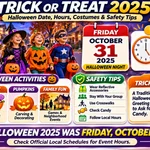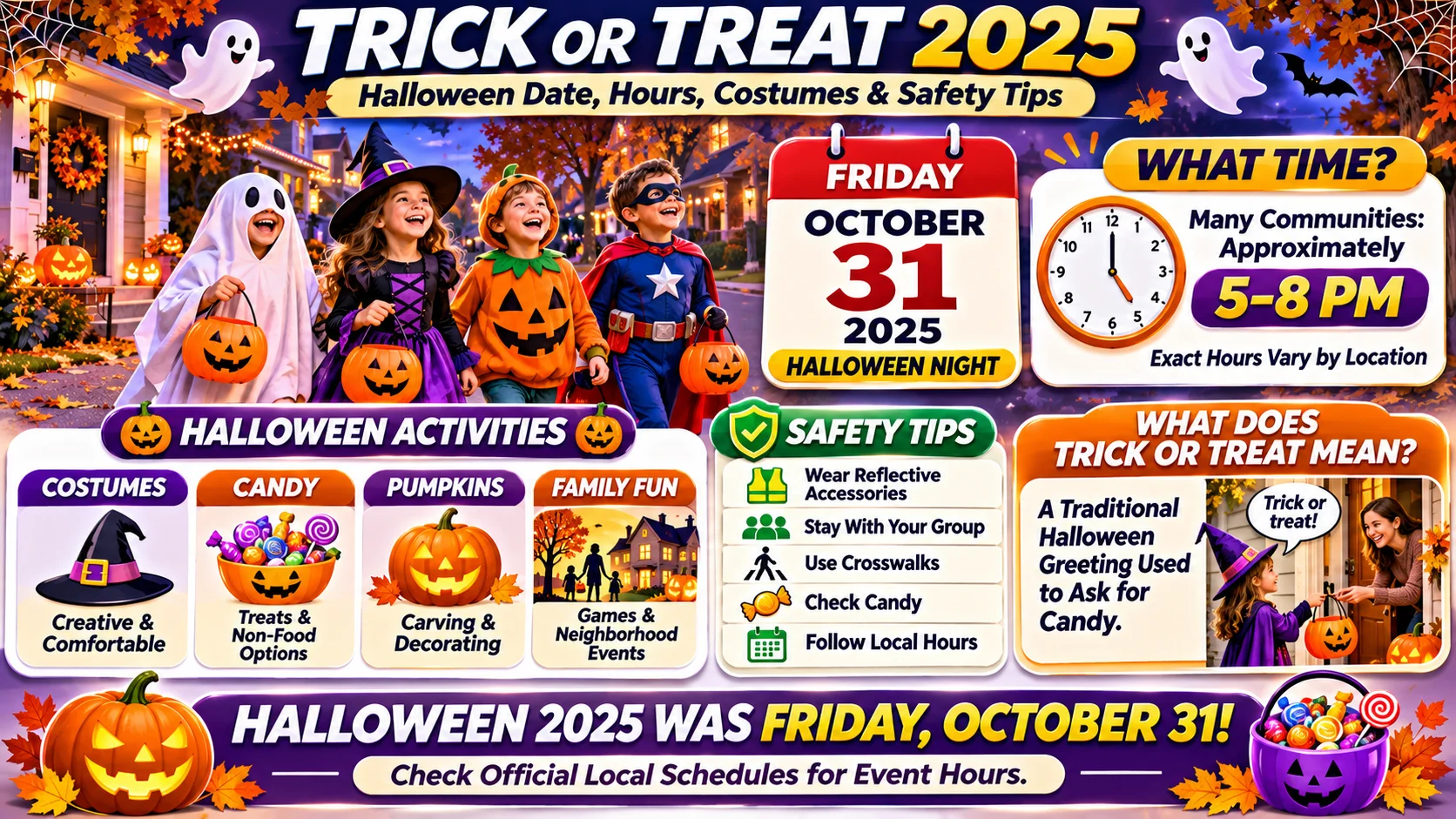
Trick or treat 2025 took place primarily on Friday, October 31, 2025, the official date of Halloween. Children traditionally dressed in costumes and visited participating homes to collect candy. Many US communities scheduled trick-or-treating between approximately 5 p.m. and 8 p.m., although exact hours and dates varied by location. Some neighborhoods also organized earlier Halloween events or adjusted schedules because of weather.
Wondering when trick or treat 2025 took place and what made the Halloween celebration special? Halloween fell on Friday, October 31, 2025, giving many families a convenient opportunity to enjoy costumes, candy, neighborhood activities, and spooky evening celebrations. However, trick-or-treating schedules weren’t identical everywhere, as different cities and communities established their own hours.
Trick-or-treating is one of Halloween’s most recognizable traditions. Each year, children dress as superheroes, witches, ghosts, princesses, and other imaginative characters before visiting neighborhood homes to ask for candy. Meanwhile, families decorate their houses with pumpkins, lights, and seasonal decorations to create a festive atmosphere. Consequently, Halloween brings together creativity, community participation, and family entertainment.
Moreover, planning a successful Halloween celebration involves more than selecting a costume. Parents often need to check neighborhood schedules, prepare suitable treats, consider weather conditions, and follow basic pedestrian safety recommendations. Additionally, community celebrations such as trunk-or-treat events and school parties provide alternatives to traditional door-to-door visits.
In this guide, you’ll discover the confirmed Halloween 2025 date, examples of official trick-or-treating hours, the meaning behind the tradition, and popular ways families celebrated. Furthermore, we’ll explore costume inspiration, practical safety tips, candy etiquette, fun activities, and frequently asked questions.
When Was Trick or Treat in 2025?
Halloween took place on Friday, October 31, 2025.
This was the traditional date for trick-or-treating in many American communities.
However, some cities organized celebrations on nearby dates, particularly when local events, school schedules, or weather conditions influenced their plans.
For example, a community might schedule a Halloween parade during the preceding weekend and reserve October 31 for neighborhood trick-or-treating.
Therefore, Halloween’s calendar date and an individual community’s trick-or-treating schedule were not always identical.
Halloween 2025 Quick Facts
| Detail | Information |
|---|---|
| Halloween date | Friday, October 31, 2025 |
| Day of the week | Friday |
| Traditional activity | Trick-or-treating |
| Typical participation | Children and families |
| Common evening hours | Approximately 5–8 p.m., varying locally |
| Popular activities | Costumes, candy, pumpkin carving, parties |
| Alternative events | Trunk-or-treat, festivals, school celebrations |
| Following Halloween | Saturday, October 31, 2026 |
Although October 31 remained the traditional holiday date, local announcements provided the most accurate information about community schedules.
What Time Did Trick-or-Treating Start in 2025?
There was no single nationwide starting time.
Instead, cities, towns, and neighborhood organizations established their own schedules.
Some communities began activities in the afternoon, while others waited until early evening.
Generally, organized neighborhood trick-or-treating events frequently took place between 5 p.m. and 8 p.m.
However, those hours were not a universal rule.
Confirmed Trick-or-Treating Hours in Selected US Cities
| Location | Date | Official Hours |
|---|---|---|
| Pittsburgh, Pennsylvania | October 31, 2025 | 5:30–7:30 p.m. |
| Reading, Pennsylvania | October 31, 2025 | 5–8 p.m. |
| Covington, Kentucky | October 31, 2025 | 6–8 p.m. |
| Normal, Illinois | October 31, 2025 | 5–8 p.m. |
| Bozeman, Montana, downtown | October 31, 2025 | 4–6 p.m. |
| Monroeville, Pennsylvania | October 31, 2025 | 6–8 p.m. |
These examples come from published 2025 community announcements.
For instance, Pittsburgh announced its 5:30–7:30 p.m. window through an official city notice.
Meanwhile, Reading established a 5–8 p.m. schedule, and Covington selected 6–8 p.m.
Therefore, families needed to check local information rather than assume every neighborhood followed identical hours.
Why Did Some Communities Change Their Halloween Schedules?
Weather and local event planning sometimes affected trick-or-treating dates.
For example, several communities in New Hampshire and Pennsylvania reconsidered their original schedules because of forecasts for unfavorable weather.
In some cases, events were moved to Friday, October 31.
Other communities held separate Halloween activities earlier in the week or on the preceding weekend.
Consequently, families sometimes had multiple opportunities to participate in seasonal celebrations.
Common Reasons for Schedule Changes
- Heavy rain or thunderstorms
- Strong winds
- Local school activities
- Community festivals
- Traffic management
- Organized neighborhood events
- Public safety concerns
However, any schedule change depended on the local organizer or government authority.
What Does Trick or Treat Mean?
The phrase trick or treat is a traditional Halloween greeting used by children when visiting participating homes to ask for candy or other treats.
The wording playfully presents two possibilities:
Trick: A harmless prank or playful joke.
Treat: Candy, chocolate, or another small gift.
Historically, the phrase suggested that residents could offer a treat instead of receiving a playful trick.
However, modern trick-or-treating is primarily a friendly neighborhood activity.
Children generally expect candy rather than threatening or performing pranks.
Example Conversation
Child: “Trick or treat!”
Homeowner: “Happy Halloween! Here’s some candy.”
Child: “Thank you!”
This simple exchange represents the familiar tradition.
Why Do People Celebrate Trick-or-Treating?
Trick-or-treating combines historical customs with modern neighborhood celebrations.
Halloween traditions developed from several cultural influences, including seasonal festivals and Christian observances associated with All Hallows’ Eve.
Over time, customs involving costumes, visiting homes, and receiving food or small gifts contributed to modern Halloween activities.
However, today’s door-to-door candy tradition developed particularly strongly in North America during the twentieth century.
Consequently, trick-or-treating became a widely recognized part of Halloween celebrations.
Community Participation
Neighborhood visits allow families to interact with participating residents.
Moreover, decorated houses and shared activities can create a festive community atmosphere.
Creative Costumes
Children often enjoy dressing as favorite fictional characters or creating original designs.
Therefore, Halloween provides opportunities for imagination and self-expression.
Family Traditions
Many families celebrate through pumpkin carving, costume preparation, and neighborhood walks.
Additionally, parents may enjoy continuing traditions they remember from childhood.
How Trick-or-Treating Works
The activity generally follows a simple process.
First, children choose costumes and prepare bags or buckets for collecting treats.
Next, families identify neighborhoods or organized events where participation is encouraged.
At the designated time, children visit participating homes and knock or ring the doorbell.
When a resident answers, children say “Trick or treat!”
The resident may offer candy or another suitable treat.
Finally, children thank the homeowner and continue to the next participating location.
Basic Trick-or-Treat Etiquette
- Visit only homes that appear to welcome trick-or-treaters.
- Respect local event hours.
- Say “please” and “thank you.”
- Take a reasonable amount of candy.
- Avoid damaging decorations.
- Stay with your group or supervising adult.
- Respect households that do not participate.
- Follow pedestrian safety rules.
These simple expectations help keep the experience enjoyable for everyone.
Popular Halloween Costume Ideas for 2025
Costumes were a central feature of the 2025 celebration.
Families could choose from traditional Halloween characters, recognizable fictional characters, animals, and original designs.
Although specific trends differed between communities, several broad costume categories remained popular choices.
Classic Halloween Costumes
Traditional Halloween costumes are recognizable and relatively easy to customize.
Examples include:
- Witches
- Ghosts
- Vampires
- Skeletons
- Zombies
- Black cats
- Pumpkins
- Werewolves
Moreover, many of these designs can be created using clothing and accessories already available at home.
Superhero Costumes
Superheroes provide colorful and recognizable costume inspiration.
Popular fictional-character options include Spider-Man, Batman, Wonder Woman, and Superman.
However, licensed costumes may vary in availability and price.
Fantasy and Fairytale Costumes
Fantasy-inspired outfits offer creative possibilities.
Examples include:
- Princesses
- Dragons
- Fairies
- Wizards
- Knights
- Mermaids
Additionally, accessories such as capes, crowns, and decorative wings can help complete the look.
Animal Costumes
Animal outfits are particularly suitable for young children.
For example, families might select costumes inspired by cats, bears, rabbits, lions, or butterflies.
Consequently, these designs can provide comfortable alternatives to elaborate outfits.
DIY Costume Ideas
Homemade costumes allow families to use affordable materials.
Examples include:
- A ghost made with a safely designed white outfit
- A robot using decorated cardboard
- A scarecrow with a checked shirt
- A detective with a coat and magnifying-glass prop
- A gardener with an apron and artificial flowers
However, costumes should allow clear visibility, comfortable movement, and safe walking.
Halloween Costume Safety Tips
Costume safety is especially important when children walk outdoors after dark.
The American Red Cross and American Academy of Pediatrics recommend precautions involving visibility, fit, and pedestrian awareness.
Choose Visible Clothing
Bright colors and reflective accessories can help drivers notice children.
Additionally, reflective tape can be added to costumes and candy bags.
Avoid Poorly Fitting Masks
Masks that restrict vision can make walking or crossing roads more dangerous.
Therefore, consider face paint or accessories that leave the eyes unobstructed.
Check Costume Length
Long costumes may create tripping hazards.
Consequently, children should be able to walk and use stairs comfortably.
Select Safe Accessories
Costume props should be lightweight and flexible.
For example, soft toy swords or wands are preferable to sharp or rigid objects.
Consider Weather Conditions
Late October temperatures vary significantly by region.
Therefore, costumes may need warm layers, comfortable shoes, or rain protection.
Trick-or-Treat Safety Tips for Parents
Planning ahead can reduce common Halloween risks.
Although the activity is generally intended to be lighthearted, streets can become crowded with pedestrians and vehicles.
Supervise Young Children
Young children should go with a responsible adult.
Older children participating without direct adult supervision should follow age-appropriate family rules and an agreed route.
Use Sidewalks
Whenever possible, walk on sidewalks and use designated crossings.
If no sidewalk is available, follow local pedestrian safety recommendations.
Additionally, avoid crossing between parked cars.
Stay Visible
Reflective clothing, glow accessories, and flashlights can improve visibility.
However, these items do not replace careful attention when crossing roads.
Avoid Entering Homes
Children should remain outside homes and vehicles when collecting treats unless they are with a trusted adult in an explicitly arranged situation.
Moreover, families should discuss these boundaries before heading out.
Inspect Treats
Parents should review collected treats before young children eat them.
Check packaging, allergies, age-appropriate food sizes, and other potential hazards.
For example, hard candies may pose choking risks for very young children.
Best Time to Take Young Children Trick-or-Treating
Early evening or organized afternoon events are often more convenient for younger children.
For example, a community event beginning at 4 p.m. may offer better daylight visibility than one starting after sunset.
Additionally, younger children may become tired or overwhelmed during long outings.
Therefore, planning a shorter route can be useful.
Tips for Families With Young Children
- Choose a familiar neighborhood.
- Begin during an authorized early time slot.
- Keep the route manageable.
- Bring water when needed.
- Use comfortable shoes.
- Take breaks.
- Consider indoor or organized alternatives if weather is poor.
Ultimately, the appropriate schedule depends on the child’s age, comfort, and local event arrangements.
What Is Trunk-or-Treat?
Trunk-or-treat is an organized Halloween activity in which participants distribute candy from decorated vehicle trunks or designated stations.
These events commonly take place in school parking lots, community centers, churches, and other organized venues.
Instead of visiting multiple neighborhood homes, children move between decorated stations.
Why Families Choose Trunk-or-Treat
Some families appreciate the defined event area and shorter walking distances.
Furthermore, organizers can establish specific hours and provide activities beyond candy collection.
However, safety still requires supervision, traffic control, and appropriate event planning.
Trick-or-Treat vs. Trunk-or-Treat
| Feature | Trick-or-Treat | Trunk-or-Treat |
|---|---|---|
| Location | Neighborhood homes | Organized event area |
| Candy distribution | Participating households | Decorated vehicle trunks or stations |
| Schedule | Local neighborhood hours | Organizer-defined hours |
| Walking distance | Varies | Often more compact |
| Common organizers | Residents and communities | Schools, organizations, community groups |
| Decorations | Houses and porches | Vehicles and designated stations |
Both activities offer opportunities to enjoy Halloween traditions.
Halloween Candy and Treat Ideas
Candy remains an important part of traditional trick-or-treating.
However, households can offer different types of treats to accommodate varying preferences.
Popular Candy Choices
Examples include:
- Individually wrapped chocolates
- Fruit-flavored candies
- Lollipops
- Chewy sweets
- Candy bars
- Small packaged treats
However, allergies and choking hazards should be considered when distributing food to children.
Non-Candy Alternatives
Some households provide small items instead of sweets.
For example:
- Stickers
- Temporary tattoos
- Pencils
- Mini notebooks
- Glow bracelets
- Small activity cards
Additionally, non-food treats may provide options for children with certain food allergies.
Nevertheless, small objects should be age-appropriate and should not create choking hazards.
How Much Candy Should You Prepare?
The amount of candy needed depends on neighborhood participation.
For example, a household receiving 20 visitors needs much less candy than one receiving several hundred children.
Therefore, reviewing participation from previous years may provide a useful estimate.
Example Planning Table
| Expected Visitors | One Treat Each | Two Treats Each |
|---|---|---|
| 25 | 25 treats | 50 treats |
| 50 | 50 treats | 100 treats |
| 100 | 100 treats | 200 treats |
| 150 | 150 treats | 300 treats |
| 200 | 200 treats | 400 treats |
These are planning examples rather than predictions of attendance.
Furthermore, households can adjust quantities according to their preferred budget and local customs.
Halloween Decorations for Trick-or-Treating
Decorations help make homes inviting and festive.
However, decorations should not obstruct walking routes or create unnecessary hazards.
Jack-o’-Lanterns
Carved pumpkins are among the most recognizable Halloween decorations.
Families often place them near entrances or windows.
However, battery-powered lights are generally safer than exposed flames near costumes and foot traffic.
Outdoor Lighting
Porch lights can help indicate participation and improve visibility.
Additionally, illuminated pathways may reduce the risk of tripping.
Halloween Door Decorations
Wreaths, paper bats, artificial spiderwebs, and seasonal signs can create a welcoming appearance.
However, keep decorations away from steps and narrow pathways.
Yard Displays
Some families create themed displays involving ghosts, skeletons, or pumpkins.
Nevertheless, secure large decorations against wind and prevent electrical cords from crossing walking areas.
Fun Halloween Activities Beyond Trick-or-Treating
Not every family chooses to participate in door-to-door candy collection.
Fortunately, Halloween offers many other entertaining activities.
Pumpkin Decorating
Families can paint or decorate pumpkins with stickers and other craft materials.
Additionally, decorating can be adapted for younger children who are not ready for carving tools.
Halloween Movie Nights
A themed movie night can provide a relaxed alternative.
For example, families may select age-appropriate animated films or spooky comedies.
However, horror content should match the preferences and comfort levels of participants.
Costume Contests
Schools, community organizations, and family gatherings can host friendly costume showcases.
Categories may include creativity, handmade design, or group costumes.
Halloween Scavenger Hunts
A scavenger hunt can involve finding pumpkins, toy spiders, bats, or other seasonal objects.
Furthermore, clues and challenges can be adjusted for different ages.
Party Games
Simple activities include:
- Halloween charades
- Pumpkin bowling
- Costume guessing games
- Spooky trivia
- Candy guessing contests
Consequently, families can celebrate Halloween even without visiting neighborhood homes.
How to Plan a Halloween Party
Planning a celebration is easier when the activities match the participants’ ages and interests.
Choose a Theme
For example, select a haunted mansion, pumpkin patch, friendly monsters, or classic Halloween theme.
A consistent theme can guide decorations, costumes, and activities.
Prepare Food and Drinks
Offer a combination of treats and ordinary refreshments.
Moreover, clearly label foods when guests have allergies or dietary restrictions.
Organize Activities
Choose games that encourage participation without making anyone uncomfortable.
For instance, a costume parade or pumpkin decorating station can work well for younger guests.
Create a Safe Environment
Keep walking areas clear and use appropriate lighting.
Additionally, supervise activities involving tools, decorations, or food preparation.
Establish a Schedule
A simple event schedule helps families know when activities will begin and finish.
However, allow flexibility for breaks and unexpected delays.
Halloween 2025 Celebration Checklist
The following checklist summarizes practical preparations that were relevant to the 2025 celebration and remain useful for similar Halloween events.
- Confirm the local event date and time.
- Choose comfortable costumes.
- Check costume visibility.
- Prepare treat bags or buckets.
- Identify safe walking routes.
- Charge phones and flashlights.
- Review pedestrian safety with children.
- Prepare age-appropriate treats.
- Check weather conditions.
- Keep emergency contact information available.
- Respect participating and nonparticipating households.
- Inspect collected treats before eating.
Completing these preparations can make seasonal activities more organized and enjoyable.
Common Mistakes During Halloween
Several avoidable mistakes can create confusion or inconvenience.
Assuming Every Community Celebrates at the Same Time
Although Halloween always falls on October 31, local trick-or-treating schedules may differ.
Therefore, official city or event announcements are more reliable than general online estimates.
Wearing Costumes That Restrict Vision
Poor visibility can increase the risk of accidents.
Consequently, masks and accessories should not interfere with safe movement.
Forgetting Road Safety
Excitement may distract children near roads.
However, pedestrian rules remain important during celebrations.
Visiting Houses That Are Not Participating
Not every household distributes candy.
Therefore, families should respect homes that do not appear to welcome visitors.
Ignoring Food Allergies
Certain candies contain ingredients such as peanuts, tree nuts, milk, or wheat.
Consequently, checking labels and considering non-food alternatives can help accommodate different needs.
Staying Out Too Late
Long outings may leave young children tired or uncomfortable.
Instead, choose an appropriate schedule based on age, weather, and local event hours.
Was Trick-or-Treating Always on October 31?
Halloween itself is observed on October 31.
However, organized trick-or-treating has not always taken place exclusively on that date in every community.
Local traditions, school schedules, weather concerns, and municipal decisions can influence when children collect candy.
For example, some communities have held trick-or-treating on a nearby weekend.
Others have designated particular neighborhood hours regardless of the day of the week.
Therefore, October 31 is the traditional holiday date rather than a universal nationwide schedule for every organized event.
Trick or Treat 2025 vs. Halloween 2026
For readers comparing holiday dates, Halloween falls on a different weekday each year.
| Detail | Halloween 2025 | Halloween 2026 |
|---|---|---|
| Calendar date | October 31 | October 31 |
| Day of the week | Friday | Saturday |
| Traditional activity | Trick-or-treating | Trick-or-treating |
| Local schedules | Varied by community | Must be verified locally |
| Weekend convenience | Friday evening | Saturday evening |
Although the 2026 celebration falls on a Saturday, this does not guarantee identical schedules across cities.
Therefore, updated local notices remain important for future celebrations.
Frequently Asked Questions
When was trick or treat in 2025?
The traditional Halloween date was Friday, October 31, 2025. However, individual communities could schedule organized trick-or-treating on nearby dates or during different hours.
What day of the week was Halloween 2025?
Halloween 2025 fell on a Friday, making it convenient for many families to celebrate before the weekend.
What time did trick-or-treating start in 2025?
Starting times depended on the community. For example, Bozeman’s downtown event began at 4 p.m., while Pittsburgh began at 5:30 p.m. and Covington at 6 p.m.
Was Halloween 2025 on a Friday or Saturday?
Halloween 2025 was on Friday, October 31. Halloween 2026 falls on Saturday, October 31.
Did every city have trick-or-treating on October 31?
No. Some communities organized activities on other dates or adjusted their schedules. Therefore, official local announcements determined the correct information for each area.
What does trick or treat mean?
The phrase is a traditional Halloween greeting used when asking for candy. Originally, it playfully suggested a choice between offering a treat and receiving a harmless trick. Today, it mainly represents a friendly candy-collecting tradition.
What were typical trick-or-treat hours in 2025?
Many American communities scheduled events between approximately 5 p.m. and 8 p.m. However, some events began earlier or ended at different times.
Could children trick-or-treat before Halloween?
Yes, where communities organized earlier celebrations. These included school events, neighborhood activities, and trunk-or-treat gatherings.
What are the best trick-or-treat safety tips?
Choose visible, well-fitting costumes, use sidewalks, supervise young children, cross roads carefully, and inspect treats. Additionally, follow the designated local hours and neighborhood rules.
What is the difference between trick-or-treat and trunk-or-treat?
Traditional trick-or-treating involves visiting participating neighborhood homes. Meanwhile, trunk-or-treat events distribute candy from decorated vehicle trunks or organized stations.
Can adults participate in trick-or-treating?
Adults often participate by accompanying children, distributing candy, decorating homes, or attending costume events. However, expectations about adults collecting candy themselves differ between communities.
What should children say when trick-or-treating?
The traditional greeting is “Trick or treat!” After receiving candy, children are encouraged to say “Thank you!”
What if it rains on Halloween?
Families can wear weather-appropriate clothing, attend indoor activities, or follow any official schedule changes. However, they should avoid unsafe outdoor conditions.
Is Halloween celebrated outside the United States?
Yes. Halloween is observed in several countries, although traditions and levels of participation differ. However, American-style door-to-door trick-or-treating is not equally common everywhere.
How can parents find local trick-or-treating hours?
The most reliable sources include municipal websites, official community announcements, neighborhood associations, and event organizers. Additionally, local news outlets may publish confirmed schedules.
Conclusion
Trick or treat 2025 was primarily celebrated on Friday, October 31, bringing costumes, candy, decorations, and family activities to participating communities. Although Halloween’s traditional date remained the same nationwide, local trick-or-treating schedules varied, with some cities setting official evening hours and others organizing separate events.
Furthermore, the celebration involved much more than collecting sweets. Families enjoyed costume preparation, pumpkin decorating, Halloween parties, and community activities. Meanwhile, organized trunk-or-treat gatherings offered an alternative to traditional neighborhood visits.
Most importantly, safe participation depended on suitable costumes, pedestrian awareness, responsible supervision, and respect for local schedules. Checking official announcements helped families prepare for weather-related adjustments and other changes.
Ultimately, Halloween 2025 was another opportunity for families and communities to enjoy a familiar seasonal tradition. Whether through trick-or-treating, creative costumes, or home celebrations, the holiday offered plenty of ways to make memorable experiences while keeping safety and courtesy in mind.