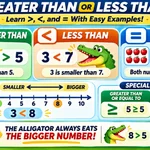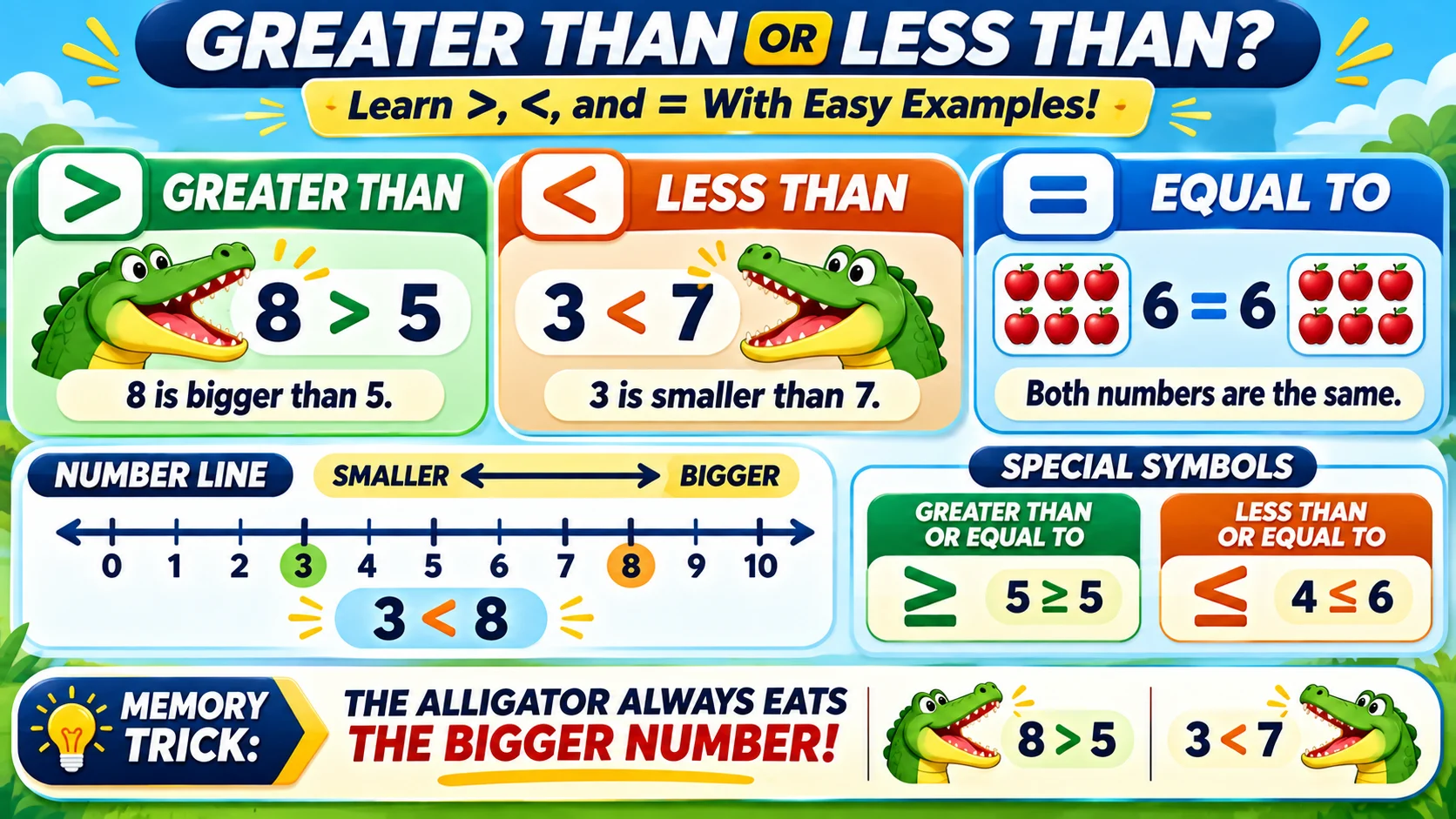
Greater than or less than symbols are mathematical signs used to compare two numbers or values. The greater than symbol (>) means the number on the left is larger than the number on the right, as in 8 > 5. The less than symbol (<) means the left number is smaller, as in 3 < 7. The open side always faces the larger value.
Have you ever looked at the symbols > and < and wondered which one means greater than or less than? Although these mathematical signs are simple, their similar shapes can confuse beginners, especially when comparing numbers for the first time. Fortunately, a few easy rules and memory tricks can help you recognize the correct symbol without hesitation.
In mathematics, comparing numbers is an essential skill that helps us understand differences in quantity, size, value, and order. For example, when comparing 10 and 6, we use the greater than sign because 10 is larger. Meanwhile, when comparing 4 and 9, we use the less than sign because 4 is smaller. Therefore, learning these symbols provides a foundation for understanding inequalities and solving more advanced math problems.
Moreover, comparison signs appear in everyday situations, including shopping, measuring distances, comparing temperatures, and calculating scores. They also play an important role in algebra, science, and computer programming. Consequently, understanding how these signs work can make mathematical expressions easier to read and interpret.
In this guide, you’ll learn the meaning of greater than and less than, how to identify their symbols, simple rules for comparing numbers, and practical examples. Additionally, we’ll explore equality signs, fractions, decimals, negative numbers, common mistakes, practice exercises, and helpful memory tricks to make learning easier.
What Does Greater Than or Less Than Mean?
The expressions greater than and less than describe the relationship between two numbers or quantities.
Greater than means one value is larger than another.
Less than means one value is smaller than another.
Mathematics uses special symbols to represent these relationships.
- > means greater than.
- < means less than.
- = means equal to.
For example:
12 > 8
This expression means 12 is greater than 8.
Similarly:
5 < 11
This expression means 5 is less than 11.
However, when two numbers have exactly the same value, we use the equal sign.
For example:
7 = 7
Therefore, the symbol you choose depends on the relationship between the two values.
Greater Than vs. Less Than
| Feature | Greater Than | Less Than |
|---|---|---|
| Symbol | > | < |
| Meaning | Larger than | Smaller than |
| Example | 9 > 4 | 3 < 8 |
| Read as | Nine is greater than four | Three is less than eight |
| Open side faces | Larger number | Larger number |
| Pointed side faces | Smaller number | Smaller number |
| Common use | Comparing larger values | Comparing smaller values |
Although the symbols point in opposite directions, they follow the same visual rule.
The wide opening faces the larger value, while the narrow point faces the smaller value.
What Is the Greater Than Symbol?
The greater than symbol (>) is used when the value on the left is larger than the value on the right.
For example:
15 > 10
This statement reads:
“Fifteen is greater than ten.”
Since 15 has a higher numerical value than 10, the comparison is true.
Greater Than Examples
- 8 > 3
- 12 > 7
- 20 > 15
- 50 > 25
- 100 > 75
- 1,000 > 500
- 9.5 > 8.2
- 3/4 > 1/2
These examples demonstrate that the sign works with whole numbers, decimals, and fractions.
Moreover, it can be used with negative numbers when the values are compared correctly.
Greater Than in Everyday Life
Imagine that Sarah has 12 pencils and Emma has 8 pencils.
Because Sarah has more pencils, we can write:
12 > 8
Similarly, if one box contains 25 chocolates and another contains 15, the first box contains the greater quantity.
Therefore:
25 > 15
This symbol helps communicate comparisons without using a complete sentence.
What Is the Less Than Symbol?
The less than symbol (<) indicates that the number on the left is smaller than the number on the right.
For example:
6 < 13
This statement means:
“Six is less than thirteen.”
Since 6 is smaller than 13, the comparison is correct.
Less Than Examples
- 2 < 5
- 4 < 10
- 11 < 18
- 25 < 40
- 70 < 100
- 0.3 < 0.8
- 1/4 < 1/2
- -5 < -2
Although some comparisons are straightforward, decimals and negative numbers may require extra attention.
Less Than in Everyday Life
Suppose a small bottle contains 250 milliliters of water while a larger bottle contains 500 milliliters.
We can write:
250 < 500
This means the first bottle contains less water than the second.
Likewise, if one student earns 65 points and another earns 90 points, their scores can be compared as:
65 < 90
Consequently, comparison symbols provide a simple way to describe numerical relationships.
How to Remember Greater Than and Less Than Symbols
One of the biggest challenges for beginners is remembering which direction each sign faces.
However, several memory tricks make the symbols easier to recognize.
The Alligator Mouth Trick
The alligator trick is one of the most popular methods for teaching comparison signs.
Imagine that the symbol represents an alligator’s open mouth.
The hungry alligator always wants to eat the larger number.
For example:
9 > 4
The mouth opens toward 9 because 9 is larger.
Similarly:
3 < 7
The mouth opens toward 7 because 7 is larger.
Therefore, remember:
The alligator always eats the bigger number!
This trick is particularly helpful for children learning inequalities.
The Open Side Trick
Another simple method is to focus on the wide opening.
The open side always faces the larger number.
Meanwhile, the pointed end faces the smaller number.
For example:
18 > 12
The opening faces 18.
6 < 14
The opening faces 14.
Consequently, you can identify the correct sign without memorizing separate rules.
The Number Line Trick
A number line helps students visualize how numbers are ordered.
Numbers generally increase as you move to the right.
For example:
0 — 1 — 2 — 3 — 4 — 5 — 6 — 7 — 8 — 9 — 10
Because 8 appears to the right of 5, it is greater than 5.
Therefore:
8 > 5
Meanwhile, 3 appears to the left of 7.
Consequently:
3 < 7
This method becomes especially useful when comparing negative numbers.
How to Read Greater Than and Less Than Signs
Reading mathematical comparisons correctly helps students understand their meaning.
For example:
10 > 6
Read it as:
“Ten is greater than six.”
Similarly:
4 < 9
Read it as:
“Four is less than nine.”
More Reading Examples
| Mathematical Expression | How to Read It |
|---|---|
| 5 > 2 | Five is greater than two |
| 3 < 7 | Three is less than seven |
| 15 > 11 | Fifteen is greater than eleven |
| 8 < 20 | Eight is less than twenty |
| 100 > 50 | One hundred is greater than fifty |
| 25 < 30 | Twenty-five is less than thirty |
In each expression, read the number on the left first, then the comparison symbol, and finally the number on the right.
Greater Than, Less Than, and Equal To
Mathematics uses three basic comparison symbols.
These signs show whether one value is larger, smaller, or equal to another.
Greater Than (>)
The symbol means the left value is larger.
Example:
14 > 9
Less Than (<)
The symbol means the left value is smaller.
Example:
5 < 12
Equal To (=)
The equal sign indicates that both sides have the same value.
Example:
8 = 8
Additionally, different mathematical expressions can have equal results.
For example:
5 + 3 = 4 + 4
Both sides equal 8.
Comparison Table
| Symbol | Name | Meaning | Example |
|---|---|---|---|
| > | Greater than | Left value is larger | 9 > 5 |
| < | Less than | Left value is smaller | 2 < 6 |
| = | Equal to | Both values are the same | 7 = 7 |
| ≥ | Greater than or equal to | Larger or equal | 8 ≥ 8 |
| ≤ | Less than or equal to | Smaller or equal | 4 ≤ 6 |
| ≠ | Not equal to | Values are different | 3 ≠ 5 |
These symbols appear frequently in arithmetic and algebra.
What Does Greater Than or Equal To Mean?
The greater than or equal to symbol (≥) means a value is either larger than or equal to another value.
For example:
x ≥ 5
This means x can be 5 or any number greater than 5.
Examples include:
- 5 ≥ 5
- 6 ≥ 5
- 10 ≥ 5
- 100 ≥ 5
However:
4 ≥ 5
is false because 4 is smaller than 5.
Real-Life Example
Suppose a competition requires participants to be at least 18 years old.
We can represent the requirement as:
Age ≥ 18
Therefore, people who are 18 or older meet the age requirement.
What Does Less Than or Equal To Mean?
The less than or equal to symbol (≤) indicates that a value is smaller than or equal to another value.
For example:
x ≤ 10
This means x can be 10 or any number smaller than 10.
Examples include:
- 10 ≤ 10
- 8 ≤ 10
- 5 ≤ 10
- 0 ≤ 10
However:
12 ≤ 10
is false because 12 is greater than 10.
Real-Life Example
Imagine that an elevator has a maximum allowed load of 500 kilograms.
The condition can be written as:
Weight ≤ 500 kg
Consequently, the load must not exceed 500 kilograms.
How to Compare Two Numbers
Comparing numbers becomes easier when you follow a systematic process.
Identify the Numbers
First, examine the two values.
For example:
16 and 25
Determine Which Is Larger
Next, compare their values.
Since 25 is larger than 16, the first number is smaller.
Choose the Correct Symbol
Finally, place the less than sign between them.
16 < 25
The comparison is now complete.
Another Example
Compare:
40 and 18
Because 40 is larger, use the greater than symbol.
40 > 18
Therefore, the correct sign always reflects the numerical relationship.
Comparing Two-Digit and Three-Digit Numbers
When numbers contain multiple digits, place value helps determine which is larger.
For example:
245 and 198
The first number contains 2 hundreds, while the second contains 1 hundred.
Consequently:
245 > 198
Now compare:
362 and 385
Both numbers contain 3 hundreds.
However, the tens digits are different.
Since 6 tens are fewer than 8 tens:
362 < 385
More Examples
- 125 < 250
- 450 > 375
- 999 > 899
- 560 < 650
- 1,200 > 950
For positive whole numbers, a number with more digits is generally larger than one with fewer digits, excluding leading zeros.
However, when numbers have the same number of digits, compare their place values from left to right.
Comparing Decimals Using Greater Than and Less Than
Decimals can be compared by examining their place values.
For example:
0.7 > 0.4
This is true because seven tenths is greater than four tenths.
Similarly:
2.35 < 2.50
Both numbers have the same whole-number part.
However, the tenths digit in 2.35 is smaller than the tenths digit in 2.50.
Therefore, 2.35 is less than 2.50.
Decimal Comparison Examples
| Expression | Result |
|---|---|
| 0.8 > 0.5 | True |
| 1.2 < 1.8 | True |
| 3.75 > 3.50 | True |
| 0.25 < 0.75 | True |
| 4.05 < 4.50 | True |
| 2.10 = 2.1 | True |
An important trick is to add zeros when comparing decimal places.
For example:
0.5 = 0.50
Adding a zero to the end of a decimal does not change its value.
Comparing Fractions Using Inequality Symbols
Fractions represent parts of a whole.
Therefore, comparing them requires understanding the relationship between numerators and denominators.
Fractions With the Same Denominator
When denominators are equal and positive, compare the numerators.
For example:
3/8 > 2/8
Both fractions have eight equal parts.
However, three parts are greater than two parts.
Fractions With the Same Numerator
For positive fractions with the same numerator, a smaller positive denominator creates a larger value.
For example:
1/3 > 1/5
One-third is larger than one-fifth because a whole divided into three equal parts produces larger pieces than a whole divided into five.
Fractions With Different Numerators and Denominators
Sometimes, you need a common denominator.
For example:
Compare:
1/2 and 3/4
Convert one-half into fourths.
1/2 = 2/4
Since 2/4 is smaller than 3/4:
1/2 < 3/4
Additional Fraction Examples
- 2/3 > 1/3
- 1/4 < 1/2
- 3/5 > 2/5
- 4/6 = 2/3
- 5/8 < 3/4
Consequently, comparison symbols are useful when working with fractions of different sizes.
Greater Than and Less Than With Negative Numbers
Negative numbers follow the same comparison rules as positive numbers.
However, they can be confusing because a number with a larger absolute value may actually be smaller.
For example:
-3 > -8
Although 8 is larger than 3 as a positive number, negative 3 is greater than negative 8.
This happens because -3 is closer to zero on the number line.
Negative Number Examples
- -1 > -5
- -4 < -2
- -10 < -3
- -6 > -9
- 0 > -7
- -12 < 2
Easy Number Line Explanation
Consider this sequence:
-5 — -4 — -3 — -2 — -1 — 0 — 1 — 2 — 3 — 4 — 5
Numbers become larger as you move to the right.
Therefore:
-2 > -4
Meanwhile:
-5 < -1
This visual approach helps students compare negative values correctly.
Greater Than and Less Than in Algebra
Comparison symbols are also used in algebra to represent inequalities.
An inequality describes a relationship between mathematical expressions.
For example:
x > 5
This means the variable x can represent any number greater than 5.
Similarly:
y < 10
This means y can represent any number smaller than 10.
Algebra Examples
- x > 3
- y < 8
- a ≥ 12
- b ≤ 20
- n ≠ 0
However, algebraic inequalities may require additional steps when solving equations.
For example:
x + 4 > 10
Subtract 4 from both sides:
x > 6
Therefore, every value greater than 6 satisfies the inequality.
Important Inequality Rule
When multiplying or dividing both sides of an inequality by a negative number, reverse the inequality sign.
For example:
-2x > 8
Divide both sides by -2:
x < -4
The greater than sign changes to a less than sign.
This rule is essential for solving inequalities correctly.
Greater Than and Less Than in Real Life
Comparison symbols are useful far beyond school mathematics.
They appear in everyday decisions involving numbers and measurements.
Comparing Prices
Suppose one notebook costs $5 and another costs $8.
We can write:
$5 < $8
Therefore, the first notebook is cheaper.
Comparing Temperatures
Imagine that one city has a temperature of 20°C while another has 28°C.
The relationship is:
20°C < 28°C
Consequently, the second city has a higher temperature.
Comparing Test Scores
A student receives 85 points, while another earns 92.
Their scores can be compared as:
85 < 92
The second student achieved the higher score.
Comparing Distances
Suppose one route is 12 kilometers and another is 18 kilometers.
We can write:
12 km < 18 km
Therefore, the first route is shorter.
Comparing Heights
If one plant is 45 centimeters tall and another is 60 centimeters tall:
45 cm < 60 cm
The second plant is taller.
These examples demonstrate how mathematical inequalities help communicate everyday comparisons.
Greater Than and Less Than in Computer Programming
Comparison operators also appear in programming languages.
For example, many programming languages use:
>for greater than<for less than>=for greater than or equal to<=for less than or equal to
These operators help computers evaluate conditions.
For example, the following Python statement checks whether a number is greater than 10:
number = 15

if number > 10:
    print("The number is greater than 10")
Since 15 is greater than 10, the program prints the message.
Similarly:
age = 16

if age < 18:
    print("Under 18")
Because 16 is smaller than 18, the condition is true.
Therefore, understanding comparison symbols is useful for mathematics and computer science.
Common Mistakes With Greater Than and Less Than
Students often make simple mistakes when learning inequality signs.
Fortunately, these errors can be avoided with regular practice.
Reversing the Symbols
Incorrect:
5 > 9
Correct:
5 < 9
Since 5 is smaller than 9, the less than sign is required.
Confusing Greater Than With Equal To
Incorrect:
7 > 7
Correct:
7 = 7
Two identical numbers are equal, not greater or smaller.
Comparing Negative Numbers Incorrectly
Incorrect:
-8 > -3
Correct:
-8 < -3
Negative 8 lies farther left on the number line.
Therefore, it is smaller.
Ignoring Decimal Place Values
Incorrect:
0.45 > 0.6
Correct:
0.45 < 0.6
The number 0.6 can be written as 0.60.
Consequently, comparing 0.45 and 0.60 makes the relationship clearer.
Forgetting to Reverse an Inequality
When multiplying or dividing by a negative value, the inequality direction must change.
For example:
-x > 4
Multiplying both sides by -1 gives:
x < -4
Failing to reverse the symbol produces an incorrect solution.
Practice Exercises: Greater Than, Less Than, or Equal To
Test your understanding by choosing the correct symbol.
Fill in the Blanks
- 8 ___ 5
- 3 ___ 9
- 12 ___ 12
- 25 ___ 18
- 7 ___ 15
- 100 ___ 99
- 0.4 ___ 0.7
- -3 ___ -6
- 1/2 ___ 1/4
- 50 ___ 75
- 2.5 ___ 2.50
- -8 ___ -2
- 350 ___ 305
- 3/4 ___ 1/2
- 1,000 ___ 999
Answers and Explanations
| Question | Correct Symbol | Explanation |
|---|---|---|
| 1 | > | 8 is larger than 5 |
| 2 | < | 3 is smaller than 9 |
| 3 | = | Both numbers are equal |
| 4 | > | 25 is larger than 18 |
| 5 | < | 7 is smaller than 15 |
| 6 | > | 100 is larger than 99 |
| 7 | < | 0.4 is smaller than 0.7 |
| 8 | > | -3 is greater than -6 |
| 9 | > | One-half is greater than one-quarter |
| 10 | < | 50 is smaller than 75 |
| 11 | = | 2.5 and 2.50 have equal values |
| 12 | < | -8 is smaller than -2 |
| 13 | > | 350 is larger than 305 |
| 14 | > | Three-quarters is greater than one-half |
| 15 | > | 1,000 is larger than 999 |
These exercises cover whole numbers, negative values, decimals, and fractions.
Why Learning Comparison Symbols Matters
Understanding mathematical comparisons develops important skills used throughout education and everyday life.
Builds Number Sense
Comparing values helps students understand numerical order, magnitude, and relationships.
Moreover, it supports the development of mental mathematics.
Supports Advanced Mathematics
Inequality signs appear frequently in algebra, geometry, statistics, and calculus.
Therefore, mastering them early makes more advanced mathematical concepts easier to understand.
Improves Problem-Solving
Many mathematical problems involve deciding which quantity is larger or smaller.
For example, comparing measurements and financial values requires accurate numerical reasoning.
Helps With Everyday Decisions
Comparison symbols can simplify information about prices, temperatures, distances, and quantities.
Consequently, they provide a useful connection between classroom mathematics and practical situations.
Supports Technology Skills
Programming languages rely on comparison operators to evaluate conditions and make decisions.
Additionally, spreadsheets and digital systems use inequalities in formulas, filters, and data analysis.
Frequently Asked Questions
What is the difference between greater than and less than?
Greater than means the value on the left is larger than the value on the right, while less than means the left value is smaller. For example, 10 > 5 and 3 < 8.
Which symbol means greater than?
The symbol > means greater than. For example, 9 > 4 means nine is greater than four.
Which symbol means less than?
The symbol < means less than. For example, 2 < 7 means two is less than seven.
How do you remember greater than and less than?
Imagine that the symbol represents a hungry alligator’s mouth. The open mouth always faces the larger number. Additionally, the pointed side faces the smaller value.
Is 5 greater than or less than 10?
Five is less than ten. Therefore, the correct expression is 5 < 10.
What does ≥ mean?
The symbol ≥ means greater than or equal to. For example, x ≥ 5 means x can be 5 or any number larger than 5.
What does ≤ mean?
The symbol ≤ means less than or equal to. For example, x ≤ 10 means x can be 10 or any number smaller than 10.
Is -5 greater than -2?
No. Negative 5 is smaller than negative 2 because it lies farther left on the number line. Therefore, -5 < -2.
How do you compare decimal numbers?
Compare decimal digits according to place value, starting with the whole-number part. For example, 0.75 > 0.50 because 75 hundredths is greater than 50 hundredths.
How do you compare fractions?
You can compare fractions by using common denominators, converting them to decimals, or using other equivalent representations. For example, 1/2 > 1/4 because one-half represents a larger quantity than one-quarter.
What is the difference between > and ≥?
The symbol > means strictly greater than, so equal values are excluded. Meanwhile, ≥ means greater than or equal to, so equality is included.
Can greater than and less than symbols be used in algebra?
Yes. Algebra uses these symbols to describe relationships between expressions and variables. For example, x > 3 represents all real numbers greater than 3.
What does the alligator mouth trick mean?
The alligator trick teaches children that the wide opening of the comparison sign faces the larger number. For instance, 8 > 3 because the imaginary alligator wants to eat 8.
Are greater than and less than used in programming?
Yes. Programming languages commonly use comparison operators to test numerical relationships. For example, x > 10 checks whether x is larger than 10.
Conclusion
Understanding greater than or less than is an important foundation for learning mathematics. These comparison symbols help us identify whether one number is larger, smaller, or equal to another value. Although the signs may look confusing initially, their meaning becomes easier to remember with practice.
The greater than symbol (>) shows that the number on the left is larger, while the less than symbol (<) indicates that the number on the left is smaller. Moreover, the open side of either symbol always faces the larger value, making the alligator mouth trick a useful memory aid.
Furthermore, these signs are used beyond basic arithmetic. They play important roles in comparing decimals, fractions, negative numbers, algebraic expressions, measurements, and everyday quantities.
Ultimately, the best way to master these symbols is to practice comparing different values and checking their positions on a number line. With consistent practice, you’ll be able to recognize and use inequality signs accurately and confidently.