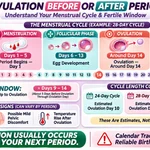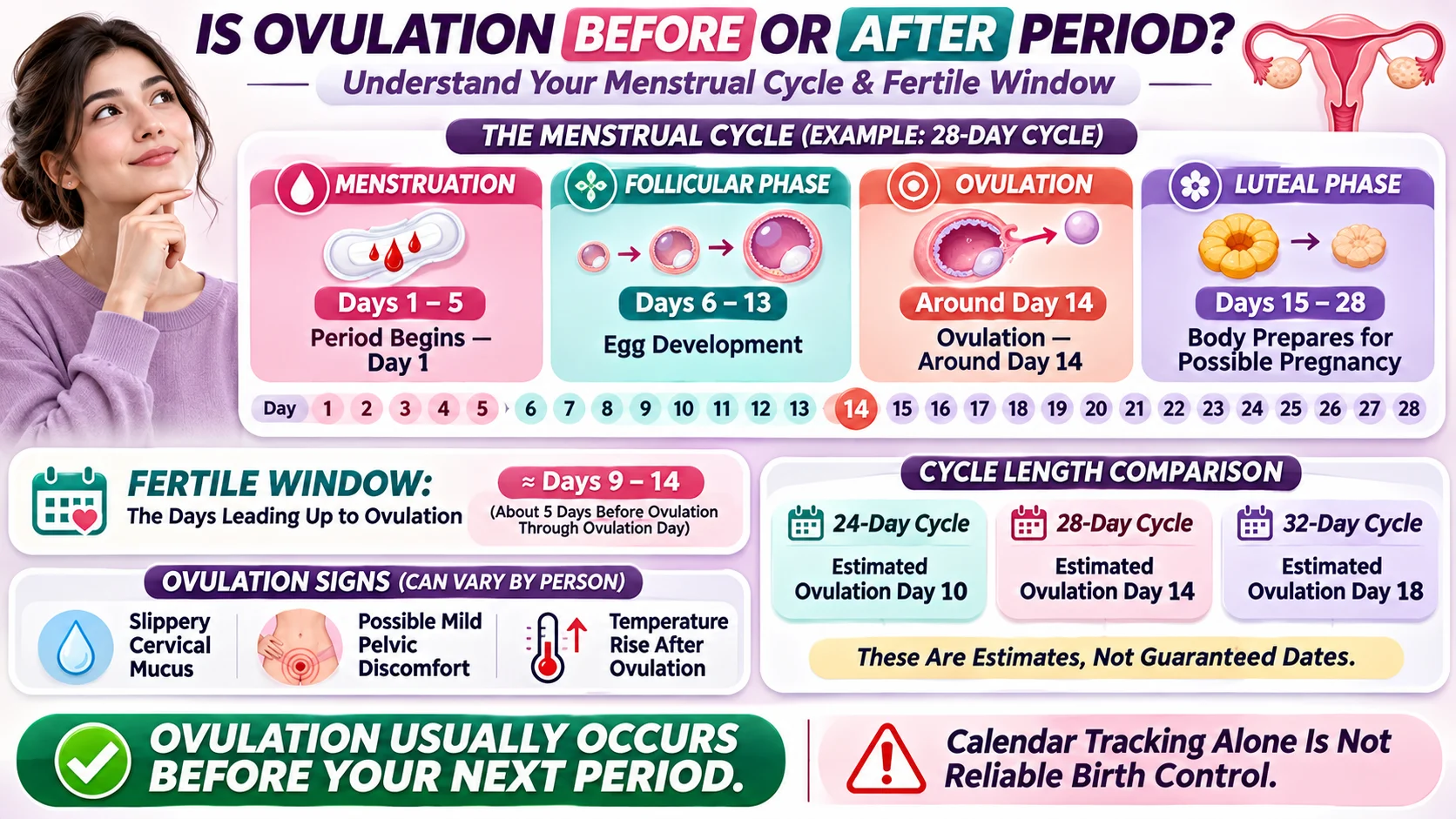
Ovulation typically happens after your period begins and before your next period starts. In a regular 28-day menstrual cycle, ovulation often occurs around day 14, approximately 14 days before the next period. However, timing varies with cycle length. The fertile window generally includes the five days before ovulation and the day of ovulation, with a short possibility of fertilization afterward.
Have you ever wondered, is ovulation before or after period, especially when trying to understand your fertile days or plan a pregnancy? Although menstrual cycles follow a general pattern, figuring out exactly when your body releases an egg can feel confusing. Some people believe ovulation happens immediately after menstruation, while others assume it occurs just before the next period. However, the timing is more specific and depends on your individual cycle.
Ovulation is a natural reproductive process in which an ovary releases an egg. This usually happens during the interval between two menstrual periods. For example, someone with a typical 28-day cycle may ovulate around day 14, counting the first day of menstrual bleeding as day one. Nevertheless, people with shorter, longer, or irregular cycles may ovulate at different times.
Moreover, knowing when ovulation occurs can help you understand fertility, recognize hormonal changes, and track your menstrual health. Since sperm can survive for several days inside the reproductive tract, pregnancy may occur even when intercourse happens before the actual day of ovulation. Therefore, understanding the fertile window is just as important as identifying a predicted ovulation date.
In this guide, you’ll learn when ovulation happens, how it relates to your period, ways to estimate fertile days, and common signs that ovulation may be approaching. Additionally, we’ll explain cycle-length differences, pregnancy chances, common misconceptions, and when to seek medical advice.
Does Ovulation Happen Before or After Your Period?
Ovulation generally occurs after one period starts and before the next period begins.
The menstrual cycle starts on the first day of menstrual bleeding and continues until the day before the following period.
During this time, hormonal changes prepare the body for a possible pregnancy.
First, the uterine lining is shed during menstruation. Meanwhile, follicles in the ovaries develop as hormone levels change.
Next, an ovary may release a mature egg during ovulation.
If fertilization and pregnancy do not occur, hormone levels eventually decline, and another period begins.
Therefore, ovulation occurs between periods rather than at a fixed number of days after bleeding ends.
Quick Overview
| Menstrual Event | Typical Timing | What Happens |
|---|---|---|
| Period begins | Day 1 | Menstrual bleeding starts |
| Follicular phase | Beginning of cycle until ovulation | Egg-containing follicles develop |
| Fertile window | Several days before ovulation and around ovulation | Pregnancy is more likely |
| Ovulation | Around day 14 in a 28-day cycle | An ovary releases an egg |
| Luteal phase | After ovulation | Hormones support the uterine lining |
| Next period | Around day 29 in a 28-day cycle | A new cycle begins if pregnancy has not occurred |
These timings are examples, not guaranteed dates.
In particular, the day of ovulation can vary even among people with apparently regular periods.
What Is Ovulation?
Ovulation is the release of a mature egg from an ovary.
It is an important part of the menstrual cycle and the process of natural conception.
During the first part of a cycle, several ovarian follicles begin developing under the influence of reproductive hormones.
Usually, one follicle becomes dominant.
A rise in luteinizing hormone, often called the LH surge, then helps trigger the release of an egg.
Afterward, the egg enters the fallopian tube, where fertilization may occur if sperm are present.
The released egg generally remains capable of being fertilized for approximately 12–24 hours.
However, sperm can survive for as long as five days under favorable conditions in the reproductive tract.
Consequently, pregnancy can result from intercourse that occurs several days before ovulation.
Understanding the Menstrual Cycle
The menstrual cycle includes several overlapping hormonal and reproductive changes.
Although a 28-day cycle is commonly used as an educational example, real cycles vary in length.
Menstrual Phase
The menstrual phase begins when bleeding starts.
During this stage, the uterus sheds its lining because pregnancy has not occurred and hormone levels have declined.
Menstrual bleeding commonly lasts several days, although duration varies.
Importantly, the first day of bleeding is counted as day one of the new cycle.
Follicular Phase
The follicular phase begins on the first day of menstruation and continues until ovulation.
During this stage, follicles develop within the ovaries.
Additionally, estrogen levels generally rise as the body prepares for the possible release of an egg.
The length of this phase can vary substantially between cycles.
Therefore, differences in follicular-phase length are an important reason that ovulation dates are not identical for everyone.
Ovulation Phase
Ovulation occurs when an ovary releases an egg.
For someone with a regular 28-day cycle, this is often around day 14.
However, ovulation does not necessarily occur halfway through every cycle.
Instead, it is often more useful to estimate backward from the expected next period.
Luteal Phase
The luteal phase begins after ovulation.
During this stage, progesterone helps maintain the uterine lining in preparation for a possible pregnancy.
If pregnancy does not occur, hormone levels fall and menstruation begins.
The interval from ovulation to the following period is often approximately 10–16 days, with individual variation.
How Many Days After Your Period Do You Ovulate?
There is no single number of days after menstruation that applies to everyone.
The timing depends on overall cycle length, the duration of bleeding, and individual hormonal patterns.
For example, someone with a 28-day cycle and five days of bleeding might ovulate around nine days after bleeding ends.
However, someone with a shorter cycle could ovulate much sooner.
Meanwhile, a person with a longer cycle may ovulate considerably later.
Estimated Ovulation by Cycle Length
| Cycle Length | Approximate Ovulation Day | Approximate Days Before Next Period |
|---|---|---|
| 21 days | Day 7 | 14 days |
| 24 days | Day 10 | 14 days |
| 26 days | Day 12 | 14 days |
| 28 days | Day 14 | 14 days |
| 30 days | Day 16 | 14 days |
| 32 days | Day 18 | 14 days |
| 35 days | Day 21 | 14 days |
These values are mathematical estimates based on a 14-day luteal phase, not individualized predictions.
Actual ovulation may occur earlier or later, and not every menstrual cycle includes ovulation.
How to Calculate Your Ovulation Date
A simple calendar estimate starts with your average menstrual cycle length.
First, identify the first day of your most recent period.
Next, determine approximately how many days usually pass between the start of one period and the start of the next.
Then subtract about 14 days from your average cycle length to estimate an ovulation day.
Example: A 28-Day Cycle
Cycle length: 28 days
28 − 14 = 14
Estimated ovulation: Day 14
Example: A 30-Day Cycle
Cycle length: 30 days
30 − 14 = 16
Estimated ovulation: Day 16
Example: A 24-Day Cycle
Cycle length: 24 days
24 − 14 = 10
Estimated ovulation: Day 10
However, these calculations cannot confirm exactly when an egg is released.
Furthermore, stress, illness, hormonal changes, and natural cycle variation may affect ovulation.
Therefore, calendar tracking should be treated as an estimate rather than a reliable contraceptive method.
Ovulation Timeline Calculator
Use this simple educational calculator to understand approximate ovulation timing.
Formula:
Estimated ovulation day = Average cycle length − 14
For example, entering a 28-day cycle gives an estimate of day 14.
The estimated fertile window is approximately the five days leading up to ovulation and the ovulation day.
However, because actual timing varies, the calculation cannot identify guaranteed fertile or infertile days.
What Is the Fertile Window?
The fertile window is the part of the menstrual cycle when intercourse is most likely to result in pregnancy.
It typically includes the five days before ovulation and the day of ovulation.
Some clinical guidance also includes the day afterward because the released egg can remain viable for a short period.
Why Can Pregnancy Happen Before Ovulation?
Sperm may survive in the reproductive tract for up to five days under favorable conditions.
Therefore, sperm from intercourse several days before ovulation may still be present when an egg is released.
For example, intercourse on day 11 of a cycle could result in pregnancy if ovulation occurs on day 14.
Consequently, pregnancy is not limited to intercourse occurring on the exact ovulation day.
Fertile Window Example for a 28-Day Cycle
| Cycle Day | Approximate Stage |
|---|---|
| Day 1 | Period begins |
| Days 2–5 | Possible menstrual bleeding |
| Days 9–13 | Estimated days leading up to ovulation |
| Day 14 | Estimated ovulation |
| Day 15 | Possible short remaining egg viability |
| Days 16–28 | Post-ovulation phase in this example |
| Day 29 | Start of next cycle |
This timeline assumes ovulation on day 14.
Nevertheless, an individual may have a different fertile window even with the same average cycle length.
Can You Ovulate Right After Your Period?
Yes. Ovulation can occur soon after menstrual bleeding ends, particularly in people with shorter cycles.
For example, someone with a 21-day cycle might ovulate around day 7.
If their bleeding lasts five days, ovulation could occur only a couple of days later.
Additionally, sperm from intercourse during the final days of menstruation may survive until ovulation.
Therefore, having sex during or immediately after a period does not guarantee that pregnancy cannot occur.
This is an important distinction for people trying to avoid an unintended pregnancy.
Can Ovulation Happen Before Your Next Period?
Yes. In a typical ovulatory cycle, ovulation happens before the next menstrual period.
Generally, menstruation begins around 10–16 days after ovulation if pregnancy does not occur.
For example, if an egg is released around day 16 of a 30-day cycle, the following period may begin approximately two weeks later.
However, the exact interval can vary.
Moreover, certain health conditions or hormonal changes may disrupt normal ovulation and menstrual patterns.
Therefore, a late or irregular period does not always indicate a late ovulation date with certainty.
Signs and Symptoms of Ovulation
Some people notice physical changes around ovulation, while others experience no obvious symptoms.
Consequently, symptoms alone cannot reliably confirm the exact day an egg is released.
Changes in Cervical Mucus
One common fertility-related change involves cervical mucus.
Around ovulation, mucus may become clear, slippery, stretchy, and similar in appearance to raw egg whites.
These characteristics can help sperm move through the reproductive tract.
Therefore, observing mucus changes may provide useful fertility information.
Mild Pelvic Discomfort
Some people experience mild discomfort on one side of the lower abdomen near ovulation.
This is sometimes called mittelschmerz.
However, pelvic pain can have many causes.
Severe, persistent, or unusual pain should not automatically be attributed to ovulation.
Changes in Basal Body Temperature
Basal body temperature may rise slightly after ovulation because of progesterone.
Tracking temperature over time can help identify a pattern consistent with ovulation having occurred.
However, this method generally confirms a change retrospectively rather than predicting ovulation in advance.
Breast Tenderness
Hormonal changes may cause breast tenderness during different parts of the menstrual cycle.
Nevertheless, this symptom is not specific to ovulation.
Changes in Sexual Desire
Some people report increased sexual desire around fertile days.
However, libido varies for many reasons and is not a dependable indicator of egg release.
Light Spotting
Occasional light spotting may occur around ovulation.
However, persistent, heavy, or unusual bleeding should be assessed by a healthcare professional.
How to Know When You’re Ovulating
Several methods can help you better understand your reproductive cycle.
Ovulation Predictor Kits
Ovulation predictor kits detect a rise in luteinizing hormone in urine.
A positive test suggests ovulation may occur soon, often within approximately the next 24–36 hours, although individual timing varies.
However, a positive result does not prove that an egg was released.
Furthermore, certain hormonal conditions can make interpretation more difficult.
Period Tracking Applications
Period tracking apps use previous cycle information to predict future menstrual and ovulation dates.
They can be useful for identifying patterns.
Nevertheless, an app’s prediction is only an estimate.
Accordingly, it should not be used alone to prevent pregnancy.
Cervical Mucus Tracking
Changes in vaginal and cervical secretions can help identify potentially fertile days.
For example, slippery, stretchy mucus often appears near ovulation.
However, infections, medications, hormonal changes, and other factors may affect mucus observations.
Basal Body Temperature Tracking
Recording your resting temperature each morning may reveal a sustained rise after ovulation.
Nevertheless, sleep changes, illness, and inconsistent measurement times can interfere with results.
Medical Testing
Healthcare professionals can sometimes assess ovulation using hormone tests, including appropriately timed progesterone testing.
Additionally, ultrasound monitoring may be used in fertility care.
These methods can provide more information when irregular cycles or difficulty conceiving require evaluation.
Can You Get Pregnant Before Ovulation?
Yes. The days before ovulation are among the most important for conception.
Because sperm may survive for several days, intercourse before egg release can result in fertilization.
For example, someone who ovulates on day 15 could potentially become pregnant from intercourse on day 12.
Moreover, the chance of conception is often highest during the days immediately preceding ovulation.
Therefore, people attempting pregnancy may benefit from understanding their fertile window rather than targeting only one predicted day.
Can You Get Pregnant After Ovulation?
Pregnancy may be possible shortly after ovulation while the egg remains viable.
However, the opportunity for fertilization generally decreases after approximately 12–24 hours.
Nevertheless, it is difficult to know the exact ovulation time without appropriate monitoring.
Consequently, someone should not assume that intercourse is safe from pregnancy simply because a calendar or app predicts that ovulation has already occurred.
Can You Get Pregnant During Your Period?
Yes, pregnancy from intercourse during menstrual bleeding is possible.
Although fertility is often lower during menstruation, it is not necessarily zero.
For example, someone with a short menstrual cycle may ovulate relatively early.
If sperm survive until that ovulation, conception can occur.
Additionally, bleeding does not always represent an ordinary menstrual period.
Therefore, using menstrual bleeding alone to identify supposedly safe days is unreliable.
Is Ovulation Always on Day 14?
No. The idea that ovulation always occurs on day 14 is a common misconception.
Day 14 is an approximate example associated with a typical 28-day cycle.
However, not everyone has a 28-day cycle.
Even people whose cycles are usually regular may experience natural variation in their ovulation timing.
For example, someone with a 35-day cycle may ovulate substantially later than day 14.
Moreover, illness, stress, certain medications, and hormonal conditions can influence cycle timing.
Therefore, fixed-day predictions should not be treated as universally accurate.
What Happens if You Do Not Ovulate?
A menstrual cycle without ovulation is called an anovulatory cycle.
Occasional anovulatory cycles can occur, and they may be more common during certain life stages.
However, repeated absence of ovulation can affect fertility and menstrual regularity.
Potential contributing factors include:
- Polycystic ovary syndrome (PCOS)
- Thyroid disorders
- Significant changes in body weight
- High physical or psychological stress
- Certain medications
- Breastfeeding-related hormonal changes
- Perimenopause
Not every irregular period means ovulation is absent.
Nevertheless, persistent menstrual irregularities deserve medical evaluation.
Can Stress Delay Ovulation?
Yes. Significant physical or psychological stress can affect the hormonal signals involved in reproductive cycles.
As a result, ovulation may occur later than expected or occasionally not occur.
For example, major illness, substantial energy restriction, or intense training may disrupt normal menstrual patterns.
However, everyday stress does not affect everyone in the same way.
Therefore, tracking cycle changes over time is often more informative than attributing a single late period to stress.
Does Birth Control Affect Ovulation?
Some hormonal contraceptives prevent pregnancy primarily by suppressing ovulation.
For example, combined hormonal contraceptive pills generally prevent egg release when used correctly.
Other contraceptive methods may work through a combination of mechanisms.
However, not all birth control methods suppress ovulation consistently.
Additionally, bleeding while using certain hormonal contraceptives may be withdrawal bleeding rather than a natural menstrual period.
Therefore, ordinary ovulation calendar calculations may not apply while using hormonal contraception.
When Should You See a Doctor?
Medical advice may be appropriate when menstrual cycles change significantly or fertility concerns arise.
Consider contacting a healthcare professional if:
- Your periods are repeatedly absent or unusually irregular.
- You experience severe pelvic pain.
- Menstrual bleeding becomes unusually heavy.
- You experience persistent bleeding between periods.
- You suspect pregnancy but are uncertain about your test results.
- You’re having difficulty conceiving.
- You have symptoms suggesting a hormonal disorder.
For adults under 35 who are regularly attempting pregnancy without success, evaluation is commonly recommended after 12 months.
For those aged 35 or older, evaluation is generally recommended after six months, and earlier assessment may be appropriate depending on health history or age.
Additionally, people with known menstrual disorders or other fertility concerns may benefit from earlier evaluation.
Common Myths About Ovulation and Periods
Myth: Ovulation Always Happens Exactly Two Weeks After Menstruation
Fact: Ovulation timing varies by cycle length and hormonal patterns.
The approximately two-week interval more commonly refers to the time between ovulation and the following period.
Myth: Pregnancy Is Impossible During Menstruation
Fact: Pregnancy can occur from intercourse during a period, particularly when ovulation occurs soon afterward.
Therefore, menstruation should not be considered reliable contraception.
Myth: Everyone Experiences Ovulation Pain
Fact: Some people notice mild discomfort, while others have no noticeable symptoms.
Consequently, the absence of pain does not prove that ovulation has not occurred.
Myth: Period Tracking Apps Know the Exact Ovulation Day
Fact: Many apps estimate dates using previous cycle lengths.
However, predictions do not directly establish when an egg was released.
Myth: You Can Only Become Pregnant on Ovulation Day
Fact: Pregnancy can result from intercourse several days before ovulation because sperm may survive inside the reproductive tract.
Therefore, the fertile window is broader than one day.
Myth: Regular Periods Always Prove Ovulation
Fact: Regular cycles often suggest ovulation, but bleeding patterns alone do not confirm it.
Medical testing may be needed when there is a specific concern.
Practice Examples: Understanding Ovulation Timing
Example: A 28-Day Cycle
Suppose the first day of your period is March 1.
With a consistently 28-day cycle, the next period would be expected around March 29.
Ovulation might occur around March 14.
However, this is an estimate and not an exact prediction.
Example: A 32-Day Cycle
Imagine your cycle usually lasts 32 days.
Subtracting approximately 14 days gives an estimated ovulation day of 18.
Therefore, ovulation may occur around cycle day 18.
Nevertheless, your actual date can differ.
Example: A Short Cycle
Suppose your cycles average 23 days.
The simple calendar formula gives:
23 − 14 = 9
Estimated ovulation: Day 9
Consequently, fertile days could overlap with the end of menstrual bleeding in some cycles.
These examples illustrate why ovulation cannot be assigned the same date for everyone.
Frequently Asked Questions
Is ovulation before or after your period?
Ovulation usually occurs after the start of one menstrual period and before the next begins. It often happens approximately 10–16 days before the following period, although timing varies.
How many days after your period do you ovulate?
There is no fixed number. For someone with a 28-day cycle, ovulation may occur around day 14, counting from the first day of menstrual bleeding. The number of days after bleeding ends depends on how long the period lasts.
Can ovulation happen three days after a period?
Yes, particularly with shorter menstrual cycles or longer bleeding duration. However, a specific ovulation date cannot be confirmed from bleeding dates alone.
Is ovulation seven days before your period?
Ovulation typically occurs more than seven days before the next true menstrual period, often around 10–16 days beforehand. However, irregular cycles and unusual bleeding can complicate the timing.
Do you ovulate immediately after your period ends?
Some people ovulate soon after menstruation, but many do not. Therefore, the timing depends on individual cycle characteristics.
What are the most common signs of ovulation?
Common signs may include slippery cervical mucus, mild one-sided pelvic discomfort, and a slight temperature rise afterward. However, some people experience no noticeable symptoms.
How long does ovulation last?
The released egg typically remains viable for approximately 12–24 hours. Nevertheless, the fertile window lasts longer because sperm can survive for several days.
Can you get pregnant five days before ovulation?
Yes. Sperm can sometimes survive for up to five days in the reproductive tract. Consequently, intercourse during that period may result in pregnancy.
Can you get pregnant two days after ovulation?
If ovulation truly occurred more than 24 hours earlier, fertilization from intercourse at that point is unlikely. However, determining the exact moment of ovulation is difficult, so a predicted date should not be used to rule out pregnancy.
Is ovulation always on day 14?
No. Day 14 is only a common estimate for a 28-day cycle. People with different cycle lengths or natural variation may ovulate earlier or later.
Can you have a period without ovulating?
Yes. Bleeding can occur during an anovulatory cycle. Therefore, bleeding alone does not always confirm that ovulation occurred.
Does irregular menstruation affect ovulation?
Irregular cycles can make ovulation less predictable. Additionally, some hormonal conditions can affect the frequency of egg release.
Can ovulation tests confirm pregnancy?
No. Ovulation tests are designed to detect luteinizing hormone changes, not to diagnose pregnancy. Use a pregnancy test for that purpose.
Is it safe to have unprotected sex after a predicted ovulation date?
A predicted ovulation date does not guarantee that pregnancy is impossible. If pregnancy prevention is your goal, use an effective contraceptive method rather than relying solely on calendar estimates.
When should you take a pregnancy test after ovulation?
Home pregnancy tests are generally most reliable from the first day of a missed period. If the expected period date is unknown, testing at least 21 days after unprotected intercourse is a useful guideline.
Conclusion
Understanding is ovulation before or after period becomes easier when you consider the entire menstrual cycle. Ovulation generally occurs after one menstrual period begins and before the following period starts. Although the typical 28-day cycle places ovulation around day 14, individual timing can vary considerably.
Furthermore, the fertile window includes several days before ovulation because sperm may survive inside the reproductive tract. Consequently, pregnancy can occur from intercourse before the actual release of an egg, including near the end of menstruation in some cycles.
Tracking periods, observing cervical mucus, and using ovulation predictor kits can help you understand possible fertility patterns. However, no simple calendar calculation can guarantee an exact ovulation date or identify completely risk-free days for unprotected sex.
Ultimately, learning how your menstrual cycle works can support informed reproductive health decisions. If your periods are persistently irregular, you experience unusual symptoms, or you have concerns about fertility, a qualified healthcare professional can provide individualized guidance.