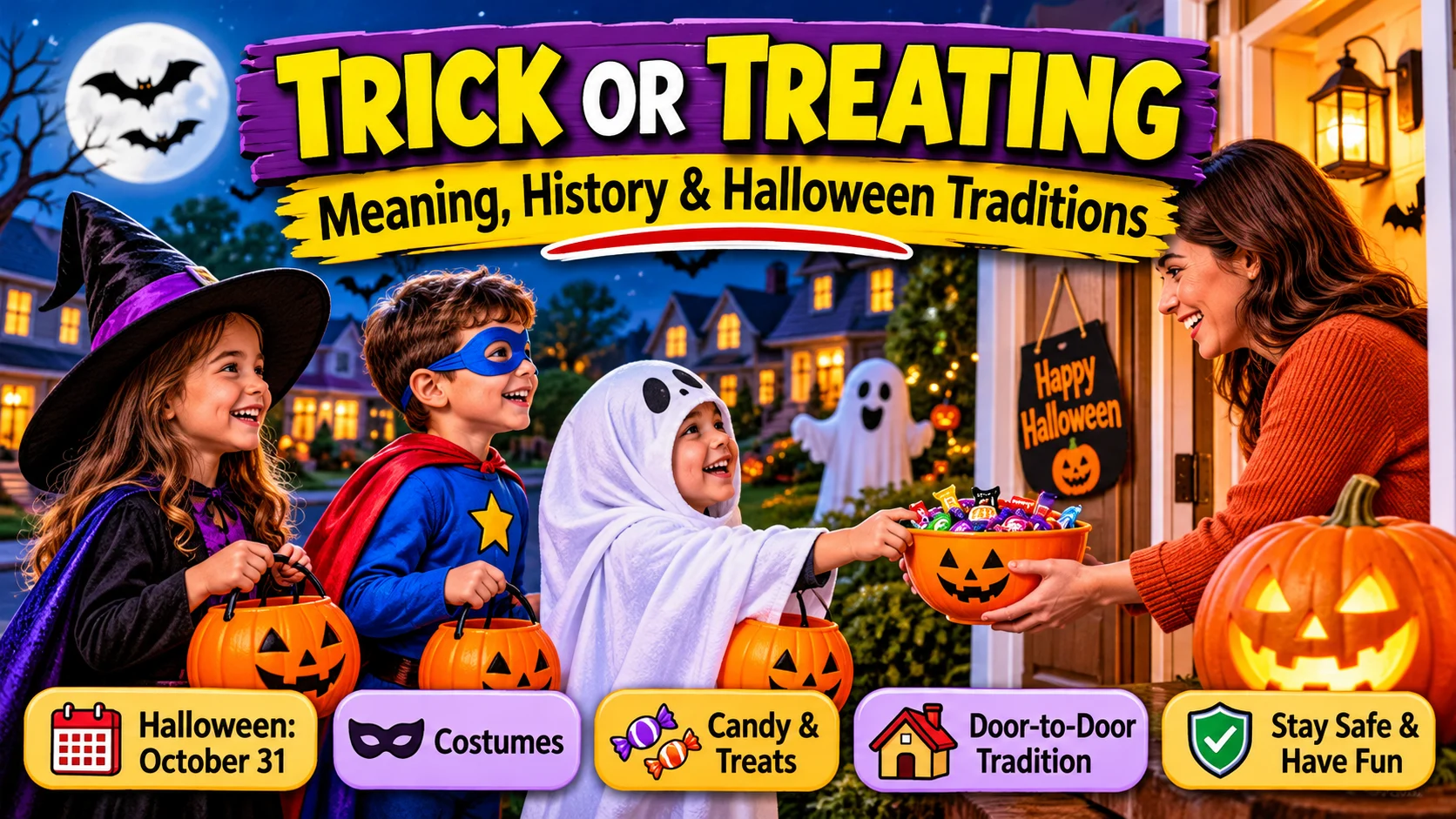
Trick or treating is a popular Halloween tradition in which children dress up in costumes and visit homes to ask for candy or other treats. They usually say “trick or treat” when someone opens the door. The tradition is a fun way to celebrate Halloween, enjoy costumes, and connect with neighbors.
Trick or treating is one of the most exciting parts of Halloween. Every year, children put on fun costumes, carry candy bags, and visit homes in their neighborhoods. They knock on doors and say, “Trick or treat!” In return, people often give them candy, chocolates, or small gifts.
But where did this tradition come from? Why do children say these words? And what are the rules for taking part? Many people enjoy Halloween without knowing the story behind it. This guide explains the meaning, history, customs, and safety tips of trick or treating in simple language.
Quick Answer and Overview
Trick or treating is a Halloween activity where people, mainly children, visit houses to collect sweets and treats. It usually takes place on October 31, the night of Halloween.
Here is a quick overview:
| Topic | Explanation |
|---|---|
| Meaning | Visiting homes to ask for Halloween treats |
| Main date | October 31 |
| Main participants | Children, families, and sometimes adults |
| Common phrase | Trick or treat! |
| Popular treats | Candy, chocolates, cookies, and small toys |
| Common costumes | Witches, ghosts, superheroes, and monsters |
| Main purpose | Fun, community, and Halloween celebration |
| Popular countries | United States, Canada, Ireland, and the United Kingdom |
The activity is especially popular in North America, where many neighborhoods organize special Halloween events.
What Does Trick or Treating Mean?
Trick or treating is a Halloween custom in which children visit houses and ask residents for treats. The phrase “trick or treat” gives the tradition its name.
The words have a simple meaning:
- Trick: A playful joke or harmless prank.
- Treat: Something enjoyable, such as candy, chocolate, or a small gift.
In the traditional idea, children offer a playful trick if they do not receive a treat. Today, the activity is mostly about collecting sweets and having fun. Tricks are not expected, and children should always respect the people they visit.
For example, a child dressed as a vampire may knock on a door and say, “Trick or treat!” The homeowner may then give the child a chocolate bar.
This simple exchange is what makes trick or treating a special part of Halloween.
History and Origin of Trick or Treating
The history of trick or treating goes back many centuries. However, the modern tradition developed over time through different customs and celebrations.
Ancient Celtic Traditions
One historical influence is Samhain, an ancient Celtic festival celebrated around the end of October and the beginning of November.
People believed this time marked a change between the seasons and was connected with the spirit world. Some communities used fires, special clothing, and other customs during the celebration.
Samhain is often discussed when explaining Halloween’s history, although modern trick or treating did not come directly from one ancient practice.
The Medieval Tradition of Souling
During the Middle Ages, a custom known as souling became popular in parts of Europe.
People, often children or poor visitors, went from house to house asking for food. In some places, they received small cakes called soul cakes. In return, they offered prayers for the dead.
This custom is considered one of the historical influences on modern Halloween door-to-door traditions.
The Tradition of Guising
Another related custom was guising, which became popular in Scotland and Ireland.
People dressed in costumes and visited homes. They sometimes performed a song, joke, poem, or trick in exchange for food or other gifts.
Guising helped shape some of the activities that later became part of modern Halloween celebrations.
The Growth of Modern Trick or Treating
Trick or treating became especially popular in the United States and Canada during the twentieth century.
By the 1930s and 1940s, Halloween door-to-door visits were becoming more common. After World War II, the tradition grew as candy became more widely available and communities began organizing family-friendly celebrations.
Today, trick or treating is one of the best-known Halloween traditions.
How Does Trick or Treating Work?
Taking part in trick or treating is easy. Children usually visit homes in their neighborhoods during the evening of October 31.
Here is how the activity normally works:
- Choose a costume: Children dress as superheroes, animals, ghosts, witches, or other characters.
- Prepare a candy bag: Each child carries a bucket, basket, or bag for collecting treats.
- Visit nearby homes: Children walk with parents or trusted adults and visit homes that welcome Halloween visitors.
- Knock on the door: They ring the bell or knock politely.
- Say trick or treat: When someone answers, children greet them with the famous Halloween phrase.
- Collect a treat: The homeowner may offer candy, chocolate, or another small gift.
- Say thank you: Children thank the homeowner before moving to the next house.
The goal is to enjoy the celebration while being polite and safe.
Advantages and Disadvantages of Trick or Treating
Trick or treating is a fun activity, but like other celebrations, it has both benefits and possible concerns.
Advantages of Trick or Treating
1. Builds Community Connections
Children and families meet their neighbors. This creates a friendly atmosphere and helps people feel connected to their communities.
2. Encourages Creativity
Choosing costumes allows children to express their imagination. They can become their favorite characters, animals, or fantasy creatures.
3. Creates Happy Memories
Families often take pictures, decorate their homes, and enjoy the evening together. These moments can become special childhood memories.
4. Encourages Social Skills
Children practice greeting people, speaking politely, and saying thank you. These small activities can help build confidence.
5. Provides Outdoor Fun
Walking through decorated neighborhoods gives children a chance to enjoy an outdoor activity with family and friends.
Disadvantages of Trick or Treating
1. Too Much Candy
Eating large amounts of candy can lead to excessive sugar consumption. Parents should help children enjoy treats in moderation.
2. Road Safety Risks
Halloween evenings can be busy. Drivers may not see children clearly, especially when costumes are dark.
3. Weather Problems
Rain, cold temperatures, and strong winds can make outdoor celebrations uncomfortable.
4. Costume Safety Issues
Long clothing, masks, and oversized accessories can make walking difficult or limit visibility.
5. Food Allergies
Some candies contain nuts, dairy, or other ingredients that may cause allergic reactions.
A little planning can help families avoid many of these problems.
Real-World Examples of Trick or Treating
Here are some simple examples that show how people use the tradition in everyday life.
Example 1: A Child Collecting Candy
A child dresses as a pumpkin and visits a neighbor’s house.
Child: “Trick or treat!”
Neighbor: “Happy Halloween! Here is some candy.”
Child: “Thank you!”
This is a typical trick or treating experience.
Example 2: A Family Celebrating Halloween
A family prepares costumes for their children. They decorate their front door with pumpkins and lights. In the evening, they walk around the neighborhood and visit homes that welcome visitors.
Example 3: A Homeowner Giving Treats
A homeowner buys chocolate bars, candy, and small toys before Halloween. When children arrive, the homeowner gives each child a treat.
Example 4: A School Halloween Event
A school organizes a Halloween party. Children wear costumes and visit decorated classrooms to collect small treats. This creates a safer and more organized alternative to neighborhood visits.
Trick or Treating Around the World
Halloween traditions are not exactly the same in every country. Some places have large door-to-door celebrations, while others focus more on parties, festivals, or family activities.
| Country | Halloween Traditions |
|---|---|
| United States | Children visit homes and collect candy on October 31 |
| Canada | Trick or treating is popular in many neighborhoods |
| Ireland | Halloween has strong historical connections, with costumes, parties, and traditional games |
| United Kingdom | Some children go trick or treating, while others attend Halloween parties |
| Australia | Halloween events and neighborhood celebrations have become more visible |
| Japan | Halloween is often celebrated through costume events and public gatherings |
| Mexico | Día de los Muertos is an important cultural celebration honoring deceased loved ones |
It is important to understand that Halloween and Día de los Muertos are different celebrations. They may occur around similar dates, but they have different histories, meanings, and traditions.
Rules and Safety Tips for Trick or Treating
Safety should always come first during Halloween. Parents and children can follow a few simple rules to make the evening enjoyable.
Safety Tips for Children
- Stay with a parent, guardian, or trusted adult.
- Visit homes that welcome trick or treaters.
- Use sidewalks and cross at safe crossing points.
- Look both ways before crossing a street.
- Carry a flashlight or use reflective clothing.
- Avoid running between parked cars.
- Never enter a stranger’s home.
- Do not eat candy until an adult has checked it.
- Avoid damaged or unwrapped treats.
- Respect homes that do not want visitors.
Safety Tips for Parents
Parents can make the experience safer by:
- Planning a route before leaving home.
- Choosing comfortable and visible costumes.
- Checking masks to make sure children can see clearly.
- Carrying a phone for emergencies.
- Checking food labels for allergy risks.
- Setting a return time.
- Keeping younger children close at all times.
These simple steps help make Halloween safer for everyone.
Common Mistakes People Make About Trick or Treating
Some people misunderstand the meaning and customs of trick or treating. Here are common mistakes and their corrections.
| Common Mistake | Correct Explanation |
|---|---|
| Thinking tricks are required | Tricks are not expected in modern celebrations |
| Believing it happens every night | The main traditional date is October 31 |
| Assuming every home gives candy | Some homes do not participate |
| Taking treats without asking | Children should politely say “trick or treat” |
| Eating candy without checking | An adult should inspect treats first |
| Thinking only children can celebrate | Adults can also join Halloween activities |
| Confusing Halloween with Día de los Muertos | They are different cultural celebrations |
One of the most important rules is to respect other people. Nobody is required to give candy or participate.
Related Concepts and Halloween Traditions
Trick or treating is only one part of Halloween. Several other activities are also connected with the celebration.
| Related Term | Meaning |
|---|---|
| Halloween | A celebration observed on October 31 |
| Jack-o’-lantern | A carved pumpkin, often with a light inside |
| Halloween costume | Special clothing worn to represent a character |
| Haunted house | A decorated attraction designed to create spooky experiences |
| Candy corn | A popular Halloween candy in the United States |
| Guising | A traditional costume-based activity associated with parts of Scotland and Ireland |
| Soul cakes | Small cakes historically connected with the custom of souling |
| Halloween party | A social gathering with costumes, games, and decorations |
These traditions help make Halloween a popular event for children and adults.
Exercises With Answers
Test your understanding of trick or treating with these simple questions.
Exercise 1: Multiple-Choice Questions
1. When does trick or treating usually happen?
A. October 1
B. October 15
C. October 31
D. November 15
Answer: C. October 31
2. What do children usually collect during trick or treating?
A. Books
B. Candy and treats
C. School supplies
D. Clothes
Answer: B. Candy and treats
3. What does the word “treat” mean in this tradition?
A. A punishment
B. A gift or something enjoyable
C. A scary costume
D. A Halloween game
Answer: B. A gift or something enjoyable
4. Which country is especially known for modern trick or treating?
A. United States
B. Brazil
C. Egypt
D. China
Answer: A. United States
Exercise 2: True or False
- Trick or treating usually takes place on October 31. True
- Children must play a trick at every house. False
- Children should check their candy with an adult. True
- Every homeowner must give candy. False
Exercise 3: Complete the Sentences
- Children often wear ______ during Halloween.Answer: Costumes
- The famous Halloween phrase is ______.Answer: Trick or treat!
- A carved pumpkin is called a ______.Answer: Jack-o’-lantern
- Children usually collect candy in a ______.Answer: Bag, bucket, or basket
Frequently Asked Questions
What does trick or treating mean?
Trick or treating is a Halloween tradition where children visit homes and ask for candy or other treats by saying “trick or treat.”
When is trick or treating celebrated?
Trick or treating usually takes place on October 31, which is Halloween night. Some communities organize their events on nearby dates.
Why do children say trick or treat?
The phrase refers to a playful trick or a treat. Today, children mainly use it to ask politely for Halloween candy.
What age should children stop trick or treating?
There is no official age limit. Younger children often participate with parents, while older children may go with friends or family members.
What time does trick or treating usually start?
Many communities begin around sunset or early evening. Exact times depend on local customs, weather, and community rules.
What should you give trick or treaters?
Popular choices include individually wrapped candy, chocolates, small toys, stickers, and other age-appropriate treats.
Is trick or treating safe for children?
It can be safe when children stay with trusted adults, follow road safety rules, visit welcoming homes, and have their treats checked before eating.
Do all countries celebrate trick or treating?
No. It is especially popular in the United States and Canada. Other countries have different Halloween customs, and some do not widely celebrate the tradition.
What should you say when someone gives you candy?
You should say “Thank you” and wish the person a happy Halloween. Being polite is an important part of the tradition.
Conclusion
Trick or treating is a fun Halloween tradition that brings children, families, and neighbors together. It involves wearing costumes, visiting welcoming homes, and collecting candy by saying “trick or treat.” Its history includes several older European customs, while the modern activity became especially popular in North America.
To enjoy trick or treating, families should plan ahead, follow safety rules, and respect their neighbors. With a little care, everyone can enjoy a happy and memorable Halloween celebration.