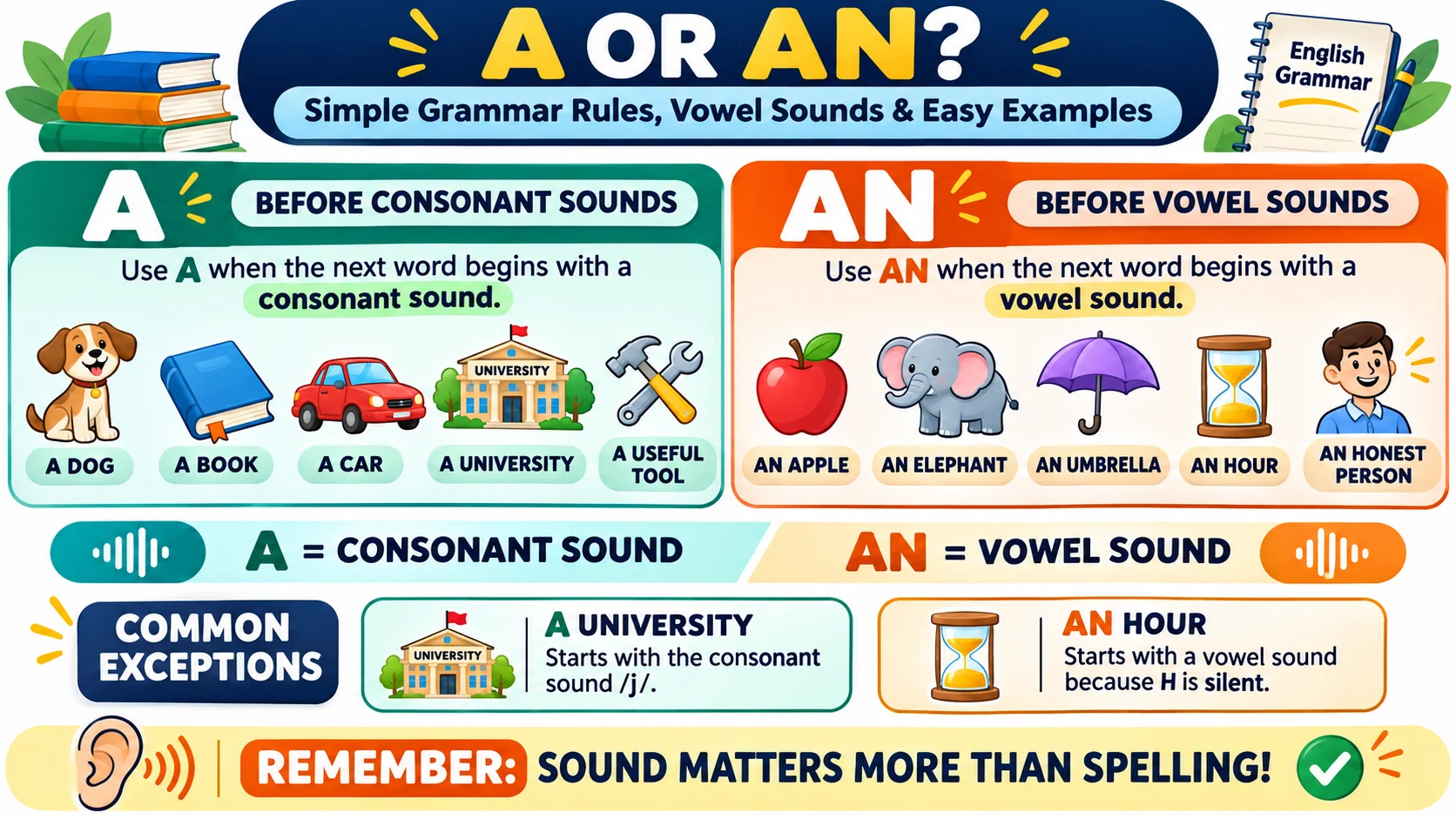
A or an are indefinite articles used before singular countable nouns in English. Use a before a consonant sound, as in “a dog,” “a university,” or “a European country.” Use an before a vowel sound, as in “an apple,” “an hour,” or “an honest person.” The correct choice depends on pronunciation, not simply the first letter of the following word.
Have you ever wondered whether to use a or an before words like apple, university, hour, or honest? Although these two tiny English words look simple, choosing the correct one can sometimes be confusing. Many learners assume that a always comes before consonants and an always comes before vowels. However, the real rule depends on how a word sounds rather than how it is spelled.
These words are called indefinite articles, and they play an essential role in English grammar. They are commonly used when talking about a person, place, object, or idea that is not specifically identified. For example, “a book” refers to one unspecified book, while “an umbrella” refers to one unspecified umbrella. Therefore, understanding when to use each article can make your sentences clearer and more grammatically accurate.
Moreover, English contains several exceptions that can surprise even experienced writers. Words beginning with silent letters, abbreviations, and certain vowel letters may require an article that appears unexpected. For instance, we say “an hour” because the letter h is silent, but “a university” because the word begins with a consonant sound.
In this guide, you’ll learn the difference between a and an, their grammar rules, pronunciation patterns, special cases, and practical examples. Additionally, we’ll explore common mistakes, easy memory tricks, practice exercises, and frequently asked questions to help you choose the correct article confidently.
What Is the Difference Between A and An?
The difference between these two indefinite articles depends primarily on the sound that begins the following word.
Use a before a consonant sound.
Use an before a vowel sound.
For example:
- A car
- A book
- A teacher
- An apple
- An elephant
- An orange
Although the rule appears straightforward, spelling can sometimes be misleading.
Consider these examples:
- A university
- A European country
- An hour
- An honest person
The word university begins with the vowel letter u, yet it starts with a “yoo” sound. Consequently, it takes a.
Meanwhile, hour begins with the consonant letter h, but that letter is silent. Therefore, it takes an.
Quick Comparison Table
| Feature | A | An |
|---|---|---|
| Article type | Indefinite | Indefinite |
| Used before | Consonant sounds | Vowel sounds |
| Basic example | A book | An apple |
| Silent-letter example | A house | An hour |
| Vowel-letter exception | A university | An umbrella |
| Abbreviation example | A URL | An MBA |
| Main rule | Listen for a consonant sound | Listen for a vowel sound |
The most important point is that pronunciation determines the correct article.
What Does A Mean?
A is an indefinite article used before a singular countable noun or noun phrase that begins with a consonant sound.
It generally refers to one person, object, place, or thing without identifying a specific one.
For example:
“I bought a book.”
Here, the speaker mentions one book without specifying exactly which book.
Similarly:
“She adopted a puppy.”
The article introduces one unspecified puppy.
Examples of A in Sentences
- I saw a bird outside my window.
- She bought a new laptop yesterday.
- He works as a teacher.
- We visited a beautiful village.
- They adopted a small dog.
- My brother wants a bicycle.
- She found a useful website.
- He is a university student.
- We stayed in a comfortable hotel.
- The company hired a European consultant.
Notice that the article appears before consonant sounds, even when a word begins with a vowel letter.
What Does An Mean?
An is an indefinite article used before a singular countable noun or noun phrase beginning with a vowel sound.
Like a, it introduces something that is not specifically identified.
For example:
“She ate an apple.”
The speaker refers to one apple without identifying a particular one.
Another example is:
“He waited for an hour.”
Although hour begins with the letter h, the first pronounced sound is a vowel.
Consequently, an is the correct choice.
Examples of An in Sentences
- She ate an orange after lunch.
- He carried an umbrella.
- I saw an elephant at the zoo.
- They reached an agreement.
- She is an excellent student.
- He gave an honest answer.
- We waited for an hour.
- My father met an old friend.
- She completed an MBA program.
- The article included an interesting example.
In every example, the sound immediately following the article begins with a vowel.
The Golden Rule: Sound Matters More Than Spelling
The most important rule is:
Use a before consonant sounds and an before vowel sounds.
However, many people mistakenly focus only on the first written letter.
English pronunciation doesn’t always match spelling, so this approach can lead to errors.
For instance, the word hour begins with h, but its pronunciation starts with a vowel sound.
Therefore, we say:
“An hour.”
Likewise, the word university begins with u, but its pronunciation starts with the consonant /j/, similar to the beginning of yes.
Consequently, we say:
“A university.”
Examples Based on Pronunciation
| Word | Beginning Sound | Correct Phrase |
|---|---|---|
| Apple | Vowel | An apple |
| Banana | Consonant | A banana |
| Hour | Vowel | An hour |
| House | Consonant | A house |
| University | Consonant | A university |
| Umbrella | Vowel | An umbrella |
| Honest | Vowel | An honest person |
| European | Consonant | A European country |
| MBA | Vowel | An MBA |
| One-time | Consonant | A one-time offer |
Therefore, listening to a word’s pronunciation is more reliable than looking at its first letter.
When to Use A in English Grammar
The article a appears before words that begin with consonant sounds.
However, it has several common grammatical uses.
Before Singular Countable Nouns
Use the article when introducing one unspecified countable item.
Examples:
- A chair
- A pencil
- A student
- A flower
- A computer
For instance:
“She needs a pencil.”
The sentence refers to one pencil without identifying a particular one.
Before Professions and Occupations
English commonly uses an indefinite article when describing someone’s occupation.
Examples:
- He is a doctor.
- She is a lawyer.
- My sister is a teacher.
- He works as a mechanic.
- She wants to become a pilot.
However, occupations beginning with vowel sounds require an.
For example:
“He is an engineer.”
Before Certain Words Beginning With U
Some words beginning with u have an initial “yoo” sound.
Therefore, they take a rather than an.
Examples:
- A university
- A uniform
- A unique opportunity
- A useful tool
- A united team
- A user account
Although the spelling begins with a vowel letter, the pronunciation begins with a consonant sound.
Before Words Beginning With European Sounds
Words such as European and eulogy begin with a consonant /j/ sound.
Consequently, they normally take a.
Examples:
- A European country
- A European tradition
- A eulogy
- A euphemism
This rule applies because the initial sound is similar to the letter y in yes.
Before Certain Abbreviations
Some abbreviations begin with consonant sounds when spoken.
Examples:
- A URL
- A USB drive
- A UK citizen
- A BBC reporter
However, pronunciation varies for some abbreviations, so always consider how the letters are spoken.
When to Use An in English Grammar
The article an appears before words beginning with vowel sounds.
Additionally, it applies to several situations where the written word begins with a consonant letter.
Before Words Beginning With Vowel Sounds
Common examples include:
- An apple
- An egg
- An island
- An orange
- An umbrella
For example:
“She brought an umbrella because it was raining.”
The word umbrella begins with a vowel sound, so an is appropriate.
Before Words With a Silent H
Some English words begin with a silent h.
Examples:
- An hour
- An honest person
- An honor
- An heir
- An honorable decision
For instance:
“He made an honest mistake.”
The word honest begins with a vowel sound because the h is not pronounced.
Therefore, the correct article is an.
Before Abbreviations Beginning With Vowel Sounds
When an abbreviation begins with a vowel sound in its spoken form, use an.
Examples:
- An MBA
- An FBI agent
- An MRI scan
- An NGO
- An HTML document
- An NFL player
For example:
“She completed an MBA.”
The letter M is pronounced “em,” which begins with a vowel sound.
Consequently, an is required.
Before Adjectives Beginning With Vowel Sounds
The article depends on the next spoken word, which may be an adjective rather than the noun itself.
For example:
“An interesting book.”
Although book begins with a consonant, interesting begins with a vowel sound.
Similarly:
“An excellent teacher.”
Therefore, choose the article according to the first sound after it.
A or An Before Adjectives
When an adjective appears before a noun, the article depends on the adjective’s initial sound.
This rule is especially important because writers sometimes focus on the noun instead.
Consider these examples:
- A beautiful apple
- An expensive car
- A large elephant
- An interesting story
- A wonderful opportunity
- An unusual experience
For example:
“She bought an expensive dress.”
The noun dress begins with a consonant, but the preceding adjective expensive begins with a vowel sound.
Consequently, an is correct.
Comparison Table
| Without Adjective | With Adjective |
|---|---|
| An apple | A red apple |
| A car | An expensive car |
| An elephant | A large elephant |
| A house | An old house |
| An umbrella | A colorful umbrella |
| A story | An interesting story |
The article changes because the first sound immediately after it changes.
A or An Before H Words
Words beginning with h are among the most confusing cases.
However, the correct choice still depends on pronunciation.
Pronounced H
When the h is pronounced, use a.
Examples:
- A house
- A hotel
- A hospital
- A history lesson
- A happy child
- A helpful teacher
For instance:
“We stayed at a hotel.”
The h is pronounced, so the article is a.
Silent H
When the h is silent, use an.
Examples:
- An hour
- An honest answer
- An honor
- An heir
For example:
“She received an honor.”
Because the h is silent, the word begins with a vowel sound.
Is It A Historic or An Historic?
Both forms can be found in English, depending on pronunciation and style.
However, a historic event is generally preferred in modern English when the initial h is pronounced.
Some speakers and traditional writing styles use an historic.
Nevertheless, most modern learners should choose a historic event when pronouncing the h.
The same principle applies to words such as historical.
A or An Before U Words
The letter u can represent different beginning sounds.
Therefore, not every word starting with u takes the same article.
Use A Before the Yoo Sound
Examples:
- A university
- A uniform
- A unique idea
- A useful invention
- A user
- A united group
For instance:
“She attends a university.”
Although university begins with a vowel letter, its first sound is a consonant.
Use An Before Other Vowel Sounds
Examples:
- An umbrella
- An uncle
- An unusual event
- An urgent message
- An update
- An unexpected result
For example:
“He received an urgent call.”
The word urgent begins with a vowel sound, so an is correct.
Easy Comparison
| Use A | Use An |
|---|---|
| A university | An umbrella |
| A uniform | An uncle |
| A unique idea | An unusual idea |
| A useful tool | An urgent request |
| A user | An update |
These examples demonstrate why pronunciation is more important than spelling.
A or An Before O Words
Words beginning with o can also create confusion.
Most begin with a vowel sound and take an.
However, some begin with a consonant sound and require a.
Use An Before Vowel Sounds
Examples:
- An orange
- An office
- An opportunity
- An old book
- An ocean
- An opinion
Use A Before the W Sound
Some words beginning with o are pronounced with an initial /w/ sound.
Examples:
- A one-time payment
- A one-way street
- A once-in-a-lifetime opportunity
- A one-year course
For instance:
“She received a one-time bonus.”
The word one begins with a “w” sound, so a is correct.
A or An Before Abbreviations and Acronyms
Abbreviations require special attention because pronunciation determines the article.
Some abbreviations are pronounced letter by letter, while others are spoken as words.
Abbreviations That Take An
Examples:
- An FBI agent
- An MBA graduate
- An MRI scan
- An LCD screen
- An HTML file
- An X-ray
- An SMS message
These abbreviations begin with vowel sounds when spoken.
For example:
“She is an FBI agent.”
The letter F is pronounced “ef,” so an is required.
Abbreviations That Take A
Examples:
- A USB cable
- A URL
- A UK company
- A NASA scientist
- A PDF document
- A UNICEF program
However, abbreviations may have different pronunciations in different settings.
Therefore, consider the pronunciation your audience is likely to use.
A or An Before Numbers
Numbers can also require an indefinite article.
The correct choice depends on how the number is pronounced.
For example:
- An 8-year-old child
- An 11-hour journey
- A 100-year celebration
- A 1-year membership
- An 18-minute presentation
The number 8 begins with a vowel sound when spoken as “eight.”
Meanwhile, 100 usually begins with the consonant sound of one or hundred, depending on how the expression is read.
Consequently, the article follows the spoken form rather than the digits.
Examples in Sentences
- She has an 8-year-old daughter.
- We completed an 11-hour journey.
- The town celebrated a 100-year anniversary.
- He purchased a 1-year subscription.
- They watched an 18-minute documentary.
These constructions are especially common in written English.
A vs. An vs. The
English uses three main articles: a, an, and the.
However, they do not have identical functions.
A and an are indefinite articles, while the is the definite article.
Indefinite Articles
Use a or an when referring to one unspecified person or thing.
Examples:
- I saw a dog.
- She bought an umbrella.
- He needs a pen.
Definite Article
Use the when referring to something identifiable or specific in the context.
Examples:
- The dog is sleeping.
- The umbrella is near the door.
- The pen you gave me is blue.
Comparison Table
| Article | Type | Main Usage | Example |
|---|---|---|---|
| A | Indefinite | Before consonant sounds | A book |
| An | Indefinite | Before vowel sounds | An apple |
| The | Definite | Before identifiable nouns | The book |
For example:
“I bought a book yesterday. The book was interesting.”
The first sentence introduces the book, while the second refers to the same identifiable book.
When Should You Avoid A and An?
Although indefinite articles are common, they are not used before every noun.
Before Most Plural Nouns
Incorrect: “A books are on the table.”
Correct: “Books are on the table.”
Because books is plural, it cannot directly take the singular indefinite article.
Before Uncountable Nouns Used Generally
Incorrect: “I need a water.”
Correct: “I need water.”
However, “a water” can be used informally when referring to a serving or bottle of water.
For example:
“I ordered a water.”
Therefore, context can affect whether a noun is treated as countable.
Before Most Proper Names
Incorrect: “She visited a London.”
Correct: “She visited London.”
Names generally do not require indefinite articles in ordinary usage.
However, special constructions such as “a young Picasso” or “a Mr. Smith” are possible in particular contexts.
Before Possessive Determiners
Incorrect: “She bought a my book.”
Correct: “She bought my book.”
Indefinite articles cannot normally be combined directly with possessive determiners such as my, your, or his in this way.
Common Mistakes With A and An
Many errors occur because learners focus on spelling rather than pronunciation.
Saying An University
Incorrect: “She studies at an university.”
Correct: “She studies at a university.”
The word university begins with a consonant /j/ sound.
Saying A Hour
Incorrect: “I waited for a hour.”
Correct: “I waited for an hour.”
The h is silent, so the first sound is a vowel.
Saying A Honest Person
Incorrect: “He is a honest person.”
Correct: “He is an honest person.”
Again, the initial h is silent.
Saying An European Country
Incorrect: “France is an European country.”
Correct: “France is a European country.”
The word European begins with a consonant /j/ sound.
Saying A MBA
Incorrect: “She completed a MBA.”
Correct: “She completed an MBA.”
Because the letter M is pronounced “em,” the abbreviation begins with a vowel sound.
Using an Article Before a Plural Noun
Incorrect: “I have a friends.”
Correct: “I have friends.”
Alternatively, use the singular form:
“I have a friend.”
Therefore, checking whether the noun is singular and countable is just as important as choosing the article.
Easy Tricks to Remember the Difference
Learning the correct article becomes easier when you focus on pronunciation.
Listen to the First Sound
Instead of looking only at the first letter, say the next word aloud.
If it begins with a consonant sound, use a.
If it begins with a vowel sound, use an.
Remember the University Exception
The phrase a university is a useful reminder that a vowel letter doesn’t always represent a vowel sound.
Similarly, a useful tool follows the same rule.
Remember the Hour Exception
The phrase an hour reminds you that a consonant letter can be silent.
Therefore, the sound determines the article.
Check the Entire Noun Phrase
When an adjective appears before a noun, choose the article based on the adjective.
For example:
“An expensive car.”
Although car begins with a consonant, the first word after the article begins with a vowel sound.
Practice Exercises: Choose A or An
Test your understanding with the following sentences.
Fill in the Blanks
- She bought ___ apple.
- He is ___ university student.
- We waited for ___ hour.
- My brother wants ___ new bicycle.
- She gave ___ honest answer.
- They visited ___ European country.
- He received ___ unexpected message.
- I need ___ useful suggestion.
- She completed ___ MBA.
- He works as ___ engineer.
- We saw ___ elephant.
- She has ___ unique personality.
- They made ___ important decision.
- He is ___ FBI agent.
- She purchased ___ one-year membership.
Answers With Explanations
| Question | Correct Answer | Reason |
|---|---|---|
| 1 | An | Apple begins with a vowel sound |
| 2 | A | University begins with a /j/ sound |
| 3 | An | Hour has a silent h |
| 4 | A | New begins with a consonant sound |
| 5 | An | Honest has a silent h |
| 6 | A | European begins with a /j/ sound |
| 7 | An | Unexpected begins with a vowel sound |
| 8 | A | Useful begins with a /j/ sound |
| 9 | An | MBA begins with the sound “em” |
| 10 | An | Engineer begins with a vowel sound |
| 11 | An | Elephant begins with a vowel sound |
| 12 | A | Unique begins with a /j/ sound |
| 13 | An | Important begins with a vowel sound |
| 14 | An | FBI begins with the sound “ef” |
| 15 | A | One begins with a /w/ sound |
These exercises illustrate the most important pronunciation patterns.
Why Using the Correct Article Matters
Correct article usage makes English sentences sound more natural and grammatically accurate.
Moreover, mastering these small words can improve both writing and speaking.
Improves Grammar Accuracy
Articles are essential parts of many English noun phrases.
Therefore, understanding their placement helps prevent common grammatical mistakes.
Makes Writing More Professional
Incorrect article use can distract readers, especially in formal writing.
For example, “an university” may appear awkward to fluent English readers.
Consequently, using a university improves clarity and professionalism.
Supports Spoken English
The pronunciation-based rule encourages learners to pay attention to English sounds.
Additionally, understanding vowel and consonant sounds helps with other pronunciation patterns.
Builds Confidence
When you know the correct rules, you can write sentences without repeatedly guessing.
As a result, everyday communication becomes easier.
Frequently Asked Questions
What is the difference between a and an?
Both are indefinite articles used before singular countable nouns. However, a comes before consonant sounds, while an comes before vowel sounds. For example, “a book” and “an apple” are correct.
When should I use a or an?
Use a when the next word begins with a consonant sound and an when it begins with a vowel sound. Therefore, pronunciation is more important than spelling.
Is it a university or an university?
The correct phrase is a university. Although the word begins with the vowel letter u, its pronunciation starts with a consonant /j/ sound.
Is it a hour or an hour?
The correct phrase is an hour. The initial h is silent, so the word begins with a vowel sound.
Is it a honest person or an honest person?
The correct expression is an honest person because the h in honest is silent.
Is it a European country or an European country?
The correct phrase is a European country. The word European begins with a consonant sound similar to y in yes.
Is it a MBA or an MBA?
The correct expression is an MBA. The letter M is pronounced “em,” which begins with a vowel sound.
Is it a historic event or an historic event?
Both forms occur in English, but a historic event is generally preferred in modern usage when the h is pronounced. Some traditional styles and pronunciations use an historic event.
Is it a one-time payment or an one-time payment?
The correct expression is a one-time payment. The word one begins with a consonant /w/ sound.
Can a and an be used with plural nouns?
No. These indefinite articles normally appear before singular countable nouns or noun phrases. For example, “a book” is correct, while “a books” is incorrect.
Can a and an be used before adjectives?
Yes. When an adjective precedes a noun, the article depends on the adjective’s first sound. For example, “an expensive car” and “a beautiful apple” are correct.
Is it an umbrella or a umbrella?
The correct expression is an umbrella because the word begins with a vowel sound.
Is it an unique idea or a unique idea?
The correct phrase is a unique idea. Although the word begins with u, its pronunciation starts with a consonant /j/ sound.
What is the easiest way to remember a and an?
Remember this simple rule: A before consonant sounds, an before vowel sounds. Additionally, use a university and an hour as reminders that pronunciation matters more than spelling.
Conclusion
Understanding when to use a or an is an essential part of mastering English grammar. Although the two words serve the same general purpose, their correct usage depends on the sound at the beginning of the following word rather than simply its first written letter.
Use a before consonant sounds, as in “a book,” “a university,” and “a European country.” Meanwhile, use an before vowel sounds, as in “an apple,” “an hour,” and “an honest person.” Furthermore, remember that adjectives, abbreviations, and numbers follow the same pronunciation-based rule.
The most effective way to avoid mistakes is to say the word aloud and listen carefully to its beginning sound. Additionally, practicing common exceptions will help you recognize correct article usage more naturally.
Ultimately, mastering these two small words can make a significant difference in your writing and speaking. With consistent practice, you’ll be able to choose the appropriate indefinite article confidently in everyday conversations, academic assignments, and professional communication.