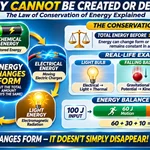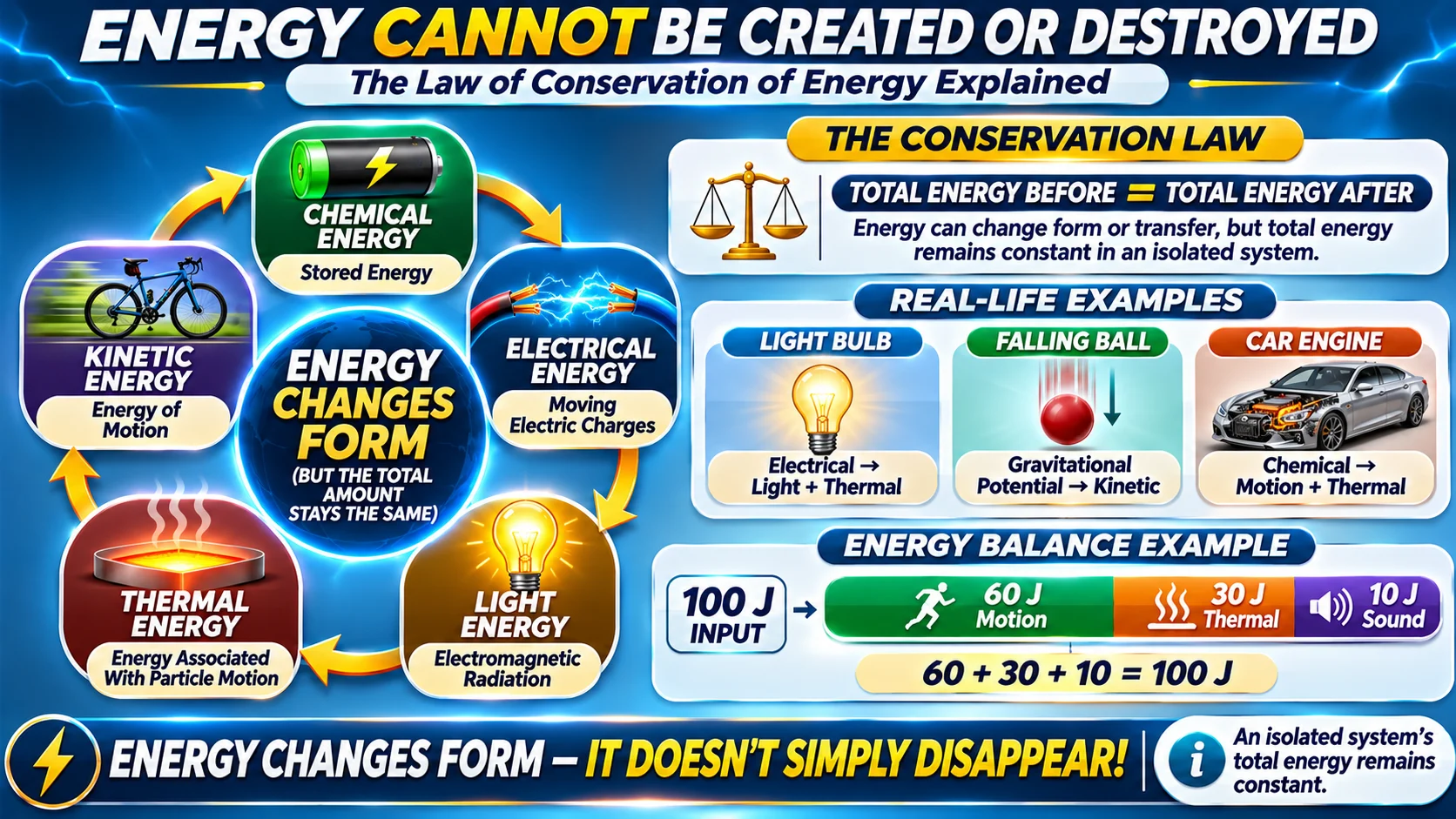
Energy cannot be created or destroyed is the fundamental principle known as the law of conservation of energy. It states that energy can change from one form to another or transfer between objects, but the total energy of an isolated system remains constant. For example, a light bulb converts electrical energy into light and thermal energy rather than creating new energy.
Have you ever wondered why scientists say energy cannot be created or destroyed, even though we use energy every day to power lights, drive cars, and operate machines? At first, the statement might sound confusing. After all, batteries eventually run out, moving objects stop, and electrical devices consume power. However, energy doesn’t simply disappear during these processes. Instead, it changes form or moves from one place to another.
This fundamental scientific principle is called the law of conservation of energy. It explains that the total energy within an isolated system remains constant, even when energy undergoes complicated transformations. For example, when you switch on a light bulb, electrical energy becomes light and heat. Similarly, when a ball falls from a height, gravitational potential energy changes into kinetic energy.
Moreover, the conservation principle helps scientists explain how engines operate, how electricity is generated, how living organisms obtain energy, and why machines cannot produce unlimited power without an energy source. Consequently, it forms an essential foundation for physics, chemistry, engineering, and environmental science.
In this guide, you’ll learn what the conservation of energy means, why energy cannot simply disappear, and how the principle works in everyday life. Additionally, we’ll explore its mathematical formulas, connection to thermodynamics, different forms of energy, scientific examples, common misconceptions, and frequently asked questions.
What Does Energy Cannot Be Created or Destroyed Mean?
The statement means that energy is conserved during physical processes.
Energy may change its form, move between objects, or spread into the surrounding environment. However, it does not simply vanish.
For example, consider a moving bicycle.
The rider uses chemical energy obtained from food to move the pedals. Through muscular activity, that energy is transferred into the bicycle’s motion.
Meanwhile, friction and air resistance cause some of the energy to become thermal energy in the bicycle and surrounding environment.
Although the bicycle eventually stops, the energy associated with its motion has been transferred or transformed rather than destroyed.
Therefore, conservation describes what happens to the total energy, not whether every form remains useful for a particular task.
Simple Explanation
Imagine that you have 100 joules of energy available in a system.
During a process, the energy changes into:
- 60 joules of motion-related energy
- 30 joules of thermal energy
- 10 joules of sound-related energy
The total remains:
60 + 30 + 10 = 100 joules
Consequently, the original energy has been redistributed among different forms.
This example assumes that all relevant energy transfers have been accounted for.
What Is the Law of Conservation of Energy?
The law of conservation of energy is a fundamental principle of physics stating that total energy remains constant in an isolated system.
An isolated system does not exchange energy or matter with its surroundings.
Therefore, energy changes may occur within the system, but its total energy remains unchanged.
For example, a swinging pendulum continuously exchanges gravitational potential energy and kinetic energy.
At its highest point, the pendulum has greater gravitational potential energy.
As it moves downward, some of that energy changes into kinetic energy.
Meanwhile, friction and air resistance gradually convert some mechanical energy into thermal energy.
If we include the pendulum and its relevant surroundings, total energy remains conserved.
Key Principles
| Principle | Explanation |
|---|---|
| Conservation | Total energy remains constant in an isolated system |
| Transformation | Energy changes from one form into another |
| Transfer | Energy moves between objects or systems |
| Energy balance | Changes in a system’s energy equal the net energy transferred |
| Mechanical energy | May decrease when friction converts it into thermal energy |
| Energy efficiency | Not all input energy becomes the intended useful output |
These principles are essential for explaining natural processes and technological systems.
Who Discovered the Law of Conservation of Energy?
The modern law developed through the work of several scientists during the nineteenth century.
It cannot be attributed entirely to one person.
Among the important contributors were Julius Robert Mayer, James Prescott Joule, and Hermann von Helmholtz.
Julius Robert Mayer
Julius Robert Mayer was a German physician and scientist who helped develop the idea that heat and mechanical work are related forms of energy transfer.
His work contributed to the emerging understanding of energy conservation during the 1840s.
James Prescott Joule
James Prescott Joule conducted experiments demonstrating relationships between mechanical work and heating.
His findings helped establish that mechanical energy could be transformed into thermal energy in measurable quantities.
Moreover, the SI unit of energy, the joule (J), is named in his honor.
Hermann von Helmholtz
Hermann von Helmholtz contributed to the formal development and widespread understanding of energy conservation.
His work helped connect the principle with multiple areas of physical science.
Consequently, conservation of energy became a foundational scientific concept through experimental evidence and theoretical development.
What Is the Formula for Conservation of Energy?
The simplest expression is:
Total Energy Before = Total Energy After
For an isolated system:
E_initial = E_final
Here:
- E_initial represents the initial total energy.
- E_final represents the final total energy.
The equation means that energy may change form, but the overall amount remains constant.
Example Calculation
Suppose a system initially contains 200 joules of energy.
After a transformation, 120 joules appear as kinetic energy, 50 joules as thermal energy, and 30 joules in another accounted-for form.
Then:
200 J = 120 J + 50 J + 30 J
Therefore:
200 J = 200 J
The total is unchanged.
Mechanical Energy Formula
In an ideal mechanical system where only conservative forces perform work:
KE + PE = Constant
Here:
- KE = Kinetic energy
- PE = Potential energy
For example, a falling object exchanges gravitational potential energy for kinetic energy.
However, when friction or air resistance is significant, mechanical energy alone may not remain constant.
Instead, those effects must be included in the complete energy balance.
What Are the Different Forms of Energy?
Energy appears in several forms, each associated with different physical processes.
Understanding these forms makes conservation easier to recognize.
Kinetic Energy
Kinetic energy is the energy associated with motion.
For example:
- A moving car
- A rolling ball
- Flowing water
- A running person
- A spinning fan
The kinetic energy of an object depends on its mass and speed.
Its classical formula is:
KE = ½mv²
Where:
- m = Mass
- v = Speed
Therefore, increasing an object’s speed increases its kinetic energy.
Potential Energy
Potential energy is energy associated with position or configuration.
For example, a raised object has gravitational potential energy relative to a chosen reference level.
Similarly, a stretched spring stores elastic potential energy.
For gravitational potential energy near Earth’s surface:
PE = mgh
Where:
- m = Mass
- g = Gravitational acceleration
- h = Height relative to the chosen reference
Consequently, raising an object increases its gravitational potential energy when other factors remain constant.
Chemical Energy
Chemical energy is associated with the arrangement and interactions of atoms and molecules.
Examples include:
- Food
- Gasoline
- Batteries
- Wood
- Natural gas
During chemical reactions, energy can be transferred through heating, work, or radiation.
For instance, burning fuel releases energy through chemical reactions involving fuel and oxygen.
Electrical Energy
Electrical energy is associated with electric charges and electric fields.
It is used to operate:
- Computers
- Refrigerators
- Televisions
- Electric motors
- Household lighting
However, electrical devices do not create energy from nothing.
Instead, they receive energy from a source and transform it into other forms.
Thermal Energy
Thermal energy is associated with the microscopic motion and interactions of particles within matter.
For example, heating a pot of water increases its internal energy.
Additionally, friction may increase the temperature of interacting surfaces.
Light Energy
Light carries energy through electromagnetic radiation.
Sunlight, lamps, and lasers are familiar examples.
Moreover, plants absorb light energy during photosynthesis.
Sound Energy
Sound involves vibrations traveling through a medium.
For example, a vibrating speaker transfers energy to surrounding air, producing sound waves.
As those waves travel, some energy eventually becomes dispersed as thermal energy.
Nuclear Energy
- Nuclear energy is associated with atomic nuclei and nuclear interactions.
- Nuclear reactions can release large amounts of energy.
However, these processes still obey conservation laws, including the conservation of total mass-energy.
How Does Energy Change From One Form to Another?
Energy transformation occurs when one form of energy becomes another through a physical or chemical process.
These changes happen constantly in nature and technology.
Electrical Energy to Light
A light bulb converts electrical energy into electromagnetic radiation and thermal energy.
For example, an LED lamp uses electrical energy to produce visible light.
However, it also releases some energy as heat.
Chemical Energy to Motion
A car engine uses fuel and oxygen in combustion reactions.
The resulting energy transfers help produce mechanical work and vehicle movement.
Meanwhile, a considerable amount becomes thermal energy.
Potential Energy to Kinetic Energy
A ball held above the ground has gravitational potential energy.
When released, it accelerates downward.
Consequently, gravitational potential energy decreases while kinetic energy increases.
Kinetic Energy to Thermal Energy
When a moving vehicle brakes, friction converts motion-related energy into thermal energy.
For example, conventional braking systems warm the brake components.
However, certain electric vehicles can recover some kinetic energy through regenerative braking.
Solar Energy to Electrical Energy
Solar panels convert part of the energy carried by sunlight into electrical energy.
Therefore, solar panels do not create energy from nothing.
Instead, they capture and transform energy arriving from the Sun.
Real-Life Examples of the Conservation of Energy
The law applies to nearly every physical process.
Several everyday situations make it easier to understand.
A Swinging Pendulum
A pendulum moves between high and low positions.
At its highest point, gravitational potential energy is relatively large.
As the pendulum swings downward, potential energy changes into kinetic energy.
At the lowest point, its speed is greatest during an ideal swing.
However, friction and air resistance gradually reduce the pendulum’s mechanical energy.
That energy is transferred into other forms, primarily thermal energy.
A Roller Coaster
A roller coaster illustrates the relationship between height, speed, and energy.
At the top of a hill, the coaster possesses gravitational potential energy.
As it moves downward, that energy is converted into kinetic energy.
Consequently, the coaster gains speed.
Meanwhile, braking and friction transfer some energy to the surroundings as heat and sound.
A Burning Candle
A candle contains chemical energy in its wax.
During combustion, chemical reactions release energy through heat and light.
Although the wax is consumed, the energy is transferred and transformed.
Therefore, the flame does not violate conservation of energy.
A Moving Bicycle
Cycling involves converting chemical energy from food into mechanical work.
The rider’s muscles transfer energy to the pedals and wheels.
Additionally, energy is transferred to the environment through friction, air resistance, and heating.
Charging a Phone
When a smartphone charges, electrical energy is transferred into the battery.
The battery stores energy through changes in its chemical state.
Later, the device converts stored energy into electrical activity, light, sound, and heat.
Thus, battery charging and discharging involve energy transformations rather than creation or destruction.
Boiling Water
An electric stove transfers electrical energy into heating.
The pot and water receive energy and become warmer.
Additionally, some energy is transferred to the surrounding air.
Therefore, energy is conserved even though not all the electrical input heats the water.
Why Does Energy Seem to Disappear?
Energy sometimes appears to disappear because it changes into forms that are harder to notice or use.
For example, a moving ball eventually stops rolling.
It may seem that the motion energy has vanished.
However, friction and deformation transfer energy into the ball, floor, and surrounding environment.
Much of it becomes thermal energy.
Similarly, a machine may receive 100 joules of electrical energy but produce only 70 joules of intended mechanical output.
The remaining 30 joules are not necessarily lost from the complete system.
Instead, they may be transferred as heat, sound, or other forms.
Consequently, conservation of energy does not mean every transformation is perfectly efficient.
What Is the First Law of Thermodynamics?
The first law of thermodynamics is an expression of energy conservation applied to thermodynamic systems.
It explains how a system’s internal energy changes when energy is transferred through heating or work.
A commonly used equation is:
ΔU = Q − W
Where:
- ΔU = Change in internal energy
- Q = Heat transferred into the system
- W = Work done by the system
This equation uses the convention that work done by the system is positive.
Example
Suppose a gas receives 500 joules of energy through heating.
During expansion, it performs 200 joules of work on its surroundings.
Then:
ΔU = 500 − 200
ΔU = 300 J
Therefore, the internal energy increases by 300 joules.
However, the full equation may require additional terms when accounting for changes in kinetic energy, gravitational potential energy, or matter crossing the system boundary.
Open, Closed, and Isolated Systems
Energy conservation is easier to apply when the type of system is clearly defined.
Open System
An open system can exchange both matter and energy with its surroundings.
For example, an uncovered pot of boiling water transfers heat and releases water vapor.
Therefore, the energy contained within the pot may change through several processes.
Closed System
A closed system can exchange energy but not matter with its surroundings.
For example, a sealed container may receive heat without allowing material to enter or leave.
Consequently, its internal energy may increase or decrease.
Isolated System
An ideal isolated system exchanges neither matter nor energy with its surroundings.
Therefore, its total energy remains constant.
Perfect isolation is difficult to achieve in practice.
Nevertheless, isolated-system models are extremely useful in physics.
Conservation of Energy vs. Energy Efficiency
Energy conservation and energy efficiency are related but different concepts.
Conservation of energy is a physical law describing how energy is accounted for.
Energy efficiency measures how much input energy becomes a desired output.
For example, a motor receives 100 joules of electrical energy.
Suppose it produces 80 joules of useful mechanical work.
The remaining 20 joules are transferred into other forms, such as thermal energy.
The motor’s efficiency is:
Efficiency = Useful Output Energy ÷ Input Energy × 100
Efficiency = 80 ÷ 100 × 100
Efficiency = 80%
Although the efficiency is 80%, total energy remains conserved.
Therefore, lower efficiency does not mean energy has been destroyed.
Does Energy Conservation Mean Unlimited Energy?
No. The law does not mean energy is always available in a useful form.
Although total energy is conserved, it can become dispersed in ways that make it difficult to recover for useful work.
For example, an engine releases some energy as heat into its surroundings.
That thermal energy still exists, but converting all of it back into useful mechanical work is generally impossible.
This limitation is connected with the second law of thermodynamics.
Consequently, conservation of energy does not allow machines to operate forever while producing useful work without appropriate energy inputs.
Can a Perpetual Motion Machine Work?
A machine that creates energy from nothing would violate the first law of thermodynamics.
Meanwhile, a machine that continuously converts all dispersed energy back into useful work without other changes would conflict with the second law.
Therefore, proposed perpetual motion machines of these types are not physically achievable.
Does Einstein’s E = mc² Break the Law?
No. Einstein’s mass-energy relationship is consistent with conservation laws.
The famous equation is:
E = mc²
Where:
- E = Energy
- m = Mass
- c = Speed of light in a vacuum
This equation expresses the relationship between mass and energy.
For example, nuclear reactions can release energy as the total rest mass of the products differs from that of the initial system.
However, total energy, including rest-mass energy and other forms, remains conserved in the appropriate physical description.
Therefore, relativity expands our understanding of energy rather than simply overturning the conservation principle.
In more advanced physics, especially general relativity and cosmology, defining a globally conserved total energy can require additional care.
Conservation of Energy in Living Organisms
Living organisms depend on energy transformations to survive.
Plants, animals, and humans continually obtain and use energy.
Energy in Plants
Plants absorb sunlight during photosynthesis.
They use energy from light to support chemical reactions that produce energy-rich organic molecules.
Therefore, photosynthesis transforms energy rather than creating it from nothing.
Energy in Humans
Humans obtain chemical energy through food.
The body uses metabolic reactions to transfer energy for movement, maintaining body temperature, and supporting essential biological processes.
For example, running involves converting chemical energy into mechanical activity and heat.
Energy in Food Chains
Energy moves through ecosystems when organisms consume food.
For example:
Sunlight → Plants → Herbivores → Carnivores
At each stage, energy is transferred or transformed.
However, much of the energy becomes dispersed as heat rather than remaining available for the next organism.
Consequently, energy transfer through food chains is not 100% efficient.
Conservation of Energy in Electricity Generation
Power stations convert energy from various sources into electrical energy.
Different technologies use different transformation processes.
Hydroelectric Power
Water stored at a height possesses gravitational potential energy.
When it flows through a turbine, some of that energy becomes mechanical energy.
A generator then transforms mechanical energy into electrical energy.
Wind Power
Moving air possesses kinetic energy.
Wind turbines capture some of this energy and transfer it into rotational motion.
Consequently, generators can produce electrical energy.
Solar Power
Solar panels absorb electromagnetic radiation from sunlight.
They convert part of that energy into electrical energy.
However, not all incoming sunlight becomes electricity.
Some energy is reflected or contributes to heating.
Thermal Power Stations
Thermal power stations use a heat source to produce mechanical work and electricity.
For example, combustion can release chemical energy that ultimately drives a turbine.
Nevertheless, significant energy transfers also occur as waste heat.
Common Misconceptions About Energy Conservation
Several misunderstandings arise from the familiar statement.
Myth: Energy Disappears When a Device Stops
Fact: Energy has been transferred or transformed into other forms.
For example, friction can convert motion-related energy into heat.
Myth: Batteries Create Electricity From Nothing
Fact: Batteries store energy in chemical form and convert it into electrical energy during discharge.
Myth: Energy Conservation Means Saving Electricity
Fact: Saving electricity is an everyday environmental and economic practice, while the scientific law describes energy accounting.
Although the two concepts are related, they are not identical.
Myth: All Energy Can Be Reused Without Limit
Fact: Energy can become dispersed, making it less available for useful work.
Therefore, thermodynamic limitations still apply.
Myth: Energy Always Remains in the Same Object
Fact: Energy can cross system boundaries.
For example, a warm cup transfers energy to cooler surroundings.
Myth: Nuclear Reactions Destroy Matter and Create Energy
Fact: Nuclear reactions are described through conservation of total mass-energy.
Consequently, the energy released is accounted for by changes in the physical system.
Practice Questions About Conservation of Energy
Test your understanding with these examples.
Question: A Light Bulb
A bulb receives 100 joules of electrical energy.
If 20 joules become visible light and 80 joules become thermal energy and other radiation, how much energy is accounted for?
Answer: 100 joules.
The total input equals the combined output.
Question: A Falling Ball
A falling ball loses gravitational potential energy as it moves downward.
What form of energy increases during an ideal fall?
Answer: Kinetic energy.
The ball speeds up as potential energy transforms into motion-related energy.
Question: A Car’s Brakes
What happens to a moving car’s kinetic energy when conventional friction brakes slow it down?
Answer: Much of it is transformed into thermal energy in the brakes and surroundings.
Question: A Battery
Does a battery create energy when powering a flashlight?
Answer: No.
The battery converts stored chemical energy into electrical energy, which the flashlight transforms into light and heat.
Question: A Closed System
A system receives 300 joules of heat and performs 100 joules of work.
What is its change in internal energy when other relevant changes are negligible?
Answer:
ΔU = Q − W
ΔU = 300 − 100
ΔU = 200 joules
Therefore, its internal energy increases by 200 joules.
Why Is the Law of Conservation of Energy Important?
This principle supports scientific understanding across many fields.
Physics
It helps scientists analyze motion, forces, collisions, and mechanical systems.
Moreover, it provides a method for solving problems without tracking every individual force in detail.
Chemistry
Energy accounting helps explain chemical reactions, heating, cooling, and changes of state.
For example, combustion transfers chemical energy into other forms.
Engineering
Engineers use energy balance calculations when designing engines, turbines, electrical systems, and heating equipment.
Consequently, conservation principles help improve performance and identify inefficiencies.
Environmental Science
Understanding energy transfers helps scientists study climate processes, ecosystems, and energy resources.
Additionally, it clarifies why renewable energy technologies transform naturally available energy rather than create it.
Everyday Technology
From smartphones to refrigerators, modern devices depend on energy transfers and transformations.
Therefore, the conservation law helps explain how familiar technology works.
Frequently Asked Questions
What does energy cannot be created or destroyed mean?
It means that energy may change form or transfer between objects, but the total energy of an isolated system remains constant. This principle is called the law of conservation of energy.
Who said energy cannot be created or destroyed?
The principle developed through the work of several nineteenth-century scientists, including Julius Robert Mayer, James Prescott Joule, and Hermann von Helmholtz. It was not established by a single scientist alone.
What is the law of conservation of energy?
It is the scientific law stating that total energy remains constant in an isolated system. Energy can be transferred or transformed, but it is not created from nothing or simply destroyed.
Can energy ever be destroyed?
In ordinary physical processes, energy is conserved. It may become dispersed as thermal energy or transferred elsewhere, but it does not simply disappear.
Can energy be created from nothing?
Ordinary physical systems cannot produce energy without an appropriate source or transfer. Energy conservation requires all changes to be accounted for.
What is a real-life example of energy conservation?
A moving bicycle provides a clear example. Chemical energy from food contributes to motion, while friction and air resistance transfer energy into the surroundings.
Why does a battery run out if energy cannot be destroyed?
A battery runs out of readily available stored chemical energy for its intended electrical operation. Its energy has been transferred into other forms rather than destroyed.
Is energy conservation the first law of thermodynamics?
Yes. The first law of thermodynamics expresses energy conservation in terms of energy changes and transfers involving heat and work.
Does friction destroy energy?
No. Friction converts mechanical energy into other forms, especially thermal energy. Therefore, total energy remains accounted for even when an object slows down.
Does a light bulb create light energy?
A light bulb transforms electrical energy into light and thermal energy. It does not create energy from nothing.
What happens to energy when a person dies?
Energy transfers and transformations continue through ordinary physical, chemical, and biological processes. The conservation law describes physical energy and does not establish claims about consciousness or an afterlife.
Does E = mc² contradict energy conservation?
No. Einstein’s equation describes the relationship between mass and energy. Total energy remains conserved in the appropriate relativistic framework.
Can we recycle all energy forever?
Although energy is conserved, it may become dispersed and less available for useful work. Therefore, it cannot always be completely recovered for repeated use.
What is the easiest way to remember this law?
Remember:
Energy changes form, but it doesn’t simply disappear.
For example, electrical energy can become light, heat, or motion while remaining part of the total energy balance.
Conclusion
The statement energy cannot be created or destroyed describes one of the most important principles in science: the law of conservation of energy. This law explains that energy can change between different forms or transfer between systems, but the total energy of an isolated system remains constant.
For example, a light bulb transforms electrical energy into light and heat, while a falling object converts gravitational potential energy into kinetic energy. Similarly, engines, batteries, plants, and human bodies depend on energy transfers and transformations rather than creating energy from nothing.
Furthermore, this principle forms the foundation of the first law of thermodynamics and supports calculations in physics, chemistry, engineering, and environmental science. However, it does not mean energy can always be recovered for useful work, since real processes often disperse energy into the surroundings.
Ultimately, the simplest way to understand the law is to remember that energy does not vanish during ordinary physical processes; it changes form or moves elsewhere. Recognizing those changes makes it easier to explain how natural systems and modern technology operate.