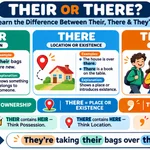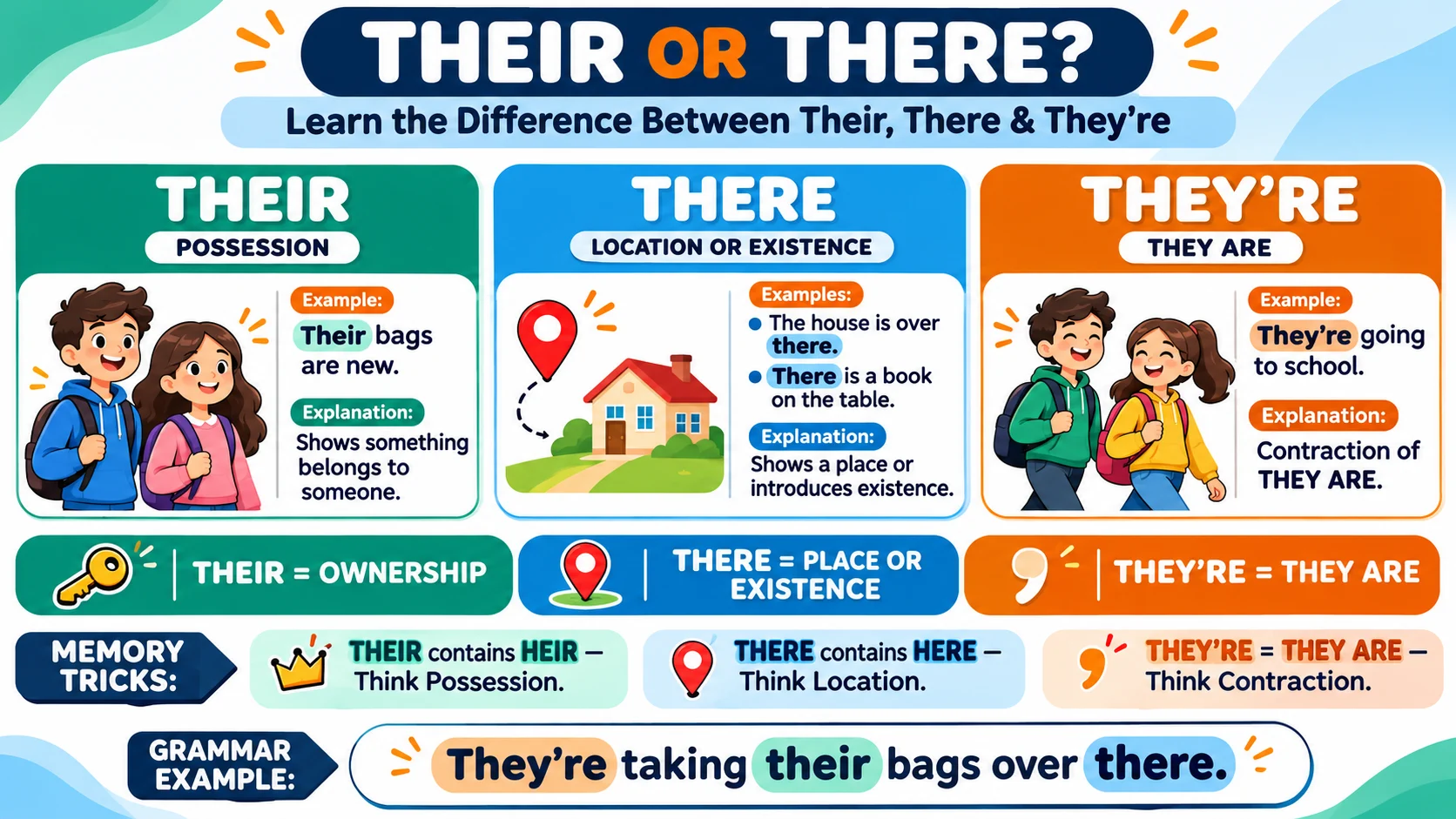
Their or there are commonly confused English words that sound alike but have different meanings. Their is a possessive determiner showing ownership, as in “Their house is beautiful.” There refers to a place or introduces the existence of something, as in “The books are over there” or “There is a problem.” Meanwhile, they’re is a contraction of “they are,” as in “They’re happy.”
Have you ever wondered whether to write their or there when describing someone’s belongings, talking about a location, or constructing a sentence? Although these words sound exactly the same, their meanings and grammatical functions are completely different. As a result, even experienced English speakers occasionally confuse them, especially when writing quickly.
The word their indicates possession or association with someone, while there usually refers to a place or introduces the existence of something. For example, “Their car is parked there” uses both words correctly in the same sentence. Additionally, a third word, they’re, creates confusion because it has the same pronunciation but means “they are.”
Moreover, understanding these differences is essential for clear and professional communication. Whether you’re writing school assignments, emails, social media captions, or blog articles, choosing the correct word helps prevent grammatical mistakes. Fortunately, a few straightforward rules and memory tricks can make the distinction easy to remember.
In this guide, you’ll learn the meanings of their and there, their grammatical functions, pronunciation, and practical examples. Furthermore, we’ll compare them with they’re, explore common mistakes, explain special situations, and provide practice exercises to help you use all three forms confidently.
What Is the Difference Between Their and There?
The main difference between these words is their grammatical function.
Their indicates that something belongs to or is associated with people, animals, or a person whose gender is unspecified.
There generally refers to a location or introduces the existence or presence of something.
For example:
- Their books are on the table.
- The books are over there.
- Their teacher is waiting there.
- There is a meeting tomorrow.
- Their children enjoy playing outside.
Although both words have identical pronunciations in most English accents, they cannot normally be used interchangeably.
Quick Comparison Table
| Feature | Their | There |
|---|---|---|
| Main meaning | Shows possession or association | Refers to a place or introduces existence |
| Grammar role | Possessive determiner | Adverb or introductory element |
| Main question | Whose? | Where? or what exists? |
| Example | Their house is big. | The house is over there. |
| Ownership | Yes | No |
| Location | No | Yes |
| Pronunciation | Usually the same | Usually the same |
Therefore, the easiest way to choose correctly is to determine whether your sentence expresses possession, location, or existence.
What Does Their Mean?
Their is a possessive determiner used to show that something belongs to or is associated with someone.
It appears before a noun or noun phrase.
For example:
“Their dog is friendly.”
Here, their indicates that the dog belongs to the people being discussed.
Similarly:
“The students completed their homework.”
The word connects the homework to the students.
Examples of Their in Sentences
- Their house is near the school.
- The children packed their bags.
- Their teacher explained the lesson.
- My friends invited me to their party.
- The players celebrated their victory.
- Their parents arrived early.
- Everyone should bring their notebook.
- The employees finished their assignments.
- Their garden looks beautiful.
- The students shared their ideas.
In these examples, their identifies a relationship between a person or group and a noun.
What Does There Mean?
There is a word commonly used to refer to a place or location.
Additionally, it appears in sentences that introduce the existence or presence of something.
For example:
“The library is over there.”
Here, there identifies a location.
However, consider another sentence:
“There is a book on the table.”
In this case, the word introduces the existence of a book rather than pointing to a distant place.
Consequently, understanding both functions is important.
Examples of There in Sentences
- The keys are over there.
- There is a park near my house.
- Please put your bag there.
- There are several books on the shelf.
- We went there yesterday.
- There was a strange noise outside.
- The children are playing over there.
- There will be a meeting tomorrow.
- Is there any water left?
- There seems to be a mistake.
Although the exact meaning changes with context, none of these examples uses there to indicate ownership.
Their vs. There vs. They’re
The confusion becomes more common when a third homophone, they’re, is included.
All three words have similar or identical pronunciation in standard English.
However, each has a separate meaning.
Their shows possession.
There refers to location or existence.
They’re means “they are.”
Comparison Table
| Word | Meaning | Example |
|---|---|---|
| Their | Belonging to them | Their car is red. |
| There | In or at that place | The car is over there. |
| They’re | They are | They’re driving home. |
| Their | Associated with someone | Their decision was final. |
| There | Introduces existence | There is a problem. |
| They’re | Contraction | They’re excited. |
For example:
“They’re taking their children over there.”
This sentence uses all three forms correctly.
- They’re = They are
- Their = Belonging to them
- There = Location
Therefore, understanding the meaning of each word makes the correct spelling much easier to identify.
When to Use Their in English Grammar
The word their is used when expressing possession or association.
However, it has several common applications.
Showing Ownership
The most familiar use involves describing something that belongs to a group.
For example:
“The children forgot their lunchboxes.”
Here, the lunchboxes belong to the children.
Additional examples include:
- Their bicycle is new.
- Their house has three bedrooms.
- Their clothes are clean.
- Their teacher is helpful.
- Their belongings are in the car.
Referring to a Group
The word can describe something associated with several people.
For example:
“The team celebrated their success.”
In this sentence, their connects the success with the team members.
Similarly:
“The students submitted their projects.”
Therefore, the word is useful when discussing groups and shared responsibilities.
Using Singular They
Modern English commonly uses singular they when a person’s gender is unknown, unspecified, or when the person uses they/them pronouns.
The possessive form is still their.
For example:
“Someone left their umbrella.”
Similarly:
“Every student should check their schedule.”
Although the nouns someone and student are singular, singular they is widely accepted in contemporary English.
Consequently, their does not always refer to multiple people.
Expressing Association
Possession doesn’t always mean legal ownership.
For example:
“The children love their school.”
The students do not own the school.
However, it is associated with them.
Likewise:
“The workers discussed their responsibilities.”
Here, the responsibilities are associated with the workers.
When to Use There in English Grammar
The word there serves several purposes in English.
Most commonly, it identifies a location or introduces the existence of something.
Referring to a Place
Use there when pointing to a specific or understood location.
Examples:
- The restaurant is over there.
- We stayed there last summer.
- Please stand there.
- My phone is somewhere over there.
- They will meet us there.
In these examples, the word answers the question “Where?”
Introducing Existence
The word also appears at the beginning of sentences that introduce something.
Examples:
- There is a problem.
- There are five chairs.
- There was an accident.
- There were many visitors.
- There will be an announcement.
This construction is called existential there.
Although the word does not identify a physical location in these examples, it introduces the existence or occurrence of something.
Asking Questions
The word frequently appears in questions.
For example:
- Is there a doctor nearby?
- Are there any questions?
- Was there a meeting yesterday?
- Will there be enough food?
- Is there anything I can help with?
Therefore, it is important not to assume that there always refers to location.
Common Expressions
The word also appears in familiar expressions.
Examples include:
- There you go!
- Here and there
- There is no doubt.
- There you are!
- There is no way.
Depending on context, these expressions may have meanings beyond a literal location.
Understanding There Is and There Are
One of the most important uses of there involves there is and there are.
These expressions introduce the existence of something.
Use There Is With Singular Nouns
Examples:
- There is a cat outside.
- There is an apple on the table.
- There is a new student in class.
- There is a problem with the computer.
- There is an interesting movie tonight.
Additionally, there is is commonly used with uncountable nouns.
For example:
“There is water in the bottle.”
Use There Are With Plural Nouns
Examples:
- There are two cats outside.
- There are several apples on the table.
- There are many students in class.
- There are three problems to solve.
- There are five chairs in the room.
Quick Grammar Comparison
| Singular or Uncountable | Plural |
|---|---|
| There is a book. | There are books. |
| There is a chair. | There are chairs. |
| There is an apple. | There are apples. |
| There is some water. | There are several bottles of water. |
| There is a student. | There are students. |
However, informal spoken English sometimes uses “there’s” before plural expressions.
In formal writing, there are is generally preferred when the following noun phrase is plural.
What Does They’re Mean?
They’re is a contraction of they are.
It combines two words into a shorter form.
For example:
“They’re happy.”
This means:
“They are happy.”
Similarly:
“They’re going to school.”
The full sentence is:
“They are going to school.”
Examples of They’re
- They’re waiting outside.
- They’re playing football.
- They’re excited about the trip.
- They’re studying for exams.
- They’re coming tomorrow.
- They’re ready to leave.
- They’re working together.
- They’re enjoying the party.
- They’re planning a vacation.
- They’re very helpful.
The easiest way to identify this form is to replace it with they are.
If the sentence still makes sense, they’re is probably correct.
Easy Tricks to Remember the Difference
Several simple memory tricks can help you distinguish these homophones.
Their Contains Heir
The word their contains heir.
An heir is someone who may inherit property or belongings.
Therefore, you can associate their with possession.
For example:
“Their house is beautiful.”
There Contains Here
The word there contains here.
Both words are associated with places.
For example:
“The shop is over there.”
This memory trick helps you connect the spelling with location.
However, remember that there also introduces existence.
They’re Contains an Apostrophe
The apostrophe in they’re shows that letters have been omitted from they are.
For example:
“They’re happy.”
Replace the contraction:
“They are happy.”
If the replacement works, the contraction is correct.
The Three-Word Memory Rule
Remember:
Their = Ownership
There = Location or Existence
They’re = They Are
This simple pattern can help you avoid many common mistakes.
Their or There in Everyday Conversations
The two words appear frequently in ordinary English.
However, their roles change according to meaning.
At School
“The students left their bags over there.”
In this sentence:
- Their shows that the bags belong to the students.
- There identifies where the bags are located.
At Home
“The children are cleaning their room.”
The word their connects the room with the children.
Meanwhile:
“There is a mess in the kitchen.”
Here, there introduces the existence of a mess.
At Work
“The employees submitted their reports.”
The reports belong to or are associated with the employees.
Another example is:
“There will be a meeting at noon.”
The word introduces a scheduled event.
While Traveling
“They left their luggage there.”
This sentence correctly uses both words.
Consequently, understanding their grammatical functions allows you to construct clear sentences in different situations.
Examples Using Their, There, and They’re Together
Combining all three words in one sentence provides excellent practice.
- They’re putting their bags over there.
- Their friends are waiting there because they’re early.
- They’re taking their children to the park over there.
- Their teacher said they’re meeting there tomorrow.
- They’re looking for their missing dog over there.
- Their parents know they’re staying there tonight.
- They’re leaving their bicycles there.
- Their neighbors said they’re moving over there.
- They’re keeping their books there.
- Their friends are happy because they’re going there together.
Although these sentences may look complicated, each word has a clear purpose.
Therefore, focusing on meaning makes the choice easier.
Is Their Singular or Plural?
Traditionally, their was associated primarily with plural subjects.
For example:
“The students brought their notebooks.”
However, singular their is also standard in contemporary English when referring to a person whose gender is unspecified or who uses they/them pronouns.
For example:
“Someone forgot their phone.”
Similarly:
“Every participant should bring their identification.”
This usage is recognized by major dictionaries and widely adopted by modern style guides.
Therefore, it is incorrect to claim that their must always refer to more than one person.
Is There an Adverb or Pronoun?
The grammatical classification of there depends on its role.
There as an Adverb
When it identifies a place, there functions as an adverb.
For example:
“She lives there.”
The word describes where someone lives.
Existential There
When the word introduces a statement of existence, it functions as an introductory or dummy subject element.
For example:
“There is a problem.”
Although there appears at the beginning of the sentence, it does not refer to a particular location.
Instead, the construction introduces the existence of a problem.
Some grammar systems describe this use as a dummy pronoun or an existential element.
Therefore, its grammatical classification can vary slightly depending on the grammar framework.
Their vs. There in Formal Writing
Correct word choice is especially important in academic, business, and professional communication.
Although the words sound alike, using the wrong spelling can distract readers.
For example:
Incorrect:
“The employees completed there tasks.”
Correct:
“The employees completed their tasks.”
Similarly:
Incorrect:
“The documents are over their.”
Correct:
“The documents are over there.”
Consequently, proofreading for these specific homophones can improve writing quality.
Academic Writing Example
“Students should review their assignments before submission.”
The word their is correct because it associates the assignments with the students.
Business Writing Example
“There will be a meeting on Monday.”
The word introduces the scheduled event.
Email Writing Example
“They’re sending their documents there tomorrow.”
This sentence correctly uses the contraction, possessive determiner, and location word.
Common Mistakes With Their and There
Several errors occur repeatedly in English writing.
Using There Instead of Their
Incorrect:
“The children forgot there homework.”
Correct:
“The children forgot their homework.”
Because the homework belongs to the children, the possessive determiner is required.
Using Their Instead of There
Incorrect:
“The books are over their.”
Correct:
“The books are over there.”
The sentence identifies a location, not possession.
Confusing They’re With Their
Incorrect:
“Their going to school.”
Correct:
“They’re going to school.”
The sentence means “They are going to school.”
Therefore, the contraction is necessary.
Confusing They’re With There
Incorrect:
“They’re is a problem.”
Correct:
“There is a problem.”
The sentence introduces the existence of a problem.
Using Their Before Is
Incorrect:
“Their is a cat outside.”
Correct:
“There is a cat outside.”
The word their normally modifies a noun, so it cannot replace existential there.
Forgetting the Apostrophe in They’re
Incorrect:
“Theyre coming tomorrow.”
Correct:
“They’re coming tomorrow.”
The apostrophe represents the missing letter in the contraction of they are.
How to Check Which Word Is Correct
A simple three-step method can help you choose the correct spelling.
Ask Whether the Sentence Shows Possession
If the word refers to something belonging to or associated with someone, use their.
For example:
“Their teacher is friendly.”
Ask Whether It Refers to a Location or Existence
If the word indicates where something is or introduces something that exists, use there.
For example:
“The teacher is over there.”
Or:
“There is a new teacher.”
Try Replacing the Word With They Are
If the sentence makes sense with they are, use they’re.
For example:
“They’re excited.”
Replacement:
“They are excited.”
Therefore, the contraction is correct.
Practice Exercises: Their, There, or They’re
Test your understanding by choosing the correct word.
Fill in the Blanks
- The students forgot ___ notebooks.
- Please put the bag over ___.
- ___ going to the cinema tonight.
- The children are playing with ___ toys.
- ___ is a new restaurant nearby.
- My friends said ___ coming tomorrow.
- The employees completed ___ assignments.
- We went ___ last weekend.
- ___ parents are waiting outside.
- ___ are several books on the shelf.
- The players celebrated ___ victory.
- ___ planning a surprise party.
- I left my keys over ___.
- The teachers prepared ___ lessons.
- ___ seems to be a problem with the computer.
- Someone forgot ___ umbrella.
- ___ excited about the competition.
- The students placed ___ bags ___.
- ___ going to bring ___ friends.
- ___ is no reason to worry.
Answers and Explanations
| Question | Answer | Explanation |
|---|---|---|
| 1 | Their | Shows possession |
| 2 | There | Indicates location |
| 3 | They’re | Means they are |
| 4 | Their | Shows possession |
| 5 | There | Introduces existence |
| 6 | They’re | Means they are |
| 7 | Their | Associates assignments with employees |
| 8 | There | Refers to a place |
| 9 | Their | Shows association |
| 10 | There | Introduces existence |
| 11 | Their | Associates victory with players |
| 12 | They’re | Means they are |
| 13 | There | Indicates location |
| 14 | Their | Associates lessons with teachers |
| 15 | There | Introduces a situation |
| 16 | Their | Singular possessive they |
| 17 | They’re | Means they are |
| 18 | Their, there | Possession followed by location |
| 19 | They’re, their | Contraction followed by possession |
| 20 | There | Introduces existence |
These exercises demonstrate how meaning determines the correct spelling.
Why Learning Homophones Matters
Homophones are words that have the same pronunciation but different spellings or meanings.
Understanding them helps improve accuracy in written communication.
Improves Spelling
Learning the distinctions between commonly confused words reduces spelling and usage mistakes.
For example, recognizing that their expresses possession helps prevent confusion with there.
Strengthens Grammar
Correct word choice demonstrates an understanding of sentence structure.
Moreover, identifying possessive determiners and contractions can improve other areas of grammar.
Supports Professional Communication
Business emails, academic assignments, and published articles benefit from accurate language.
Consequently, proofreading homophones makes writing appear more polished.
Builds English Confidence
When learners understand why one spelling is correct, they can write with greater confidence.
Additionally, the same learning approach can be applied to other confusing word groups.
Other Commonly Confused English Words
English contains many homophones and similar expressions.
Here are a few common examples:
| Words | Difference |
|---|---|
| Your / You’re | Possession / You are |
| Its / It’s | Possession / It is or it has |
| To / Too / Two | Direction or infinitive / Also or excessive / Number |
| Hear / Here | Perceive sound / Location |
| Their / There / They’re | Possession / Location or existence / They are |
| Affect / Effect | Usually influence as a verb / Usually result as a noun |
| Weather / Whether | Atmospheric conditions / Alternatives or possibilities |
| Then / Than | Time or sequence / Comparison |
For example, the difference between hear and here follows a similar pattern to the main comparison in this article.
Therefore, studying related word pairs can strengthen overall writing skills.
Frequently Asked Questions
What is the difference between their and there?
Their is a possessive determiner that indicates ownership or association, as in “Their house is beautiful.” Meanwhile, there refers to a location or introduces existence, as in “The house is over there” or “There is a house nearby.”
How do you know when to use their or there?
Use their when something belongs to or is associated with someone. Use there when discussing a place or introducing the existence of something. For example, “Their car is parked there.”
Is it their house or there house?
The correct phrase is their house because the word indicates possession. “There house” is incorrect when referring to ownership.
Is it over their or over there?
The correct expression is over there because it identifies a location. The word their cannot replace there in this context.
What does they’re mean?
They’re is a contraction of they are. For example, “They’re happy” means “They are happy.”
Is it their going or they’re going?
The correct phrase is they’re going because it means “they are going.” The word their expresses possession and cannot replace this contraction.
Can their be used for one person?
Yes. Singular their is commonly used when a person’s gender is unspecified or when the person uses they/them pronouns. For example, “Someone left their phone.”
Is there a noun or an adverb?
There commonly functions as an adverb when referring to location. However, in existential constructions such as “There is a problem,” it functions as an introductory element rather than an ordinary location adverb.
Is it there is or their is?
The correct expression is there is. It introduces the existence or presence of something. For example, “There is a book on the table.”
Is it their coming or they’re coming?
The correct phrase is they’re coming because the intended meaning is “they are coming.”
What is an easy trick to remember their and there?
Remember that their contains heir, which relates to inheritance and possession. Meanwhile, there contains here, which relates to location. Additionally, they’re means “they are.”
What are examples of their and there in the same sentence?
Examples include “Their bags are over there,” “Their teacher is standing there,” and “They left their bicycles there.” Each sentence uses possession and location correctly.
Why do people confuse their, there, and they’re?
The words are homophones, meaning they sound alike despite having different spellings and meanings. Consequently, people sometimes choose the wrong spelling when writing quickly.
Conclusion
Understanding the difference between their or there is an important step toward improving English grammar and spelling. Although the words sound identical, their meanings and grammatical functions are different.
Use their when expressing possession or association, as in “Their books are on the table.” Meanwhile, use there when referring to a place or introducing the existence of something, as in “The books are over there” or “There is a problem.” Additionally, remember that they’re is simply a contraction of “they are.”
Furthermore, a few memory tricks can make these words easier to distinguish. The word their contains heir, which relates to possession, while there contains here, which is associated with location. Likewise, replacing they’re with they are helps confirm whether the contraction is correct.
Ultimately, choosing the correct word depends on understanding the meaning of your sentence. With regular practice and careful proofreading, you’ll be able to use all three forms confidently in everyday conversations, academic writing, emails, and professional communication.