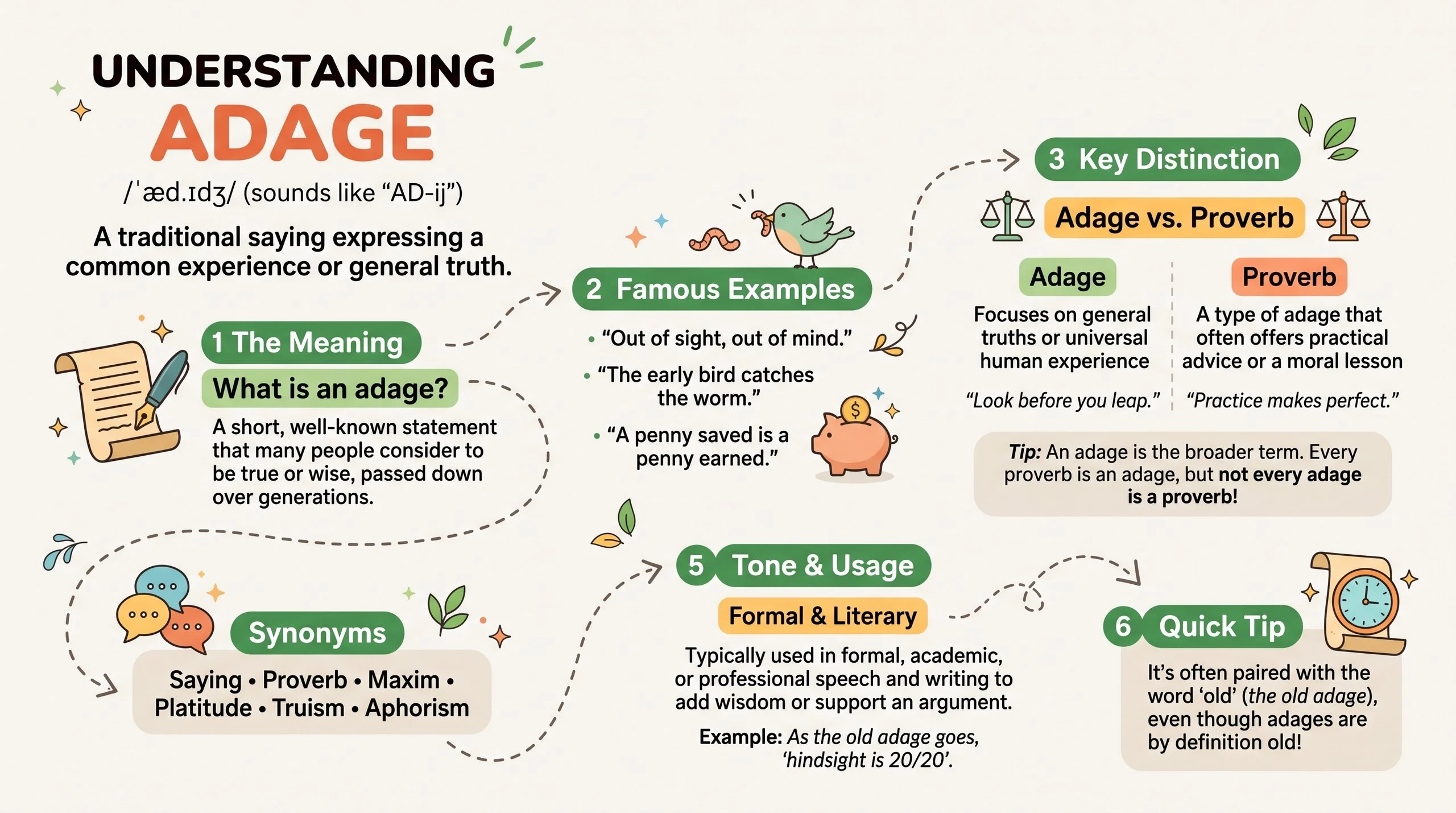
Adage meaning: An adage is a familiar, traditional saying that expresses a general truth, practical lesson, or observation about life. It is similar to a proverb or wise saying and often reflects experience shared across generations.
adage meaning refers to a familiar saying that expresses a general truth, practical lesson, or widely accepted observation. You may see the word in books, articles, speeches, classrooms, workplace writing, or everyday conversations. However, it is not usually slang or internet shorthand.
For example, someone might say, “There’s an old adage that you should look before you leap.” The speaker is referring to a traditional piece of wisdom. Similarly, a writer might introduce a familiar life lesson by saying, “As the old adage goes.”
The word can sound slightly more formal than “saying.” Therefore, understanding its tone helps you choose it naturally. It works especially well in essays, journalism, professional writing, storytelling, and thoughtful conversations.
This guide explains the definition, pronunciation, history, related words, examples, conversational uses, social media context, common mistakes, and subtle differences between an adage and similar terms.
QUICK ANSWER BOX
| Meaning | Context | Primary Platforms | Example | Tone |
| A familiar saying expressing a general truth | Writing, speech, conversation | Books, blogs, social media, texting | “That’s an old adage.” | Neutral to formal |
| A traditional piece of wisdom | Advice and life lessons | Articles, essays, conversations | “The adage still applies today.” | Thoughtful |
| A proverb-like expression | General observations | Education and media | “It follows the old adage.” | Literary |
| A concise traditional saying | Commentary and storytelling | Instagram, TikTok, blogs | “As the adage goes…” | Reflective |
What Does Adage Mean?
At its simplest, adage meaning is a well-known saying that expresses a general truth. The word usually describes something that has become familiar through repeated use.
Cambridge defines an adage as a wise saying or proverb. Oxford similarly describes it as a well-known phrase expressing a general truth about people or the world. Cambridge Dictionary
An adage often communicates more than its literal words. For example, “Look before you leap” is not really about physically looking at the ground before jumping. Instead, it advises people to think carefully before making a decision.
Pronunciation
The American English pronunciation is approximately:
adage: /ˈædɪdʒ/
It sounds roughly like “AD ij.”
The first syllable receives the main stress. Therefore, avoid pronouncing it like “uh-DAGE.”
Is adage a noun?
Yes. Adage is a countable noun.
You can say:
- “That is an old adage.”
- “She quoted several adages.”
- “The adage remains relevant.”
- “He mentioned a familiar adage.”
The plural form is adages.
Where does the word come from?
The English word entered the language through French from Latin adagium, meaning a saying or proverb. Oxford dates its English use to the mid-sixteenth century. Oxford Learner’s Dictionaries
The exact deeper history of the Latin form has some uncertainty. Therefore, it is safer to say that English adage ultimately comes from Latin adagium rather than presenting a disputed root explanation as absolute fact. Etymology Online
What does an adage usually communicate?
An adage often communicates one of these ideas:
- General wisdom
- Practical advice
- A common observation
- A lesson from experience
- A traditional belief
- A recurring pattern in life
For example, “Actions speak louder than words” suggests that behavior often provides stronger evidence than promises.
Likewise, “Better late than never” communicates the idea that doing something late can still be preferable to not doing it at all.
Adage versus ordinary saying
An ordinary saying can be any familiar expression. An adage usually carries a sense of wisdom, tradition, or general truth.
| Term | Core idea | Typical tone |
| Adage | Traditional saying expressing wisdom | Formal or thoughtful |
| Saying | Familiar expression | Neutral |
| Proverb | Short traditional statement giving advice or expressing truth | Traditional |
| Maxim | Rule or principle for behavior | Formal |
| Aphorism | Concise statement expressing an idea or observation | Literary |
| Motto | Phrase representing a principle or goal | Personal or institutional |
| Cliché | Overused expression | Often negative |
These words overlap considerably. However, they are not always interchangeable.
Contextual Dynamics & Nuances of the Term
The word becomes more useful when you understand the situations in which Americans naturally use it.
Formal writing
Adage fits comfortably into formal writing.
For example:
“The old adage that prevention is better than treatment remains relevant.”
This construction works well in essays, reports, articles, and opinion pieces.
However, it can sound unnecessarily formal in a casual text message. A friend would probably say, “You know that saying…” instead.
Academic writing
Students may encounter the term in literature, history, philosophy, communication, or language courses.
For example:
“The author uses an ancient adage to emphasize the importance of patience.”
Here, the word identifies a traditional statement that supports the author’s larger point.
Professional communication
An adage can also work in business communication.
For example:
“There is an old adage that customer trust takes years to build.”
The phrase sounds polished without becoming excessively technical.
Still, moderation matters. If every paragraph contains an old saying, the writing may feel repetitive or overly literary.
Everyday conversation
People do use the word in conversation, although “saying” is generally more common.
Someone might say:
“There’s an old adage about preparation and success.”
That sounds natural.
On the other hand:
“Hey, adage, what are you doing tonight?”
would be incorrect because adage is not a form of address or slang term for a person.
Humor and irony
Adages can also appear in humorous situations.
Someone who ignored good advice might jokingly say:
“Well, I guess that old adage was right.”
The speaker may be admitting that experience proved the traditional wisdom correct.
Similarly, a person can intentionally twist an established saying for comedic effect.
Emotional tone
The word itself is neutral. The emotional effect comes from the saying being discussed.
An adage about patience may sound reassuring. An adage about consequences may sound cautionary. Furthermore, an adage about success may sound motivational.
Therefore, the word does not automatically mean something positive.
Real-Life Conversation Examples Using adage meaning
Example 1: Giving practical advice
Alex: I’m thinking about buying this expensive laptop tonight.
Jordan: Do you really need it?
Alex: Not really, but the discount ends tonight.
Jordan: Remember the old adage: look before you leap.
Alex: Fair point. I’ll compare a few options first.
Here, the term introduces traditional advice about avoiding impulsive decisions.
Example 2: Talking about relationships
Maya: I keep giving him chances, but nothing changes.
Emma: Sometimes that old adage about actions speaking louder than words really applies.
Maya: Exactly. I need to watch what he does, not what he promises.
The word fits because the speaker refers to a familiar principle rather than inventing new advice.
Example 3: Discussing work
Sam: I thought the project would be finished in two days.
Chris: It always takes longer than expected.
Sam: Apparently, that old adage about measuring twice and cutting once applies here.
The phrase creates a connection between a traditional lesson and a current workplace situation.
Example 4: Casual texting
Taylor: I almost posted that angry comment.
Riley: Good thing you waited.
Taylor: Yeah. “Think before you speak” strikes again.
Riley: That adage saved you from a whole internet disaster.
This example shows how the word can appear naturally in a casual conversation when someone is discussing a familiar principle.
Example 5: Reflecting on experience
Nina: I finally started saving money every month.
Chris: Nice!
Nina: I wish I had started years ago.
Chris: Well, you know the adage. Better late than never.
The word connects a traditional saying with a personal realization.
Platform-Specific Breakdown
The term does not have a special hidden meaning on social platforms. Instead, its meaning stays essentially the same.
However, platform culture can change how people use it.
How It Is Used on Snapchat
On Snapchat, people usually favor short, casual language. Therefore, “saying” is often more natural than “adage.”
Still, the word can appear when someone is joking about advice or reacting to a familiar quote.
For example:
“Guess that old adage was right 😂”
A Snapchat user might pair the phrase with a photo showing a situation that proves the saying.
The important point is that Snapchat does not give adage a separate slang definition.
The Role of adage meaning on TikTok
TikTok creates many opportunities for traditional sayings to become part of modern commentary.
A creator might discuss an old principle and say:
“There’s an old adage that says…”
The phrase can introduce a life lesson, relationship observation, productivity tip, or humorous story.
However, TikTok captions usually favor simpler wording.
For example:
“That old saying really is different now.”
This feels more conversational than:
“That adage remains remarkably applicable.”
Both communicate the same basic idea, but the second sounds more formal.
Instagram and Texting Dynamics
Instagram captions can use adage when the creator wants a reflective or polished tone.
For example:
“The old adage still holds true: patience pays off.”
A more casual caption might say:
“As they say, good things take time.”
Texting follows the same pattern.
If you are chatting with a friend, “old saying” usually feels more natural. If you are discussing language, literature, or writing, “adage” may fit better.
| Situation | More natural choice |
| Casual text | Saying |
| Instagram reflection | Adage or saying |
| Academic essay | Adage |
| Business article | Adage |
| TikTok caption | Saying |
| Literature discussion | Adage |
| Formal speech | Adage |
| Everyday conversation | Saying |
Alternative Meanings & NLP Variations of the Phrase
Although the core definition remains stable, several semantic variations appear around the word.
Wise saying
This is one of the closest alternatives.
A wise saying communicates an observation or lesson that people consider valuable.
Proverb
A proverb is a short traditional statement that expresses a common truth or gives advice. Cambridge lists adage and proverb as synonyms, although their usage can differ slightly by context. Cambridge Dictionary
For many sentences, either word works.
Maxim
A maxim usually presents a principle or rule for behavior.
For example:
“Honesty is the best policy.”
Calling this a maxim emphasizes the principle behind the statement.
Aphorism
An aphorism is typically concise and memorable. It can express an observation, principle, or idea.
The term often sounds more literary or intellectual than “saying.”
Motto
A motto represents a guiding principle, identity, organization, or personal goal.
For example, a company may have a motto. That does not necessarily make the motto an adage.
Axiom
An axiom is a statement accepted as true within a particular system or field. In ordinary language, people sometimes use it loosely to mean an accepted principle.
However, an axiom is generally more technical than an adage.
Cliché
A cliché is an expression that has become overly familiar through repeated use.
An adage can become a cliché, but the words are not automatically synonymous.
The difference matters because adage often carries a neutral or respectful tone, while cliché can suggest that an expression feels tired or unoriginal.
Semantic variations
Search engines and language models may associate the term with phrases such as:
- old adage
- famous adage
- traditional adage
- common adage
- ancient adage
- popular saying
- wise saying
- traditional saying
- familiar proverb
- old proverb
- common wisdom
- traditional wisdom
- general truth
- life lesson
- words of wisdom
These variations help explain the concept without repeating the same wording.
Misinterpretations: When NOT to Use adage meaning
Knowing when not to use the term is just as important as knowing its definition.
Do not use it for every quote
A quote is not automatically an adage.
For example:
“I love this movie.”
That is a quote, but it is not an adage.
An adage normally expresses a broader observation, principle, or piece of wisdom.
Do not use it for personal opinions
Consider:
“I think pizza tastes better at night.”
That is an opinion.
It does not become an adage simply because someone says it confidently.
Do not confuse it with a slogan
A slogan promotes a product, campaign, organization, or idea.
For example, a brand slogan can be memorable without expressing traditional wisdom.
Do not assume every old sentence is an adage
Age alone does not make something an adage.
A historical sentence can be old without becoming a widely recognized saying.
The expression normally gains its character through familiarity and repeated cultural use.
Avoid unnecessary formality
If you are texting your best friend, saying:
“Your statement resembles a longstanding adage.”
may sound humorous because it is overly formal.
Instead, say:
“Yep, that old saying is true.”
Context controls naturalness.
Do not treat the word as slang
The term is a standard English noun. It is not modern internet slang.
Therefore, if someone searches for “adage meaning slang,” the safest interpretation is that they may be asking whether the word has a hidden social media meaning.
Usually, it does not.
How to Respond in Chat Comfortably
If someone uses the word adage in a message, you usually do not need a complicated response.
Your reply should focus on the actual saying or idea.
When you agree
You can say:
- “That’s definitely true.”
- “I’ve heard that one before.”
- “That saying really applies here.”
- “Honestly, I agree.”
- “That’s a good point.”
When you disagree
You can respond:
- “I get the idea, but I don’t think it always applies.”
- “That may be true sometimes.”
- “I see where you’re coming from, but there are exceptions.”
- “Interesting point. I’m not completely convinced.”
When you want clarification
Try:
- “Which saying do you mean?”
- “What adage are you referring to?”
- “What’s the saying again?”
- “Can you explain what you mean?”
When someone uses the word incorrectly
Do not embarrass them.
Instead, respond naturally and focus on the intended meaning.
For example:
“I think you mean ‘saying’ here, but I get what you mean.”
That approach keeps the conversation friendly.
When the word appears in a professional message
A professional response can acknowledge the principle directly:
“That principle makes sense in this situation.”
This avoids repeating the word unnecessarily while maintaining a polished tone.
FAQs
What does adage mean in simple English?
It means a familiar saying that expresses a general truth, useful lesson, or common observation. “Saying” and “proverb” are often simpler alternatives.
Is adage a slang word?
No. It is a standard English noun. It can appear online, but social media does not normally give it a separate slang meaning.
What is a simple example of an adage?
“Better late than never” is a familiar example because it expresses a general lesson about completing something even after a delay.
Is an adage the same as a proverb?
They are very close. Both can describe traditional statements expressing wisdom or common truth. However, “proverb” often emphasizes traditional folk wisdom, while “adage” can have a somewhat broader or more formal feel.
Is the adage formal or informal?
It is generally neutral to somewhat formal. In casual texting, “saying” often sounds more natural. In essays, articles, speeches, and professional writing, “adage” can fit very well.
What is the plural of adage?
The plural is adages. For example, “The book contains several traditional adages.”
How do you pronounce an adage?
In American English, it is pronounced approximately AD ij, with the stress on the first syllable.
What is a synonym for adage?
Common synonyms include saying, proverb, maxim, aphorism, motto, axiom, and wise saying. However, each word carries slightly different implications. Cambridge Dictionary
Can adage refer to a modern saying?
Yes. Although many adages are traditional, the essential idea is a familiar saying expressing a general truth. A saying does not need to be extremely ancient to function as an adage.
Why do people say “old adage”?
“Old adage” emphasizes that the saying has existed for a long time or has been repeated across generations. The phrase is common, although “old” is sometimes unnecessary because tradition is already associated with the word.
Conclusion
Understanding adage meaning becomes much easier when you connect the word to its central idea: a familiar saying that expresses general wisdom or truth. The term has a long history, but its practical use remains straightforward.
Today, you may encounter adages in books, articles, classrooms, speeches, workplace writing, captions, and online discussions. However, the word itself has not developed a major separate slang definition on social media.
The biggest distinction is context. In casual conversation, “saying” often sounds simpler. In formal or thoughtful writing, “adage” can sound precise and polished. Furthermore, related words such as proverb, maxim, aphorism, motto, and cliché overlap with it but are not always identical.
Once you understand those differences, you can use the word naturally and recognize it whenever someone refers to traditional wisdom, familiar sayings, or lessons that have stood the test of time.
Files, images, and data analysis are unavailable until usage resets at 8:33 PM. Continue chatting with text only, or upgrade for more access.