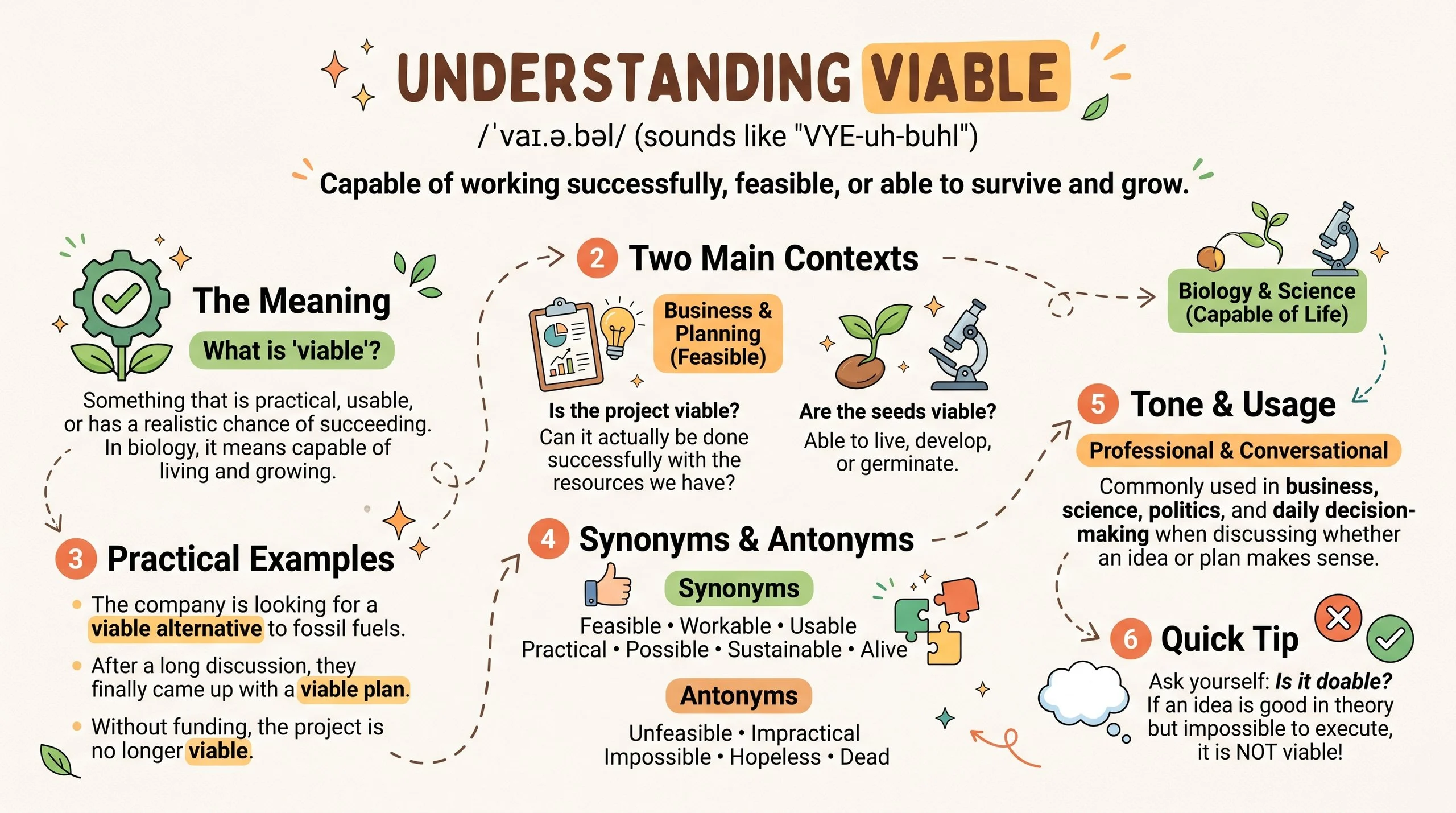
Viable means capable of working successfully, surviving, or being developed into a practical option. The viable meaning often describes an idea, plan, solution, business, method, or opportunity that has a realistic chance of succeeding.
viable meaning usually refers to something that can work, succeed, survive, or become practical under real conditions. However, the word can carry slightly different shades depending on the situation. For example, a business idea can be viable if it has enough customers and resources to succeed. Likewise, a solution can be viable if people can realistically use it.
You will often see this word in business, education, science, technology, healthcare, economics, and everyday conversations. It can describe both concrete and abstract things. A viable option might be a career choice, a treatment approach, a product idea, or even a simple plan for solving a problem.
Therefore, understanding the word requires more than memorizing one definition. You also need to understand tone, context, common collocations, synonyms, and situations where the word sounds natural.
Quick Answer Box
| Meaning | Context | Primary Platforms | Example | Tone |
| Able to work or succeed realistically | Business, plans, solutions, science, everyday English | Texting, social media, school, work | “That sounds like a viable option.” | Neutral, practical, professional |
What Does viable meaning Mean?
The word viable generally describes something that has the ability or potential to work successfully. In simple English, it means practical enough to succeed.
For example, imagine that someone wants to open a coffee shop. They have a good location, enough money, strong local demand, and a realistic business plan. You could describe the idea as viable.
On the other hand, an exciting idea might not be viable if it costs too much, lacks customers, or requires technology that does not exist yet.
The word can therefore communicate possibility plus practicality. That distinction matters because something can be possible without being viable.
Simple definition
A viable thing is something that can realistically work, survive, or succeed.
Consider these examples:
- “We need a viable solution.”
- “The company needs a viable business model.”
- “Working remotely is a viable option for me.”
- “The proposal does not seem financially viable.”
- “Scientists are looking for a viable alternative.”
In each sentence, the speaker is discussing whether something can realistically work.
Viable versus possible
These words are related, but they are not identical.
Possible means something can happen or exist.
Viable suggests that something can realistically work or succeed.
For example, moving to another country may be possible. However, it might not be viable if the person cannot afford housing, obtain the required visa, or find suitable employment.
Consequently, viable often sounds more practical and analytical than possible.
Word origin and linguistic background
Viable comes from French viable, which is connected to the idea of being capable of living or continuing successfully. The English word developed around the broader idea of something being capable of functioning, surviving, or succeeding.
Today, the term appears across many fields. Its meaning has expanded beyond biological survival to include plans, businesses, strategies, technologies, and solutions.
That broader modern usage explains why you may encounter the word in both academic writing and casual professional conversation.
Contextual Dynamics and Nuances of the Term
The meaning becomes clearer when you look at what comes after the word. The noun paired with it often reveals exactly what the speaker is evaluating.
For instance, a viable solution focuses on whether an answer can realistically solve a problem. A viable business focuses on whether the company can operate and succeed. A viable candidate may describe someone who has a realistic chance of being selected.
Therefore, context determines the precise shade.
Financial context
In finance and business, viable business often relates to profitability, sustainability, resources, and long term performance.
For example:
“The company needs a financially viable strategy.”
This suggests that the strategy must make economic sense.
Another example is:
“The project is not commercially viable.”
Here, the speaker means that the project probably cannot succeed as a commercial venture.
Academic context
Students and researchers may use viable when discussing ideas, research methods, solutions, or theories.
For example:
“This method provides a viable approach to the problem.”
The sentence suggests that the method is practical and capable of producing useful results.
Everyday context
You do not need to be discussing business or science to use the word.
For example:
“Taking the train is a viable option.”
This simply means that taking the train is realistically workable.
Medical and biological context
In healthcare and biology, viable can refer to something that remains capable of living, functioning, or developing.
For example, scientific or medical writing may discuss whether cells remain viable after a particular process.
This use is more technical than the everyday sense. However, the underlying concept remains similar: the subject retains the ability to function or continue.
Emotional nuance
The word itself is usually neutral. It does not automatically communicate excitement, approval, or disappointment.
Compare these statements:
“That is a viable option.”
This sounds neutral and practical.
“That is an excellent option.”
This sounds strongly positive.
“That is barely viable.”
This suggests that something can work, but only under difficult conditions.
Thus, adjectives and adverbs around viable can significantly change the emotional force.
Real Life Conversation Examples Using viable meaning
The word can sound natural in conversations when someone is evaluating an option. It works especially well when the discussion involves choices, plans, or practical solutions.
Example 1: Career decision
Alex: “I am thinking about freelancing full time.”
Jordan: “Do you already have enough regular clients?”
Alex: “Yes, and I have savings for several months.”
Jordan: “Then freelancing could be a viable option.”
Here, viable means the career plan has a realistic chance of working.
Example 2: Weekend plans
Mia: “Could we drive there instead of flying?”
Sam: “It is about eight hours.”
Mia: “True, but we can split the driving.”
Sam: “That sounds viable if we leave early.”
The speaker is not saying the plan is perfect. Instead, they are saying it is workable.
Example 3: Business discussion
Manager: “Can we launch this product next month?”
Employee: “Possibly, but we still need another supplier.”
Manager: “Then the current timeline may not be viable.”
The word communicates a practical concern rather than an emotional reaction.
Example 4: Group project
Student 1: “What if we interview fifty people?”
Student 2: “We only have three days.”
Student 1: “Good point. Maybe ten interviews are more viable.”
Here, the speaker means that ten interviews are more realistic given the available time.
Example 5: Personal decision
Friend 1: “Could you move closer to work?”
Friend 2: “Maybe, but rent is expensive there.”
Friend 1: “Then it might not be financially viable right now.”
This example shows how viable can sound natural in ordinary conversation when someone evaluates practical limitations.
Platform Specific Breakdown
The word is not traditional slang, but its meaning can shift slightly when people use it online. Social platforms often shorten complex discussions, so users may use viable as a quick way to evaluate an idea.
How It Is Used on Snapchat
On Snapchat, viable may appear in messages about plans, relationships, school, travel, or work.
For example:
“Is that actually viable?”
This could simply mean:
“Would that really work?”
Another casual example is:
“That plan is viable lol.”
The tone depends on the surrounding conversation. The word itself remains relatively neutral, although adding casual expressions can make it sound less formal.
The Role of viable meaning on TikTok
On TikTok, the term may appear in educational videos, business discussions, productivity content, technology posts, or comment sections.
A creator might say:
“Is this a viable business model?”
A commenter could respond:
“Honestly, it seems viable.”
In this setting, people may use viable as part of internet discussions about whether an idea can realistically succeed.
The word can also appear in captions or comments where users evaluate trends, side hustles, products, study methods, or lifestyle choices.
Instagram and Texting Dynamics
Instagram captions tend to favor shorter wording. Therefore, users may write:
“A viable alternative.”
or:
“Definitely a viable option.”
In texting, people may choose simpler words such as realistic, workable, or doable.
However, viable can still sound natural when the conversation involves a serious decision.
For example:
“Would moving there be viable for you?”
This sounds more analytical than:
“Would moving there work for you?”
Both sentences are correct. The second one simply feels more casual.
Alternative Meanings and NLP Variations of the Phrase
Understanding related words helps you recognize the concept in different contexts.
Practical
Practical emphasizes usefulness and real world suitability.
Example:
“We need a practical solution.”
This usually focuses on whether something makes sense in real life.
Feasible
Feasible means capable of being done successfully, especially within practical limits.
Example:
“Is the project feasible within six months?”
Feasibility often focuses on whether something can actually be completed.
Workable
Workable means capable of functioning adequately.
Example:
“That schedule seems workable.”
This word sounds more conversational.
Realistic
Realism emphasizes whether something matches actual conditions.
Example:
“That deadline is not realistic.”
This can be more direct than viable.
Sustainable
Sustainable often focuses on whether something can continue over time without exhausting resources.
Example:
“We need a sustainable business model.”
Something can be viable today without being sustainable long term. Therefore, these words should not always be treated as exact substitutes.
Successful
Successful describes an outcome that has already achieved its goal.
Viable usually describes potential. Something can be viable before it becomes successful.
This distinction is important in business and planning.
Misinterpretations: When NOT to Use viable meaning
Although viable is versatile, it does not fit every situation.
Avoid using it for simple preferences
If someone asks:
“Do you like this shirt?”
Answering:
“It is viable.”
would sound strange.
Viable evaluates whether something can work, not whether someone personally likes it.
Avoid replacing good with viable
These words communicate different ideas.
“This is a good restaurant.”
expresses approval.
“This restaurant is viable.”
would sound unusual unless you are discussing the restaurant as a business.
Avoid using it when certainty is required
Viable generally indicates realistic potential. It does not guarantee success.
For example:
“The idea is viable.”
does not mean:
“The idea will definitely succeed.”
Instead, it means the idea has a reasonable basis for working.
Avoid technical wording in very casual conversations
When chatting with a close friend, doable or realistic may sound more natural.
For example:
“Can we finish this tonight?”
A casual response might be:
“Yeah, totally doable.”
A more formal response might be:
“Yes, that appears viable.”
Both are understandable. The second simply carries a more professional tone.
How to Respond in Chat Comfortably
When someone uses the word in a message, first identify what they are evaluating.
If they are asking whether a plan can work, respond with a practical assessment.
If you agree
“Yeah, that seems workable.”
If you need more information
“Possibly. What would the budget look like?”
If you disagree
“I do not think that is realistic with the current timeline.”
If you are unsure
“It could work, but I would need more details.”
If you want to sound casual
“Yeah, I think that could work.”
If you want to sound professional
“Yes, I believe that is a viable approach.”
Notice that the response does not always need to repeat the original word. Natural conversation often uses synonyms or shorter phrases instead.
FAQs
What does viable meaning mean in simple English?
The simple idea is “able to work or succeed realistically.” If someone calls a plan viable, they believe the plan has a reasonable chance of working under the relevant conditions.
Is viable a positive word?
Usually, it is neutral to mildly positive. Calling something viable means it has realistic potential. However, the word does not promise success.
What is a simple synonym for viable?
Common alternatives include workable, feasible, practical, realistic, and possible. The best choice depends on the context because these words have slightly different meanings.
Is it formal or casual?
Viable is more common in professional, academic, technical, and business contexts. It can appear in casual conversation too, especially when people are discussing plans or decisions.
Can viable mean possible?
Yes, but the meanings are not completely identical. Possible only indicates that something can happen. Viable usually adds the idea that it can realistically work or succeed.
What is the opposite of viable?
Depending on the context, useful opposites include unworkable, impractical, infeasible, unsustainable, or unrealistic.
For example:
“The plan is not viable.”
could become:
“The plan is impractical.”
Can I use viable in a text message?
Yes. However, your choice should match the tone. If you are discussing work, money, school, or a serious plan, viable can sound completely natural.
What does financially viable mean?
Financially viable means capable of working economically. In other words, the income, savings, funding, or expected returns can reasonably support the idea or activity.
What does a viable option mean?
A viable option is a choice that can realistically work. It is not necessarily the best choice, but it is practical enough to deserve consideration.
For example:
“Taking the train is a viable option.”
This means taking the train could reasonably work for the situation.
How should I understand viable meaning in a sentence?
Look at the noun being described and the surrounding context. Ask whether the speaker is evaluating its ability to work, survive, continue, or succeed. That will usually reveal the intended sense.
Conclusion
Understanding viable meaning becomes much easier when you connect the word with its practical purpose. Viable usually describes something that has a realistic chance of working, surviving, continuing, or succeeding.
The term appears in business, education, science, technology, healthcare, social media, and everyday discussions. Therefore, learning its context is just as important as learning its basic definition.
Remember the simplest distinction: possible means something can happen, while viable suggests that it can realistically work. In casual conversations, words such as workable, doable, or realistic may sound more natural. In professional writing, however, viable remains a precise and useful choice.