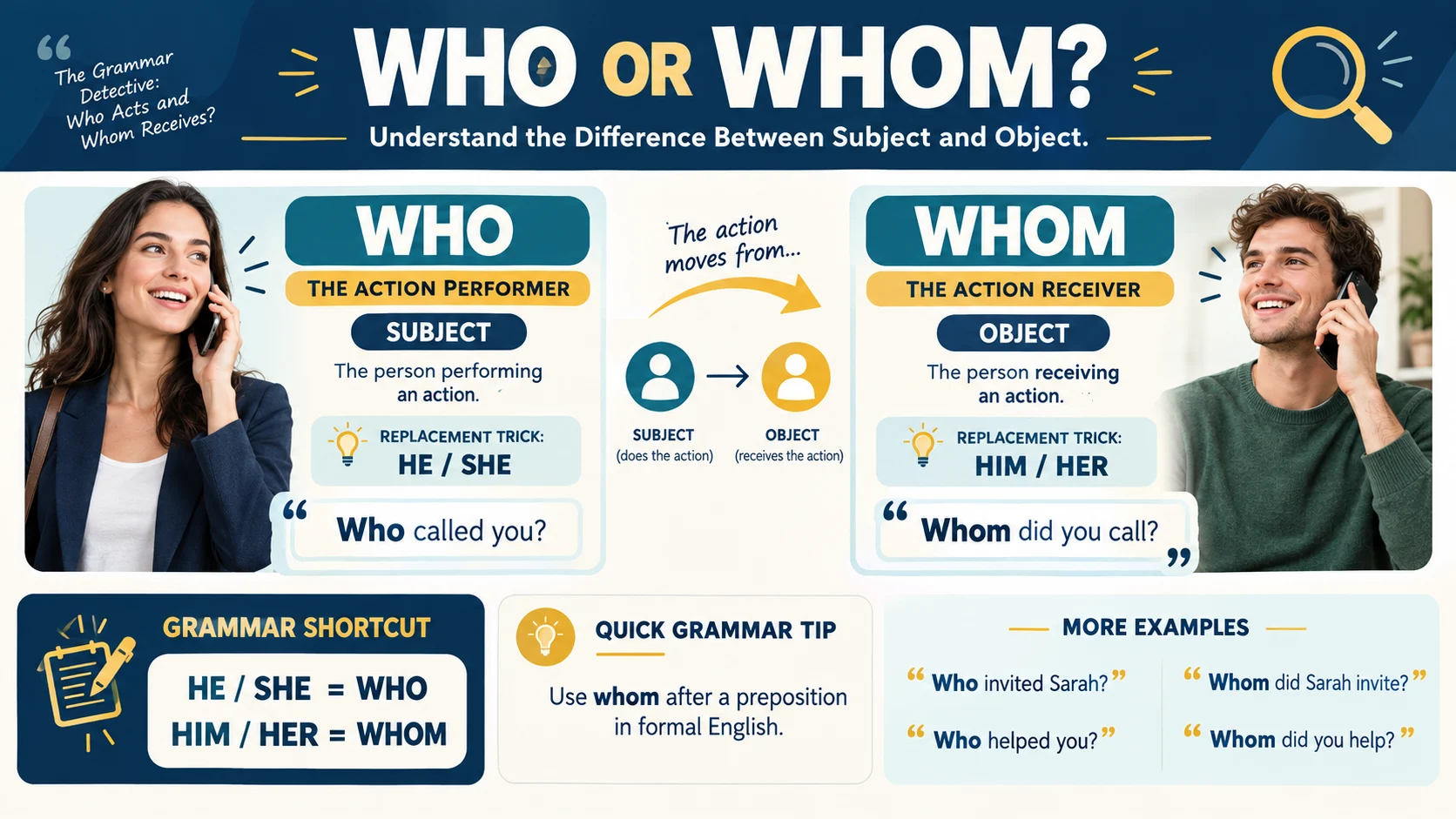
Use who when referring to the subject of a sentence, meaning the person performing an action. In contrast, use whom when referring to the object of a verb or preposition, meaning the person receiving an action. An easy trick is to replace the word with he or she for who, and him or her for whom. For example, “Who called you?” is correct, while “Whom did you call?” is correct in formal English.
Knowing when to use who or whom can make your writing clearer and more grammatically accurate. Although these two words look similar and both refer to people, they serve different grammatical purposes. Many English speakers use them interchangeably in everyday conversations. However, understanding their roles can help you avoid mistakes in professional writing, academic assignments, emails, and formal communication.
The main difference comes down to subject and object. Who identifies the person performing an action, while whom identifies the person receiving an action or following a preposition. For example, you would ask, “Who invited you?” because the person performs the action. On the other hand, you would ask, “Whom did you invite?” because the person receives the action.
Fortunately, you don’t need to memorize complicated grammar terminology to understand this rule. A simple replacement trick using he and him can help you choose the correct word in most situations. Moreover, practical examples and a little practice can make the difference much easier to remember.
In this guide, you’ll discover the meanings of both words, their grammatical differences, common usage rules, everyday examples, and simple ways to avoid confusion.
What Does Who Mean?
Who is a pronoun used to ask about or identify a person who performs an action or serves as the subject of a sentence.
In simple terms, use who when you want to know which person is doing something.
For example:
- Who opened the door?
- Who is your English teacher?
- Who wants to join us?
- Who wrote this article?
- Who called you yesterday?
In each example, who refers to the person performing the action or serving as the subject.
Furthermore, who can introduce a relative clause that provides additional information about someone.
For example:
- The woman who lives next door is a doctor.
- I know someone who speaks five languages.
- The student who won the competition received a scholarship.
In these sentences, who connects information about a person to the rest of the sentence.
What Does Whom Mean?
Whom is a pronoun used to refer to a person who receives an action or serves as the object of a verb or preposition.
In simpler words, use whom when someone does something to the person being discussed.
For example:
- Whom did you invite?
- Whom are you waiting for?
- To whom should I send this letter?
- Whom did the manager select?
- With whom are you traveling?
Here, the person referred to by whom receives the action or follows a preposition.
Additionally, whom often appears in formal writing, academic communication, and professional documents. Although it remains grammatically correct, many English speakers prefer who in casual conversations.
What Is the Difference Between Who and Whom?
The main difference between these words is their grammatical function.
Who acts as a subject, while whom acts as an object.
| Feature | Who | Whom |
|---|---|---|
| Grammatical role | Subject | Object |
| Refers to | Person performing an action | Person receiving an action |
| Replacement trick | He / She / They | Him / Her / Them |
| Common usage | Everyday and formal English | Mostly formal English |
| Example | Who called you? | Whom did you call? |
| Typical position | Subject of a clause | Object of a verb or preposition |
For example, compare these two sentences:
Who invited Sarah?
The person represented by who performs the action of inviting Sarah. Therefore, who is correct.
Whom did Sarah invite?
In this sentence, Sarah performs the action, while the person represented by whom receives it. Consequently, whom is correct in formal English.
Remember that the difference depends on the word’s role in the sentence, not simply its position.
The Easiest Trick to Remember Who or Whom
One of the easiest ways to understand when to use who or whom is the he/him replacement trick.
You don’t need to analyze an entire sentence or memorize complicated grammar rules. Instead, replace the word with either he or him.
- If he or she sounds correct, use who.
- If him or her sounds correct, use whom.
This method works because who functions like he or she, while whom functions like him or her.
Use the He or She Test for Who
Consider this question:
“Who called you?”
Try replacing who with he.
“He called you.”
The sentence makes sense. Therefore, who is the correct choice.
Here are more examples:
| Question | Replacement | Correct Word |
|---|---|---|
| Who is speaking? | He is speaking. | Who |
| Who opened the window? | She opened the window. | Who |
| Who wants coffee? | He wants coffee. | Who |
| Who helped you? | She helped you. | Who |
Use the Him or Her Test for Whom
Now consider this question:
“Whom did you call?”
Replace whom with him.
“You called him.”
The replacement makes sense. Therefore, whom is correct in formal grammar.
Consider these examples:
| Question | Replacement | Correct Word |
|---|---|---|
| Whom did you meet? | You met him. | Whom |
| Whom are you helping? | You are helping her. | Whom |
| To whom did you speak? | You spoke to him. | Whom |
| Whom did they choose? | They chose her. | Whom |
This trick is particularly useful when you are unsure about a question or a longer sentence.
When to Use Who in a Sentence
Use who whenever the person being discussed performs the action or serves as the subject of a clause.
Here are the main situations where who is appropriate.
When Someone Performs an Action
When a person does something, use who.
Examples:
- Who baked this cake?
- Who repaired your computer?
- Who sent the invitation?
- Who organized the meeting?
In each example, the unknown person performs the action.
When Asking About Someone’s Identity
Who is also used when asking for someone’s identity.
Examples:
- Who is your best friend?
- Who is that person?
- Who is responsible for this project?
- Who is your favorite actor?
In these questions, who identifies the person being discussed.
When Introducing a Relative Clause
Use who to provide additional information about a person.
Examples:
- The teacher who helped me was very kind.
- I met a woman who works at a hospital.
- The boy who won the race is my cousin.
- She knows a person who can solve this problem.
In each sentence, who introduces a clause that describes the person.
When Who Is the Subject of an Indirect Question
An indirect question does not always follow the usual question structure.
For example:
- I wonder who called you.
- Do you know who owns this house?
- Please tell me who made this decision.
- Nobody knows who started the argument.
Although these sentences are not direct questions, who remains the subject of the relevant clause.
When to Use Whom in a Sentence
Use whom when the person is the object of a verb or preposition.
Although whom sounds formal to many people, it remains an important part of traditional English grammar.
When Someone Receives an Action
If another person performs the action and the person being discussed receives it, use whom.
Examples:
- Whom did you invite to dinner?
- Whom did the teacher praise?
- Whom are they interviewing?
- Whom did your brother call?
For example, in “Whom did your brother call?” your brother performs the action of calling. The person receiving the call is the object.
After a Preposition
In formal English, use whom after prepositions such as to, with, for, about, by, and from.
Examples:
- To whom should I address this letter?
- With whom did you travel?
- For whom is this gift?
- About whom are you talking?
- From whom did you receive the message?
This is one of the clearest situations where whom is traditionally preferred.
When Whom Is the Object of an Indirect Question
Whom can also appear in indirect questions when it functions as an object.
Examples:
- I don’t know whom she invited.
- Tell me whom you contacted.
- We haven’t decided whom to hire.
- She asked whom they had selected.
Notice that the word’s grammatical function determines its use, even when it appears in the middle of a sentence.
Who or Whom in Questions
Choosing between who and whom in questions can be confusing because both words can appear at the beginning of a sentence.
However, the subject-object rule still applies.
Compare the following examples:
Who loves John?
The unknown person performs the action of loving. Therefore, who is correct.
Whom does John love?
John performs the action, and the unknown person receives it. Therefore, whom is correct in formal grammar.
More examples:
| Who Question | Whom Question |
|---|---|
| Who called you? | Whom did you call? |
| Who invited him? | Whom did he invite? |
| Who helped Sarah? | Whom did Sarah help? |
| Who selected the winner? | Whom did the judges select? |
| Who contacted the manager? | Whom did the manager contact? |
The easiest approach is to identify who performs the action before selecting your pronoun.
Who or Whom After Prepositions
Prepositions are another important part of this grammar rule.
In traditional formal English, whom follows a preposition when referring to its object.
Common prepositions include:
- To
- With
- For
- By
- About
- From
- Of
- Between
- Among
For example:
Correct: To whom are you speaking?
Incorrect in formal grammar: To who are you speaking?
Similarly:
Correct: With whom did you attend the event?
Incorrect in formal grammar: With who did you attend the event?
However, everyday American English often places the preposition at the end of a question and uses who.
For example:
- Who are you speaking to?
- Who did you attend the event with?
- Who are you waiting for?
These constructions are widely accepted in conversational English.
Therefore, formal writing generally favors whom after a preposition, while everyday conversation often favors who.
Who or Whom in Relative Clauses
Relative clauses provide additional information about people, places, or things.
When referring to people, who and whom can introduce these clauses depending on their grammatical roles.
Who as the Subject of a Relative Clause
Examples:
- The woman who teaches English is my aunt.
- I met a student who speaks French.
- The employee who completed the project received an award.
In each example, the person performs the action within the relative clause.
Whom as the Object of a Relative Clause
Examples:
- The woman whom I met was friendly.
- The student whom the teacher praised felt proud.
- The employee whom we hired starts Monday.
In these examples, the person receives the action.
Additionally, whom can be omitted in many relative clauses when it functions as an object.
For example:
- The woman I met was friendly.
- The student the teacher praised felt proud.
- The employee we hired starts Monday.
This omission is common and natural in modern English.
Who vs. Whom in Everyday American English
Although traditional grammar distinguishes between who and whom, everyday American English often favors who.
Many native speakers use who in situations where formal grammar traditionally expects whom.
For example:
Formal: Whom did you invite?
Casual: Who did you invite?
Both versions are commonly understood, but the first follows traditional formal grammar.
Similarly:
Formal: To whom should I speak?
Conversational: Who should I speak to?
Both are natural in their respective contexts.
However, this does not mean whom has disappeared. It remains useful in formal letters, professional writing, academic work, and situations where a polished tone is important.
The best choice depends on your audience and the level of formality you want to maintain.
Common Examples of Who and Whom
Understanding examples is one of the best ways to remember the difference.
Here are practical sentences from everyday life.
Using Who
- Who is coming to the party?
- Who made this delicious meal?
- Who wants to watch a movie?
- Who is your favorite singer?
- Who left the lights on?
- Who is responsible for this report?
- Who knows the answer?
- Who lives in that apartment?
- Who is calling my phone?
- Who won the football match?
Using Whom
- Whom did you invite to your wedding?
- Whom should I contact?
- Whom did the company hire?
- To whom does this bag belong?
- With whom are you working?
- Whom did she recommend?
- For whom did you buy these flowers?
- Whom are they waiting for?
- About whom were you talking?
- Whom did the principal congratulate?
In Workplace Communication
Professional communication often requires careful grammar.
For example:
- Who is leading the new project?
- Whom should I contact regarding the application?
- Who approved the final report?
- To whom should I send the documents?
- Who will attend the business meeting?
Using the correct pronouns can make your professional writing more polished.
Examples in School and Education
Students can also use these rules in academic writing.
Examples:
- Who wrote this textbook?
- Whom did the professor recommend?
- Who answered the question correctly?
- To whom should students submit their assignments?
- Who is teaching the mathematics class?
These examples demonstrate how the subject-object rule works in different situations.
Common Mistakes When Using Who or Whom
Even fluent English speakers sometimes confuse these pronouns. Fortunately, most mistakes happen because people focus on sentence structure rather than grammatical function.
Here are common errors and their corrections.
| Incorrect Sentence | Correct Sentence | Explanation |
|---|---|---|
| Whom called you? | Who called you? | The person performs the action. |
| Who did you invite? | Whom did you invite? | Traditional formal grammar uses whom as the object. |
| To who should I speak? | To whom should I speak? | Whom follows the preposition to. |
| The man whom helped me is kind. | The man who helped me is kind. | The person performs the action. |
| Who did Sarah select? | Whom did Sarah select? | Whom is the object in formal grammar. |
| The person who I met was friendly. | The person whom I met was friendly. | Whom is the formal object form. |
Mistake: Choosing Whom Because It Sounds Formal
Some writers assume whom is always more professional. However, using it incorrectly can make a sentence grammatically awkward.
For example:
Incorrect: Whom is responsible for this project?
Correct: Who is responsible for this project?
The person performs the role or action in the sentence, so who is appropriate.
Mistake: Ignoring the Verb
Another common mistake is choosing a pronoun based on the word closest to it.
For example:
Incorrect: Who did you say called?
Correct: Who did you say called?
The sentence is actually correct because who is the subject of called, even though you appears earlier.
Therefore, always identify the grammatical role of the pronoun within its own clause.
Mistake: Assuming Every Question Needs Whom
Questions do not automatically require whom.
For example:
- Who is your teacher?
- Who wants lunch?
- Who opened the window?
All three sentences require who because the pronoun acts as the subject.
Advantages and Disadvantages of Using Who and Whom Correctly
Understanding the difference between these words offers several benefits. Nevertheless, using whom in every informal conversation can sometimes sound unnecessarily formal.
Advantages
Improves Grammar: Knowing the subject-object distinction helps you construct accurate sentences.
Strengthens Professional Writing: Correct usage can make business emails, reports, and formal documents more polished.
Builds Confidence: You can communicate more confidently when asking questions or writing about people.
Supports Academic Writing: Students can avoid common pronoun errors in essays and assignments.
Improves Language Understanding: Learning this distinction also helps you understand other subject and object pronouns.
Disadvantages
Can Feel Complicated: Beginners may find the subject-object rule difficult at first.
Sounds Formal in Casual Speech: Whom can feel stiff or unnatural in relaxed conversations.
Requires Sentence Analysis: Sometimes, you must examine an entire clause to identify the correct pronoun.
Less Common in Everyday Conversation: Many native speakers prefer who in informal situations.
Despite these minor challenges, learning both forms gives you more control over your English.
How to Remember When to Use Who or Whom
If you frequently confuse these words, a few simple techniques can help.
Remember He and Him: Use who when he or she fits. Use whom when him or her fits.
Identify the Action: Ask yourself who performs the action and who receives it.
Check for Prepositions: In formal English, whom commonly follows prepositions.
Read the Sentence Aloud: Sometimes, hearing the sentence can help you recognize an awkward construction.
Practice with Short Questions: Start with simple examples before moving to longer sentences.
For example:
- Who called? He called.
- Whom did you call? You called him.
- Who helped her? She helped her.
- Whom did she help? She helped him.
With regular practice, these patterns become easier to recognize.
Who or Whom: Quick Comparison
| Situation | Correct Choice | Example |
|---|---|---|
| Asking who performs an action | Who | Who opened the door? |
| Asking who receives an action | Whom (formal) | Whom did you invite? |
| Before a verb as its subject | Who | Who wants to participate? |
| After a preposition in formal English | Whom | To whom did you write? |
| Introducing a subject relative clause | Who | The girl who won is my sister. |
| Introducing an object relative clause | Whom | The girl whom I met is kind. |
| Casual conversation | Often who | Who are you talking to? |
Related Grammar Comparisons
Understanding other commonly confused words can further improve your English grammar.
Who vs. Whose
Who asks about a person’s identity, while whose asks about ownership or possession.
Examples:
- Who is standing outside?
- Whose phone is ringing?
Remember that whose indicates possession, not the object form of who.
Who vs. Which
Who generally refers to people, while which identifies or asks about a particular person or thing from a group, depending on the context.
Examples:
- Who is your teacher?
- Which teacher teaches mathematics?
Who vs. That
Both who and that can introduce relative clauses referring to people.
Examples:
- The woman who lives here is friendly.
- The woman that lives here is friendly.
However, who is generally preferred for people in formal and polished writing.
Whom vs. Whose
Whom refers to an object, whereas whose expresses possession.
Examples:
- Whom did you call?
- Whose car is parked outside?
These words serve different grammatical purposes, even though they look similar.
Practice Exercises: Who or Whom?
Now that you understand the rules, test your knowledge with these exercises. Choose the correct word for each sentence.
Fill in the Blanks
Choose who or whom to complete each sentence.
- _____ is your favorite teacher?
- _____ did you invite to the celebration?
- _____ wants to join our team?
- To _____ should I send this email?
- _____ helped you with your homework?
- _____ did the manager select?
- _____ is knocking at the door?
- With _____ are you traveling?
- _____ wrote this beautiful poem?
- For _____ did you prepare this gift?
- _____ is responsible for the mistake?
- _____ are they waiting for?
- The student _____ won the competition is my friend.
- The person _____ I contacted was helpful.
- Do you know _____ organized the event?
Answers and Explanations
Who is correct in questions where the person performs the action or acts as the subject.
Whom is traditionally correct when the person receives an action or follows a preposition.
| Question | Correct Answer | Explanation |
|---|---|---|
| 1 | Who | Subject of is |
| 2 | Whom | Object of invited |
| 3 | Who | Subject of wants |
| 4 | Whom | Object of to |
| 5 | Who | Subject of helped |
| 6 | Whom | Object of selected |
| 7 | Who | Subject of is knocking |
| 8 | Whom | Object of with |
| 9 | Who | Subject of wrote |
| 10 | Whom | Object of for |
| 11 | Who | Subject of is |
| 12 | Whom | Object of for |
| 13 | Who | Subject of won |
| 14 | Whom | Object of contacted |
| 15 | Who | Subject of organized |
For questions 2 and 6, who is also common in informal American English. However, whom is the traditional formal choice.
Frequently Asked Questions
Is it who or whom in a sentence?
The correct choice depends on grammatical function. Use who for the subject performing an action and whom for the object receiving an action or following a preposition. For example, “Who called you?” and “Whom did you call?” are traditionally correct.
Is whom more formal than who?
Yes. Whom generally sounds more formal than who, especially in professional writing, academic communication, and traditional grammar. However, both words are grammatically correct when used in their appropriate roles.
Can I use who instead of whom?
In everyday American English, who frequently replaces whom in informal questions and conversations. For example, “Who did you invite?” is widely accepted in casual speech. Nevertheless, whom remains the preferred traditional form in formal grammar when it functions as an object.
How do I know whether to use who or whom?
Use the he/him trick. If you can replace the word with he or she, choose who. If him or her works, choose whom. For example, “Who called?” becomes “He called,” while “Whom did you call?” becomes “You called him.”
Is it who or whom did you meet?
In traditional formal grammar, whom did you meet is correct because the person receives the action of meeting. However, “Who did you meet?” is very common and acceptable in informal American English.
Is it who or whom should I contact?
Both forms can appear in different sentence structures.
- “Whom should I contact?” is traditionally correct because whom is the object of contact.
- “Who should I contact?” is widely accepted in everyday English.
The second version sounds more natural in most casual conversations.
Is it to who or to whom?
To whom is the traditional formal construction because whom follows the preposition to. For example, “To whom should I address this letter?” is appropriate in formal writing. In everyday conversation, people commonly say, “Who should I address this letter to?”
Can whom be used at the beginning of a sentence?
Yes. Whom can begin a question when it functions as the object of a verb or preposition.
For example:
- Whom did you invite?
- Whom are they interviewing?
- Whom should we choose?
Its position does not change its grammatical function.
Is who ever or whoever correct?
Whoever is a single word used to refer to any person who meets a particular condition. For example, “Whoever finishes first will win.” The expression who ever can also appear in special emphatic questions, but it has a different meaning.
Is whom still used in modern English?
Yes. Although whom is less common in everyday conversation, it remains part of modern English. Writers still use it in formal documents, professional communication, academic writing, and constructions following prepositions.
Key Takeaways: Who or Whom
Understanding the difference between who and whom becomes easier when you focus on the subject and object of a sentence.
Here are the most important points to remember:
- Who refers to the person performing an action.
- Whom refers to the person receiving an action.
- Use who when he or she fits in the sentence.
- Use whom when him or her fits.
- In formal English, use whom after prepositions.
- Everyday American English often favors who in casual conversations.
- Always consider the grammatical role instead of relying only on sentence position.
Conclusion
Learning when to use who or whom doesn’t have to be difficult. The key is understanding the difference between a subject and an object. Use who when referring to the person performing an action, and choose whom when referring to the person receiving an action or following a preposition in formal English.
The he/him replacement trick makes this distinction easier to remember. Furthermore, recognizing how these words work in questions, relative clauses, and everyday conversations will help you avoid common grammar mistakes.
Although whom is less common in casual American English, it still has an important place in formal writing. Therefore, knowing both forms allows you to communicate naturally while maintaining grammatical accuracy. With a little practice, choosing between who and whom will become much easier.