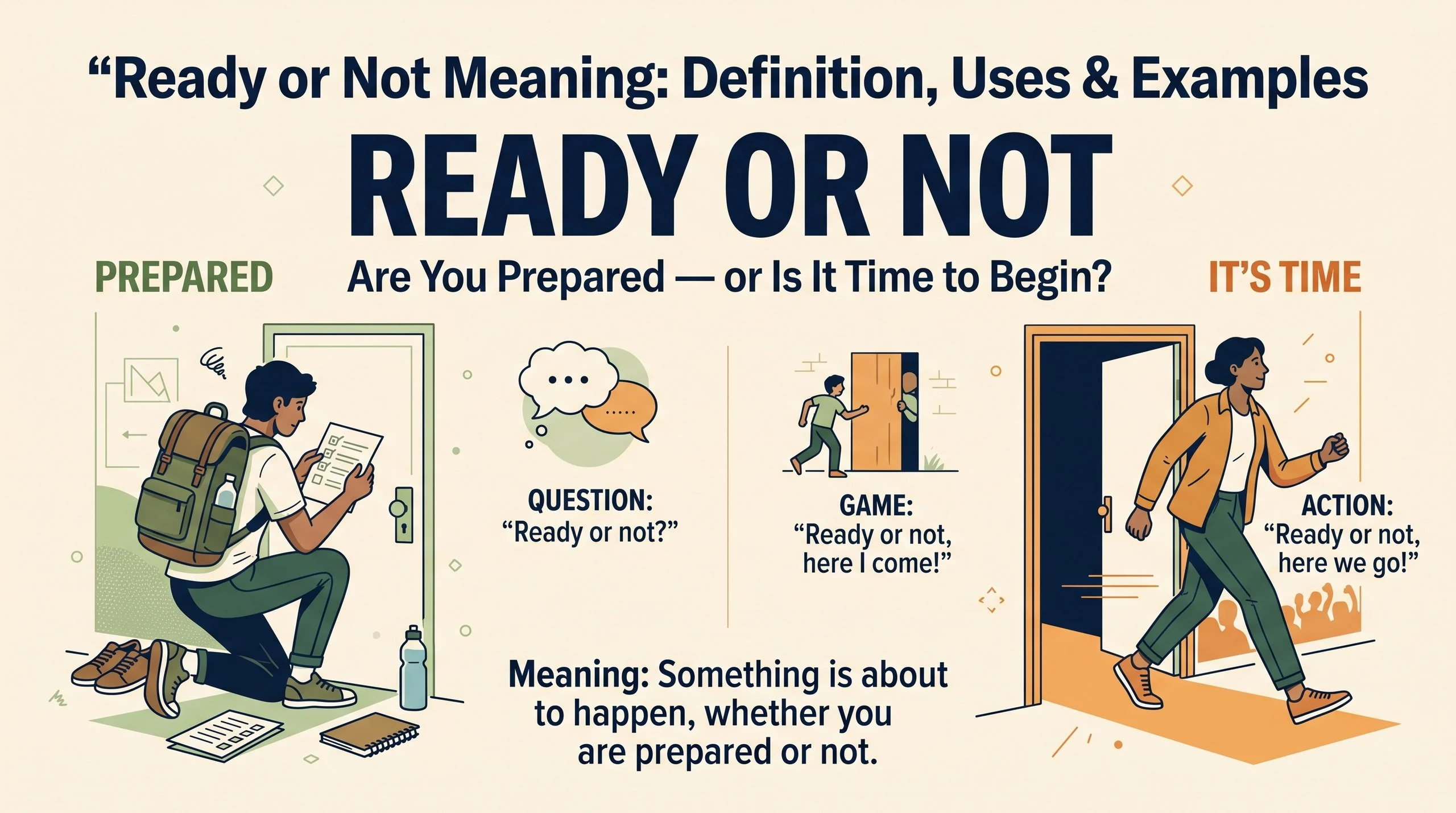
Ready or not is a phrase used to ask whether someone is prepared for something or to announce that something is about to begin whether the person is prepared or not. It can be serious, playful, teasing, or dramatic depending on the context. The phrase is especially common in games, casual conversations, challenges, and messages.
The phrase ready or not means that something is about to happen and asks whether a person is prepared for it. It can be a simple question, such as “Are you ready or not?” or an expression announcing that an event will begin regardless of someone’s preparation.
For example, a parent might say, “Ready or not, we’re leaving in five minutes.” A friend might text, “Ready or not, here I come!” during a game of hide-and-seek. Someone preparing for an exciting event might also say, “Ready or not, it’s time to begin.”
The expression is flexible because its meaning depends heavily on context and tone. In a serious situation, it may emphasize urgency or preparation. It can create suspense and excitement in a playful situation. In texting, it may be used to tease someone, encourage them, or announce that the sender is about to do something.
This guide explains the ready or not meaning, its grammar, common uses, texting interpretations, examples, synonyms, related expressions, and differences between similar phrases.
Ready or Not Meaning
| Aspect | Explanation | Example |
|---|---|---|
| Basic meaning | Are you prepared, or will something happen anyway? | “Ready or not, we’re leaving.” |
| Question form | Asking whether someone is prepared | “Ready or not?” |
| Announcement | Something is about to happen | “Ready or not, here we go!” |
| Playful use | Creates suspense or excitement | “Ready or not, I’m coming!” |
| Serious use | Emphasizes urgency | “Ready or not, the meeting starts now.” |
| Texting use | Teasing, challenging, or announcing | “Ready or not 😏” |
What Does Ready or Not Mean?
Ready or not literally presents two possibilities: a person is either prepared or unprepared. However, the phrase often carries an additional meaning: something is going to happen whether the person is ready for it or not.
Consider this sentence:
“Ready or not, we’re leaving.”
The speaker is not necessarily asking a question. Instead, they are saying that departure is happening regardless of whether the listener feels completely prepared.
The phrase can therefore express:
- Preparation
- Urgency
- Determination
- Excitement
- Playfulness
- Suspense
- An unavoidable change or event
The surrounding words usually make the intended meaning clear.
Ready or Not as a Question
When someone simply asks, “Ready or not?” they are usually asking whether you are prepared.
For example:
Alex: Ready or not?
Sam: Give me one more minute!
Here, the speaker genuinely wants to know whether Sam is prepared.
Ready or Not as an Announcement
The phrase can also introduce an event that is about to happen.
For example:
“Ready or not, the show is starting.”
In this sentence, the speaker means that the show will begin even if someone is still getting prepared.
Ready or Not as a Challenge
Friends often use the expression when challenging one another.
For example:
“Ready or not, I’m sending the photo!”
This can create a playful sense of suspense.
What Does Ready or Not Mean in Texting?
In texting, ready or not often means that the sender is about to do something and expects the recipient to react quickly. It can be playful, teasing, exciting, or slightly challenging.
The exact interpretation depends on the conversation.
1. “Ready or Not?” as a Simple Question
Someone may text:
“Ready or not?”
They may simply want to know whether you are prepared to leave, start a game, join a call, or begin an activity.
A natural response could be:
“Almost! Give me five minutes.”
2. “Ready or Not” as a Tease
A friend might text:
“Ready or not… 👀”
This can create suspense. The sender may be preparing to reveal something, send a photo, arrive somewhere, or start a joke.
The ellipsis and emoji can make the message feel more playful.
3. “Ready or Not, Here I Come”
This is strongly associated with games such as hide-and-seek.
Someone may also use it jokingly in a message when they are approaching or arriving.
For example:
“Ready or not, here I come 😂”
The sender is usually being playful rather than making a serious announcement.
4. “Ready or Not” Before a Big Event
Someone might text:
“Ready or not, tomorrow is the big day!”
Here, the phrase expresses excitement and anticipation. It suggests that the event is approaching quickly.
5. “Ready or Not” as Motivation
A friend may say:
“Ready or not, we’re finally starting!”
In this case, the phrase encourages everyone to stop waiting and begin.
Is Ready or Not a Question?
It can be.
When written as “Ready or not?”, it functions as a shortened question meaning:
“Are you ready or not?”
The full version is grammatically clearer, while the shorter version is more conversational.
However, when used in a sentence such as:
“Ready or not, we’re going.”
it is not functioning as a normal question. Instead, it introduces a condition meaning “whether you are ready or not.”
This distinction is important because punctuation and context can change the function of the phrase.
Ready or Not Grammar Explained
The expression is often used as a shortened form of:
“Whether you are ready or not.”
For example:
Full form: Whether you are ready or not, we have to leave.
Shorter form: Ready or not, we have to leave.
The shorter construction sounds more natural in everyday speech.
“Ready or Not” at the Beginning of a Sentence
This is one of the most common structures.
“Ready or not, the game is starting.”
“Ready or not, we’re heading out.”
“Ready or not, it’s time to make a decision.”
A comma usually follows the introductory phrase.
“Are You Ready or Not?”
This is the direct question form.
“Are you ready or not?”
It asks the listener to give a clear answer.
Depending on tone, it can sound:
- Friendly
- Impatient
- Playful
- Urgent
- Challenging
“Whether You’re Ready or Not”
This is a more explicit version of the same idea.
“Whether you’re ready or not, we need to go.”
It is particularly useful when you want to emphasize that the event will happen regardless of someone’s preparation.
Ready or Not Examples in Everyday Conversations
Example 1: Leaving Home
Mom: Ready or not, we’re leaving in five minutes.
Son: I’m putting my shoes on now!
Here, the phrase communicates urgency.
Example 2: Starting a Game
- Friend 1: Ready or not?
- Friend 2: Ready!
- Friend 1: Let’s go!
Here, it is a straightforward question.
Example 3: Hide-and-Seek
Player: Ready or not, here I come!
This is a classic playful use of the phrase.
Example 4: Starting a Presentation
Teacher: Ready or not, we’re beginning the presentations.
The expression suggests that the activity is starting whether everyone feels completely prepared or not.
Example 5: A New Challenge
Friend: Ready or not, we’re trying the new restaurant tonight.
You: Okay, I’m in!
Here, the phrase creates excitement around a new experience.
Example 6: A Major Change
“Ready or not, a new chapter is beginning.”
This use is more figurative. It suggests that an important change is arriving and must be faced.
Ready or Not in Different Contexts
The phrase changes slightly depending on where and how it is used.
Ready or Not in Casual Conversation
Friends and family commonly use it to encourage action.
Examples include:
- “Ready or not, let’s go.”
- “Ready or not, dinner is served.”
- “Ready or not, we’re starting.”
- “Ready or not, here comes the surprise.”
The tone is usually informal.
Ready or Not at Work
In professional settings, the phrase can emphasize a deadline or unavoidable event.
For example:
“Ready or not, the presentation starts at 9 a.m.”
However, it can sound too casual or forceful in some professional situations. A more neutral alternative might be:
“The presentation starts at 9 a.m., so please be prepared.”
Therefore, consider your audience before using the expression at work.
Ready or Not in Games
Games provide one of the most natural settings for the phrase.
It can announce the start of a round, challenge another player, or create suspense.
For example:
“Ready or not, round two starts now!”
Ready or Not in Social Media Captions
The expression works well in captions because it creates anticipation.
Examples:
- “Ready or not, here we go.”
- “Ready or not, a new chapter begins.”
- “Ready or not, vacation starts tomorrow.”
- “Ready or not, it’s finally happening.”
The phrase is especially effective when announcing a change, event, trip, project, or personal milestone.
What Does “Ready or Not, Here I Come” Mean?
“Ready or not, here I come” is a familiar expression traditionally associated with hide-and-seek.
After giving others time to hide, the seeker announces that they are coming to look for them. The phrase means something like:
“Whether you are ready or not, I am coming now.”
In modern conversation, people may use it figuratively.
For example:
“Ready or not, here I come to your office!”
A friend could say this jokingly before arriving.
It can also be used metaphorically to announce that someone is entering a new situation.
“Ready or not, here comes the next chapter of my life.”
In this context, the phrase creates a sense of excitement and inevitability.
What Does “Ready or Not, Here We Go” Mean?
“Ready or not, here we go” means that something is about to begin.
It often combines excitement with the idea that there is no reason to wait any longer.
Examples:
“Ready or not, here we go!”
“The competition starts tomorrow. Ready or not, here we go.”
“I’ve packed everything. Ready or not, here we go!”
The expression can be serious or playful depending on the situation.
What Does “Ready or Not, It’s Happening” Mean?
This expression emphasizes that an event is definitely going to happen.
For example:
“Ready or not, it’s happening tomorrow.”
The speaker is saying that preparation may not be perfect, but the event is no longer being delayed.
It can communicate excitement, nervousness, determination, or acceptance.
Ready or Not vs. Are You Ready?
These expressions are related but not identical.
| Expression | Meaning | Typical Tone |
|---|---|---|
| Are you ready? | Directly asks whether someone is prepared | Neutral |
| Ready? | Short, casual version | Informal |
| Ready or not? | Asks whether someone is prepared, often with urgency or playfulness | Casual |
| Ready or not, let’s go. | Says the activity will begin regardless of preparation | Determined |
| Whether you’re ready or not | Emphasizes that something will happen regardless | Neutral or serious |
“Are you ready?” is usually the most straightforward option. “Ready or not” adds a stronger sense of urgency, suspense, or inevitability.
Ready or Not Synonyms and Similar Expressions
There is no single synonym that perfectly replaces ready or not in every situation. The best alternative depends on what you want to communicate.
When Asking About Preparation
You can say:
- Are you ready?
- Are you prepared?
- Are you set?
- Good to go?
- Are we ready?
- All set?
For example:
“Are you ready to leave?”
can become:
“Are you all set to leave?”
When Emphasizing Inevitability
You can use:
- Whether you’re ready or not
- Here we go
- It’s time
- We’re starting now
- It’s happening
- There’s no waiting now
For example:
“Ready or not, we’re starting.”
can become:
“Whether you’re ready or not, we’re starting.”
When Creating Excitement
Similar expressions include:
- Here we go!
- Let’s do this!
- It’s showtime!
- Game on!
- Bring it on!
- Let’s get started!
These alternatives are more energetic and may not carry exactly the same meaning.
Is Ready or Not Positive or Negative?
The phrase itself is neutral. Its emotional meaning depends on context.
- It can sound positive when used to express excitement:
“Ready or not, vacation starts tomorrow!”
- It can sound neutral:
“Ready or not, the meeting begins at nine.”
- It can sound slightly negative or forceful:
“Ready or not, you’re coming with us.”
Tone, relationship, and circumstances determine how the listener interprets it.
Does Ready or Not Mean Hurry Up?
Not necessarily.
Sometimes ready or not implies urgency, but it does not always mean “hurry up.”
For example:
“Ready or not, here I come!”
does not necessarily tell someone to hurry. It announces that the speaker is beginning something.
Similarly:
“Ready or not, the new year is coming.”
is about inevitability rather than speed.
If someone specifically wants you to move faster, they might say:
- “Hurry up.”
- “Get ready.”
- “We need to leave.”
- “We’re running late.”
Therefore, context is important.
Is “Ready or Not” Rude?
Usually, no. The phrase is not inherently rude.
However, it can sound demanding if someone uses it to pressure another person.
Compare these examples:
“Ready or not? 😂”
This sounds playful.
“Ready or not, we’re leaving now.”
This sounds firm.
“Ready or not, you have to do it.”
This may sound controlling or dismissive.
If you are speaking to someone who needs additional time, a gentler phrase may be better.
For example:
“Are you almost ready?”
or:
“Let me know when you’re ready.”
How to Respond to “Ready or Not?”
Your response can depend on whether you are prepared.
If You Are Ready
You can say:
- “Ready!”
- “I’m ready.”
- “Let’s go!”
- “All set.”
- “Good to go.”
- “Absolutely!”
If You Need More Time
Try:
- “Almost!”
- “Give me a minute.”
- “Not quite.”
- “I need five more minutes.”
- “Almost ready.”
If You Are Unsure
You can say:
- “I’m not sure yet.”
- “Give me a little more time.”
- “I need to prepare first.”
- “Almost, but not quite.”
These responses make your situation clear without creating confusion.
Common Mistakes With Ready or Not
Mistake 1: Treating It Only as a Question
“Ready or not” does not always ask for an answer.
Compare:
“Ready or not?”
with:
“Ready or not, we’re leaving.”
The first asks about preparation. The second announces an action.
Mistake 2: Ignoring Context
The phrase can be playful, serious, urgent, or dramatic. Do not automatically assume that someone is angry when they use it.
Mistake 3: Using It in Every Professional Situation
Although grammatically correct, the expression can sound informal. In formal communication, “Please be prepared” may be more appropriate.
Mistake 4: Confusing It With “Already”
“Ready” and “already” have completely different meanings.
- Ready: prepared.
- Already: by this time or previously.
For example:
“Are you ready?”
means “Are you prepared?”
“Are you already here?”
means “Did you arrive before now?”
Frequently Asked Questions
What does ready or not mean?
Ready or not means that someone is either prepared or unprepared, often with the additional idea that something is about to happen regardless of their level of preparation.
What does ready or not mean in texting?
In texting, ready or not can ask whether someone is prepared, tease them, announce an upcoming action, or create suspense.
What does “ready or not, here I come” mean?
It means that the speaker is coming regardless of whether the other person is prepared. It is traditionally associated with hide-and-seek and is often used playfully.
Is ready or not a question?
“Ready or not?” is a shortened question meaning “Are you ready or not?” However, “Ready or not, we’re leaving” is an introductory expression rather than a direct question.
Is ready or not grammatically correct?
Yes. “Ready or not” is a natural English expression. It is often a shortened form of “whether you are ready or not.”
What is another way to say ready or not?
Depending on the context, alternatives include “Are you ready?”, “Are you all set?”, “Whether you’re ready or not,” “Here we go,” and “It’s time.”
Does ready or not mean hurry up?
Not always. It can imply urgency, but it often simply announces that something is beginning or creates suspense.
Is ready or not rude?
The phrase is not inherently rude. Its tone depends on context. It can be playful, friendly, neutral, or forceful.
What is the difference between ready and prepared?
Both words can describe someone who is equipped or able to do something. “Ready” is generally more common in everyday conversation, while “prepared” can sound more formal or emphasize prior preparation.
How should I reply to “Ready or not?”
If you are prepared, you can say “Ready!” or “I’m all set.” If you need more time, say “Almost” or give the person a realistic amount of time you need.
Key Takeaways
- Ready or not asks whether someone is prepared or emphasizes that something will happen regardless of their preparation.
- “Ready or not?” is a shortened version of “Are you ready or not?”
- “Ready or not, we’re leaving” means the departure will happen whether everyone is prepared or not.
- The phrase is common in games, casual conversations, texting, captions, and announcements.
- “Ready or not, here I come” is strongly associated with hide-and-seek.
- Tone determines whether the expression sounds playful, exciting, urgent, or forceful.
- The phrase is not automatically rude or negative.
- In formal situations, “Please be prepared” may be more appropriate.
- If you need more time, you can respond with “Almost,” “Not quite,” or a specific time.
- Context is essential because the same phrase can function as a question or an announcement.
Conclusion
The ready or not meaning is simple but surprisingly flexible. At its most basic level, the phrase asks whether someone is prepared. In another common use, it communicates that something is about to happen whether the person is fully prepared or not.
You might hear it before a game, see it in a text message, use it before starting an exciting activity, or encounter it when someone announces an unavoidable change. Its tone can range from playful and humorous to urgent and serious.
The most familiar example, “Ready or not, here I come,” creates suspense and is traditionally connected with hide-and-seek. Meanwhile, expressions such as “Ready or not, here we go” and “Ready or not, it’s happening” use the same idea to communicate excitement and inevitability.
Ultimately, understanding the context makes the phrase easy to interpret. When someone asks “Ready or not?”, they may simply want to know whether you are prepared. When someone says “Ready or not, we’re going,” they are telling you that it is time to move forward.