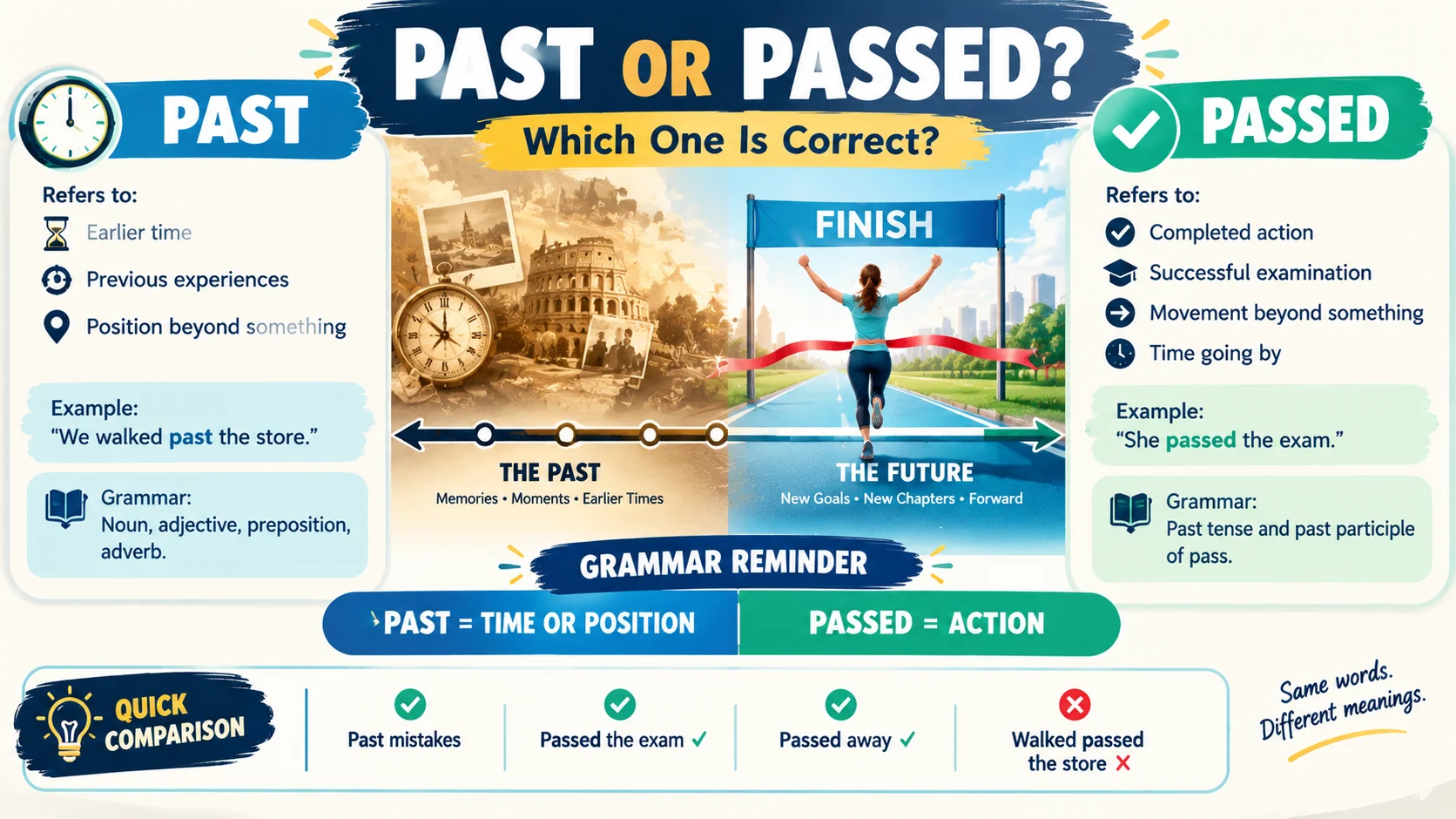
Past and passed are two different English words with different grammatical functions. Past usually refers to an earlier time, something that has already happened, or a position beyond something. In contrast, passed is the past tense and past participle of the verb pass, meaning to move beyond something, succeed in an exam, or go by. For example, “We walked past the store” and “She passed her exam” are both correct.
Have you ever wondered whether to write past or passed when describing something that happened earlier or someone moving beyond a particular place? These two words sound exactly alike, which makes them easy to confuse in everyday writing. However, their meanings and grammatical functions are different. Understanding the difference between past or passed can help you avoid common spelling mistakes and communicate more clearly.
The word past generally refers to an earlier period, a previous experience, or something located beyond a particular point. On the other hand, passed is a verb form that describes an action, such as moving forward, completing an exam successfully, or allowing time to go by. Although both words are pronounced the same way, you cannot use them interchangeably.
For example, you might say, “We drove past the school” when describing movement beyond a building. However, “We passed the school” is also correct because passed describes the action of moving beyond it. In this guide, you’ll discover their meanings, grammatical differences, practical examples, common mistakes, and simple tricks to remember when to use each word correctly.
What Is the Difference Between Past and Passed?
The main difference between past and passed is their grammatical role. Although they share the same pronunciation, one usually describes time, position, or a previous situation, while the other describes an action.
Past can function as a noun, adjective, preposition, or adverb. It commonly refers to something that happened before the present moment or a location beyond a particular point.
Passed, however, is the simple past tense and past participle of the verb pass. It describes an action that has already happened.
Consider these examples:
- “I learned a lot from my past.” Here, past is a noun referring to previous experiences.
- “She passed the driving test.” In this sentence, passed is a verb describing a successful result.
- “We walked past the restaurant.” Here, past is a preposition describing location or movement.
- “The bus passed our house.” In this example, passed is a verb describing movement.
Therefore, the correct choice depends on what you want to communicate. If you are describing time, position, or something previous, use past. If you are describing an action involving the verb pass, use passed when referring to the past.
What Does Past Mean?
Past refers to a time before the present, a previous event, or something that exists beyond a particular point. It can also describe experiences, memories, historical events, and earlier stages of life.
Unlike passed, this word is not a verb form. Instead, it performs several grammatical functions depending on how it appears in a sentence.
Past as a Noun
As a noun, past refers to a period or events that have already happened.
Examples:
- “We cannot change the past.”
- “She often talks about her childhood past.”
- “His past taught him valuable lessons.”
- “The past is full of important memories.”
- “They wanted to forget their troubled past.”
In each example, the word refers to an earlier time or previous experiences.
Past as an Adjective
As an adjective, past describes something that belonged to an earlier period or is no longer current.
Examples:
- “We discussed our past experiences.”
- “The past president attended the ceremony.”
- “Her past mistakes helped her grow.”
- “They reviewed the past year’s results.”
- “He learned from his past relationships.”
Here, the word provides information about something that existed or happened previously.
Past as a Preposition
As a preposition, past describes movement or position beyond a particular place, person, or point.
Examples:
- “She walked past the library.”
- “The car drove past our house.”
- “We went past the shopping center.”
- “He ran past the finish line.”
- “The restaurant is just past the bridge.”
In these sentences, past indicates a position beyond something or movement alongside and beyond it.
Past as an Adverb
As an adverb, past describes movement beyond a point or something continuing beyond a particular time.
Examples:
- “The train went past.”
- “We drove past without stopping.”
- “The deadline is already past.”
- “She looked past and kept walking.”
Consequently, understanding these different uses makes it easier to recognize when past is the correct choice.
What Does Passed Mean?
Passed is the simple past tense and past participle of the verb pass. It describes an action that has already occurred.
Depending on the sentence, it can mean moving beyond something, successfully completing a test, transferring something, or allowing time to go by.
For example:
- “He passed the examination.”
- “The bus passed our car.”
- “Three hours passed before she arrived.”
- “She passed the message to her friend.”
- “My grandfather passed away peacefully.”
Unlike past, this word always relates to the verb pass.
Passed as a Past-Tense Verb
When describing an action that happened previously, use passed as the simple past tense.
Examples:
- “I passed the grocery store yesterday.”
- “She passed me on the highway.”
- “They passed the ball to their teammate.”
- “He passed the entrance examination.”
- “The afternoon passed quickly.”
Passed as a Past Participle
The word passed also works as a past participle. It commonly appears with helping verbs such as has, have, and had.
Examples:
- “She has passed her final exam.”
- “They have passed the first stage.”
- “He had passed the interview before receiving the offer.”
- “Several weeks have passed since our last meeting.”
Thus, remember that passed is a verb form, regardless of whether it appears in the simple past or present perfect tense.
Past vs. Passed: Quick Comparison
| Feature | Past | Passed |
|---|---|---|
| Pronunciation | /pæst/ | /pæst/ |
| Main meaning | Earlier time or beyond a point | Completed action of passing |
| Part of speech | Noun, adjective, preposition, adverb | Verb |
| Verb form | Not a form of pass | Past tense and past participle |
| Refers to time | Yes | Sometimes, when time goes by |
| Refers to movement | Can describe position or direction | Describes the action of moving |
| Example | “Think about the past.” | “She passed the test.” |
The easiest distinction: Past describes a time or position, whereas passed describes an action.
When to Use Past or Passed
Choosing between these words becomes easier when you understand the purpose of your sentence.
Use Past When Talking About Time
When referring to something that happened before the present, past is generally the correct choice.
Examples:
- “We enjoyed our past vacations.”
- “The past few days have been stressful.”
- “She remembers her past very clearly.”
- “It happened sometime in the past.”
- “We discussed the events of the past decade.”
Moreover, common time expressions include past experiences, past events, past mistakes, and past years.
Use Past When Describing a Position
When something is located beyond a particular place, use past as a preposition.
Examples:
- “The bank is past the traffic lights.”
- “Walk past the pharmacy and turn left.”
- “Our house is just past the bridge.”
- “The hotel is past the main entrance.”
In these sentences, the word describes where something is located.
Use Passed When Describing Movement
When someone or something moves beyond a particular point, passed can describe that completed action.
Examples:
- “The runner passed the other competitors.”
- “A truck passed our vehicle.”
- “She passed the building on her way home.”
- “The cyclist passed me on the road.”
Notice that these sentences describe actions performed by a person or object.
Use Passed When Talking About Exams
When someone successfully completes an examination, use passed.
Examples:
- “I passed my English test.”
- “She passed her driving examination.”
- “They passed the final assessment.”
- “He finally passed the certification exam.”
However, use past when referring to previous examinations or experiences.
Use Passed When Talking About Time Going By
The verb pass can also describe time moving forward.
Examples:
- “Two hours passed before the meeting started.”
- “The days passed quickly.”
- “Several months have passed since graduation.”
- “Time passed without anyone noticing.”
This is an important distinction because both words can appear in sentences about time.
Past or Passed in Common Expressions
Some expressions are especially easy to confuse. Therefore, learning their correct forms can improve your everyday writing.
Past or Passed Away
The correct expression is passed away.
It is a polite and gentle way to say that someone has died.
Examples:
- “Her grandfather passed away last year.”
- “The actor passed away peacefully.”
- “His beloved dog passed away yesterday.”
Never write “past away” when referring to someone’s death.
Past or Passed the Time
Both words can appear in expressions about time, but their meanings differ.
- “It is past midnight.” This describes a time later than midnight.
- “Two hours passed.” This describes time moving forward.
- “We talked about the past.” This refers to an earlier period.
Past or Passed the Store
Both forms can be correct, depending on the sentence.
- “We walked past the store.” Here, past acts as a preposition.
- “We passed the store.” Here, passed is the verb describing the action.
Both sentences communicate that someone moved beyond the store.
Past or Passed the Deadline
The correct choice depends on the intended meaning.
- “The deadline is past.” This means the deadline has already gone by.
- “The deadline passed yesterday.” This describes the deadline passing.
- “We passed the deadline.” This is less natural when referring to missing a deadline; “We missed the deadline” is clearer.
Past or Passed Your Prime
The correct expression is past your prime.
It describes someone who is beyond the period when they were at their strongest, most successful, or most effective.
Example: “Some people believe he is past his prime, but he still performs exceptionally well.”
Past or Passed: Sentence Examples
Here are practical examples that show how these words work in everyday American English.
Examples Using Past
- “I often think about my past.”
- “She walked past the coffee shop.”
- “We discussed our past experiences.”
- “The deadline is five minutes past noon.”
- “He lives just past the hospital.”
- “The past few months have been challenging.”
- “They traveled past the mountains.”
- “You should leave your past mistakes behind.”
- “The movie takes place in the distant past.”
- “Our office is past the main entrance.”
Examples Using Passed
- “She passed her mathematics exam.”
- “The bus passed our house.”
- “He passed the ball to his teammate.”
- “Three days passed without any updates.”
- “My grandmother passed away peacefully.”
- “They have passed the first round.”
- “The driver passed another vehicle.”
- “Time passed faster than we expected.”
- “He passed the interview successfully.”
- “The opportunity passed before I could respond.”
Real-Life Conversations Using Past and Passed
Understanding grammar rules is helpful. However, seeing how people use these words in natural conversations makes the difference easier to remember.
Conversation About an Exam
Alex: “Did you pass your English exam?”
Sam: “Yes! I passed it yesterday.”
Alex: “Congratulations! You worked hard for it.”
Conversation About Memories
Emma: “Do you ever think about your past?”
Olivia: “Sometimes, but I prefer focusing on the future.”
Emma: “That’s a healthy way to look at life.”
Conversation About Directions
David: “How do I get to the library?”
Michael: “Walk past the bank and turn right.”
David: “Is it far from there?”
Michael: “No, it’s just around the corner.”
Conversation About Time
Sarah: “How long did the meeting last?”
James: “Almost three hours passed before we finished.”
Sarah: “That was a long meeting!”
Common Mistakes When Using Past and Passed
Even fluent English speakers sometimes confuse these words because they sound identical. Nevertheless, a few simple corrections can prevent most mistakes.
Mistake: Writing Past Away
Incorrect: “My uncle past away last year.”
Correct: “My uncle passed away last year.”
Explanation: Passed away is the correct expression because passed is the past-tense verb.
Mistake: Writing Passed Experiences
Incorrect: “I learned a lot from my passed experiences.”
Correct: “I learned a lot from my past experiences.”
Explanation: Use past because you are describing previous experiences, not an action.
Mistake: Writing Walked Passed
Incorrect: “We walked passed the school.”
Correct: “We walked past the school.”
Explanation: The verb walked already describes the action. The word past identifies the position or direction beyond the school.
Mistake: Writing Passed Memories
Incorrect: “She remembers her passed very clearly.”
Correct: “She remembers her past very clearly.”
Explanation: Use past as a noun to refer to previous experiences or events.
Mistake: Writing Past the Exam
Incorrect: “I past the exam.”
Correct: “I passed the exam.”
Explanation: The sentence describes successfully completing an examination, so it requires the verb passed.
Mistake: Confusing Past Time With Passed Time
Incorrect: “Three hours past before he arrived.”
Correct: “Three hours passed before he arrived.”
Explanation: The sentence describes time moving forward. Therefore, passed is the correct verb form.
How to Remember the Difference Between Past and Passed
If you struggle to remember which word to use, try these simple techniques.
Remember the Letter D in Passed
The word passed contains the letter D. Think of it as an action that has already been completed.
For example: “She passed the test.”
Connect Past With History
The word past can remind you of history, memories, and previous events.
For example: “We learned from the past.”
Try the Verb Replacement Trick
Replace passed with another past-tense action verb, such as completed, moved, or succeeded. If the sentence still makes sense, passed may be correct.
For example:
“She passed the examination.”
“She completed the examination.”
Both sentences describe an action, so passed is appropriate.
Check Whether You Mean a Position
If you are describing a location beyond something, use past.
For example: “The grocery store is past the gas station.”
You can also think of past as a direction or location rather than an action.
Synonyms of Past and Passed
Although these words are sometimes related in meaning, their synonyms depend on their grammatical functions.
Synonyms of Past
When past refers to an earlier time:
- Previous
- Former
- Earlier
- Historic
- Bygone
- Preceding
- Prior
When past describes a position beyond something:
- Beyond
- After
- Further than
Synonyms of Passed
- When passed describes movement:
- Went by
- Moved beyond
- Traveled past
- Proceeded
- Advanced
2. When passed describes successful completion:
- Succeeded
- Cleared
- Completed
- Qualified
- Achieved
3. When passed away refers to death:
- Died
- Perished
- Deceased (adjective)
Remember that synonyms are not always interchangeable in every sentence. Always consider the intended meaning and grammatical structure.
Past vs. Passed vs. Past Tense
These expressions are related to grammar, but they do not mean the same thing.
Past refers to an earlier time or something beyond a particular point.
Passed is the past-tense and past-participle form of the verb pass.
Past tense is a grammatical tense used to describe actions or situations that happened before the present.
Examples:
- “I remember my past.”
- “I passed the examination.”
- “I studied English yesterday.”
The first sentence uses past as a noun. Meanwhile, the second uses passed as a verb. The third uses the simple past tense of another verb, studied.
Past or Passed: Advantages and Disadvantages of Understanding the Difference
Learning the distinction between these words may seem like a small grammar lesson. However, it can make a meaningful difference in your writing.
Advantages
- Better Grammar: You can use both words correctly in sentences.
- Clear Communication: Readers can understand whether you mean an earlier time or a completed action.
- Improved Writing: Correct word choices make emails, essays, articles, and professional documents easier to read.
- Stronger Vocabulary: Understanding grammatical functions helps you learn related English expressions.
- Fewer Spelling Errors: You can avoid common mistakes in everyday communication.
Disadvantages of Confusing Them
- Unclear Meaning: Using the wrong word can change the intended meaning.
- Grammar Problems: Incorrect usage can make otherwise good writing appear less polished.
- Reader Confusion: People may need to reread sentences to understand your message.
- Professional Mistakes: Repeated errors can affect the quality of academic and workplace writing.
Fortunately, these mistakes are easy to correct once you understand the basic distinction.
Related Comparisons: Other Commonly Confused Words
English contains many words that sound alike but have different meanings and grammatical functions. Similarly, these comparisons can help you improve your spelling and vocabulary.
| Word Comparison | Main Difference |
|---|---|
| There vs. Their | Location vs. possession |
| Your vs. You’re | Possession vs. you are |
| Then vs. Than | Time or sequence vs. comparison |
| Affect vs. Effect | Usually a verb vs. usually a noun |
| Lose vs. Loose | Fail to keep vs. not tight |
| Weather vs. Whether | Atmospheric conditions vs. alternatives |
| To vs. Too | Direction or infinitive vs. also or excessively |
| Accept vs. Except | Receive vs. exclude |
| Breath vs. Breathe | Noun vs. verb |
| Advice vs. Advise | Noun vs. verb |
These comparisons are especially useful for students, writers, and anyone learning American English.
Exercises: Test Your Understanding of Past or Passed
Now that you understand the difference, try these exercises to check your knowledge. Choose the correct word in each sentence.
Fill in the blanks with Past or Passed.
- She ______ her driving test last week.
- We walked ______ the grocery store.
- My grandfather ______ away peacefully.
- I learned many lessons from my ______ mistakes.
- Two hours ______ before the movie started.
- The restaurant is just ______ the bank.
- He has ______ all his examinations.
- They discussed their ______ experiences.
- The bus ______ our house this morning.
- The deadline is already ______.
Exercise Answers and Explanations
Passed: She passed her driving test last week.
Explanation: Passing an examination is an action, so use the verb passed.
Past: We walked past the grocery store.
Explanation: The word describes movement beyond a location.
Passed: My grandfather passed away peacefully.
Explanation: Passed away is the correct expression for death.
Past: I learned many lessons from my past mistakes.
Explanation: The word describes previous mistakes.
Passed: Two hours passed before the movie started.
Explanation: Here, passed describes time moving forward.
Past: The restaurant is just past the bank.
Explanation: The word indicates a location beyond the bank.
Passed: He has passed all his examinations.
Explanation: Passed is the past participle used with the helping verb has.
Past: They discussed their past experiences.
Explanation: The word refers to previous experiences.
Passed: The bus passed our house this morning.
Explanation: The sentence describes the action of moving beyond the house.
Past: The deadline is already past.
Explanation: The word describes a time or deadline that has gone by.
Frequently Asked Questions
Is It Past or Passed?
Both words are correct, but they have different grammatical functions. Past refers to an earlier time or position beyond something, whereas passed is the past tense of the verb pass.
Is It Past or Passed Away?
The correct expression is passed away. It is a polite way to say that someone has died. For example, “Her grandmother passed away last winter.”
Is It Walk Past or Walk Passed?
The correct expression is generally walk past. The verb walk describes the action, while past indicates the direction or position beyond something. For example, “We walked past the school.”
Is It Has Past or Has Passed?
The correct expression is has passed when using the verb pass in the present perfect tense. For example, “She has passed her exam.” However, past can appear after has in a different grammatical construction, such as “The deadline has gone past.”
Is It Time Past or Time Passed?
Both can be correct in different contexts. “The time has passed” describes time moving forward, while “the past time” is an unusual construction that may refer to an earlier period. In everyday writing, use “time passed” when describing elapsed time.
Is It Past or Passed Your Bedtime?
The correct expression is past your bedtime. It means that the current time is later than the time you should go to sleep.
Example: “It’s already past your bedtime.”
Is It Past or Passed the Point?
Both can be correct, depending on the sentence.
- “We walked past the point.” This describes movement beyond a location.
- “We passed the point.” This describes the action of moving beyond it.
Is Past a Verb?
No. Past is not a verb form of pass. It can function as a noun, adjective, preposition, or adverb. The correct past-tense verb form is passed.
Is Passed a Verb?
Yes. Passed is the simple past tense and past participle of the verb pass. It can describe movement, successful completion, transfer, or time going by.
Why Do Past and Passed Sound the Same?
Both words are homophones, meaning they share the same pronunciation but have different spellings and meanings. Therefore, you must use their grammatical roles and sentence context to choose the correct word.
Can I Use Past and Passed in the Same Sentence?
Yes. Both words can appear naturally in one sentence.
Example: “She passed the old school where she spent her past childhood years.”
Here, passed describes movement, while past refers to an earlier period.
Which Is Correct: A Thing of the Past or A Thing of the Passed?
The correct expression is a thing of the past. It describes something that no longer exists or is no longer relevant.
Example: “Printed phone directories are becoming a thing of the past.”
Is It Passed Time or Past Time?
Both expressions can be correct, but they have different uses. “Time passed quickly” describes time going by. Meanwhile, “It’s past time to leave” means it is already later than the appropriate time to leave.
Key Takeaway and Summary
The difference between past or passed becomes simple once you understand their grammatical roles.
- Past refers to an earlier time, previous experiences, or a position beyond something.
- Passed is the past tense and past participle of the verb pass.
- Use past in expressions such as “past mistakes,” “past experiences,” and “walk past the store.”
- Use passed in expressions such as “passed the exam,” “passed the building,” and “passed away.”
- Both words sound alike, but their meanings and uses are different.
The easiest trick is to remember that past often relates to time or position, while passed describes an action.
Conclusion
Choosing between past or passed does not have to be confusing. Although these words sound identical, they serve different grammatical purposes. Past generally refers to an earlier time, previous experiences, or a location beyond something. In contrast, passed describes an action that has already happened, such as moving beyond a place, succeeding in an examination, or allowing time to go by.
Remember to use “walk past the store” when describing a direction and “passed the examination” when describing success. Similarly, always write “passed away” when referring to someone’s death.
Ultimately, understanding these simple rules will help you write more confidently and avoid common English grammar mistakes. Whenever you are unsure, check whether your sentence describes a time or position or an action. That small habit can make choosing the correct word much easier.