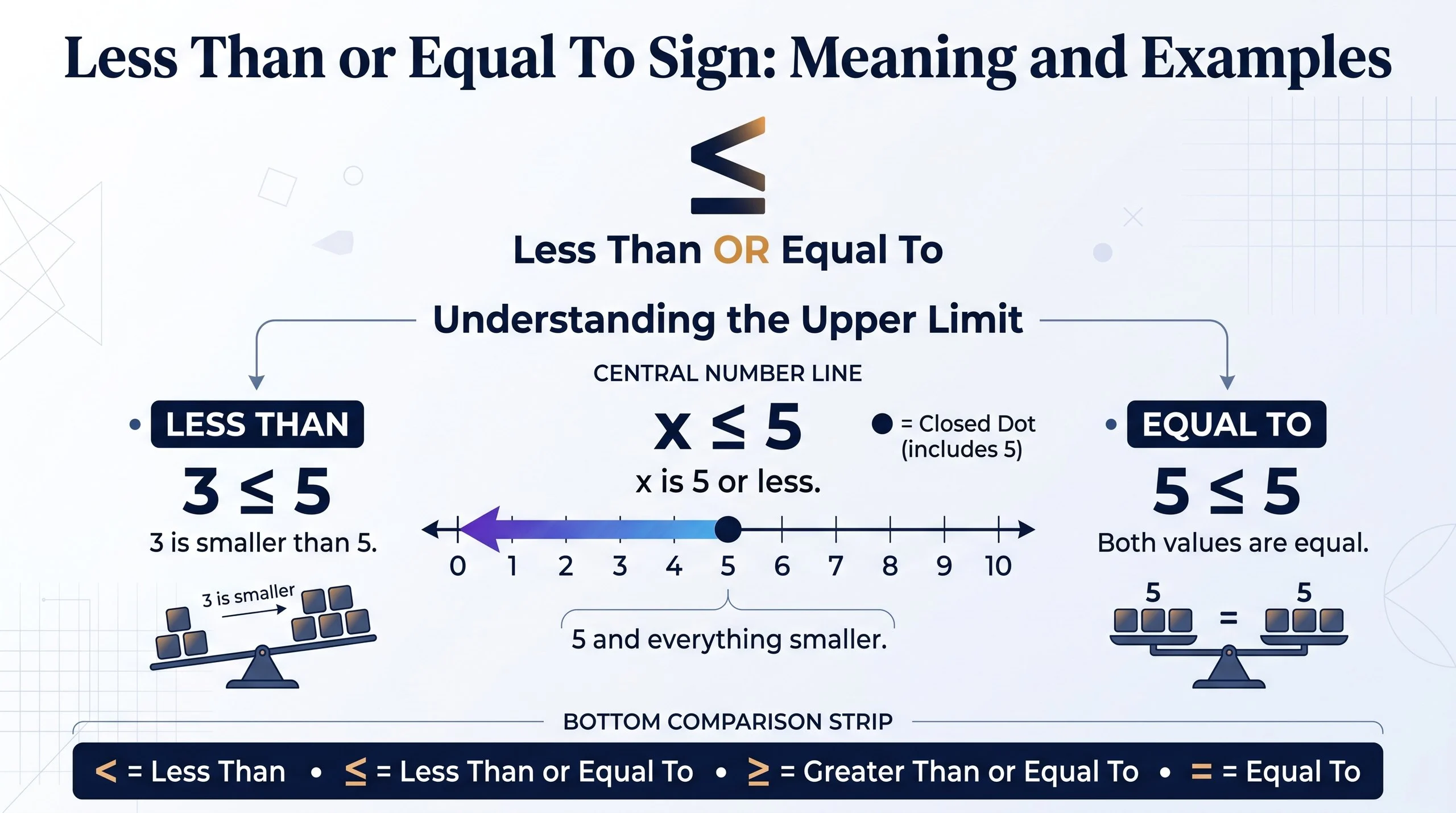
The less than or equal to sign (≤) means that one value is smaller than another value or exactly equal to it. For example, x ≤ 10 means that x can be 10 or any number smaller than 10.
The less than or equal to sign is a common mathematical symbol used to compare two values. Written as ≤, it means that the value on the left is either smaller than the value on the right or exactly equal to it. In other words, the symbol allows a value to meet a limit without exceeding it.
For example, x ≤ 10 means that x can be 10 or any number below 10. Possible values include 10, 9, 8, 5, 0, and negative numbers. The number 10 is included because the symbol contains an equal sign.
You may encounter this symbol in algebra, number lines, statistics, science, spreadsheets, and computer programming. It is especially useful when describing a maximum value or an upper limit. For instance, a rule stating that a bag must weigh 20 kg or less can be written as weight ≤ 20 kg.
This guide explains the less than or equal to sign in simple language, shows how to use it correctly, and compares it with similar mathematical symbols.
| Meaning | Context | Primary Platforms | Example | Tone |
|---|---|---|---|---|
| Less than or equal to | Mathematics, inequalities, comparisons | Schoolwork, calculators, spreadsheets, coding, documents | x ≤ 5 | Mathematical, precise |
What Is the Less Than or Equal To Sign?
The less than or equal to sign is:
≤
It means:
“Less than or equal to.”
The symbol compares two values and allows two possibilities:
- The value on the left is smaller than the value on the right.
- Both values are equal.
For example:
3 ≤ 8
This statement is true because 3 is smaller than 8.
Another example is:
8 ≤ 8
This statement is also true because both values are equal.
However:
12 ≤ 8
is false because 12 is greater than 8.
What Does ≤ Mean?
The symbol ≤ means that the number on the left must be less than or equal to the number on the right.
Consider this inequality:
x ≤ 5
It means:
x is 5 or less.
Possible values include:
- 5
- 4
- 3
- 2
- 1
- 0
- -1
- -10
If x can be any real number, decimals and fractions are also allowed.
For example, 4.5, 2.75, and -3.2 all satisfy the inequality.
However, 6 does not satisfy it because 6 is greater than 5.
How to Read the ≤ Symbol
There are several ways to understand the symbol.
Standard Reading
Read ≤ as:
“Less than or equal to.”
For example:
x ≤ 7
Read it as:
“x is less than or equal to seven.”
Simple Reading
In everyday language, you can often translate it as:
“At most.”
For example:
Age ≤ 18
means the age is at most 18.
Another Easy Interpretation
You can also read the symbol as:
“No more than.”
For instance:
Cost ≤ $50
means the cost cannot be more than $50.
Exactly $50 is allowed.
Why Does ≤ Have Two Parts?
The less than or equal to sign combines two mathematical ideas.
The first part is:
<
This means less than.
The second part is:
=
This means equal to.
Together, they form:
≤
The combined meaning is less than OR equal to.
That is why the two values can be equal without making the statement false.
Examples of the Less Than or Equal To Sign
Here are some simple examples.
| Statement | True or False? | Explanation |
|---|---|---|
| 3 ≤ 7 | True | 3 is less than 7. |
| 5 ≤ 5 | True | Both values are equal. |
| 9 ≤ 4 | False | 9 is greater than 4. |
| 0 ≤ 2 | True | 0 is less than 2. |
| -3 ≤ 1 | True | -3 is less than 1. |
| 10 ≤ 10 | True | Both values are equal. |
The most important rule is that the symbol includes equality.
Less Than or Equal To in Algebra
In algebra, the symbol helps describe a range of possible solutions.
Consider:
x ≤ 10
This means x can be 10 or any number smaller than 10.
If x is restricted to whole numbers, possible solutions include:
10, 9, 8, 7, 6, …
If x can be any real number, solutions also include values such as:
9.5, 7.25, 0.1, -2.5, and -100.
Unlike an equation such as x = 10, the inequality does not specify one exact value. Instead, it defines a range.
Less Than or Equal To vs. Less Than
These two symbols look similar:
- < = less than
- ≤ = less than or equal to
The difference is whether the boundary value is included.
Less Than
x < 5
This means x must be smaller than 5.
Therefore:
- 4 works.
- 3 works.
- 0 works.
- 5 does not work.
Less Than or Equal To
x ≤ 5
This means x can be 5 or any value below it.
Therefore:
- 5 works.
- 4 works.
- 3 works.
- 0 works.
Remember: The symbol ≤ includes the boundary value, while < does not.
Less Than or Equal To vs. Equal To
The equal sign is:
=
It means both values are exactly the same.
For example:
x = 5
means x must equal 5.
However:
x ≤ 5
means x can be 5 or any smaller value.
The difference is simple:
- x = 5: One exact value.
- x ≤ 5: A range of values up to and including 5.
Less Than or Equal To vs. Greater Than or Equal To
These symbols represent opposite directions.
≤ means less than or equal to.
≥ means greater than or equal to.
For example:
x ≤ 10
means x is 10 or less.
By contrast:
x ≥ 10
means x is 10 or greater.
Both include 10, but they allow values on different sides of that boundary.
How to Remember ≤ and ≥
A useful trick is to look at the direction of the symbol’s open side.
The wider side faces the larger value.
For example:
3 ≤ 8
The open side faces 8, which is the larger number.
Likewise:
8 ≥ 3
The open side also faces 8.
Another way to remember the symbols is to focus on the small point. It faces the smaller value.
Less Than or Equal To on a Number Line
A number line makes inequalities easier to understand.
Consider:
x ≤ 4
Place a closed dot at 4.
Then shade the line to the left.
Why?
Because 4 is included, and every value smaller than 4 also satisfies the inequality.
The closed dot matters because the symbol includes equality.
Compare this with:
x < 4
That inequality uses an open dot at 4 because 4 itself is excluded.
Number Line Rules
- ≤ — closed dot, shade left.
- < — open dot, shade left.
- ≥ — closed dot, shade right.
- > — open dot, shade right.
These rules are useful when solving inequalities in algebra.
Less Than or Equal To in Real Life
The symbol is useful whenever a rule sets a maximum limit.
For example:
Weight ≤ 20 kg
means the weight must be 20 kilograms or less.
Other examples include:
- Age ≤ 18: Age is 18 or younger.
- Price ≤ $100: Price is $100 or less.
- Speed ≤ 60 mph: Speed is no more than 60 miles per hour.
- Score ≤ 50: Score is 50 or lower.
- Temperature ≤ 0°C: Temperature is zero degrees Celsius or lower.
In each case, the boundary value is allowed.
Less Than or Equal To in Age Requirements
Imagine a competition is open to children aged 12 and younger.
You can express the age condition as:
Age ≤ 12
This includes children who are:
- 12 years old
- 11 years old
- 10 years old
- 8 years old
- 5 years old
A person aged 13 would not meet the condition.
This is a simple example of how the symbol communicates a maximum age.
Less Than or Equal To in Money
Suppose you have a budget of $100.
You can represent your spending limit as:
Spending ≤ $100
This means you can spend exactly $100 or any amount below it.
For example:
- $100 — allowed.
- $85 — allowed.
- $50 — allowed.
- $99.99 — allowed.
- $105 — exceeds the limit.
The symbol is especially useful when working with budgets, purchase limits, discounts, and financial calculations.
Less Than or Equal To in Measurements
Measurements often have maximum limits.
For example, if a package must weigh no more than 5 kilograms, the condition is:
Weight ≤ 5 kg
A package weighing exactly 5 kg meets the requirement.
A package weighing 4.8 kg also meets it.
However, a package weighing 5.2 kg exceeds the limit.
The same concept can apply to height, length, temperature, volume, and other measurements.
Less Than or Equal To in Statistics
The symbol appears in statistics when describing ranges or conditions.
For example:
x ≤ 100
means the value of x is 100 or lower.
A researcher might use a condition such as:
Age ≤ 30
to describe a group of participants aged 30 or younger.
In statistical notation, the symbol can also appear in probability statements. For example:
P(X ≤ 5)
means the probability that the random variable X takes a value less than or equal to 5.
The exact interpretation depends on the distribution and the problem being studied.
Less Than or Equal To in Programming
Many programming languages represent the less than or equal to comparison using two keyboard characters:
<=
For example:
age <= 18This checks whether the value of age is less than or equal to 18.
If age is 18, the comparison is true.
If age is 16, the comparison is also true.
If age is 19, the comparison is false.
The exact syntax depends on the programming language, but <= is common across many widely used languages.
Less Than or Equal To in Spreadsheets
Spreadsheet formulas use comparison operators to test conditions.
The operator <= means less than or equal to.
For example, a spreadsheet condition could check whether a score is 70 or below.
A comparison such as:
A1<=70returns a logical result based on whether the value in cell A1 is less than or equal to 70.
This is useful for grading rules, budgets, inventory limits, and data filtering.
How to Type the Less Than or Equal To Sign
The symbol ≤ may not appear on a standard keyboard. However, you can enter it in several ways.
Copy and Paste
The simplest method is to copy this symbol:
≤
You can paste it into a document, message, search box, or other application that supports the character.
Microsoft Word
Use Word’s symbol insertion or equation tools to find and insert the less than or equal to sign.
Google Docs
Open the special-character insertion tool and search for less than or equal to.
HTML
You can represent the symbol with the HTML entity:
≤You can also use the numeric character reference:
≤Both represent ≤.
Unicode
The Unicode code point for the less than or equal to sign is:
U+2264
This code point is useful for digital documents, software, and technical references.
How to Type ≤ on a Phone
On many mobile keyboards, the symbol may not appear on the main keyboard screen.
Try opening the numbers and symbols section. If it is unavailable, copy and paste:
≤
You can also use a text replacement shortcut if your device or keyboard supports it.
Common Mistakes
Mistake 1: Forgetting That Equality Is Included
Some people interpret:
x ≤ 5
as meaning x must be smaller than 5.
That is incomplete.
The correct meaning is:
x is less than or equal to 5.
Therefore, 5 is included.
Mistake 2: Confusing ≤ With <
These symbols are not identical.
- x < 5: 5 is excluded.
- x ≤ 5: 5 is included.
Mistake 3: Reversing the Symbol
Consider:
8 ≤ 3
This is false because 8 is greater than 3.
The correct statement for “8 is greater than or equal to 3” is:
8 ≥ 3
Mistake 4: Using an Open Dot on a Graph
When graphing:
x ≤ 5
use a closed dot at 5.
An open dot would incorrectly suggest that 5 is not included.
Mistake 5: Assuming Only Positive Numbers Count
An inequality such as:
x ≤ 5
can include zero and negative numbers, as well as positive values.
For example, -3 ≤ 5 is true.
Unless the question restricts the possible values, do not assume that x must be positive.
Advantages of Using the ≤ Symbol
1. It Saves Space
The symbol replaces the longer phrase “less than or equal to.”
2. It Defines Maximum Limits
It provides a clear way to describe upper limits in mathematics and real-life situations.
3. It Works in Many Fields
You will find it in algebra, statistics, science, engineering, economics, and programming.
4. It Makes Conditions Precise
For example, Budget ≤ $500 clearly communicates that spending must not exceed $500 and that exactly $500 is acceptable.
Practice Questions
Test your understanding with these examples.
Question 1
What does x ≤ 8 mean?
Answer: x is less than or equal to 8.
Question 2
Is 6 ≤ 6 true?
Answer: Yes. Both values are equal.
Question 3
Is 10 ≤ 7 true?
Answer: No. 10 is greater than 7.
Question 4
Does x ≤ 4 include 4?
Answer: Yes.
Question 5
Does x < 4 include 4?
Answer: No.
Question 6
Which symbol means greater than or equal to?
Answer: ≥
Question 7
How can you write “no more than 25” mathematically?
Answer: ≤ 25
Question 8
Is -5 ≤ 2 true?
Answer: Yes. -5 is less than 2.
Quick Comparison of Mathematical Symbols
| Symbol | Meaning | Example | Interpretation |
|---|---|---|---|
| < | Less than | 3 < 8 | 3 is smaller |
| > | Greater than | 8 > 3 | 8 is larger |
| ≤ | Less than or equal to | 5 ≤ 5 | 5 is smaller than or equal to 5 |
| ≥ | Greater than or equal to | 5 ≥ 5 | 5 is larger than or equal to 5 |
| = | Equal to | 4 = 4 | Both values are the same |
| ≠ | Not equal to | 4 ≠ 7 | Values are different |
Frequently Asked Questions
What is the less than or equal to sign?
The less than or equal to sign is ≤. It means one value is smaller than or equal to another value.
What does ≤ mean in math?
It means less than or equal to. For example, x ≤ 10 means x can be 10 or any value below 10.
What does ≤ mean in simple words?
It means “at most,” “no more than,” or “less than or equal to.”
Does ≤ include the number after it?
Yes. In x ≤ 5, the value 5 is included because the symbol allows equality.
What is the difference between < and ≤?
The symbol < means strictly less than, so it excludes equality. The symbol ≤ includes equality.
What is the opposite of ≤?
The opposite direction is represented by ≥, which means greater than or equal to.
How do you read ≤?
Read it as “less than or equal to.” Depending on the context, you can also say “at most” or “no more than.”
What does x ≤ 10 mean?
It means x is 10 or less. The solution includes 10 and all smaller real numbers unless the problem specifies a restricted set of values.
Is 10 ≤ 10 true?
Yes. Both values are equal, so the statement is true.
How do you type ≤ on a keyboard?
You can copy ≤, use a symbol or equation tool in a document editor, or use its Unicode or HTML representation.
What is the Unicode for ≤?
The Unicode code point is U+2264.
What is the programming version of ≤?
Many programming languages use <= to represent less than or equal to.
Key Takeaway & Summary
The less than or equal to sign (≤) means that one value is smaller than or exactly equal to another value.
For example:
x ≤ 5
means:
x is 5 or less.
The value 5 is included, along with every smaller value that meets the problem’s conditions.
Remember this simple phrase:
≤ = at most
Once you understand this rule, you can recognize the symbol in algebra, number lines, statistics, spreadsheets, programming, and everyday limits.
Conclusion
The less than or equal to sign is an essential mathematical symbol used to compare values and describe maximum limits. Written as ≤, it allows the value on the left to be smaller than or exactly equal to the value on the right.
The easiest way to remember its meaning is “at most” or “no more than.” For example, x ≤ 10 means that x can equal 10 or take any smaller value.
Unlike the less-than symbol <, the ≤ symbol includes the boundary value. Therefore, 10 ≤ 10 is true, while 10 < 10 is false.
You will encounter this symbol in mathematics, science, programming, spreadsheets, and real-life situations involving age limits, budgets, measurements, and scores. Once you remember that the symbol combines less than and equal to, it becomes much easier to read and apply correctly.