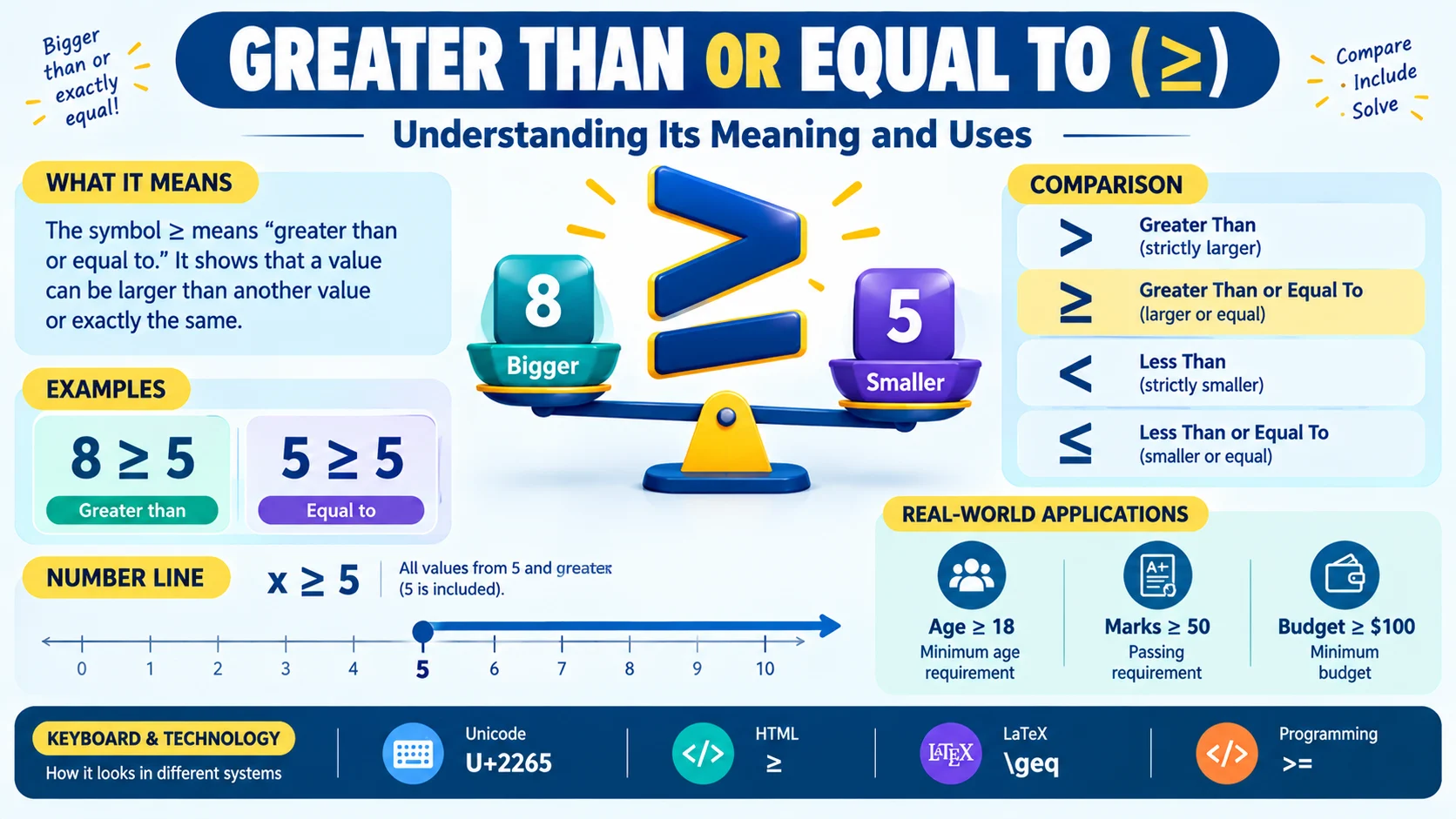
The greater than or equal to sign (≥) is a mathematical symbol used to show that one number is greater than or exactly equal to another number. For example, 8 ≥ 5 means 8 is greater than 5, while 5 ≥ 5 means both numbers are equal. This symbol is commonly used in mathematics, inequalities, algebra, programming, and statistics.
The greater than or equal to sign is an important mathematical symbol that helps compare two numbers or quantities. Written as ≥, it tells us that the value on the left side is either larger than or exactly the same as the value on the right side. For example, 10 ≥ 7 means 10 is greater than 7, while 7 ≥ 7 shows that both values are equal.
Although this symbol may look simple, it plays an important role in mathematics, algebra, inequalities, and everyday calculations. Moreover, students frequently encounter it when solving equations, understanding number relationships, and working with mathematical expressions. Teachers also use it to explain minimum requirements, acceptable ranges, and numerical conditions.
Understanding the greater than or equal to symbol makes mathematical comparisons easier. However, it is important to distinguish it from the greater than sign (>) and the less than or equal to sign (≤). Each symbol communicates a different relationship between two values.
In this guide, you’ll discover the meaning of ≥, its mathematical applications, practical examples, keyboard shortcuts, common mistakes, and differences from similar symbols. Additionally, you’ll learn how to recognize and use it correctly in everyday situations.
What Is the Greater Than or Equal To Sign?
The greater than or equal to sign is a mathematical comparison symbol represented by ≥. It indicates that the number, expression, or quantity on the left side is either greater than or equal to the value on the right side.
In simple terms, this symbol communicates two possible relationships:
- The first value is larger than the second value.
- Both values have exactly the same numerical value.
For example:
9 ≥ 4
This statement is true because 9 is greater than 4.
Similarly:
9 ≥ 9
This statement is also true because both numbers are equal.
Therefore, the symbol includes equality as well as greater-than relationships. This is what makes it different from the ordinary greater than sign (>), which only represents a strictly larger value.
The greater than or equal to symbol is especially useful when a mathematical condition allows a value to reach a particular limit without going below it.
For instance, if a school requires students to score at least 60 marks to pass an examination, the condition can be written as:
Marks ≥ 60
This means students must earn 60 marks or more to meet the requirement.
Greater Than or Equal To Symbol (≥) in Simple Words
In simple words, ≥ means “greater than or equal to.”
It tells you that a number can be bigger than another number or exactly the same.
Consider these examples:
- 12 ≥ 8 means 12 is greater than 8.
- 8 ≥ 8 means both numbers are equal.
- 15 ≥ 10 means 15 is greater than 10.
- 20 ≥ 20 means both values are equal.
However, the statement 6 ≥ 10 is false because 6 is smaller than 10.
A useful way to remember this symbol is to think of it as two mathematical ideas combined into one:
> + = represented by ≥
The symbol contains a greater-than sign with an additional horizontal line underneath. That line represents equality.
Consequently, whenever you see ≥, remember that the left-hand value must be either larger than or equal to the right-hand value.
What Does ≥ Mean in Mathematics?
In mathematics, the ≥ symbol represents a relationship between two numerical values or algebraic expressions. It is commonly used to express inequalities.
An inequality is a mathematical statement that compares two quantities rather than saying they are exactly equal.
For example:
x ≥ 5
This expression means that x can be 5 or any number greater than 5.
Possible values include:
- 5
- 6
- 7
- 10
- 25
- 100
Therefore, x does not have to equal exactly 5. It simply cannot be smaller than 5.
Similarly, consider this expression:
x + 2 ≥ 8
To solve it, subtract 2 from both sides:
x ≥ 6
As a result, any value of x that is 6 or greater makes the inequality true.
This concept is particularly important in algebra because inequalities describe a range of possible solutions rather than just one answer.
How to Read the Greater Than or Equal To Sign
The symbol ≥ is read as “greater than or equal to.”
For example:
A ≥ B
You can read this expression as:
“A is greater than or equal to B.”
Likewise:
25 ≥ 15
This means 25 is greater than or equal to 15.
You can also read it as:
“Twenty-five is greater than or equal to fifteen.”
The reading remains the same whether the values are whole numbers, decimals, fractions, or algebraic expressions.
For example:
- 4.5 ≥ 3.5
- ½ ≥ ½
- 3x ≥ 12
- 100 ≥ 75
In each case, the symbol describes the relationship between the left and right sides.
Greater Than or Equal To Sign Examples
The easiest way to understand the greater than or equal to symbol is through practical examples.
Here are several examples showing how it works.
| Mathematical Expression | Meaning | Result |
|---|---|---|
| 10 ≥ 5 | 10 is greater than 5 | True |
| 8 ≥ 8 | Both numbers are equal | True |
| 15 ≥ 12 | 15 is greater than 12 | True |
| 7 ≥ 9 | 7 is smaller than 9 | False |
| 20 ≥ 20 | Both numbers are equal | True |
| 3 ≥ 6 | 3 is smaller than 6 | False |
| 100 ≥ 50 | 100 is greater than 50 | True |
| 4.5 ≥ 4.5 | Both decimals are equal | True |
These examples demonstrate that the greater than or equal to symbol accepts both larger values and equal values.
However, it does not accept smaller values.
Examples With Whole Numbers
Whole numbers are among the simplest values to compare.
For instance:
- 30 ≥ 20
- 45 ≥ 45
- 100 ≥ 75
- 12 ≥ 10
- 50 ≥ 50
All these statements are true because the left-hand number is either larger than or equal to the right-hand number.
Examples With Decimal Numbers
The same rule applies to decimal values.
For example:
- 5.5 ≥ 4.5
- 7.25 ≥ 7.25
- 10.8 ≥ 9.6
- 3.75 ≥ 3.50
Each statement is true because the first value is not smaller than the second.
Examples With Fractions
Fractions can also be compared using the greater than or equal to symbol.
Consider these examples:
- ¾ ≥ ½
- ⅔ ≥ ⅔
- ⅞ ≥ ¾
- 1 ≥ ½
Each expression is true.
Nevertheless, you should compare the actual numerical values before deciding whether an inequality is correct.
Greater Than or Equal To Sign in Real Life
The greater than or equal to symbol is not limited to classroom mathematics. It also appears in everyday situations where people need to describe minimum requirements or acceptable limits.
Here are some practical examples.
Age Requirements
Suppose a competition allows participants who are at least 18 years old.
The condition can be written as:
Age ≥ 18
This means anyone aged 18 or older can participate.
However, someone who is 17 does not meet the requirement.
Minimum Exam Marks
Imagine a school requires students to score at least 50 marks to pass an examination.
The condition becomes:
Marks ≥ 50
Therefore, students who score 50, 60, or 90 marks meet the requirement.
Minimum Salary
A job advertisement may specify a minimum monthly salary of $3,000.
This requirement can be represented as:
Salary ≥ $3,000
Consequently, a salary of $3,000 or more satisfies the condition.
Speed Requirements
A vehicle may need to maintain a minimum speed of 40 miles per hour on a particular road.
The condition is:
Speed ≥ 40 mph
This means the speed must be 40 mph or higher.
Actual road-speed requirements and legal limits should always be followed according to local regulations.
Shopping and Budgeting
Suppose you want to purchase a product that costs at least $100.
You can express your budget requirement as:
Budget ≥ $100
In this situation, a budget of $100, $150, or $200 meets the condition.
These examples show why the greater than or equal to symbol is useful for describing minimum values.
How to Type the Greater Than or Equal To Sign (≥) on a Keyboard
Many people know what ≥ means but do not know how to type it on their devices.
Fortunately, there are several ways to insert this mathematical symbol.
On Windows
You can use the Character Map to find and copy the symbol.
Follow these steps:
- Open the Windows Start menu.
- Search for Character Map.
- Open the Character Map application.
- Find the greater than or equal to symbol (≥).
- Select the symbol and click Copy.
- Paste it into your document.
Alternatively, you can use the Unicode character code in applications that support Unicode input.
The Unicode code point for ≥ is U+2265.
In Microsoft Word, type 2265 and then press Alt + X to convert it into ≥.
On Microsoft Word
Microsoft Word provides a simple way to insert mathematical symbols.
Follow these steps:
- Open your Word document.
- Select the Insert tab.
- Choose Symbol.
- Open More Symbols if necessary.
- Find the greater than or equal to symbol.
- Select ≥ and click Insert.
You can also use the Unicode conversion method:
Type 2265, then press Alt + X.
Word will convert the code into the required symbol.
On Mac
Mac users can access special mathematical characters through the Character Viewer.
Follow these steps:
- Open the document or text field.
- Press
Control + Command + Space. - Open the Character Viewer.
- Search for “greater than or equal to.”
- Select ≥ to insert it.
On Linux
Linux users can often enter the Unicode character directly using a Unicode input sequence.
On supported desktop environments:
- Press
Ctrl + Shift + U. - Type
2265. - Press Enter or Space.
The result should be:
≥
The exact behavior may vary depending on your Linux distribution and keyboard settings.
On Android
Android users can usually copy and paste the symbol because many standard mobile keyboards do not provide a dedicated ≥ key.
Follow these steps:
- Copy the symbol: ≥
- Open your preferred application.
- Touch and hold the text area.
- Select Paste.
On iPhone
iPhone users can also copy and paste the symbol.
Simply copy ≥ from this article and paste it into your message, document, note, or mathematical expression.
You can also create a text replacement shortcut through your keyboard settings if you use this symbol regularly.
What Is the Unicode and HTML Code for ≥?
The greater than or equal to symbol has a standard Unicode code point that allows computers and applications to recognize it.
Here are its common technical representations.
| Format | Code |
|---|---|
| Symbol | ≥ |
| Unicode | U+2265 |
| HTML Entity Name | ≥ |
| HTML Entity Number | ≥ |
| Decimal Character Code | 8805 |
| Hexadecimal Code | 2265 |
| LaTeX | \geq |
| MathML | ≥ |
These codes are particularly useful for web developers, mathematicians, students, and people working with digital documents.
For example, HTML can display the symbol using:
≥
The browser will render it as:
≥
Similarly, LaTeX users can write \geq inside a mathematical expression to produce the same symbol.
Greater Than (>) vs. Greater Than or Equal To (≥)
The greater than sign and greater than or equal to sign look similar. However, they communicate different mathematical relationships.
The greater than symbol (>) indicates that the first number must be strictly larger than the second number.
In contrast, the greater than or equal to symbol (≥) allows the first number to be larger than or exactly equal to the second.
| Feature | Greater Than (>) | Greater Than or Equal To (≥) |
|---|---|---|
| Meaning | Greater than | Greater than or equal to |
| Equality allowed? | No | Yes |
| Symbol | > | ≥ |
| Example | 8 > 5 | 8 ≥ 8 |
| Minimum value allowed? | No, not at equality | Yes |
| Common use | Strict comparison | Minimum requirements |
For example:
x > 5
This means x must be greater than 5. Therefore, 5 is not an acceptable value.
However:
x ≥ 5
This means x can equal 5 or be any number greater than 5.
Consequently, the horizontal line underneath the greater-than symbol makes an important difference.
Greater Than or Equal To (≥) vs. Less Than or Equal To (≤)
These two symbols are often confused because both include an equality line.
However, they represent opposite numerical relationships.
Greater than or equal to (≥) means the left value is greater than or equal to the right value.
Less than or equal to (≤) means the left value is smaller than or equal to the right value.
| Feature | Greater Than or Equal To | Less Than or Equal To |
|---|---|---|
| Symbol | ≥ | ≤ |
| Meaning | Greater or equal | Smaller or equal |
| Example | 10 ≥ 5 | 5 ≤ 10 |
| Equality allowed? | Yes | Yes |
| Direction | Opens toward the smaller value | Opens toward the larger value |
For example:
10 ≥ 10 is true.
Similarly:
10 ≤ 10 is also true.
Both symbols allow equality. Nevertheless, they describe opposite directions when the numbers are different.
Greater Than or Equal To Sign on a Number Line
A number line makes inequalities easier to understand because it visually shows which values satisfy a condition.
For example:
x ≥ 3
This inequality means that x can equal 3 or any number greater than 3.
On a number line, you represent this condition using:
- A filled or closed circle at 3.
- A line or arrow extending toward the right.
- All numbers to the right of 3 are included.
The filled circle is important because it indicates that 3 is part of the solution.
In contrast, an inequality such as x > 3 uses an open circle because the number 3 itself is not included.
Therefore, remember this simple rule:
Closed circle = equality included.
Open circle = equality excluded.
This visual method is commonly used in algebra and introductory mathematics.
How to Solve Inequalities Using ≥
The greater than or equal to symbol frequently appears in algebraic inequalities.
Solving these expressions follows many of the same rules as solving equations. However, one important rule changes when you multiply or divide by a negative number.
Example: Addition
Solve:
x + 4 ≥ 10
Subtract 4 from both sides:
x ≥ 10 − 4
Therefore:
x ≥ 6
Any number equal to or greater than 6 satisfies the original inequality.
Example: Subtraction
Solve:
x − 3 ≥ 7
Add 3 to both sides:
x ≥ 7 + 3
Therefore:
x ≥ 10
Example: Multiplication
Solve:
2x ≥ 12
Divide both sides by 2:
x ≥ 6
Since you divided by a positive number, the inequality sign remains unchanged.
Example: Division by a Negative Number
Solve:
−2x ≥ 8
Divide both sides by −2.
When dividing by a negative number, reverse the inequality sign:
x ≤ −4
This is an important mathematical rule. Forgetting to reverse the sign can produce an incorrect answer.
Advantages and Disadvantages of Using the Greater Than or Equal To Sign
The greater than or equal to symbol offers several advantages in mathematics and practical calculations. However, it also has some limitations when used without enough context.
Advantages
Clearly Communicates Minimum Values
The symbol makes minimum requirements easy to express. For example, age ≥ 18 immediately shows that 18 is an acceptable minimum age.
Includes Equality
Unlike the ordinary greater than sign, ≥ allows the two values to be equal. Therefore, it is useful when exact-limit values must be accepted.
Simplifies Mathematical Expressions
Instead of writing lengthy explanations, you can express numerical conditions using a single symbol.
Useful in Algebra
Students and mathematicians use it to solve inequalities and describe ranges of possible answers.
Supports Real-World Applications
Moreover, the symbol is useful in budgeting, education, engineering, statistics, business rules, and scientific measurements.
Disadvantages
Can Be Confused With Similar Symbols
Beginners sometimes confuse ≥ with > or ≤. As a result, they may misunderstand a mathematical condition.
Requires Understanding of Inequalities
Knowing the symbol alone is not enough. Users must also understand how to compare values correctly.
May Be Difficult to Type
Some keyboards do not provide a dedicated key for ≥. Consequently, users may need to copy and paste it or use Unicode shortcuts.
Does Not Explain Context by Itself
The symbol communicates a mathematical relationship, but it does not explain what the numbers represent. For instance, age ≥ 18 needs additional context to identify the relevant age requirement.
Common Mistakes When Using the Greater Than or Equal To Symbol
Although ≥ is easy to recognize, students sometimes make mistakes when interpreting or writing it.
Here are some common errors to avoid.
Confusing ≥ With >
The greater than sign does not include equality.
For example, 5 > 5 is false, whereas 5 ≥ 5 is true.
Therefore, always check whether the condition allows equal values.
Confusing ≥ With ≤
These symbols have opposite directions.
For example, 10 ≥ 5 is true, but 10 ≤ 5 is false.
Always check which value must be greater or smaller.
Forgetting to Reverse the Sign
When multiplying or dividing an inequality by a negative number, you must reverse its direction.
For example:
−x ≥ 4
Multiplying both sides by −1 gives:
x ≤ −4
Thinking the Symbol Means Only Greater Than
The horizontal line underneath the symbol represents equality.
Therefore, ≥ does not simply mean greater than. It means greater than or equal to.
Assuming the Right-Hand Number Must Be Included
The symbol itself does not automatically include every value in a particular range. Instead, it includes the boundary value and all qualifying values on the correct side.
For example, x ≥ 10 includes 10 and values above it, not values below it.
Related Mathematical Symbols and Their Meanings
Several mathematical symbols are closely related to the greater than or equal to sign.
Learning their meanings can help you understand inequalities more easily.
| Symbol | Name | Meaning | Example |
|---|---|---|---|
| > | Greater than | Larger than | 9 > 5 |
| < | Less than | Smaller than | 3 < 8 |
| ≥ | Greater than or equal to | Larger than or equal | 8 ≥ 8 |
| ≤ | Less than or equal to | Smaller than or equal | 5 ≤ 5 |
| = | Equal to | Same numerical value | 6 = 6 |
| ≠ | Not equal to | Different numerical values | 7 ≠ 5 |
| ≈ | Approximately equal to | Nearly equal | π ≈ 3.14 |
| ≡ | Identically equal to or equivalent to | Depends on mathematical context | x ≡ x |
These symbols are useful in different mathematical situations. However, each has a specific meaning, so they should not be used interchangeably.
Greater Than or Equal To Sign in Programming
The greater than or equal to operator is also widely used in computer programming.
Many programming languages use >= to compare two values.
For example, a programmer may write:
age >= 18
This condition checks whether a person’s age is 18 or higher.
If the condition is true, the program can execute a particular instruction.
In Python, an example would be:
if age >= 18:
print("Eligible")
This code checks whether the age meets the minimum requirement.
Similarly, JavaScript, Java, C, C++, and many other programming languages use >= for greater-than-or-equal comparisons.
However, remember that the mathematical symbol ≥ and the programming operator >= represent the same comparison but use different written formats.
Key Takeaways and Summary
The greater than or equal to sign (≥) is a mathematical symbol used to compare two values when the first value can be larger than or equal to the second.
Here are the most important points to remember:
- Symbol: ≥
- Name: Greater than or equal to
- Meaning: Larger than or exactly equal to
- Unicode: U+2265
- HTML code:
≥ - LaTeX code:
\geq - Programming equivalent:
>= - Example: 10 ≥ 10 is true.
- Common application: Algebra, inequalities, programming, and minimum requirements.
Most importantly, remember that the horizontal line underneath the greater-than symbol represents equality. Therefore, the symbol includes the possibility that both values are exactly the same.
Practice Exercises: Test Your Understanding
Now that you understand the meaning and uses of ≥, try these exercises to check your knowledge.
Exercise: Decide Whether Each Statement Is True or False
- 8 ≥ 5
- 6 ≥ 6
- 4 ≥ 9
- 15 ≥ 10
- 20 ≥ 20
- 3 ≥ 7
- 12 ≥ 12
- 25 ≥ 30
Exercise: Fill in the Blanks
Choose the correct symbol: >, <, or ≥.
- 10 ___ 10
- 15 ___ 8
- 4 ___ 9
- 12 ___ 12
- 20 ___ 15
- 6 ___ 11
Exercise: Solve the Inequalities
- x + 5 ≥ 12
- x − 4 ≥ 6
- 3x ≥ 15
- 2x + 4 ≥ 12
- −3x ≥ 9
Exercise Answers
True or False Answers
- 8 ≥ 5 — True
- 6 ≥ 6 — True
- 4 ≥ 9 — False
- 15 ≥ 10 — True
- 20 ≥ 20 — True
- 3 ≥ 7 — False
- 12 ≥ 12 — True
- 25 ≥ 30 — False
Fill in the Blanks Answers
- 10 ≥ 10
- 15 > 8
- 4 < 9
- 12 ≥ 12
- 20 > 15
- 6 < 11
Inequality Answers
- x + 5 ≥ 12 → x ≥ 7
- x − 4 ≥ 6 → x ≥ 10
- 3x ≥ 15 → x ≥ 5
- 2x + 4 ≥ 12 → x ≥ 4
- −3x ≥ 9 → x ≤ −3
Notice that the last answer reverses the inequality sign because both sides are divided by a negative number.
FAQs
What does ≥ mean?
The symbol ≥ means greater than or equal to. It indicates that the value on the left is either larger than or exactly equal to the value on the right.
What is the greater than or equal to symbol?
The greater than or equal to symbol is ≥. It is commonly used in mathematics to compare numbers, expressions, and quantities.
What is the difference between ≥ and >?
The symbol ≥ allows the two values to be equal or the left value to be greater. In contrast, > only allows the left value to be strictly greater.
Is 5 greater than or equal to 5?
Yes. The statement 5 ≥ 5 is true because both values are equal. The horizontal line underneath the symbol allows equality.
How do you type ≥ on a keyboard?
On Windows, you can type 2265 in Microsoft Word and press Alt + X to insert ≥. Alternatively, you can copy the symbol directly from this article.
What is the opposite of greater than or equal to?
The opposite relationship is less than, represented by <. However, the logical negation of x ≥ y is x < y, while the reverse comparison is x ≤ y.
What does x ≥ 10 mean?
It means x can equal 10 or any number greater than 10. For example, 10, 11, 15, and 20 all satisfy the inequality.
Does greater than or equal to include the number itself?
Yes. The symbol includes the boundary value because the horizontal line represents equality. Therefore, 10 ≥ 10 is a true statement.
Is ≥ used in algebra?
Yes. It is frequently used in algebra to represent inequalities and describe possible values of unknown variables.
What is the difference between ≥ and ≤?
The symbol ≥ means greater than or equal to, whereas ≤ means less than or equal to. Both include equality, but they describe opposite numerical relationships.
What is the Unicode for the greater than or equal to sign?
The Unicode code point for the symbol is U+2265. Its decimal character code is 8805.
Is ≥ the same as >=?
Yes. Both represent the same mathematical relationship. The symbol ≥ is the standard mathematical notation, while >= is a common text-based and programming representation.
Conclusion
The greater than or equal to sign (≥) is a simple but essential mathematical symbol that helps compare two numbers or quantities. It indicates that the value on the left side can be greater than or exactly equal to the value on the right side. Therefore, it is especially useful when expressing minimum requirements, mathematical inequalities, and numerical conditions.
Understanding the difference between ≥, >, and ≤ also makes it easier to solve algebraic problems and interpret mathematical statements correctly. Additionally, knowing how to type the symbol on different devices can make working with digital documents and mathematical expressions more convenient.
Remember one simple rule: ≥ means greater than or equal to, so equality is always allowed. Once you understand this relationship, recognizing and using the symbol becomes much easier.