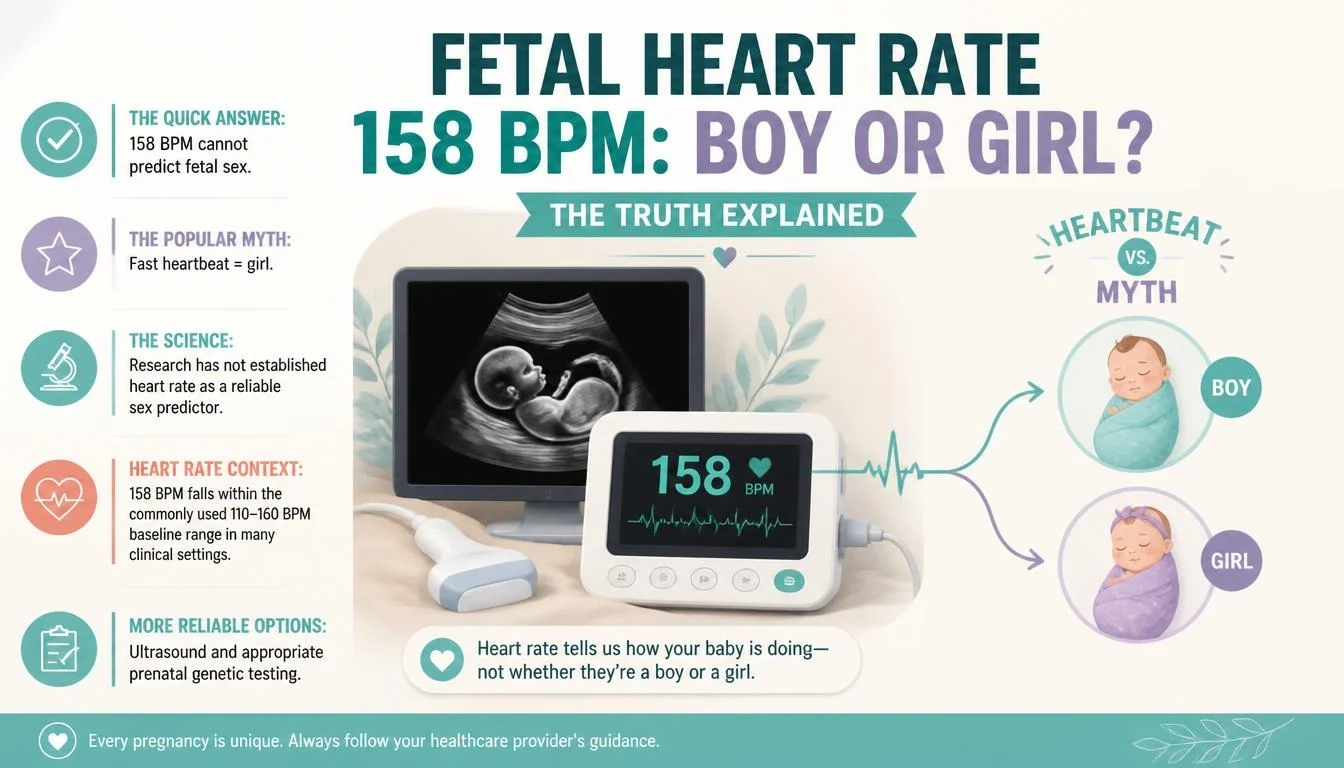
A fetal heart rate of 158 BPM cannot reliably tell you whether you are having a boy or a girl. Although an old pregnancy myth suggests that a faster heartbeat means a girl, scientific research has not established fetal heart rate as a reliable predictor of fetal sex. A heart rate of 158 beats per minute falls within the commonly used 110–160 BPM baseline range for many pregnancies, although its interpretation depends on gestational age and clinical context.
The question “fetal heart rate 158 bpm boy or girl” is common among expectant parents who are excited to discover their baby’s sex before birth. Hearing your baby’s heartbeat during an ultrasound or prenatal appointment can be a memorable experience. Naturally, you might wonder whether that number offers a clue about whether you are expecting a boy or a girl.
According to a popular pregnancy myth, a faster fetal heartbeat means a girl, while a slower heartbeat suggests a boy. Because 158 BPM sounds relatively fast, some people may interpret it as a sign that they are having a daughter. However, this belief is not supported by reliable scientific evidence.
Instead, a baby’s heart rate changes throughout pregnancy and can vary with gestational age, fetal activity, and other factors. Therefore, a single reading of 158 BPM cannot determine fetal sex or, by itself, establish whether a pregnancy is healthy.
In this guide, you’ll learn what a fetal heart rate of 158 BPM means, why people associate heartbeat speed with a baby’s sex, and which methods can provide more reliable information. Additionally, you’ll discover how fetal heart rate changes during pregnancy, when to discuss a reading with your healthcare provider, and which common pregnancy myths deserve a closer look.
What Does a Fetal Heart Rate of 158 BPM Mean?
| Question | Answer |
|---|---|
| Does 158 BPM mean a boy? | No. The heart rate cannot reliably predict a boy. |
| Does 158 BPM mean a girl? | No. The heart rate cannot reliably predict a girl. |
| Is 158 BPM normal? | It falls within the commonly used 110–160 BPM baseline range, but context matters. |
| Can heartbeat speed reveal fetal sex? | No. Research has not established a reliable connection. |
| How can you find out fetal sex? | Depending on your circumstances, an ultrasound or prenatal genetic testing may provide information. |
| Should you worry about 158 BPM? | Not based on this number alone. Your provider should interpret it alongside the pregnancy’s stage and other findings. |
What Does Fetal Heart Rate 158 BPM Boy or Girl Mean?
When people search for fetal heart rate 158 bpm boy or girl, they usually want to know whether their baby’s heartbeat indicates a particular sex.
The short answer is that 158 BPM does not tell you whether your baby is male or female.
BPM stands for beats per minute. A fetal heart rate of 158 BPM means the baby’s heart is beating approximately 158 times in one minute at the time of measurement.
However, heart rate is a physiological measurement, not a sex-prediction test. Research comparing fetal heart rates has not found a consistent difference that can accurately distinguish male from female fetuses. For example, a study published in 2016 examined fetal heart rates during the first trimester and found no statistically significant difference between the two groups. Research study
Consequently, the number 158 does not favor a boy or a girl in a medically meaningful way.
Why Do People Think 158 BPM Means a Girl?
The belief comes from an old pregnancy myth that links a faster heartbeat with a female baby. Under this theory, a heartbeat above 140 BPM supposedly suggests a girl, while a slower heartbeat supposedly suggests a boy.
Since 158 BPM is above that traditional cutoff, the myth would predict a girl.
Nevertheless, the cutoff has no established scientific value for predicting fetal sex. A heartbeat of 158 BPM can occur in pregnancies involving male or female fetuses.
Although guessing can be a fun family activity, it is important to distinguish entertainment from medical evidence.
Is a Fetal Heart Rate of 158 BPM Normal?
In many situations, a fetal heart rate of 158 BPM falls within the commonly used baseline range of 110–160 BPM. Healthcare professionals use this range when assessing fetal heart rate in appropriate clinical settings, particularly during labor monitoring. However, the interpretation of a reading also depends on the pregnancy’s stage and how the measurement was obtained. ACOG
Here are some important factors to understand.
1. Gestational Age
A baby’s heart rate changes as pregnancy progresses. During early pregnancy, the rate rises as the fetal heart develops and matures. Later, it generally settles into a different pattern.
Therefore, the same number may need different interpretation depending on whether the measurement was taken during early pregnancy, the second trimester, or near delivery.
2. Fetal Movement
A baby’s heart rate can increase temporarily with movement. In addition, the reading may fluctuate during an examination because fetal heart rate is not a perfectly fixed number.
For this reason, one measurement does not tell the entire story.
3. How the Heart Rate Was Measured
An ultrasound examination, a handheld Doppler device, and continuous fetal monitoring do not provide identical types of information.
For example, a brief measurement during an ultrasound is different from a clinician’s assessment of a baseline heart rate over time. Your healthcare provider can explain what your particular result means.
4. The Overall Clinical Picture
Healthcare professionals consider more than the number alone. Depending on the circumstances, they may evaluate fetal movement, heart rate patterns, gestational age, maternal symptoms, and other examination findings.
Important: A reading of 158 BPM alone is not a reason to assume something is wrong. However, it also cannot independently confirm that everything is healthy. If you have concerns about your report, ask your prenatal care provider to interpret it.
Fetal Heart Rate Chart by Pregnancy Stage
The following table offers a general overview of how fetal heart rate changes during pregnancy. These figures are illustrative rather than diagnostic cutoffs for every week.
| Pregnancy Stage | General Heart Rate Pattern | What to Know |
|---|---|---|
| Early first trimester | Heart rate rises rapidly as the heart develops | The expected rate changes with gestational age. |
| Late first trimester | The heart rate often reaches a relatively high level before changing later | A single number cannot predict fetal sex. |
| Second trimester | The heart rate generally settles into a more stable pattern | Your provider interprets the reading in context. |
| Third trimester | The rate often remains within a clinically expected range but changes with activity | Monitoring may consider the baseline and variations over time. |
| During labor | Clinicians commonly use a baseline range of 110–160 BPM | The complete heart rate pattern matters, not just one number. |
The exact expected heart rate depends on gestational age and clinical circumstances. In particular, the range used for fetal monitoring during labor should not be treated as a universal diagnostic rule for every early-pregnancy ultrasound.
The 140 BPM Myth: Does a Faster Heartbeat Mean a Girl?
One of the most widespread pregnancy myths suggests that a fetal heart rate above 140 BPM means a girl, while a rate below 140 BPM means a boy.
Under this belief, a reading of 158 BPM would supposedly indicate a girl.
However, scientific studies do not support this method as a reliable way to determine fetal sex. Research has found that fetal heart rates overlap substantially between male and female fetuses. Consequently, there is no dependable threshold that separates the two groups.
Consider these examples:
- A baby with a heart rate of 158 BPM could be male or female.
- A baby with a heart rate of 145 BPM could be male or female.
- A baby with a heart rate of 135 BPM could be male or female, depending on the gestational age and clinical context.
These examples demonstrate why the 140 BPM rule cannot provide a reliable answer.
The myth persists partly because some parents remember predictions that turned out to be correct. However, a correct guess does not prove that the method works. With two common outcomes, guesses will sometimes be right by chance.
Therefore, enjoy the prediction if it makes your pregnancy more exciting, but do not use it to make medical decisions.
What Factors Affect a Baby’s Heart Rate?
A fetal heart rate is influenced by several physiological factors. Understanding them can explain why the number changes between appointments.
Fetal Development
As the fetal cardiovascular system develops, the heart rate changes. This is one reason gestational age matters when interpreting early-pregnancy measurements.
Activity and Rest
Like adults, fetuses have changing activity patterns. Movement can be associated with temporary heart rate increases, while periods of rest may produce different readings.
Maternal and Pregnancy Factors
A healthcare professional may consider maternal temperature, medications, hydration, and other clinical factors when assessing an unusual or persistent heart rate pattern. The relevance of each factor depends on the individual situation.
Measurement Conditions
A short reading provides less information than a comprehensive assessment. Furthermore, the method used and the timing of the measurement can affect how a result should be interpreted.
None of these factors makes a fetal heart rate of 158 BPM a reliable predictor of fetal sex.
How Can You Find Out Whether You’re Having a Boy or a Girl?
If you want a more dependable answer, discuss the available options with your healthcare provider. The best method depends on your gestational age, medical history, preferences, and the purpose of the test.
1. Ultrasound
An ultrasound uses sound waves to produce images of the developing baby. During the mid-pregnancy anatomy scan, usually performed around 18–22 weeks, a sonographer may be able to identify the baby’s external genitalia.
However, the result depends on factors such as fetal position, image quality, and gestational age. An ultrasound performed earlier may not reliably identify fetal sex, and sometimes the view remains unclear even later.
An ultrasound also assesses aspects of fetal development and anatomy. It is not simply a sex-prediction procedure.
2. Cell-Free DNA Screening
Cell-free DNA screening, often called NIPT, analyzes small fragments of DNA in a pregnant person’s blood. It is commonly available from around 10 weeks of pregnancy, although timing and eligibility vary by test and clinical circumstances.
Some tests can provide information about fetal sex chromosomes. However, NIPT is primarily a screening test for certain chromosomal conditions, not a diagnostic test for every genetic or developmental condition.
Discuss the test’s benefits, limitations, and relevance to your pregnancy with your healthcare provider.
3. Diagnostic Genetic Testing
Certain diagnostic procedures, including chorionic villus sampling (CVS) and amniocentesis, can provide genetic information that may establish chromosomal sex.
However, these procedures are generally performed for specific medical indications and have potential risks. They should not usually be pursued solely to learn a baby’s sex without a medical reason.
Your healthcare provider can explain whether either procedure is appropriate in your circumstances.
Which Method Is Best?
For many expectant parents, a routine mid-pregnancy ultrasound provides an opportunity to learn fetal sex without undergoing an invasive procedure. Meanwhile, prenatal genetic screening may provide relevant information earlier when appropriate.
Importantly, no method provides every possible answer about a baby’s future health or development. Your provider can help you understand what a particular result does and does not establish.
Fetal Heart Rate 158 BPM Boy or Girl: Common Examples
The following scenarios show how to interpret the question without relying on pregnancy myths.
Example 1: An Early Ultrasound Shows 158 BPM
A pregnant person has an ultrasound during the first trimester, and the report lists a fetal heart rate of 158 BPM.
They wonder whether the number means they are having a girl.
Explanation: The reading alone cannot determine fetal sex. The provider should interpret it according to gestational age and the ultrasound findings.
Example 2: A Second-Trimester Appointment Shows 158 BPM
Another expectant parent hears a heartbeat of 158 BPM during a prenatal appointment.
A relative says the faster heartbeat proves the baby is a girl.
Explanation: The prediction is a traditional myth, not a scientifically reliable method. The heartbeat does not establish fetal sex.
Example 3: A Heartbeat Changes Between Appointments
At one appointment, a baby has a recorded heart rate of 150 BPM. At a later appointment, the measurement is 158 BPM.
The parents wonder whether the change reveals the baby’s sex.
Explanation: Fetal heart rate can fluctuate naturally. A difference between these two readings does not establish a change in fetal sex or predict whether the baby is male or female.
Example 4: A Reading Is Above the Common Baseline Range
A prenatal monitoring report shows a sustained baseline above 160 BPM.
Explanation: A clinician should interpret the pattern and assess the circumstances. A sustained baseline above 160 BPM can be considered fetal tachycardia in relevant monitoring settings, but a brief increase is not the same as a sustained abnormal baseline.
The important point is to follow your healthcare provider’s advice rather than using heart rate to guess fetal sex.
Common Pregnancy Myths About Predicting a Baby’s Sex
Heartbeat speed is not the only traditional method people use to guess a baby’s sex. Several other beliefs remain popular, even though they are not reliable scientific tests.
| Pregnancy Myth | Popular Belief | What Evidence Supports |
|---|---|---|
| Faster fetal heartbeat | A girl is expected | Heart rate does not reliably predict fetal sex. |
| Slower fetal heartbeat | A boy is expected | There is no dependable heart rate cutoff for fetal sex. |
| Carrying the baby low | A boy is expected | Belly position does not establish fetal sex. |
| Craving sweet foods | A girl is expected | Food cravings cannot reliably identify fetal sex. |
| Craving salty foods | A boy is expected | Cravings are not a validated sex-prediction method. |
| Severe morning sickness | A girl is expected | Symptoms alone cannot determine fetal sex. |
| The shape of the belly | A particular shape predicts sex | Belly shape varies for many reasons. |
These beliefs can be fun conversation starters. Nevertheless, they should not replace evidence-based prenatal care.
Advantages and Disadvantages of Heartbeat-Based Sex Prediction
Although fetal heart rate cannot reliably predict sex, some parents enjoy using it as part of a playful guessing game.
Advantages
- Easy to discuss: Parents may already have a heart rate reading from an appointment.
- Fun for family predictions: Friends and relatives can make guesses before an ultrasound.
- Creates excitement: The guessing game may become a memorable part of pregnancy.
- Encourages curiosity: Parents may become more interested in learning how fetal development works.
Disadvantages
- Not scientifically reliable: The method cannot accurately determine fetal sex.
- Can create false expectations: Families may become attached to a prediction that has no dependable basis.
- May cause unnecessary worry: People may misinterpret a normal fluctuation or an isolated number.
- Cannot replace medical assessment: Heart rate needs to be interpreted in its proper clinical context.
The best approach is to treat heartbeat-based predictions as entertainment rather than medical information.
Common Mistakes to Avoid
When researching fetal heart rate 158 bpm boy or girl, it is easy to confuse a popular belief with a medical fact.
Mistake 1: Assuming 158 BPM Means a Girl
A reading of 158 BPM does not prove that you are having a girl. The traditional 140 BPM cutoff is not a reliable scientific test.
Mistake 2: Assuming a Normal-Looking Number Guarantees a Healthy Pregnancy
Although 158 BPM falls within a commonly used baseline range, one reading cannot establish the overall health of a pregnancy. Your provider considers the complete clinical picture.
Mistake 3: Comparing Your Reading With Someone Else’s
Every pregnancy is different. A friend may have a different reading because of gestational age, activity, measurement timing, or other factors.
Mistake 4: Treating Every Brief Increase as a Problem
A temporary increase does not automatically indicate a complication. Clinicians interpret the duration, pattern, and circumstances of the measurement.
Mistake 5: Using an Online Calculator as a Medical Test
An online chart or calculator cannot reliably determine fetal sex from heartbeat speed. Likewise, it cannot diagnose a fetal heart condition.
Mistake 6: Ignoring Professional Advice
If your healthcare provider recommends additional monitoring or follow-up, do not dismiss that advice because the number seems normal. The recommendation may reflect information beyond the heart rate itself.
Frequently Asked Questions
1. Fetal Heart Rate 158 BPM Boy or Girl: What Is the Answer?
A fetal heart rate of 158 BPM cannot tell you whether you are having a boy or a girl. The belief that faster heartbeats indicate girls is a pregnancy myth. A more reliable answer may come from an appropriately timed ultrasound or prenatal genetic testing.
2. Does 158 BPM Mean I’m Having a Girl?
No. Although the traditional heartbeat myth would predict a girl, scientific evidence does not support that conclusion. A heart rate of 158 BPM can occur in pregnancies involving male or female fetuses.
3. Does 158 BPM Mean I’m Having a Boy?
No. The reading cannot establish that you are having a boy either. Fetal heart rate overlaps between the sexes, so it cannot provide a dependable prediction.
4. Is 158 BPM a Good Heart Rate for a Baby?
A reading of 158 BPM falls within the commonly used 110–160 BPM baseline range in many clinical settings. However, the meaning depends on gestational age, the type of measurement, and the overall findings. Your healthcare provider can interpret the result for your pregnancy.
5. Can a Heartbeat Above 150 BPM Mean a Girl?
No reliable evidence establishes 150 BPM as a cutoff for predicting fetal sex. The same applies to 140 BPM, 145 BPM, and other proposed thresholds.
6. Can You Tell a Baby’s Sex From the Heartbeat in the First Trimester?
No. First-trimester fetal heart rate does not reliably reveal fetal sex. A study of first-trimester measurements found no significant difference between male and female fetal heart rates. Read the study
7. When Can an Ultrasound Show Whether the Baby Is a Boy or a Girl?
A mid-pregnancy anatomy ultrasound is usually performed around 18–22 weeks. During this examination, the sonographer may be able to identify the baby’s external genitalia. However, fetal position and image quality can affect whether the result is clear.
8. Can a Blood Test Reveal Fetal Sex Earlier?
Some prenatal cell-free DNA screening tests can provide information about fetal sex chromosomes from around 10 weeks of pregnancy. Availability, timing, accuracy, and limitations vary by test. Ask your healthcare provider which options are appropriate for you.
9. Does a Baby’s Heart Rate Change During Pregnancy?
Yes. Fetal heart rate changes as the baby develops and can also fluctuate with activity and other physiological factors. Therefore, readings from different appointments may not be identical.
10. Is 158 BPM Too High During Pregnancy?
Not necessarily. A reading of 158 BPM falls within the commonly used 110–160 BPM baseline range in many settings. Nevertheless, gestational age and the circumstances of measurement matter, so your provider should interpret the result rather than relying on a single number.
11. What If My Baby’s Heart Rate Is Above 160 BPM?
A sustained baseline above 160 BPM may be classified as fetal tachycardia in relevant monitoring settings. However, a brief rise during movement is not the same as a sustained elevated baseline. If your provider identifies a persistent elevation or recommends additional assessment, follow their advice.
12. Should I Worry If My Baby’s Heart Rate Is 158 BPM?
The number alone is not usually a reason to panic. However, it cannot guarantee that everything is healthy, either. Discuss any concerns about your ultrasound or monitoring report with your healthcare provider, especially if you have other symptoms or have been told to seek follow-up.
13. Does a Higher Fetal Heart Rate Mean the Baby Is More Active?
A temporary increase can occur with fetal movement, but a single reading does not establish the baby’s overall activity pattern. Your provider can explain the measurement in the context of the examination.
14. Can I Use a Fetal Heart Rate Chart to Predict Sex?
You can use a chart for general educational information about fetal heart rate, but not as a reliable sex-prediction tool. Charts that label specific heart rates as “boy” or “girl” are based on an unsupported myth.
15. Is the Heartbeat Gender Test Accurate?
No. The so-called heartbeat gender test has not been shown to reliably predict fetal sex. Although it can be entertaining, it should not be treated as a medical test.
Practice Questions: Test Your Understanding
Use these questions to check what you’ve learned about fetal heart rate and fetal sex prediction.
Question 1: Does a fetal heart rate of 158 BPM prove that the baby is a girl?
Answer: No. Heart rate cannot reliably predict fetal sex.
Question 2: What does BPM stand for?
Answer: Beats per minute.
Question 3: Is the 140 BPM rule scientifically reliable?
Answer: No. It is a popular pregnancy myth.
Question 4: Can a fetal heart rate change between appointments?
Answer: Yes. Heart rate changes with development and can fluctuate with activity and measurement conditions.
Question 5: Which methods may provide more reliable information about fetal sex?
Answer: An appropriately timed ultrasound or certain prenatal genetic tests, depending on the circumstances.
Question 6: Does a reading of 158 BPM guarantee that a pregnancy is healthy?
Answer: No. The number must be interpreted in the context of gestational age and other clinical findings.
Conclusion
If your baby’s heart rate is 158 BPM, the most important thing to understand is that the number cannot tell you whether you are having a boy or a girl. Although the traditional pregnancy myth associates faster heartbeats with girls, scientific research has not established a reliable connection between fetal heart rate and fetal sex.
Furthermore, a reading of 158 BPM falls within the commonly used 110–160 BPM baseline range in many clinical settings. Nevertheless, its interpretation depends on gestational age, measurement conditions, and other clinical findings. Your healthcare provider is the right person to explain what your particular result means.
If you want to learn your baby’s sex, an appropriately timed ultrasound or certain prenatal genetic tests may provide more reliable information. In the meantime, enjoy the excitement of pregnancy without allowing an unsupported prediction to create unnecessary expectations or worry.
The bottom line: A fetal heart rate of 158 BPM does not mean boy or girl. It is a heart rate measurement, not a reliable sex-prediction test.