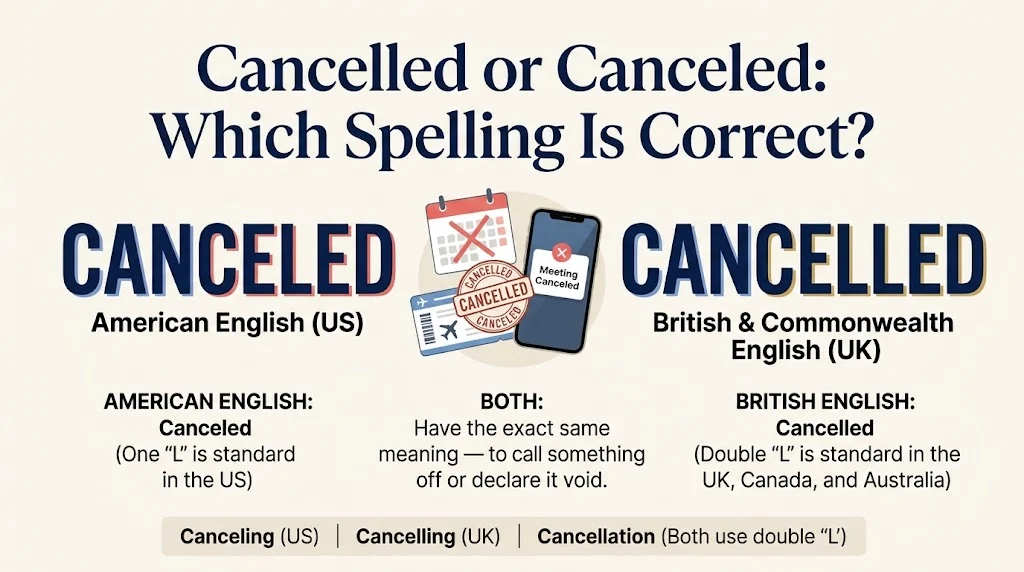
Both cancelled and canceled are correct spellings of the same word. Canceled is the preferred spelling in American English, while cancelled is standard in British English. Both forms mean that something planned, scheduled, or arranged has been called off.
Choosing between cancelled or canceled can be confusing because both spellings appear in books, news articles, emails, and everyday conversations. Although the two words look different, they have exactly the same meaning. The main difference is regional spelling preference.
In American English, writers generally use canceled with one L. In British English, writers typically use cancelled with two Ls. The same pattern appears in related forms, such as canceling and cancelling. However, the noun cancellation uses two Ls in both varieties.
Understanding this distinction helps you write more clearly and avoid unnecessary spelling mistakes. It is particularly useful when preparing professional emails, academic assignments, website content, business announcements, or social media posts.
For US-focused writing, including American SEO content, canceled is usually the best choice. Nevertheless, cancelled is not incorrect; it simply follows the spelling convention commonly used in British English and several other English-speaking regions.
Cancelled or Canceled: What Is the Difference?
The difference between cancelled and canceled is spelling, not meaning.
Both words are the past tense and past participle of the verb cancel. They describe an event, appointment, order, agreement, or activity that has been called off.
The main distinction is the regional convention used by the writer.
| Spelling | Preferred Variety | Meaning | Example |
|---|---|---|---|
| Canceled | American English | Called off or stopped | The flight was canceled. |
| Cancelled | British English | Called off or stopped | The flight was cancelled. |
Both sentences are grammatically correct. The choice depends on the English variety you are following.
Why Are There Two Spellings?
English spelling developed through different historical influences, and regional conventions gradually became established. American English often favors simplified spellings, while British English has retained certain traditional forms.
The spelling of cancel follows this pattern. American writers generally use one L in canceled, whereas British writers typically double the L in cancelled.
Neither spelling is universally more correct. Each is appropriate in its respective variety of English.
Is Canceled or Cancelled Correct in American English?
Canceled is the standard preferred spelling in American English.
American dictionaries and style guides generally favor one L in the past tense of cancel. This convention also applies to canceling, the present participle.
Examples include:
- The school canceled classes because of the snowstorm.
- The airline canceled our flight.
- I canceled my appointment yesterday.
- The company canceled its advertising campaign.
- She is canceling her subscription next month.
Although American readers may encounter cancelled in British publications or international writing, canceled is usually the safer choice for content intended for a US audience.
Should American Writers Always Use Canceled?
For most standard American writing, yes. However, consistency matters more than changing every instance without considering the context.
For example, if you are quoting a British publication, reproducing an official name, or following a particular organization’s spelling, you may need to retain cancelled.
Otherwise, use canceled throughout your American English article.
Is Cancelled or Canceled Correct in British English?
Cancelled is the standard preferred spelling in British English.
British writers typically double the final L when adding endings to words such as cancel. Therefore, they commonly write cancelled and cancelling.
Examples include:
- The concert was cancelled because of the weather.
- Our train was cancelled this morning.
- The manager cancelled the meeting.
- She is cancelling her membership.
- The event has been cancelled until further notice.
These spellings are standard in British English and are also common in other varieties that follow British spelling conventions.
Do Other Countries Use Cancelled?
Yes. Many writers in countries such as Australia, New Zealand, and other regions influenced by British English generally prefer cancelled.
However, individual organizations, publishers, and style guides may have their own preferences. When writing for a particular audience, follow the relevant style guide.
Cancelled vs. Canceled: Quick Comparison
The following table summarizes the most useful differences.
| Feature | Canceled | Cancelled |
|---|---|---|
| Preferred spelling | American English | British English |
| Number of Ls | One | Two |
| Meaning | Called off | Called off |
| Past tense | Yes | Yes |
| Past participle | Yes | Yes |
| Correct grammar | Yes | Yes |
| Common audience | US readers | UK readers |
| Example | The game was canceled. | The game was cancelled. |
As the comparison shows, the two forms do not differ in grammar or meaning. Only the spelling convention changes.
Canceling or Cancelling: Which Is Correct?
The same regional pattern applies to the present participle.
- Canceling is preferred in American English.
- Cancelling is preferred in British English.
The present participle can describe an action happening now or form part of a continuous verb construction.
Examples:
American English
- I am canceling my reservation.
- They are canceling the afternoon classes.
- The company is canceling its contract.
British English
- I am cancelling my reservation.
- They are cancelling the afternoon classes.
- The company is cancelling its contract.
Both sets of sentences are correct. Choose the form that matches the audience and maintain that spelling throughout your writing.
Cancellation or Cancelation: Which Spelling Is Correct?
This is where the spelling rule becomes slightly different.
Cancellation, with two Ls, is the standard spelling in both American and British English.
Examples:
- The cancellation of the event surprised everyone.
- We received a cancellation notice.
- The airline announced the cancellation of several flights.
- There is no cancellation fee for this booking.
You may occasionally see cancelation with one L, particularly in American usage, but it is much less common. For most formal writing, cancellation is the safest choice.
Notice that American English uses canceled but generally retains cancellation. You should not automatically remove an L from every related word.
Cancelled or Canceled in a Sentence
Examples can make the spelling distinction easier to remember.
Examples Using Canceled
These examples follow American English spelling.
- The school canceled classes because of severe weather.
- My doctor canceled our appointment.
- The airline canceled the flight without warning.
- We canceled our dinner reservation.
- The company canceled the product launch.
- She canceled her gym membership last week.
- The organizers canceled the outdoor concert.
- They canceled the order before it shipped.
- He canceled the meeting to finish an urgent report.
- The tournament was canceled because of heavy rain.
Examples Using Cancelled
These examples follow British English spelling.
- The school cancelled classes because of severe weather.
- My doctor cancelled our appointment.
- The airline cancelled the flight without warning.
- We cancelled our dinner reservation.
- The company cancelled the product launch.
- She cancelled her gym membership last week.
- The organisers cancelled the outdoor concert.
- They cancelled the order before it was dispatched.
- He cancelled the meeting to finish an urgent report.
- The tournament was cancelled because of heavy rain.
The sentences communicate the same ideas. Some examples also use other regional spelling differences, such as organizers in American English and organisers in British English.
How to Use Canceled and Cancelled in Everyday Writing
Both spellings can appear in several everyday situations. The correct choice depends on your audience.
1. Emails and Professional Messages
Use the spelling preferred by the people or organization receiving your message.
American English:
The meeting has been canceled. I will send an updated schedule shortly.
British English:
The meeting has been cancelled. I will send an updated schedule shortly.
Both versions are professional and grammatically correct.
2. Travel and Flight Updates
Airlines and travel companies frequently use the word when communicating schedule changes.
- American: Your flight has been canceled.
- British: Your flight has been cancelled.
If you are writing a travel article for a US audience, choose canceled. For a UK-focused travel guide, cancelled is generally more appropriate.
3. School and University Announcements
Schools may use either form depending on their location.
- American: Today’s classes are canceled.
- British: Today’s classes are cancelled.
For academic assignments, follow your institution’s spelling guidelines.
4. Online Shopping and Subscriptions
The word also appears in order updates and subscription notices.
- American: Your order was canceled successfully.
- British: Your order was cancelled successfully.
When describing a company’s official policy, preserve its terminology if necessary.
5. News Articles and Blog Posts
Publishers typically maintain a consistent regional style.
An American news website may write, “The event was canceled after organizers reviewed the weather forecast.”
A British publication may write, “The event was cancelled after organisers reviewed the weather forecast.”
Both sentences are correct within their respective conventions.
Common Mistakes to Avoid
Although the spelling difference is simple, several mistakes can occur.
Mistake 1: Assuming Cancelled Is Always Wrong
Some American writers assume that cancelled is a spelling error.
That is incorrect. It is the preferred spelling in British English and is widely used internationally.
Better approach: Choose the spelling that matches your audience.
Mistake 2: Assuming Canceled Is Always Wrong
The opposite mistake also occurs. Some writers believe that canceled is incorrect because they learned British English.
However, canceled is standard American English.
Better approach: Remember that both spellings are correct.
Mistake 3: Switching Spellings in One Article
Using canceled in one paragraph and cancelled in another can make an article look inconsistent.
Although readers can understand both, mixing regional conventions without a reason can reduce editorial quality.
Better approach: Select one English variety before writing and follow it throughout the article.
Mistake 4: Writing Cancelation in Formal Content
The spelling cancelation exists, but cancellation is much more widely accepted and is the usual choice in formal writing.
Better approach: Use cancellation unless a specific style guide or proper name requires another form.
Mistake 5: Applying the Rule to Every Related Word
Not every related word follows the same L pattern. For example, cancellation normally has two Ls in both American and British English.
Better approach: Learn the common forms together: cancel, canceled, canceling, and cancellation for American English; cancel, cancelled, cancelling, and cancellation for British English.
Advantages of Knowing the Difference
Understanding the difference between cancelled and canceled can improve your writing in several ways.
- Better consistency: You can maintain one spelling convention throughout a document.
- Clearer communication: Your writing matches the expectations of your intended audience.
- Professional presentation: Consistent spelling makes emails, reports, and articles look polished.
- Improved editing: You can identify regional spelling differences without incorrectly marking valid words as mistakes.
- More effective SEO localization: American-focused content can use the spelling US readers generally expect, while British-focused pages can use British conventions.
The main benefit is not that one spelling is better than the other. Rather, it is knowing when each form is appropriate.
Related Words and Their Spellings
The following words can help you remember the pattern.
| American English | British English |
|---|---|
| Canceled | Cancelled |
| Canceling | Cancelling |
| Traveler | Traveller |
| Traveled | Travelled |
| Traveling | Travelling |
| Labeled | Labelled |
| Labeling | Labelling |
| Fueled | Fuelled |
| Fueling | Fuelling |
These examples show a broader tendency in American English to use one L in certain forms where British English uses two. Nevertheless, English spelling has exceptions, so check individual words when uncertain.
Practice Quiz: Cancelled or Canceled?
Test your understanding with these short questions.
1. Which spelling is preferred in American English?
A. Cancelled
B. Canceled
Answer: B. Canceled.
2. Which spelling is preferred in British English?
A. Cancelled
B. Canceled
Answer: A. Cancelled.
3. Which noun spelling is standard in both varieties?
A. Cancelation
B. Cancellation
Answer: B. Cancellation.
4. Complete the sentence using American English: “The airline ___ my flight.”
A. cancelled
B. canceled
Answer: B. canceled.
5. Complete the sentence using British English: “The concert was ___ yesterday.”
A. cancelled
B. canceled
Answer: A. cancelled.
6. Are cancelled and canceled different in meaning?
A. Yes
B. No
Answer: B. No. They have the same meaning.
Frequently Asked Questions
Is cancelled or canceled correct?
Both are correct. Canceled is the preferred spelling in American English, while cancelled is preferred in British English.
Is canceled American or British?
Canceled is the standard American English form. British English generally uses cancelled.
Is cancelled British English?
Yes. Cancelled is the preferred form in British English and is also common in several other English-speaking countries.
Why does American English use canceled?
American English commonly uses one L in this form, reflecting regional spelling conventions that favor simplified spellings in certain words.
Is canceling or cancelling correct?
Both are correct. American English generally uses canceling, while British English generally uses cancelling.
Is cancellation spelled with one L or two?
The standard spelling is cancellation, with two Ls. It is used in both American and British English.
Which spelling should I use in a US-focused blog?
Use canceled for the past tense and canceling for the present participle. Use cancellation for the noun. Apply the same convention consistently throughout your content.
Can I use cancelled in an American sentence?
Yes. Readers will understand it, and it is an established spelling. However, canceled is the usual preference for standard American English writing.
Does cancelled mean the same as postponed?
Not exactly. Cancelled means that something has been called off. Postponed means that it has been delayed until a later time. A canceled event may never happen, while a postponed event is generally expected to happen later.
Is cancelation ever correct?
The one-L form cancelation is recorded in some usage, especially in American English, but cancellation is much more common and is the safer choice for most formal writing.
Is canceled the correct spelling for SEO content?
For content targeting American readers, canceled is generally the preferred spelling. However, spelling alone does not determine search performance; relevance, usefulness, and overall content quality also matter.
Conclusion
The choice between cancelled or canceled comes down to regional spelling preferences. Both words are correct and have the same meaning, but American English generally favors canceled, while British English favors cancelled.
For American writing, use canceled and canceling. For British writing, use cancelled and cancelling. In both varieties, cancellation is the standard noun spelling.
Most importantly, remain consistent. Once you know your audience, selecting the right spelling becomes simple.