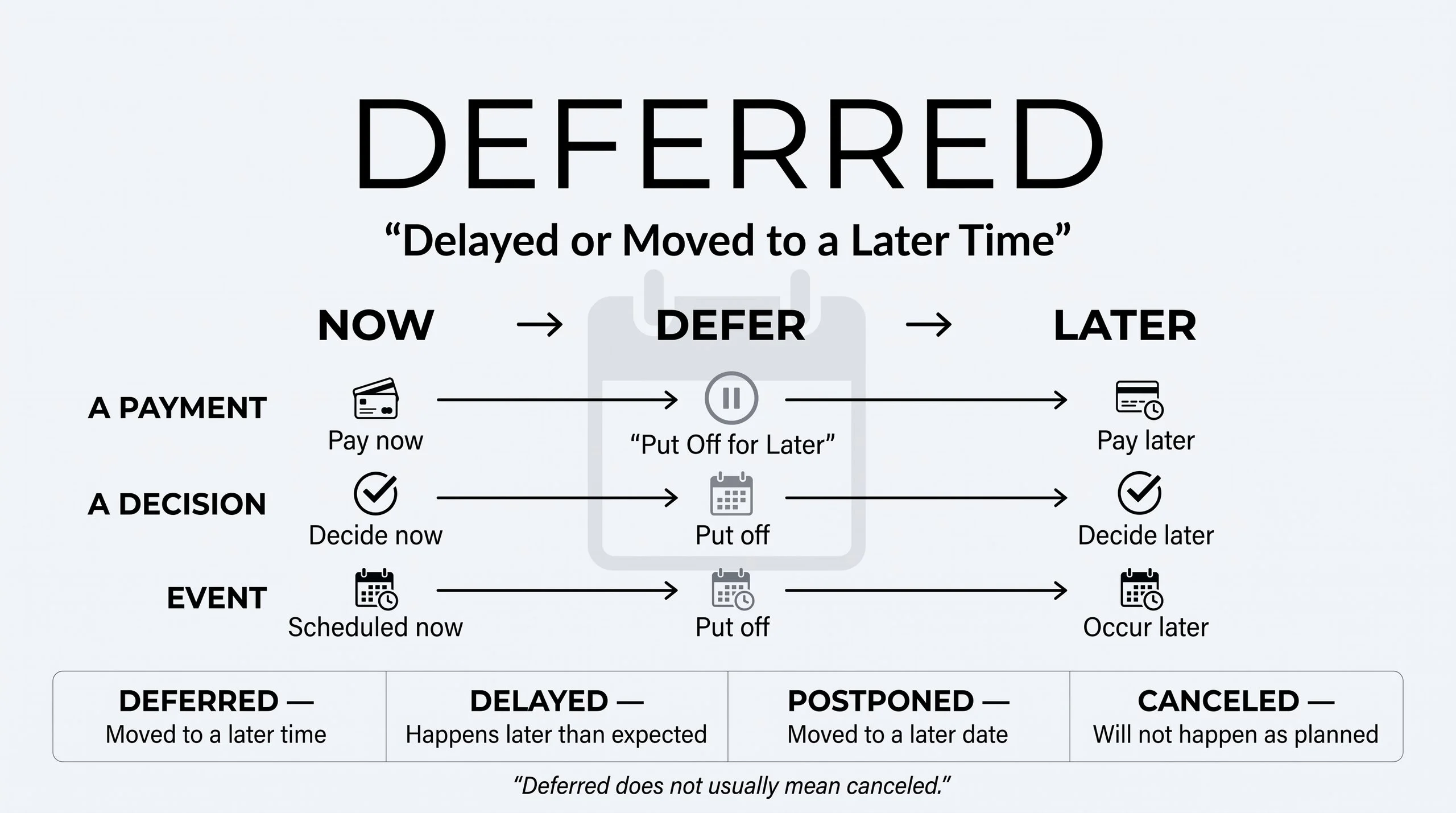
Deferred meaning refers to something that has been delayed, postponed, or moved to a later time. It often describes a decision, payment, action, event, or obligation that will happen later instead of happening immediately.
Deferred meaning describes something that has been put off until a later time. In simple terms, when something is deferred, it does not happen now. Instead, someone decides or agrees to deal with it later.
For example, if a company says, “The payment has been deferred,” the payment has been moved to a later date. Likewise, if a university offers deferred admission, the student’s admission decision or enrollment may be handled at a later stage.
The word deferred commonly appears in education, finance, business, law, employment, taxes, technology, and everyday conversation. Its exact meaning depends on the situation.
Importantly, deferred does not always mean canceled. Usually, it means that something has been delayed or intentionally moved forward to another time.
This guide explains deferred meaning, how to use the word naturally, its common contexts, examples, synonyms, related terms, and the differences between deferred, delayed, postponed, suspended, and canceled.
Quick Answer
| Meaning | Context | Primary Platforms | Example | Tone |
|---|---|---|---|---|
| Delayed until later | Everyday English | Conversation, texting | “The meeting was deferred.” | Neutral |
| Payment moved to a later date | Finance | Banking, business | “The payment was deferred.” | Formal |
| Decision made at a later time | Education | College applications | “Her admission was deferred.” | Formal |
| Action postponed intentionally | Business | Workplace | “The decision has been deferred.” | Professional |
| Obligation handled later | Legal or financial | Documents, contracts | “The payment is deferred.” | Formal |
What Does Deferred Mean?
Deferred means delayed, postponed, or moved to a later time.
It is the past tense and past participle of the verb defer.
For example:
“The meeting was deferred until Monday.”
This means the meeting will not happen at its original time. It has been moved to Monday.
Another example:
“The payment was deferred for six months.”
This means the person does not have to make the payment immediately. The payment will occur later.
The word often suggests that someone intentionally decided to wait.
Therefore, while deferred and delayed can have similar meanings, deferred often sounds more formal and deliberate.
Deferred Meaning in Simple English
In simple English:
Deferred means put off until later.
For example:
“The decision was deferred.”
Simply means:
“The decision was postponed.”
Another example:
“My payment has been deferred.”
This means:
“I will make the payment later.”
The word does not normally mean that something has disappeared or been canceled.
Instead, it suggests that the matter remains active but has been moved to a later time.
Deferred as a Verb
The base verb is defer.
For example:
“We decided to defer the meeting.”
This means:
“We decided to postpone the meeting.”
The past form is:
“We deferred the meeting.”
The past participle is:
“The meeting was deferred.”
Therefore:
| Form | Example |
|---|---|
| Defer | “We may defer the decision.” |
| Deferred | “We deferred the decision.” |
| Deferring | “They are deferring the decision.” |
Deferred as an Adjective
Deferred can also function as an adjective.
For example:
“The employee receives deferred compensation.”
Here, deferred describes compensation that will be paid later.
Similarly:
“She has a deferred payment plan.”
The word describes a payment arrangement in which payment occurs at a later time.
In these cases, deferred describes the timing of an action or obligation.
Deferred vs. Delayed
These words are very similar, but they can carry slightly different nuances.
Delayed means something happens later than expected or planned.
“The flight was delayed because of bad weather.”
Deferred often suggests that someone intentionally moved something to a later date.
“The committee deferred the decision until Friday.”
A delay can happen because of circumstances.
A deferral often results from a decision to wait.
However, the two words overlap in many situations.
Deferred vs. Postponed
Postponed means moved to a later time.
Deferred can mean the same thing, but it often sounds more formal.
Compare:
“The game was postponed until Saturday.”
“The decision was deferred until Saturday.”
Both sentences indicate that something will happen later.
However, postponed is especially common for events, while deferred frequently appears in formal, financial, educational, and administrative contexts.
Deferred vs. Canceled
These words have very different meanings.
Deferred means something is delayed or moved to a later time.
Canceled means something will not happen as planned.
For example:
“The meeting was deferred until Friday.”
The meeting still exists.
But:
“The meeting was canceled.”
The meeting will not happen.
Therefore, a deferred event may still take place later.
Deferred vs. Suspended
Suspended means temporarily stopped or interrupted.
Deferred means moved to a later time.
For example:
“The project was suspended.”
This suggests the project has been stopped temporarily.
“The project was deferred.”
This suggests the project was put off until later.
The distinction can become subtle because both terms can involve waiting.
Still, deferred focuses on timing, while suspended focuses on interruption.
Contextual Dynamics & Nuances of Deferred
The word deferred appears in many areas of modern life.
Its meaning remains connected to postponement, but the practical effect can differ depending on the context.
Deferred Payment
A deferred payment is a payment that will be made later.
For example:
“The customer received a deferred payment option.”
This means the customer does not have to pay immediately.
A business might offer this arrangement to give customers more time.
Deferred Admission
In education, a college may defer an admission decision.
For example:
“The university deferred her application.”
This can mean the institution has not made a final decision during the current admission round.
The application may be reconsidered later.
Importantly, deferred admission does not automatically mean acceptance or rejection.
Deferred Compensation
Deferred compensation refers to money earned or awarded now but paid at a later time.
For example:
“The employee receives part of the compensation through a deferred plan.”
The payment is delayed according to the terms of the arrangement.
Deferred Tax
In accounting and taxation, deferred tax generally refers to tax amounts recognized for a later period because of differences in when income, expenses, or tax effects are recognized.
The term is more technical in this context.
Therefore, the exact meaning depends on the relevant accounting or tax rules.
Deferred Decision
A deferred decision is a decision that has been intentionally postponed.
For example:
“The board deferred its decision until next month.”
The board has not necessarily rejected the proposal.
Instead, it plans to consider the matter later.
Deferred in Education
Education is one of the most common contexts for the word.
Students may encounter terms such as:
- Deferred admission
- Deferred enrollment
- Deferred application
- Deferred decision
- Deferred exam
- Deferred assessment
For example:
“My college application was deferred.”
This means the institution has not made the final admission decision at that stage.
The application may move into another review process.
Deferred Enrollment
Deferred enrollment means starting a program later than originally planned.
For example:
“The student deferred enrollment for one year.”
The student plans to begin later rather than immediately.
Deferred Exam
A deferred exam is an exam taken at a later time than the original scheduled date.
For example:
“She took a deferred exam after missing the original examination.”
The exact rules vary by school or institution.
Deferred in Finance
The word is particularly common in financial language.
Deferred Payment
A deferred payment allows payment to occur later.
For example:
“The agreement includes a deferred payment.”
The payment does not become due immediately.
Deferred Revenue
Deferred revenue refers to money a business receives before it has earned the related revenue under applicable accounting rules.
For example, a customer may pay for a yearly service in advance.
The company receives the money, but the revenue may be recognized over the period in which the service is provided.
Deferred Compensation
Deferred compensation involves compensation that is paid at a later date.
Depending on the arrangement, it may include salary, bonuses, retirement benefits, or other forms of compensation.
Because financial rules can be complex, the exact treatment depends on the specific plan and applicable regulations.
Deferred in Business
Businesses frequently defer decisions, payments, projects, investments, and expenses.
For example:
“Management deferred the expansion plan.”
This means management decided to delay the expansion.
Another example:
“The company deferred the product launch.”
The launch will happen later rather than at the original time.
A company may defer something because it needs:
- More information
- More funding
- Additional planning
- Better market conditions
- More time
- Approval from another party
The reason is not always stated.
Deferred in Legal Language
Legal and contractual documents often use deferred to describe obligations or actions that occur later.
For example:
“The parties agreed to a deferred payment schedule.”
This means the payment arrangement specifies a later date or future schedule.
Legal documents can use the term precisely, so the surrounding contract determines the exact obligation.
Deferred in Everyday Conversation
Although deferred sounds somewhat formal, people can use it in ordinary conversation.
For example:
“We deferred the trip until next month.”
This means:
“We postponed the trip until next month.”
Another example:
“Let’s defer that conversation until tomorrow.”
This means:
“Let’s talk about it tomorrow instead.”
In casual speech, however, put off, delay, or postpone may sound more natural.
Real-Life Conversation Examples Using Deferred
Example 1: Workplace
Manager: “Are we making the final decision today?”
Employee: “No. The team deferred the decision until Friday.”
Here, deferred means postponed.
Example 2: Education
Student: “Did the university reject your application?”
Friend: “No. They deferred it.”
The friend explains that the application remains under consideration.
Example 3: Payment
Customer: “When do I need to make the payment?”
Representative: “Your first payment has been deferred for 30 days.”
The payment will happen later.
Example 4: Personal Plans
Alex: “Are you moving next month?”
Sam: “Not anymore. We deferred the move until summer.”
The move has been postponed.
Example 5: Project Planning
Employee: “Why hasn’t the company started the project?”
Manager: “Leadership deferred the project while we review the budget.”
The project has been put off temporarily.
Platform-Specific Breakdown
How It Is Used on Snapchat
On Snapchat, deferred is not common slang. Users generally use it according to its standard English meaning.
For example:
“We deferred the trip until next week.”
A person could also use the word humorously in a message:
“I deferred cleaning my room again.”
Here, the speaker means they postponed the task.
However, words such as put off or delayed are usually more casual.
The Role of Deferred on TikTok
TikTok users may use deferred when discussing education, finance, work, or personal decisions.
For example, a student might say:
“My college application got deferred.”
Another creator might explain:
“What does deferred admission mean?”
The term itself is not primarily TikTok slang.
Instead, TikTok can provide a social-media setting where the standard term appears.
Instagram and Texting Dynamics
In Instagram captions and text messages, deferred can describe postponed plans or decisions.
For example:
“Trip deferred until next month.”
Or:
“Decision deferred.”
However, casual users may choose:
- Delayed
- Postponed
- Put off
- Pushed back
- Moved to later
These alternatives often sound more conversational.
Alternative Meanings & NLP Variations of Deferred
The core idea remains the same: something happens later instead of now.
However, several phrases can express different versions of that idea.
Deferred Until
“The meeting was deferred until Monday.”
This identifies the new time.
Deferred For
“The payment was deferred for six months.”
This identifies the length of the postponement.
Deferred Payment
A payment scheduled for a later time.
Deferred Decision
A decision postponed until more information or another stage.
Deferred Admission
An admission decision or enrollment situation moved to a later stage or date.
Deferred Compensation
Compensation paid at a later time under an arrangement.
Deferred Revenue
Money received before the related revenue is recognized under applicable accounting rules.
Synonyms for Deferred
The best synonym depends on the context.
Postponed
One of the closest general alternatives.
“The meeting was postponed.”
Delayed
Useful when something happens later than expected.
“The flight was delayed.”
Put Off
A casual expression meaning postponed.
“We put off the meeting.”
Rescheduled
Used when something is assigned a different date or time.
“The appointment was rescheduled.”
Held Back
Can describe something intentionally kept from happening immediately.
“The release was held back.”
Adjourned
Often used for meetings, hearings, or formal proceedings.
“The hearing was adjourned.”
Suspended
Means temporarily stopped rather than simply moved to another time.
“The program was suspended.”
Shelved
Often means an idea, project, or plan has been put aside, sometimes indefinitely.
“The proposal was shelved.”
Therefore, not every synonym works in every sentence.
Deferred vs. Delayed vs. Postponed
| Word | Main Idea | Typical Tone | Example |
|---|---|---|---|
| Deferred | Moved to a later time | Formal | “The decision was deferred.” |
| Delayed | Happened later than expected | Neutral | “The train was delayed.” |
| Postponed | Moved an event to a later date | Neutral | “The meeting was postponed.” |
| Put off | Delayed intentionally | Casual | “We put off the meeting.” |
| Rescheduled | Given a new date or time | Neutral | “The appointment was rescheduled.” |
| Suspended | Temporarily stopped | Formal | “The service was suspended.” |
| Canceled | No longer planned | Neutral | “The event was canceled.” |
Is Deferred a Negative Word?
Not necessarily.
Deferred is generally neutral.
Its emotional meaning depends on what has been deferred.
For example:
“Your payment has been deferred.”
This could be good news because the person receives more time to pay.
However:
“Your application has been deferred.”
This may create uncertainty because the person still does not have a final decision.
Therefore, the word itself does not indicate whether the situation is positive or negative.
Does Deferred Mean Rejected?
Usually, no.
This is particularly important in educational contexts.
If an application is deferred, it generally means the decision has been postponed or moved to another review stage.
That is different from:
“Your application was rejected.”
A rejection is a final negative decision.
A deferral usually means the matter remains unresolved at that point.
The exact process depends on the institution or organization.
Does Deferred Mean Canceled?
No.
Something that is deferred has generally been moved to a later time.
Something that is canceled is no longer planned.
For example:
“The event was deferred until June.”
The event may still happen.
“The event was canceled.”
The event will not happen as planned.
Does Deferred Mean Permanent?
No.
The word itself does not mean permanent.
A deferral normally indicates that something has been moved to a later time.
However, the new date may or may not be specified.
For example:
“The project has been deferred.”
This tells you that the project has been put off, but it does not necessarily tell you when it will resume.
Why Do People Defer Things?
People and organizations may defer something for many reasons.
Common reasons include:
- Waiting for more information
- Lack of resources
- Budget concerns
- Scheduling conflicts
- Changing priorities
- Additional review
- Uncertainty
- Preparation
- External circumstances
For example:
“The company deferred the launch while it tested the product.”
The company chose to wait before proceeding.
Common Mistakes With Deferred
Mistake 1: Assuming It Means Canceled
Deferred does not normally mean canceled.
It means delayed or postponed.
Mistake 2: Assuming It Means Rejected
In education and applications, a deferred decision is not necessarily a rejection.
The final outcome may come later.
Mistake 3: Using It as a Synonym for Suspended Every Time
Suspended usually suggests that something has been stopped.
Deferred focuses on moving something to a later time.
Mistake 4: Using It in Very Casual Conversation
Although grammatically correct, deferred can sound formal.
Instead of:
“I deferred cleaning my room.”
A casual speaker might say:
“I put off cleaning my room.”
Mistake 5: Forgetting the New Time
When useful, specify when something will happen.
“The meeting was deferred until Monday.”
This is clearer than:
“The meeting was deferred.”
How to Use Deferred in a Sentence
Here are several natural examples:
- “The meeting was deferred until next week.”
- “The payment has been deferred for 60 days.”
- “The committee deferred its decision.”
- “The student deferred enrollment for a year.”
- “The company deferred the project.”
- “The application was deferred for further review.”
- “The event was deferred because of the weather.”
- “The board deferred the discussion.”
- “She deferred the payment until next month.”
- “The launch was deferred until the team finished testing.”
Grammar: How to Use Deferred Correctly
Deferred commonly appears with until, for, or a noun.
Deferred Until
Use this when you identify a future time.
“The meeting was deferred until Friday.”
Deferred For
Use this when you identify the duration.
“The payment was deferred for three months.”
Deferred Decision
Use deferred before a noun when describing its status.
“The committee reached a deferred decision.”
However, in many contexts, the decision was deferred sounds more natural.
FAQs
What does deferred mean?
Deferred means delayed, postponed, or moved to a later time instead of happening immediately.
What does deferred mean in simple terms?
In simple terms, deferred means put off until later.
Does deferred mean delayed?
Yes. Deferred can mean delayed, although it often suggests an intentional decision to move something to a later time.
Does deferred mean rejected?
No. A deferred decision usually means the decision has been postponed. It does not automatically mean rejection.
Does deferred mean canceled?
No. Deferred usually means something has been postponed, while canceled means it will not happen as planned.
What is the difference between deferred and postponed?
Both can mean moved to a later time. Deferred often sounds more formal, while postponed is common for events and everyday situations.
What is the difference between deferred and delayed?
Delayed often means something happens later than expected. Deferred can suggest that someone intentionally chose to postpone it.
What is a deferred payment?
A deferred payment is a payment that is scheduled for a later time instead of being due immediately.
What is deferred admission?
Deferred admission generally means an educational institution has postponed its final admission decision or moved the applicant into a later review stage.
What is another word for deferred?
Depending on the context, alternatives include postponed, delayed, put off, rescheduled, held back, or shelved.
Conclusion
The deferred meaning is simple: something has been delayed, postponed, or moved to a later time.
The word appears in many areas, including education, finance, business, law, employment, and everyday English. Its formal tone makes it especially common in official documents and professional communication.
A deferred payment happens later. A deferred decision is made later. Deferred admission means an educational decision may be handled at a later stage. Similarly, a deferred project has been put off rather than necessarily canceled.
The most important distinction is that deferred does not usually mean canceled or rejected. Instead, it indicates that something has been moved away from the present and toward a later time.
The easiest way to remember the word is:
Deferred = put off until later.
Once you understand that core idea, terms such as deferred payment, deferred admission, deferred decision, and deferred compensation become much easier to understand.