What Is Another Word for Also?
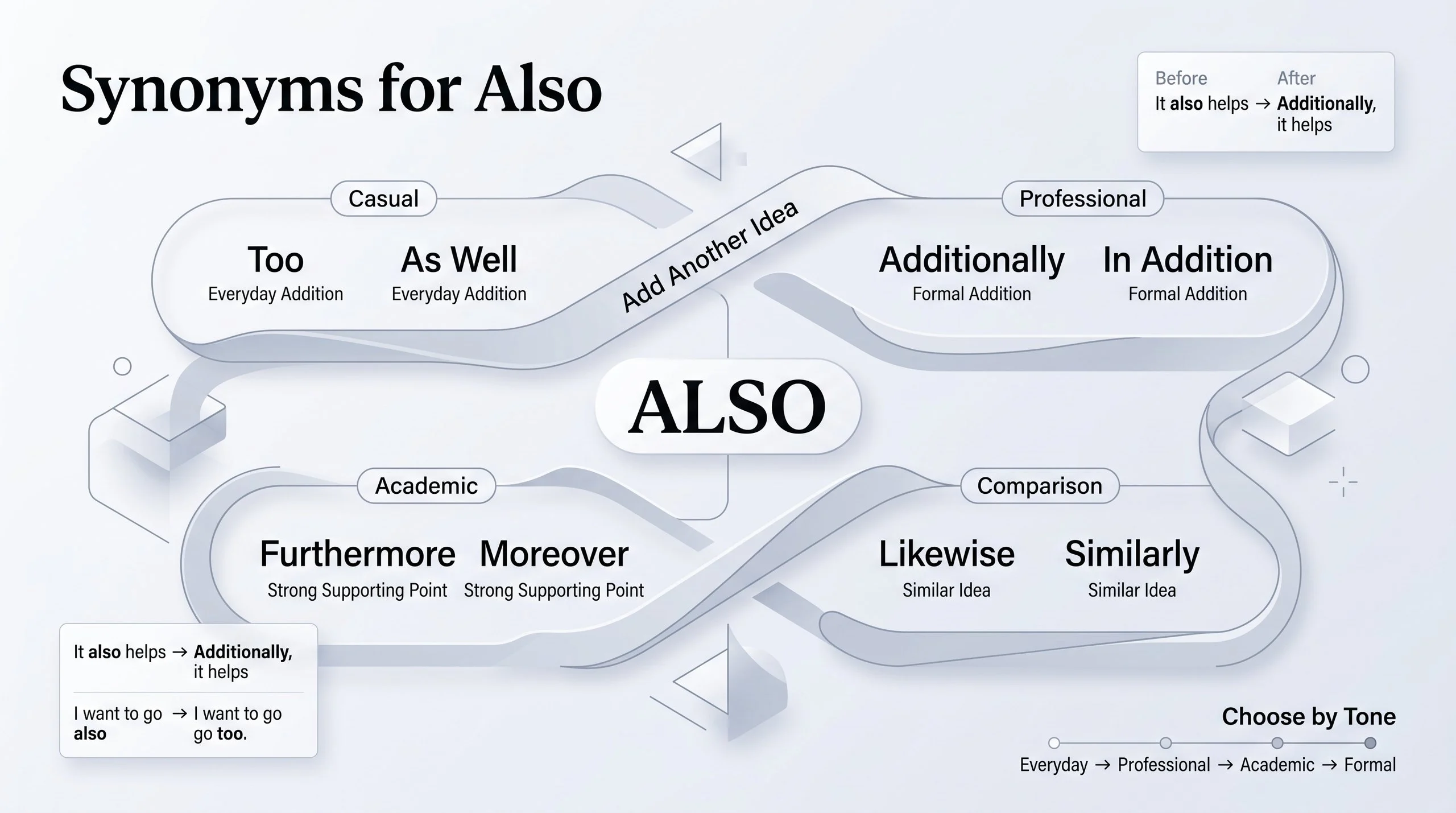
Common synonyms for also include too, additionally, furthermore, moreover, likewise, as well, besides, in addition, similarly, and what’s more. The best choice depends on your sentence and tone. For academic or professional writing, additionally, furthermore, moreover, and in addition work well. For casual English, too, as well, and besides sound more natural.
What Does Also Mean?
Also means in addition, as well, or too. It adds another fact, idea, person, action, or quality to something already mentioned.
For example:
She speaks Spanish. She also speaks French.
Here, also adds another language.
You can use also in everyday conversation, business writing, academic work, emails, essays, and online content. However, repeating it too often can make writing sound flat. Therefore, choosing a suitable alternative can improve variety and precision.
Best Synonyms for Also
| Synonym | Meaning | Best Use | Example |
|---|---|---|---|
| Additionally | In addition | Professional and academic writing | The course is affordable. Additionally, it is flexible. |
| Furthermore | In addition to what was stated | Formal writing | The method is simple. Furthermore, it is effective. |
| Moreover | Adding an important point | Formal or persuasive writing | The product is affordable. Moreover, it is durable. |
| In addition | Adding another fact | Academic and professional writing | In addition, the report includes recommendations. |
| Too | Also or as well | Everyday English | I want to go too. |
| As well | Also | Conversational English | She speaks French as well. |
| Besides | In addition; apart from that | Conversation and informal writing | Besides, we have other options. |
| Likewise | In the same way | Comparison | She enjoyed the event, and I likewise enjoyed it. |
| Similarly | In a similar way | Comparison and academic writing | Similarly, the second study found positive results. |
| What’s more | In addition, often with emphasis | Conversational or persuasive writing | What’s more, the service is free. |
Synonyms for Also by Context
Formal Synonyms for Also
When writing an essay, report, proposal, or formal document, you can replace also with:
- Additionally
- Furthermore
- Moreover
- In addition
- Likewise
- Similarly
For example:
Basic:
The policy reduces costs. It also improves efficiency.
More formal:
The policy reduces costs. Additionally, it improves efficiency.
Another option is:
The policy reduces costs. Furthermore, it improves efficiency.
These alternatives create a stronger connection between related ideas.
Academic Alternatives
Academic writing often benefits from transitions that clearly show how one point relates to another.
Useful choices include:
- Additionally
- Furthermore
- Moreover
- In addition
- Similarly
- Likewise
For example:
The study examined employee satisfaction. Additionally, it analyzed workplace productivity.
If the second point is especially important, moreover can add emphasis:
The treatment reduced symptoms. Moreover, participants reported improved quality of life.
However, use formal transitions naturally. Adding moreover to every paragraph can make an essay sound repetitive or overly formal.
Professional Alternatives
Business writing usually needs clear, direct transitions.
Good alternatives include:
- Additionally
- Furthermore
- In addition
- Moreover
- As well
- Also
- What’s more
For example:
The software reduces processing time. Additionally, it lowers operating costs.
In an email, you could write:
The meeting will cover the new schedule. In addition, we will review the project timeline.
Everyday Alternatives
Casual English usually favors shorter expressions.
Common choices include:
- Too
- As well
- Besides
- Also
- What’s more
For example:
I want to come too.
Or:
She likes coffee as well.
You can also say:
Besides, we have plenty of time.
These options usually sound more natural in conversation than furthermore or moreover.
Professional Alternatives to Also
Additionally
Meaning: In addition to something already mentioned.
Tone: Professional and neutral.
Difficulty: Easy.
Usage frequency: Common.
Best for: Reports, emails, essays, presentations, and business writing.
The new system saves time. Additionally, it reduces errors.
Furthermore
Meaning: In addition to the previous point.
Tone: Formal.
Difficulty: Medium.
Usage frequency: Common.
Best for: Academic writing, reports, formal arguments, and professional documents.
The proposal is cost-effective. Furthermore, it can be implemented quickly.
Moreover
Meaning: In addition, especially when introducing an important supporting point.
Tone: Formal.
Difficulty: Medium.
Usage frequency: Common.
Best for: Essays, persuasive writing, reports, and formal communication.
The solution is affordable. Moreover, it requires little maintenance.
In Addition
Meaning: Adding another point or fact.
Tone: Neutral to formal.
Difficulty: Easy.
Usage frequency: Very common.
Best for: Essays, reports, emails, and general writing.
In addition, the company provides free training.
Likewise
Meaning: In the same way or similarly.
Tone: Neutral to formal.
Difficulty: Medium.
Usage frequency: Common.
Best for: Comparisons and parallel ideas.
The first team performed well. Likewise, the second team exceeded expectations.
Notice that likewise is not a perfect replacement for also. It usually communicates similarity, not merely addition.
Simple Synonyms for Also
If you want a short and natural alternative, try:
- Too
- As well
- In addition
- Besides
- Additionally
For example:
She also wants to join.
can become:
She wants to join too.
Or:
She wants to join as well.
For simple everyday communication, these choices often sound more natural than formal transitions.
Stronger or More Emphatic Alternatives
Some alternatives do more than simply add information.
Moreover
Use moreover when the added point strengthens the argument.
The product is inexpensive. Moreover, it is easy to use.
Furthermore
Use furthermore when you want to continue developing a formal argument.
The approach saves time. Furthermore, it reduces unnecessary costs.
What’s More
Use what’s more when you want a more conversational emphasis.
The hotel is affordable. What’s more, breakfast is included.
Besides
Besides can add another reason or point, especially in conversation.
We should stay home. Besides, it is already getting late.
The meaning can shift slightly depending on context, so besides should not replace also automatically.
Also vs. Similar Alternatives
Also vs. Additionally
Both add information.
The service is fast. Also, it is affordable.
The service is fast. Additionally, it is affordable.
Additionally sounds more formal and works especially well as a transition between sentences.
Also vs. Furthermore
Furthermore is more formal and often helps build an argument.
The plan is practical. Furthermore, it is affordable.
Use also for simple addition and furthermore when developing a formal point.
Also vs. Moreover
Moreover often gives the added information extra rhetorical weight.
The product is useful. Moreover, it is inexpensive.
The second statement feels like an additional reason supporting the first.
Also vs. Too
Too is usually more conversational.
I want to go too.
You would rarely replace that sentence with:
I want to go additionally.
That sounds unnatural.
Also vs. As Well
As well is another natural everyday alternative.
She speaks English and French as well.
It commonly appears at the end of a sentence.
Also vs. Besides
Besides can mean in addition, but it may also introduce another reason or argument.
Besides, we have enough time.
Therefore, it is not always interchangeable with also.
Also vs. Likewise
Likewise suggests that something happens in the same way.
Sarah enjoyed the presentation. Likewise, Tom enjoyed it.
Simply saying:
Tom also enjoyed it.
does not emphasize the comparison in the same way.
Also vs. Similarly
Similarly highlights similarity between two ideas, situations, or results.
The first study found an improvement. Similarly, the second study reported positive results.
It does more than simply add another fact.
How to Choose the Right Synonym
| Your purpose | Best choice |
|---|---|
| Simple addition | Also |
| Casual addition | Too |
| Casual sentence ending | As well |
| Professional addition | Additionally |
| Formal addition | Furthermore |
| Emphasized supporting point | Moreover |
| Adding another fact | In addition |
| Similar action or result | Likewise |
| Similar idea or finding | Similarly |
| Another reason | Besides |
| Conversational emphasis | What’s more |
Before-and-After Examples
Example 1: Basic → Professional
Before:
The software is affordable. It also saves time.
After:
The software is affordable. Additionally, it saves time.
Example 2: Basic → Academic
Before:
The research found better results. It also identified fewer errors.
After:
The research found better results. Furthermore, it identified fewer errors.
Example 3: Basic → Persuasive
Before:
The product is affordable. It is also easy to use.
After:
The product is affordable. Moreover, it is easy to use.
Example 4: Formal → Conversational
Before:
Additionally, I would like to attend.
After:
I would like to attend too.
Example 5: Comparison
Basic:
The first study produced positive results. The second study also produced positive results.
More precise:
The first study produced positive results. Similarly, the second study reported positive results.
Here, similarly makes the relationship between the studies clearer.
Common Mistakes When Replacing Also
Using Moreover in Casual Conversation
I want pizza. Moreover, I want dessert.
This sounds overly formal for most casual conversations.
A more natural version is:
I want pizza. I want dessert too.
Using Likewise for Simple Addition
Likewise means “in the same way,” so it should usually connect comparable ideas.
Instead of:
I bought a notebook. Likewise, I bought a pen.
say:
I bought a notebook. I also bought a pen.
Overusing Furthermore
Repeating furthermore throughout an essay can make your writing feel mechanical.
Instead, vary transitions:
Additionally…
Moreover…
In addition…
Similarly…
This creates better flow.
Using Additionally When “Too” Sounds Better
Consider the sentence:
I would like to come additionally.
This sounds unnatural.
A better version is:
I would like to come too.
Therefore, always consider the sentence structure before choosing a synonym.
Synonym Analysis
| Word | Tone | Difficulty | Frequency | Best For |
|---|---|---|---|---|
| Also | Neutral | Easy | Very Common | All writing |
| Too | Casual | Easy | Very Common | Conversation |
| As well | Neutral | Easy | Very Common | Conversation |
| Additionally | Professional | Easy | Common | Business, reports |
| Furthermore | Formal | Medium | Common | Essays, reports |
| Moreover | Formal | Medium | Common | Persuasive writing |
| In addition | Neutral/Formal | Easy | Very Common | General writing |
| Likewise | Neutral/Formal | Medium | Common | Comparisons |
| Similarly | Neutral/Formal | Medium | Common | Academic writing |
| Besides | Casual/Neutral | Easy | Common | Conversation |
| What’s more | Conversational | Easy | Common | Persuasive speech |
FAQs
What is another word for also?
Common alternatives include too, additionally, furthermore, moreover, in addition, as well, besides, likewise, and similarly.
What is a formal synonym for also?
The most useful formal alternatives are additionally, furthermore, moreover, and in addition.
What is a professional word for also?
Additionally is one of the most natural professional alternatives to also. Furthermore and in addition also work well in business writing.
What is a simple synonym for also?
The simplest alternatives are too and as well.
Can I use additionally instead of also?
Yes. Additionally can replace also when you want a more formal or professional tone.
Is moreover the same as also?
Not exactly. Both can add information, but moreover often emphasizes that the new point provides additional support or importance.
Is furthermore a synonym for also?
Yes, in many formal contexts. However, furthermore generally sounds more formal and works especially well when developing an argument.
Is too the same as also?
Often, yes. Both can express addition.
I like coffee too.
I also like coffee.
However, their positions in a sentence differ.
What is the best synonym for also in an essay?
Additionally, furthermore, moreover, and in addition are strong choices. The best option depends on whether you simply want to add information or emphasize the next point.
What can I use instead of also in academic writing?
Use additionally, furthermore, moreover, in addition, similarly, or likewise, depending on the relationship between ideas.
What is a synonym for also in a sentence?
For example:
She also works remotely.
You could write:
She additionally works remotely.
However, a more natural alternative may be:
She works remotely as well.
The correct choice depends on tone and sentence structure.
Conclusion
The best synonyms for also depend on the tone and relationship between your ideas. For simple everyday English, too and as well are natural choices. In professional writing, additionally and in addition provide clear alternatives. Meanwhile, furthermore and moreover work well when developing a formal argument.
For comparisons, likewise and similarly can provide greater precision. On the other hand, besides and what’s more work well when adding another conversational point or reason.
Ultimately, the goal is not to replace also every time you use it. Instead, choose an alternative that accurately expresses the relationship between your ideas while keeping your writing natural and easy to understand.