What Are the Best Synonyms for A Lot?
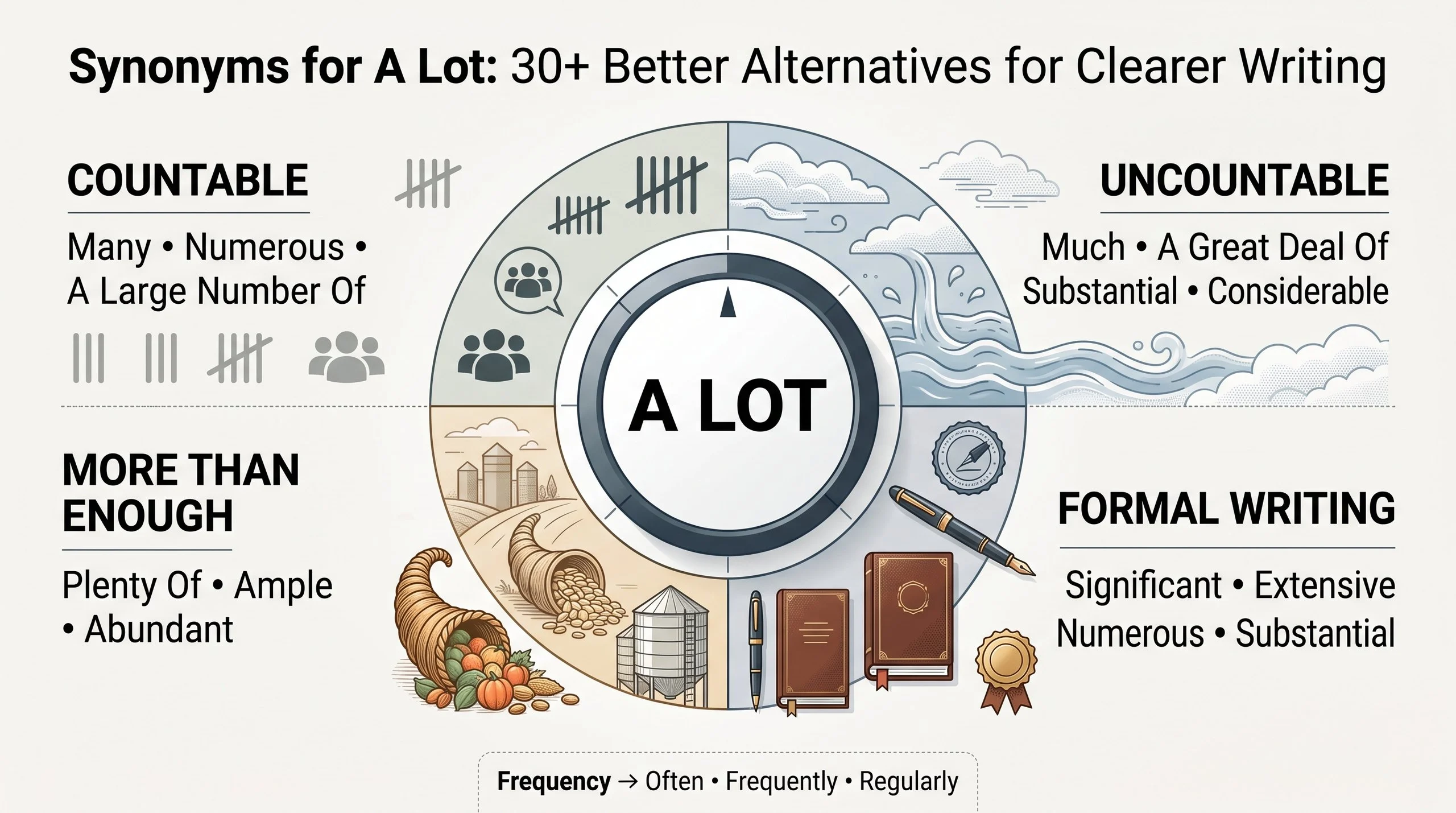
The best synonyms for a lot include many, much, numerous, plenty of, numerous amounts of, a great deal of, a large number of, substantial, considerable, abundant, ample, extensive, countless, and numerous. However, the correct alternative depends on whether you are describing people, things, money, time, effort, or an abstract amount.
For everyday writing, many, much, plenty of, and lots of are natural choices. In formal or academic writing, numerous, substantial, considerable, a significant amount of, and a large number of often sound more precise.
What Does “A Lot” Mean?
A lot usually means a large quantity, amount, number, or degree of something.
For example:
She has a lot of books.
Here, “a lot of” means many books.
It can also describe an abstract amount:
He spends a lot of time studying.
In this sentence, a lot of means a great deal of time.
The phrase can also describe frequency or degree:
I travel a lot.
Here, alternatives include frequently, often, regularly, or extensively, depending on the intended meaning.
Because “a lot” has several uses, the best synonym changes according to the sentence.
Best Synonyms for A Lot
| Synonym | Best Meaning | Best Used For | Tone |
|---|---|---|---|
| Many | A large number | Countable nouns | Neutral |
| Much | A large amount | Uncountable nouns | Neutral |
| Plenty of | More than enough | People, things, amounts | Casual |
| Lots of | A large amount or number | Everyday writing | Casual |
| Numerous | A large number | People or things | Formal |
| A great deal of | A large amount | Time, money, effort | Formal |
| A large number of | Many | Countable nouns | Formal |
| A significant amount of | A notably large amount | Data, money, resources | Professional |
| Substantial | Large and meaningful | Amounts, resources, changes | Professional |
| Considerable | Fairly large | Amounts, effort, influence | Formal |
| Abundant | More than enough | Resources, opportunities | Formal |
| Ample | Enough or more than enough | Time, space, resources | Professional |
| Countless | Too many to count | People, examples, occasions | Expressive |
| Extensive | Covering a large range | Knowledge, research, work | Formal |
| Numerous | Many individual items | Examples, studies, reasons | Formal |
Quick Rule
Use many with countable nouns, much with uncountable nouns, plenty of for more-than-enough quantities, and numerous for formal references to many individual things.
Synonyms for A Lot Meaning Many
When “a lot of” comes before a countable plural noun, many is usually the simplest replacement.
Examples
A lot of students attended the lecture.
- Better:
Many students attended the lecture.
A lot of companies use the software.
- Better:
Many companies use the software.
A lot of people support the idea.
- Better:
Many people support the idea.
Other options include:
- Numerous
- A large number of
- Countless
- Several
- Dozens of
- Hundreds of
- Thousands of
However, these alternatives are not always interchangeable.
For instance, several usually suggests more than two but does not necessarily mean a very large number. Meanwhile, countless emphasizes an extremely large or uncountable number.
Synonyms for A Lot Meaning Much
When “a lot of” comes before an uncountable noun, much or a great deal of can work well.
Examples of uncountable nouns include:
- Time
- Money
- Water
- Information
- Effort
- Energy
- Attention
- Experience
- Knowledge
Examples
She spends a lot of time reading.
- Alternative:
She spends a great deal of time reading.
The project requires a lot of effort.
- Alternative:
The project requires considerable effort.
The company invested a lot of money.
- Alternative:
The company invested a substantial amount of money.
Therefore, the noun after “a lot of” helps determine the best replacement.
Formal Synonyms for A Lot
The phrase a lot is common in conversation, but formal writing often benefits from more precise alternatives.
Consider:
- Numerous
- A great deal of
- A large number of
- A significant amount of
- Substantial
- Considerable
- Extensive
- Abundant
- Ample
- A considerable amount of
Examples
Informal:
A lot of researchers studied the issue.
Formal:
Numerous researchers studied the issue.
Informal:
The project required a lot of funding.
Formal:
The project required substantial funding.
Informal:
The organization received a lot of support.
Formal:
The organization received considerable support.
As a result, formal alternatives can make your writing more specific without simply making it more complicated.
Professional Synonyms for A Lot
Business writing often requires precision. Instead of repeatedly using “a lot,” consider:
- Substantial
- Significant
- Considerable
- Extensive
- Numerous
- Ample
- A large number of
- A significant amount of
- A substantial volume of
- A considerable amount of
Business Examples
Before:
The company received a lot of customer feedback.
After:
The company received substantial customer feedback.
Before:
We have a lot of data to analyze.
After:
We have a substantial amount of data to analyze.
Before:
The campaign generated a lot of interest.
After:
The campaign generated significant interest.
These alternatives sound more professional because they specify the scale without relying on a vague conversational phrase.
Academic Synonyms for A Lot
Academic writing generally favors precise vocabulary.
Useful alternatives include:
- Numerous
- Substantial
- Considerable
- Significant
- Extensive
- A large number of
- A considerable amount of
- A substantial body of
- A wide range of
- Abundant
Examples
Before:
A lot of studies have examined this issue.
After:
Numerous studies have examined this issue.
Before:
The researchers collected a lot of data.
After:
The researchers collected a substantial amount of data.
Before:
There are a lot of reasons for this result.
After:
There are numerous reasons for this result.
Use “Significant” Carefully
Significant can mean “large or important,” but it also has a specific technical meaning in statistics.
Therefore, don’t automatically replace every use of “a lot” with “significant.” The context should support the intended meaning.
Synonyms for A Lot in Everyday Conversation
For casual speech and informal writing, these options sound natural:
- Lots of
- Plenty of
- Loads of
- Tons of
- Heaps of
- A bunch of
- Many
- Much
- Quite a bit of
- Quite a few
Examples
We have a lot of food.
We have plenty of food.
She has a lot of friends.
She has lots of friends.
He has a lot of work today.
He has loads of work today.
Some of these phrases are highly informal. For example, tons of, loads of, and heaps of should generally stay in casual contexts.
Synonyms for A Lot of People
When referring to people, several alternatives work well:
- Many people
- Numerous people
- A large number of people
- Countless people
- Thousands of people
- A crowd of people
- Large numbers of people
Examples
A lot of people attended the event.
Neutral:
Many people attended the event.
Formal:
A large number of people attended the event.
More expressive:
Countless people attended the event.
However, countless should not be used when an exact number matters.
Synonyms for A Lot of Money
For money, use:
- A large amount of money
- A substantial amount of money
- A considerable sum
- Significant funds
- Substantial funding
- Considerable financial resources
- A sizable investment
Examples
The company spent a lot of money on advertising.
Professional:
The company made a substantial investment in advertising.
The project requires a lot of money.
Formal:
The project requires substantial funding.
These alternatives are more precise in business and financial contexts.
Synonyms for A Lot of Time
When referring to time, useful alternatives include:
- Much time
- A great deal of time
- Considerable time
- An extensive amount of time
- A significant amount of time
- A considerable period
- Extended time
Examples
She spends a lot of time studying.
She spends a great deal of time studying.
Or:
She devotes considerable time to her studies.
The final version sounds more polished because devotes also explains how the time is being used.
Synonyms for A Lot of Work
Good alternatives include:
- Considerable work
- Substantial work
- Extensive work
- A great deal of work
- Significant effort
- A substantial workload
- Extensive effort
Examples
The project requires a lot of work.
Professional:
The project requires substantial work.
More precise:
The project requires considerable effort.
Workload-focused:
The project involves a substantial workload.
Synonyms for A Lot Meaning Frequently
Sometimes a lot does not describe quantity. It describes how often something happens.
For example:
She travels a lot.
Here, “a lot” means frequently.
Better alternatives include:
- Frequently
- Often
- Regularly
- Repeatedly
- Consistently
- Continually
- Extensively
- On many occasions
Examples
He reads a lot.
He reads frequently.
She visits her family a lot.
She regularly visits her family.
This distinction is important because many or numerous would not work in these sentences.
Synonyms for A Lot Meaning Very Much
“A lot” can also mean very much.
For example:
I like this song a lot.
Possible alternatives include:
- Very much
- Greatly
- Deeply
- Strongly
- Considerably
- Extremely
Examples
I appreciate your help a lot.
I greatly appreciate your help.
She cares about her family a lot.
She cares deeply about her family.
The best alternative depends on the emotion or action being described.
Synonyms for A Lot of Experience
Instead of:
She has a lot of experience in marketing.
You could write:
She has extensive experience in marketing.
Or:
She has considerable experience in marketing.
For stronger professional emphasis:
She has extensive expertise in marketing.
However, expertise and experience are not identical. Experience describes firsthand involvement over time, while expertise emphasizes advanced knowledge or skill.
A Lot vs. Many vs. Much
These words are closely related but have different grammatical uses.
| Expression | Used With | Example |
|---|---|---|
| A lot of | Countable and uncountable nouns | A lot of books / a lot of time |
| Many | Countable plural nouns | Many books |
| Much | Uncountable nouns | Much time |
| Numerous | Countable plural nouns | Numerous books |
| A great deal of | Uncountable nouns | A great deal of time |
| Plenty of | Countable and uncountable nouns | Plenty of books / plenty of time |
Simple Rule
If you can count the items individually, many or numerous may work.
If you cannot normally count the noun individually, much or a great deal of may work.
Meanwhile, a lot of can work with both.
A Lot vs. Plenty of
These expressions are similar, but plenty of often suggests more than enough.
We have a lot of food.
This simply says there is a large amount.
We have plenty of food.
This suggests there is enough food and probably extra.
Therefore, plenty of is not always an exact replacement for “a lot of.”
A Lot vs. Numerous
Numerous means many individual people or things.
Numerous studies support the finding.
You would not normally use it with an uncountable noun:
Numerous information ❌
Instead:
A lot of information
Or:
A substantial amount of information
This distinction makes numerous especially useful in academic and professional writing.
Common Mistakes When Using Synonyms for A Lot
1. Using “Numerous” With Uncountable Nouns
Incorrect:
Numerous information was collected.
Better:
A large amount of information was collected.
Or:
Substantial information was collected.
2. Using “Much” in Every Positive Sentence
In everyday affirmative sentences, “a lot of” often sounds more natural than “much.”
I have a lot of work.
This is more natural in conversation than:
I have much work.
3. Using Informal Expressions in Academic Writing
Words such as tons of, loads of, heaps of, and a bunch of are casual.
Instead, use numerous, substantial, considerable, or extensive when appropriate.
4. Confusing Quantity With Frequency
She travels a lot.
Here, “a lot” means frequently.
The correct alternative is:
She travels frequently.
Not:
She travels numerous.
5. Using “Significant” Without Considering Meaning
“Significant” can mean important or meaningful, not simply numerous. Use it when the context supports that meaning.
Synonym Analysis: A Lot
| Synonym | Tone | Difficulty | Frequency | Best For |
|---|---|---|---|---|
| Many | Neutral | Easy | Very Common | Essays, Emails |
| Much | Neutral | Easy | Very Common | General Writing |
| Lots of | Casual | Easy | Very Common | Conversation |
| Plenty of | Casual/Neutral | Easy | Very Common | Daily Writing |
| Numerous | Formal | Medium | Common | Academic, Business |
| Substantial | Professional | Medium | Common | Business, Reports |
| Considerable | Formal | Medium | Common | Essays, Reports |
| A great deal of | Formal | Medium | Common | Academic, Professional |
| Significant | Professional | Medium | Very Common | Business, Academic |
| Extensive | Formal | Medium | Common | Academic, Professional |
| Abundant | Formal | Medium | Common | Descriptive Writing |
| Ample | Professional | Medium | Common | Business, Academic |
| Countless | Expressive | Medium | Common | Creative Writing |
| Loads of | Casual | Easy | Common | Conversation |
| Tons of | Very Casual | Easy | Common | Informal Writing |
How to Choose the Right Synonym for A Lot
The easiest way to choose the right alternative is to identify what a lot means in your sentence.
- For many people or things:
Use many, numerous, a large number of, or countless. - For large amounts:
Use much, a great deal of, substantial, or considerable. - For more than enough:
Use plenty of or ample. - For professional writing:
Use substantial, considerable, significant, extensive, or numerous. - For academic writing:
Use numerous, substantial, considerable, extensive, or a large number of. - For casual conversation:
Use lots of, plenty of, loads of, tons of, or a bunch of. - For frequency:
Use often, frequently, regularly, or repeatedly. - For strong emotion or degree:
Use very much, greatly, deeply, or considerably.
Consequently, the best synonym is the one that preserves both the quantity and the intended tone.
Frequently Asked Questions
What is another word for a lot?
Common alternatives include many, much, plenty of, numerous, substantial, considerable, extensive, abundant, ample, and a great deal of.
What is a formal synonym for a lot?
Depending on the sentence, use numerous, substantial, considerable, extensive, a great deal of, a large number of, or a significant amount of.
What is a professional synonym for a lot?
Professional alternatives include substantial, significant, considerable, extensive, numerous, ample, and a large number of.
What is a synonym for a lot of people?
Use many people, numerous people, a large number of people, large numbers of people, or countless people.
What is a synonym for a lot of money?
Use a substantial amount of money, a considerable sum, significant funds, substantial funding, or a sizable investment.
What is a synonym for a lot of time?
Good alternatives include a great deal of time, considerable time, a significant amount of time, or an extended period.
What is a synonym for a lot of work?
Possible alternatives include substantial work, considerable work, extensive work, significant effort, and a substantial workload.
What is a synonym for a lot in academic writing?
Common academic alternatives include numerous, substantial, considerable, extensive, a large number of, and a significant amount of.
What is a synonym for “a lot” meaning frequently?
Use often, frequently, regularly, repeatedly, consistently, or on many occasions.
What is a synonym for “a lot” meaning very much?
Depending on context, use very much, greatly, deeply, strongly, considerably, or extremely.
Is “lots of” the same as “a lot of”?
Yes, lots of and a lot of generally express a large quantity or number. However, “lots of” tends to sound slightly more casual.
Is “numerous” a synonym for “a lot of”?
Yes, when “a lot of” refers to many countable people or things. However, numerous does not normally modify uncountable nouns such as information, money, or time.
Conclusion
The best synonyms for a lot depend on what you are describing and how formal your writing needs to be. For countable nouns, many, numerous, and a large number of are useful choices. For uncountable amounts, much, a great deal of, substantial, and considerable work well.
Meanwhile, plenty of suggests more than enough, while abundant emphasizes a plentiful supply. In professional and academic writing, numerous, substantial, considerable, significant, and extensive can make your language more precise.
If “a lot” describes frequency, however, quantity-based synonyms are not appropriate. In that case, choose often, frequently, regularly, or repeatedly.
Ultimately, replacing “a lot” effectively is about precision. Choose the alternative that matches the quantity, meaning, grammar, and tone of your sentence.