What Is Another Word for Bad?
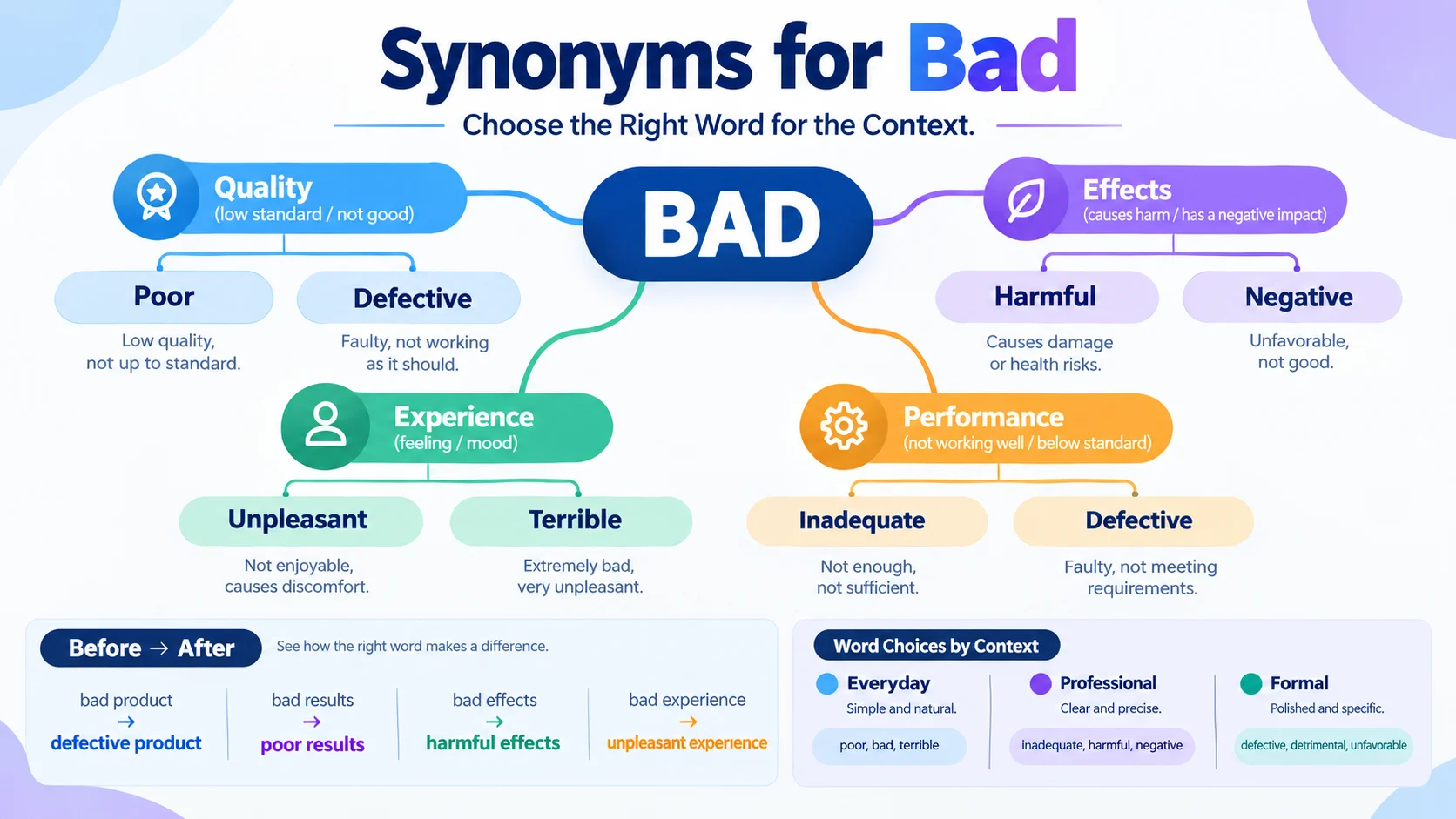
Another word for bad depends on the context. Common synonyms include poor, harmful, negative, unpleasant, terrible, awful, inferior, defective, inadequate, and unfavorable. However, each word has a slightly different meaning. Therefore, choosing the right synonym can make your writing more precise, professional, and natural.
What Does Bad Mean?
Definition
Bad is a common adjective that describes something unpleasant, harmful, unsuccessful, incorrect, low in quality, or undesirable.
However, the word has many meanings. As a result, one synonym cannot replace bad in every situation.
For example, you might describe a product as defective when it does not work properly. Similarly, you could call a poor business result unsatisfactory. In contrast, an unpleasant experience might simply be uncomfortable or negative.
Therefore, the best synonym depends on the exact meaning you want to express.
Common Uses
People use bad in everyday conversation, professional communication, academic writing, and creative work.
For instance:
The service was bad.
This sentence is understandable. However, it does not explain the specific problem.
A more precise version might be:
The service was slow and unreliable.
Likewise, instead of writing:
We had a bad experience.
You could write:
We had an unpleasant experience.
As a result, the second sentence gives the reader more useful information.
Best Synonyms for Bad
The following words cover several common meanings of bad. Nevertheless, they are not exact substitutes in every situation.
| Synonym | Meaning | Best Used When | Example |
|---|---|---|---|
| Poor | Below an expected standard | Quality or performance is low | The company received poor reviews. |
| Harmful | Causing damage or negative effects | Something creates harm | Excessive stress can be harmful. |
| Negative | Producing an unfavorable effect | Results or effects are unfavorable | The decision had negative consequences. |
| Unpleasant | Not enjoyable or comfortable | Experiences or conditions feel undesirable | The meeting became unpleasant. |
| Terrible | Extremely bad | Strong criticism is appropriate | We had terrible weather. |
| Awful | Very unpleasant or bad | Casual conversation | The food tasted awful. |
| Inferior | Lower in quality or value | Comparing things | This material is inferior to the original. |
| Defective | Having a fault | Products or equipment fail | The device was defective. |
| Inadequate | Not sufficient or suitable | Something fails to meet a standard | The explanation was inadequate. |
| Unfavorable | Not beneficial or positive | Formal situations or conditions | The company faced unfavorable conditions. |
Synonyms by Context
Formal Writing
Formal writing usually benefits from precise vocabulary. Therefore, instead of repeatedly using bad, consider words such as unfavorable, inadequate, deficient, adverse, undesirable, and unsatisfactory.
For example:
Basic:
The policy had bad effects.
Formal:
The policy had adverse effects.
The word adverse specifically suggests a harmful or unfavorable effect. Consequently, it is more precise than the general word bad.
Similarly:
Basic:
The report contained bad information.
Formal:
The report contained inaccurate information.
Here, inaccurate works better because the problem concerns correctness rather than general quality.
Professional Writing
In business writing, clarity matters. Therefore, professional alternatives should identify the specific weakness whenever possible.
Useful choices include:
- Poor
- Ineffective
- Inadequate
- Unsatisfactory
- Unreliable
- Deficient
- Unfavorable
For example:
The campaign had bad results.
A stronger professional version is:
The campaign produced unsatisfactory results.
Likewise:
The software is bad.
can become:
The software is unreliable.
As a result, the revised sentence sounds more objective and informative.
Academic Writing
Academic writing requires careful word selection. Because of that, broad terms such as bad can often be replaced with more specific language.
Useful academic alternatives include:
- Negative
- Adverse
- Limited
- Deficient
- Inadequate
- Unreliable
- Problematic
For example:
The study produced bad results.
A more precise version is:
The study produced limited results.
Alternatively:
The findings revealed negative effects.
These choices communicate the problem more clearly. Moreover, they avoid the informal tone associated with bad.
Daily Conversation
Everyday American English allows more expressive alternatives.
Common choices include:
- Awful
- Terrible
- Horrible
- Lousy
- Poor
- Unpleasant
- Rough
For example:
I had a terrible day.
Or:
That movie was awful.
Both sound natural in casual conversation. However, they may sound too informal or emotional in academic and professional writing.
Professional Alternatives for Bad
When writing a resume, email, report, proposal, or business document, choose a word that explains the actual problem.
Poor
Meaning: Below the expected standard.
Tone: Neutral and professional.
Difficulty: Easy.
Usage frequency: Very common.
Best for: Resumes, emails, essays, business writing, and everyday conversation.
For example:
The project experienced poor performance during its first quarter.
In an academic setting, you might write:
The experiment produced poor results under the original conditions.
Meanwhile, in daily conversation:
The restaurant has poor reviews.
Inadequate
Meaning: Not sufficient or good enough.
Tone: Formal.
Difficulty: Medium.
Usage frequency: Common.
Best for: Professional and academic writing.
For example:
The training provided was inadequate for the position.
Here, inadequate does more than describe something as bad. Instead, it shows that the training failed to meet a particular need.
Unfavorable
Meaning: Not advantageous, beneficial, or positive.
Tone: Formal.
Difficulty: Medium.
Usage frequency: Common.
Best for: Business writing, reports, and formal communication.
For example:
The company operated under unfavorable market conditions.
Therefore, unfavorable works particularly well when circumstances make success more difficult.
Ineffective
Meaning: Failing to produce the desired result.
Tone: Professional and neutral.
Difficulty: Medium.
Usage frequency: Common.
Best for: Strategies, methods, policies, processes, and plans.
For example:
The original marketing strategy was ineffective.
This word is especially useful because it identifies a lack of results rather than simply expressing criticism.
Simple Alternatives for Bad
Sometimes you need an easy replacement that most readers will understand immediately. In that case, use familiar words such as:
- Poor
- Wrong
- Harmful
- Negative
- Unpleasant
- Awful
- Terrible
- Unhealthy
For example:
This is a bad idea.
could become:
This is a poor idea.
However, if the idea creates a specific risk, a more precise sentence would be:
This is a risky idea.
Thus, the best replacement does not always have to be a direct synonym. Sometimes a more specific word communicates the intended meaning much better.
Stronger Alternatives for Bad
When bad does not express enough intensity, stronger alternatives can make the sentence more forceful.
Consider:
- Terrible
- Horrible
- Awful
- Dreadful
- Appalling
- Atrocious
- Disastrous
However, these words differ in strength and usage.
Terrible and awful are common in everyday American English. By comparison, atrocious is much stronger and often describes extremely poor quality or behavior.
Meanwhile, disastrous usually describes a result that causes serious problems.
For example:
The project had a disastrous outcome.
This sentence communicates considerably more intensity than:
The project had a bad outcome.
Therefore, use strong synonyms only when the situation supports that level of criticism.
Difference Between Similar Synonyms
Understanding small differences is essential when selecting a synonym. Otherwise, you may choose a word that changes the intended meaning.
Bad vs. Poor
Bad is broad. Poor, on the other hand, usually refers to low quality, weak performance, or an unsatisfactory standard.
The service was bad.
The service was poor.
Both sentences work. However, poor sounds more specific and professional.
Bad vs. Harmful
Bad can describe anything undesirable. Harmful, however, specifically indicates that something causes damage or negative effects.
Excessive exposure to sunlight can be harmful.
Therefore, harmful is more precise when health, safety, or damage is involved.
Bad vs. Unpleasant
Unpleasant usually describes an experience, feeling, environment, taste, smell, or situation that is uncomfortable or undesirable.
We had an unpleasant conversation.
The conversation may have been uncomfortable without necessarily causing serious harm.
Bad vs. Terrible
Terrible generally expresses a stronger degree of negativity than bad.
The movie was bad.
The movie was terrible.
The second sentence communicates stronger criticism. Consequently, it should be used when the speaker wants greater emphasis.
Bad vs. Inadequate
Inadequate means something fails to meet a specific requirement or standard.
The safety equipment was inadequate.
Therefore, inadequate is more precise than bad when something is insufficient.
Bad vs. Defective
Defective specifically means that an item contains a fault or does not function correctly.
The manufacturer replaced the defective device.
As a result, defective is particularly useful for products, machinery, equipment, and technical systems.
Real-World Examples
The right synonym becomes easier to understand when you see it in different situations.
Business Example
Basic:
The company had a bad sales quarter.
Improved:
The company had a poor sales quarter.
Here, poor refers to weak performance. Therefore, it sounds natural in business writing.
Academic Example
Basic:
The research produced bad results.
Improved:
The research produced limited results.
This version sounds more objective. Moreover, it avoids making a vague judgment.
Daily Conversation Example
Basic:
I had a bad experience at the restaurant.
Improved:
I had an unpleasant experience at the restaurant.
The revised version makes the emotional meaning clearer without sounding excessively dramatic.
Before-and-After Word Choices
Replacing bad with a precise alternative can improve almost any sentence.
| Before | Better Alternative |
|---|---|
| Bad product | Defective product |
| Bad results | Poor results |
| Bad effects | Harmful effects |
| Bad experience | Unpleasant experience |
| Bad strategy | Ineffective strategy |
| Bad conditions | Unfavorable conditions |
| Bad explanation | Inadequate explanation |
| Bad comparison | Inferior option |
Notice that the improved versions do more than change vocabulary. They also explain the type of problem. As a result, readers can understand the intended meaning faster.
Synonym Analysis at a Glance
| Synonym | Tone | Difficulty | Usage Frequency | Best For |
|---|---|---|---|---|
| Poor | Neutral | Easy | Very Common | Business, essays, conversation |
| Harmful | Neutral | Easy | Common | Health, safety, formal writing |
| Negative | Neutral | Easy | Very Common | Business, academic writing |
| Unpleasant | Neutral | Easy | Common | Conversation, descriptions |
| Terrible | Strong | Easy | Very Common | Conversation |
| Awful | Strong | Easy | Very Common | Casual conversation |
| Inferior | Formal | Medium | Common | Comparisons, business |
| Defective | Technical | Medium | Common | Products, equipment |
| Inadequate | Formal | Medium | Common | Academic and professional writing |
| Unfavorable | Formal | Medium | Common | Business and formal writing |
Opposite Words
The most common opposites of bad include:
- Good
- Excellent
- Positive
- Beneficial
- Effective
- Superior
- Pleasant
- Favorable
- Healthy
- Successful
However, the appropriate antonym also depends on context.
For example, good can describe acceptable quality, while excellent indicates very high quality. Similarly, beneficial specifically describes something that produces a positive effect. Meanwhile, effective means that something achieves its intended result.
Therefore, context matters when choosing an opposite just as much as it does when choosing a synonym.
FAQs
What is another word for bad?
Common synonyms for bad include poor, harmful, negative, unpleasant, terrible, awful, inferior, inadequate, defective, and unfavorable. However, the best option depends on what bad means in the sentence.
What is a formal synonym for bad?
Formal alternatives include unfavorable, inadequate, deficient, adverse, unsatisfactory, and inferior. Nevertheless, each word carries a slightly different meaning.
What is a professional word for bad?
Professional alternatives include poor, ineffective, inadequate, unsatisfactory, unreliable, deficient, and unfavorable. These words can make workplace writing more specific and objective.
What is a stronger word for bad?
Stronger alternatives include terrible, horrible, awful, dreadful, appalling, and atrocious. However, use them carefully because they express greater intensity.
What is a simple synonym for bad?
Simple alternatives include poor, wrong, negative, harmful, unpleasant, awful, and terrible. Among these, poor is especially useful when describing quality.
What is a synonym for bad quality?
Depending on the context, use poor, inferior, substandard, defective, inadequate, or low-quality. For example, defective works best when a product has a specific fault.
What is a synonym for bad behavior?
Possible alternatives include improper, inappropriate, unacceptable, harmful, dishonest, or immoral. The correct choice depends on the behavior being described.
What is a synonym for a bad result?
Useful alternatives include poor result, negative result, unfavorable outcome, disappointing outcome, unsuccessful result, and adverse outcome. The best choice depends on the exact situation.
What is the best synonym for bad in a resume?
There is no single best replacement. Instead, use a precise word such as ineffective, inadequate, inefficient, unsuccessful, or underperforming, depending on what you want to describe.
Conclusion
The best synonyms for bad depend on the specific meaning behind the word. For example, poor works well for low quality or performance, while harmful describes something that causes damage. Similarly, unpleasant fits uncomfortable experiences, whereas defective describes a faulty product.
For professional and academic writing, more precise alternatives such as ineffective, inadequate, unfavorable, deficient, and unsatisfactory can make your message clearer. Meanwhile, terrible and awful are natural choices for casual American English when you want stronger emotion.
Ultimately, the goal is not simply to replace bad with a more complicated word. Instead, choose the synonym that explains why something is bad. That approach makes your writing more accurate, natural, and useful to readers.