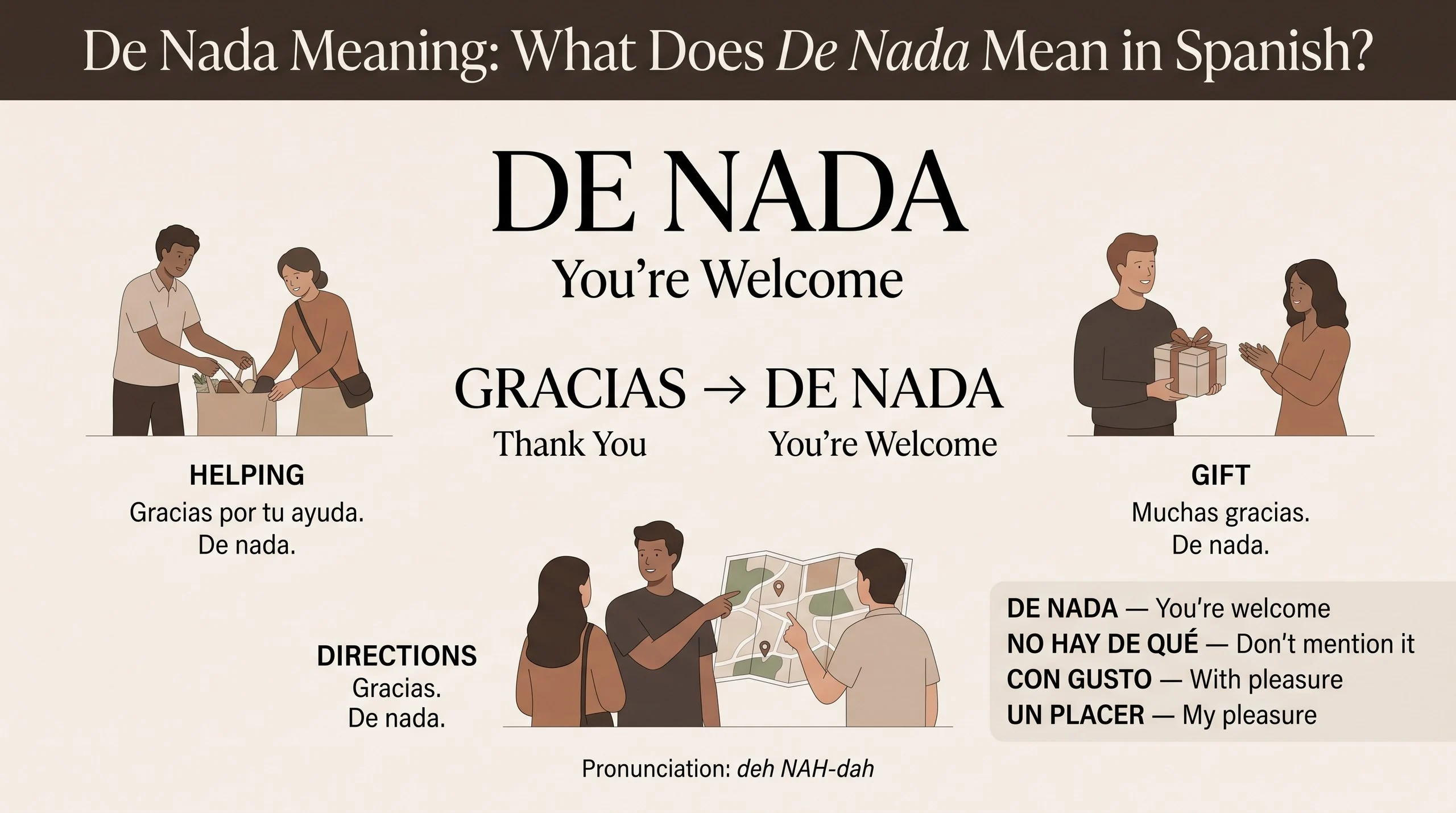
De nada meaning is “you’re welcome” in Spanish. It is a common response to gracias, meaning “thank you.” Depending on context, de nada can also convey “no problem,” “don’t mention it,” or “it was nothing.”
De nada meaning is one of the most common Spanish phrases English speakers encounter. It usually means “you’re welcome” and is used when someone thanks you for something.
For example, if someone says “Gracias” after you help them, you can respond:
“De nada.”
In English, this means:
“You’re welcome.”
The phrase is short, friendly, and easy to use. You may hear it in Spanish-speaking countries, see it in movies, encounter it while traveling, or notice it in text messages and social media conversations.
However, de nada has a slightly broader conversational sense than a direct dictionary translation might suggest. Depending on the situation, it can also mean “no problem,” “not at all,” “don’t mention it,” or “it was nothing.”
This guide explains de nada meaning, pronunciation, grammar, examples, cultural context, texting uses, related Spanish expressions, and common mistakes.
Quick Answer
| Meaning | Context | Primary Platforms | Example | Tone |
|---|---|---|---|---|
| You’re welcome | Responding to thanks | Conversation | “Gracias.” “De nada.” | Friendly |
| No problem | Casual interaction | Texting, chat | “Gracias por ayudarme.” “De nada.” | Casual |
| Don’t mention it | Polite response | Conversation | “Muchas gracias.” “De nada.” | Polite |
| It was nothing | Minimizing a favor | Everyday Spanish | “Gracias por venir.” “De nada.” | Warm |
| Glad to help | Friendly response | Social interaction | “Gracias.” “De nada.” | Positive |
What Does De Nada Mean?
De nada is a Spanish expression that means “you’re welcome.”
It is most commonly used as a response to gracias, which means “thank you.”
For example:
Person A: Gracias.
Person B: De nada.
In English:
Person A: Thank you.
Person B: You’re welcome.
The phrase is extremely common and works in many everyday situations.
Someone might say de nada after you thank them for:
- Helping you
- Giving you something
- Answering a question
- Holding a door
- Offering directions
- Completing a favor
- Sharing something
- Providing assistance
Because it is so common, it is one of the most useful Spanish phrases for beginners to learn.
De Nada Meaning in Simple English
In simple English:
De nada = You’re welcome.
Depending on the situation, it can also mean:
- No problem
- Not at all
- Don’t mention it
- It was nothing
- My pleasure
For example:
Gracias por tu ayuda.
means:
“Thank you for your help.”
A natural response is:
De nada.
meaning:
“You’re welcome.”
What Does “De Nada” Literally Mean?
The individual words help explain the expression.
- de = of / from
- nada = nothing
So, de nada literally resembles “of nothing” or “from nothing.”
However, you should not translate the phrase word for word when using it in conversation.
Its established conversational meaning is:
“You’re welcome.”
This is similar to many idiomatic expressions in English where the literal meaning differs from the natural conversational meaning.
Therefore, when someone says gracias, responding with de nada is the normal way to communicate that the favor was not a burden.
How Do You Pronounce De Nada?
De nada is commonly pronounced approximately:
deh NAH-dah
The middle word receives the stronger emphasis.
In Spanish pronunciation:
de nada
The d sounds are generally softer than an English speaker might expect, especially depending on the speaker’s accent and position within the phrase.
For beginners, simply saying:
“deh NAH-dah”
will generally be understandable.
What Does Gracias Mean?
To understand de nada, it helps to know the phrase it commonly answers.
Gracias means:
“Thank you.”
For example:
“Gracias por tu ayuda.”
means:
“Thank you for your help.”
The natural response is:
“De nada.”
So the basic exchange is:
Gracias → De nada
Thank you → You’re welcome
De Nada and Gracias: A Simple Conversation
Here is a basic example:
Maria: Gracias.
Carlos: De nada.
The meaning is:
Maria: Thank you.
Carlos: You’re welcome.
A slightly longer conversation might be:
Maria: Muchas gracias por ayudarme.
Carlos: De nada. Me alegra ayudarte.
This means:
Maria: Thank you very much for helping me.
Carlos: You’re welcome. I’m glad to help you.
When Should You Say De Nada?
You can say de nada when someone thanks you.
For example:
“Gracias.”
“De nada.”
You can also respond to longer expressions of gratitude:
“Muchas gracias.”
“De nada.”
Or:
“Muchísimas gracias.”
“De nada.”
The phrase works in both casual and polite situations.
Is De Nada Formal or Informal?
De nada is versatile.
You can use it in casual conversations with friends, but you can also use it in polite everyday interactions with people you do not know well.
For example, a friend might say:
“Gracias por the notes.”
You can respond:
“De nada.”
A customer might say:
“Muchas gracias.”
A service worker could respond:
“De nada.”
The expression itself does not sound excessively formal or excessively casual.
De Nada in Everyday Conversation
People use de nada naturally in many situations.
Helping Someone
“Gracias por ayudarme.”
“De nada.”
Giving Directions
“Gracias por decirme cómo llegar.”
“De nada.”
Sharing Something
“Gracias por compartir esto.”
“De nada.”
Holding a Door
“Gracias.”
“De nada.”
Answering a Question
“Gracias por explicarlo.”
“De nada.”
The phrase works whenever someone expresses gratitude.
De Nada in Texting
De nada is also common in Spanish texting.
Someone may simply send:
De nada 😊
Or:
De nada!
Or:
No hay de qué.
The exact choice depends on personal style.
In casual texting, people may also use shortened or more informal expressions, but de nada remains perfectly natural.
If someone texts:
“Gracias!!”
You can reply:
“De nada!!”
The number of exclamation marks or emojis can make the message sound warmer or more enthusiastic.
De Nada on Snapchat
On Snapchat, de nada can appear when friends communicate in Spanish.
For example:
“Gracias por mandar la foto!”
“De nada 😂”
The phrase retains its standard meaning.
It is not Snapchat-specific slang.
Instead, Snapchat simply provides a casual social setting where Spanish speakers may use the expression.
The Role of De Nada on TikTok
TikTok comments and messages may contain de nada when Spanish-speaking users respond to compliments, thanks, or requests.
For example:
“Gracias por explicar esto!”
“De nada!”
Creators may also use the phrase in videos teaching Spanish.
Because de nada is a basic Spanish expression, it frequently appears in beginner-language content.
Instagram and Texting Dynamics
On Instagram, users can use de nada in:
- Comments
- Direct messages
- Captions
- Replies
- Stories
For example:
“Gracias por sharing this!”
A bilingual user might reply:
“De nada!”
In a Spanish-only conversation, the exchange would be:
“Gracias por compartirlo.”
“De nada.”
The phrase remains friendly and straightforward.
De Nada in Spanish-Speaking Countries
De nada is broadly understood throughout the Spanish-speaking world.
Spanish is spoken across many regions, including Spain and much of Latin America. While local speakers may have different preferred expressions, de nada is a widely recognized response to thanks.
Other expressions may be more common in certain regions or situations, but a Spanish speaker will generally understand de nada.
Alternative Ways to Say “You’re Welcome” in Spanish
Although de nada is extremely common, it is not the only way to respond to gracias.
No Hay De Qué
No hay de qué can mean:
“Don’t mention it.”
or:
“There’s no need to thank me.”
Example:
“Muchas gracias.”
“No hay de qué.”
This can sound polite and natural.
Por Nada
Por nada can also be used to express a similar idea.
It can communicate:
“You’re welcome.”
or:
“It was nothing.”
Its use varies by region.
Con Gusto
Con gusto means approximately:
“With pleasure.”
It can be a warm way to respond to thanks.
For example:
“Gracias por ayudarme.”
“Con gusto.”
Un Placer
Un placer means:
“A pleasure.”
It is often used in polite interactions.
For example:
“Muchas gracias.”
“Un placer.”
No Hay Problema
No hay problema means:
“No problem.”
This is especially useful in casual situations.
Mi Placer
Mi placer literally means:
“My pleasure.”
It can be understood as a polite response to thanks.
De Nada vs. No Hay De Qué
Both expressions can mean “you’re welcome.”
De Nada
Simple and extremely common.
“Gracias.”
“De nada.”
No Hay De Qué
More literally conveys the idea that there is nothing to thank the person for.
“Muchas gracias.”
“No hay de qué.”
Both are appropriate responses, although local preferences and context can influence which expression sounds most natural.
De Nada vs. Por Nada
These phrases are closely related.
De nada is the standard expression many learners first encounter.
Por nada can also communicate “you’re welcome” or “it was nothing.”
For beginners, de nada is an easy and widely understood choice.
De Nada vs. Con Gusto
These expressions have slightly different feelings.
De nada is the direct equivalent of “you’re welcome.”
Con gusto communicates something closer to “with pleasure” or “gladly.”
For example:
“Gracias por ayudarme.”
“De nada.”
This is neutral and natural.
Or:
“Gracias por ayudarme.”
“Con gusto.”
This sounds warm and emphasizes willingness to help.
Is De Nada Rude?
No.
De nada is generally polite and friendly.
Some learners may worry that saying “nothing” sounds dismissive because the phrase literally contains nada, meaning “nothing.”
However, that is not how the expression functions in normal Spanish conversation.
When someone says:
“Gracias.”
and you reply:
“De nada.”
you are giving a standard polite response.
Can You Say De Nada to a Stranger?
Yes.
You can use de nada with people you do not know.
For example, someone asks you for directions:
“Muchas gracias.”
You can reply:
“De nada.”
The expression does not require a close friendship.
Can You Say De Nada to a Teacher?
Yes.
A student can say de nada to another person who thanks them, including a teacher.
For example:
“Gracias por traerme the book.”
“De nada.”
The relationship does not prevent you from using the phrase.
Can You Say De Nada at Work?
Yes.
The phrase is suitable for many normal workplace interactions.
For example:
“Gracias por sending the report.”
“De nada.”
In a more formal professional setting, you could also use:
“Con gusto.”
or:
“Un placer.”
The best choice depends on the relationship and workplace culture.
Can De Nada Be Used Sarcastically?
Yes, like many ordinary phrases, de nada can become sarcastic depending on tone.
For example, imagine someone helps another person and receives no thanks.
They might jokingly say:
“De nada…”
This could imply:
“You’re welcome, even though you didn’t thank me.”
The sarcasm comes from the context and delivery, not from the phrase itself.
Common Mistakes With De Nada
Mistake 1: Translating It Word for Word
Although de nada literally contains the idea of “nothing,” its conversational meaning is:
“You’re welcome.”
Do not translate every idiom word for word.
Mistake 2: Using It Before Someone Says Thanks
Normally, de nada responds to gratitude.
You would not usually say it randomly before anyone thanks you.
Mistake 3: Thinking It Is Only for Close Friends
De nada can be used with friends, coworkers, strangers, and acquaintances.
Mistake 4: Assuming It Means “No”
The word nada means “nothing,” but de nada as a phrase does not mean simply “no.”
Its established meaning is “you’re welcome.”
Mistake 5: Assuming It Is Slang
De nada is standard Spanish, not internet slang.
People can use it online, but its meaning does not depend on social media.
How to Use De Nada in a Sentence
Here are natural examples:
- “Gracias.” — “De nada.”
- “Muchas gracias por tu ayuda.” — “De nada.”
- “Gracias por venir.” — “De nada.”
- “Gracias por explicarlo.” — “De nada.”
- “Muchísimas gracias.” — “De nada.”
- “Gracias por esperarme.” — “De nada.”
- “Gracias por el regalo.” — “De nada.”
- “Gracias por abrir la puerta.” — “De nada.”
- “Gracias por compartirlo.” — “De nada.”
- “Gracias por ayudarme con mi tarea.” — “De nada.”
Grammar and Structure of De Nada
De nada is a fixed expression rather than a sentence that speakers normally modify.
The basic structure is:
de + nada
Here:
- de is a Spanish preposition.
- nada means “nothing.”
However, together they function idiomatically as a response to gratitude.
You generally do not need to change the phrase based on the gender or number of the person you are speaking to.
For example:
“Gracias.”
“De nada.”
The response stays the same.
Does De Nada Mean “My Pleasure”?
Sometimes, yes in practical conversational meaning, but de nada is more directly equivalent to “you’re welcome.”
If you specifically want to express “my pleasure,” un placer or a similar expression may be closer.
For example:
“Gracias por ayudarme.”
“Un placer.”
This emphasizes that helping was enjoyable or welcome.
Meanwhile:
“De nada.”
is the straightforward response.
Does De Nada Mean “No Problem”?
It can.
In many conversations, de nada performs the same social function as English “no problem.”
For example:
“Gracias por esperar.”
“De nada.”
The natural English translation could be:
“You’re welcome.”
or:
“No problem.”
The exact translation depends on context.
De Nada in Different Situations
| Situation | Spanish Response | Natural English Meaning |
|---|---|---|
| Someone thanks you | De nada | You’re welcome |
| Someone thanks you warmly | De nada | You’re very welcome |
| Casual favor | De nada | No problem |
| Polite interaction | No hay de qué | Don’t mention it |
| Helping someone | Con gusto | Gladly / With pleasure |
| Formal-friendly response | Un placer | My pleasure |
FAQs
What does de nada mean?
De nada means “you’re welcome” in Spanish. It is commonly used as a response to gracias, or “thank you.”
What does de nada mean in English?
The most direct English translation of de nada is “you’re welcome.” Depending on context, it can also mean “no problem” or “don’t mention it.”
What does de nada mean in texting?
In texting, de nada has the same basic meaning: “you’re welcome.” Spanish speakers may use it casually in messages, comments, and direct chats.
How do you respond to gracias?
A common response is de nada. Other possibilities include no hay de qué, con gusto, por nada, and un placer.
Is de nada formal or informal?
De nada works in both casual and polite everyday situations. It is a versatile and widely understood Spanish expression.
How do you pronounce de nada?
A simple English approximation is “deh NAH-dah.” The phrase is usually pronounced as two separate words with emphasis on the second word.
What is the literal meaning of de nada?
Literally, de nada can be understood as “of nothing” or “from nothing,” but its normal conversational meaning is “you’re welcome.”
Is de nada rude?
No. De nada is normally a polite and friendly response to someone who thanks you.
What is another way to say de nada?
Related Spanish expressions include no hay de qué, por nada, con gusto, and un placer. Their exact nuance can vary by context and region.
Can I use de nada with a stranger?
Yes. De nada is appropriate when responding to thanks from friends, coworkers, acquaintances, and strangers.
Conclusion
The de nada meaning is simple: “you’re welcome.”
It is one of the most common Spanish responses to gracias, which means “thank you.” Whether someone thanks you for a favor, a gift, directions, assistance, or a simple act of kindness, de nada is a natural response.
The phrase can also carry meanings such as “no problem,” “not at all,” or “don’t mention it,” depending on the context. Still, “you’re welcome” remains the clearest English equivalent.
Although de nada literally contains the Spanish word nada, meaning “nothing,” the phrase should be understood as an established expression rather than translated word for word.
It is also useful to know related expressions. No hay de qué can mean “don’t mention it,” con gusto can mean “with pleasure,” and un placer can mean “my pleasure.”
Most importantly, you do not need advanced Spanish to use de nada. When someone says gracias, a simple:
“De nada.”
is a natural, polite, and widely understood response.
In short:
Gracias = Thank you
De nada = You’re welcome