
Finding the right synonyms for curious can instantly elevate your writing, whether you are drafting an essay, polishing a story, or sending a professional email. The word “curious” can mean eager to learn, overly intrusive, or simply strange. Choosing an exact match ensures your intended tone comes through clearly.
The best synonyms for curious include inquisitive, inquiring, interested, nosy, prying, and peculiar. The ideal choice depends on whether you are describing an intellectual desire to learn, an invasive habit, or an unusual situation.
Best Synonyms for Curious
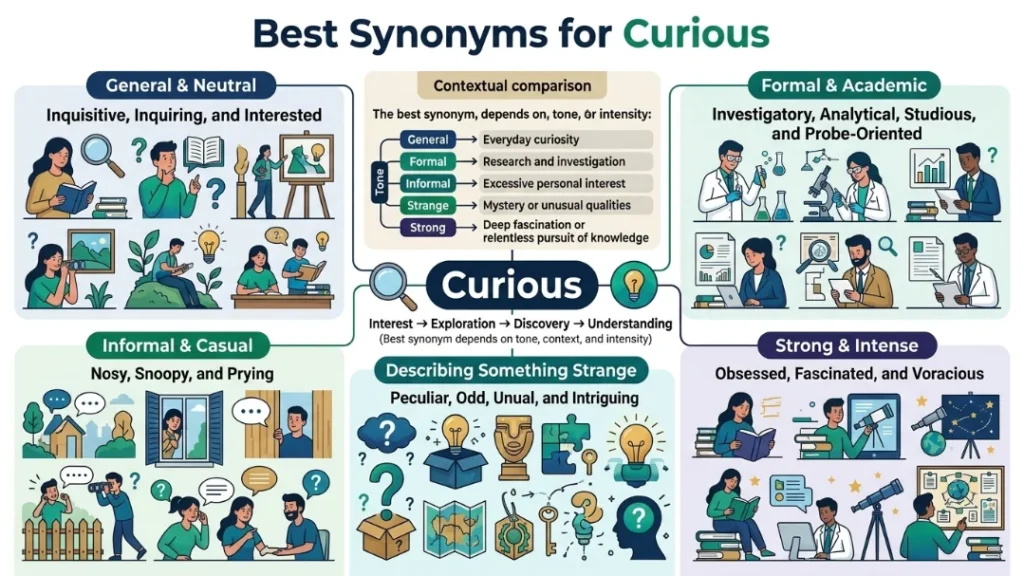
This quick breakdown matches the most effective alternatives based on tone and context:
- General / Neutral: Inquisitive, inquiring, interested
- Formal / Academic: Investigatory, analytical, studious, probe-oriented
- Informal / Casual: Nosy, snoopy, prying
- Describing Something Strange: Peculiar, odd, unusual, intriguing
- Strong / Intense: Obsessed, fascinated, voracious
What Does Curious Mean?
The word curious serves two distinct functions in the English language. Most commonly, it describes a person who has a strong desire to know or learn something. Someone might read books to understand how the universe works, or a child might ask endless questions about nature.
In its secondary role, curious describes a thing, event, or situation that is strange, unusual, or unexpected. When you notice an unexpected noise or an odd pattern, you might call it a curious detail.
Core Meaning and Grammar of Curious
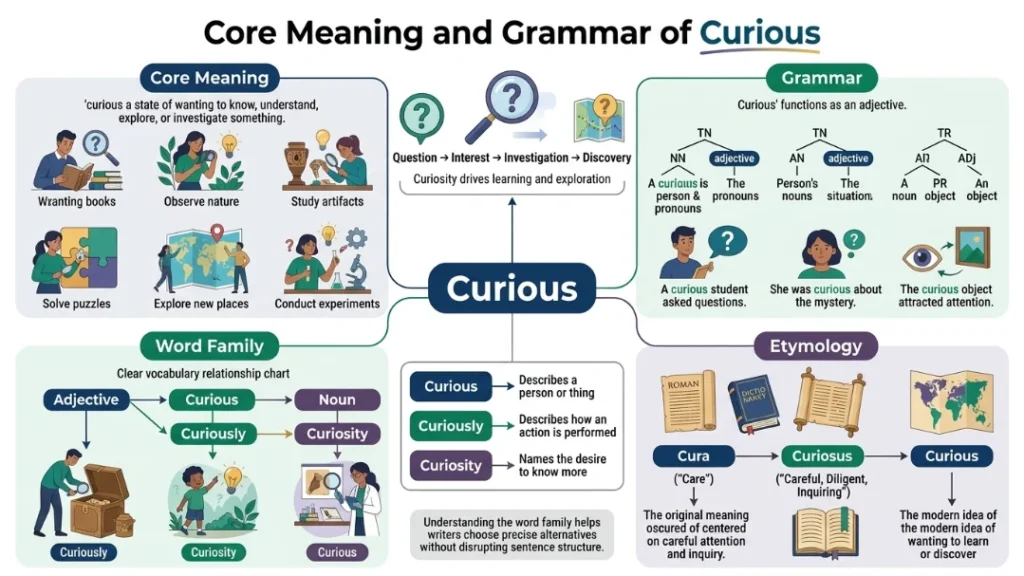
Grammatically, curious is an adjective. It modifies nouns and pronouns to show a state of mind or a quality of an object.
- Etymology: Derived from the Latin word curiosus, meaning “careful, diligent, or inquiring,” which comes from cura (care).
- Part of Speech: Adjective.
- Adverb Form: Curiously (e.g., She looked curiously at the old box.).
- Noun Form: Curiosity (e.g., His curiosity drove him to explore.).
Understanding these forms helps you replace curious smoothly without breaking the structure of your sentence.
Best Synonyms for Curious in Context
Language relies heavily on context. A word that fits a detective story might sound awkward in an academic report. The tables below outline how context shifts the meaning of curious alternatives.
Eager to Learn (Positive Inquiry)
| Synonym | Formality | Intensity | Best Usage Context |
| Inquisitive | Neutral / Formal | Medium-High | Describing someone who asks thoughtful questions. |
| Inquiring | Formal | Medium | Professional settings, academic settings, or journalism. |
| Interested | General | Low-Medium | Everyday conversations about hobbies or topics. |
| Studious | Formal | Medium | Educational or research-focused environments. |
Excessively Intrusive (Negative Inquiry)
| Synonym | Formality | Intensity | Best Usage Context |
| Nosy | Informal | High | Casual talk about someone interfering in personal matters. |
| Prying | Medium | High | Describing unwanted, deep questioning into private affairs. |
| Snoopy | Informal | Medium | Lighthearted or mild criticism of someone watching others. |
| Meddlesome | Formal | High | Characterizing someone who actively interferes in other lives. |
Strange or Unusual (Describing Objects/Events)
| Synonym | Formality | Intensity | Best Usage Context |
| Peculiar | Neutral | Medium | Spotting something slightly off or unique. |
| Intriguing | Formal | Medium-High | Highlighting something unusual that grabs attention. |
| Odd | General | Low-Medium | Simple daily observations of unusual behavior or events. |
| Bizarre | General | High | Situations that feel completely out of the ordinary. |
Common Synonyms for Curious
These options work well in almost any everyday setting without altering the basic meaning of your sentence:
- Inquisitive: Shows a habit of asking questions and seeking knowledge.
- Inquiring: Reflects an active search for facts or clarity.
- Interested: Indicates that someone’s attention is engaged by a topic.
- Keen: Expresses enthusiasm along with a desire to know more.
- Searching: Suggests a deep, continuous look for answers.
Formal Synonyms for Formal Writing
When writing research papers, business reports, or legal briefs, casual terms like “nosy” are inappropriate. Formal alternatives maintain a professional, objective tone:
- Analytical: Highlights a logical, structured desire to break down information.
- Investigative: Implies a systematic search for facts, often used in journalism or law.
- Interrogative: Describes a style focused entirely on asking questions.
- Probing: Suggests searching deeply beneath the surface to uncover hidden details.
- Studious: Focuses on dedicated learning through reading and observation.
Informal Synonyms for Casual Conversation
Casual English features vivid, expressive options. These terms usually lean toward intrusive curiosity:
- Nosy: Showing too much interest in what other people are doing.
- Snoopy: Watching or searching around secretly to discover secrets.
- Prying: Looking or asking closely into private matters.
- Busybody (Noun form): Referring to a person who constantly meddles in affairs.
Strong Synonyms for Intense Desire
When simple interest turns into an overwhelming passion to uncover the truth, standard words might feel weak. These strong options convey high energy and focus:
- Fascinated: Completely captured by a topic, driven by deep wonder.
- Obsessed: Intensely focused on learning every single detail without stopping.
- Voracious: Possessing an insatiable appetite for knowledge or information.
- Intriguing: Drawing someone in with powerful, undeniable attraction.
- Enraptured: Completely delighted and absorbed by a discovery or idea.
Mild Synonyms for Gentle Interest
Sometimes you want to show light interest without making the subject sound overly passionate or intrusive:
- Attentive: Paying close, polite attention to details.
- Observant: Noticing things quickly without necessarily asking invasive questions.
- Aware: Having knowledge or perception of a situation.
- Mildly interested: Showing a soft, relaxed level of attention.
Popular Synonyms for Curious by Usage Context
The right substitute depends heavily on the subject matter of your sentence.
1. Academic and Research Contexts
Researchers show investigative mindsets. They remain analytical while gathering data, driven by an inquiring approach to problem-solving.
2. Creative and Literary Contexts
Writers often craft inquisitive characters who explore intriguing mysteries. A plot might hinge on a peculiar clue found in an old desk.
3. Workplace and Professional Contexts
In a business setting, being curious translates to being proactive, attentive, or detail-oriented. It shows a drive for continuous improvement.
Another Word for Curious in Sentence Examples
Seeing words in real sentences helps clarify their exact tone.
- Original: The curious child asked how airplanes stay in the air.
- Revision: The inquisitive child asked how airplanes stay in the air.
- Original: I received a curious letter with no return address.
- Revision: I received a peculiar letter with no return address.
- Original: Don’t be so curious about my private financial affairs.
- Revision: Don’t be so prying about my private financial affairs.
- Original: The scientist had a curious mind that never stopped analyzing data.
- Revision: The scientist had an investigative mind that never stopped analyzing data.
- Original: She gave me a curious look when I dropped my keys.
- Revision: She gave me an inquiring look when I dropped my keys.
Comparing Key Synonyms for Curious
Words often share dictionary definitions while carrying wildly different emotional weight.
| Intent Category | Term | Core Meaning |
| Positive / Neutral | Inquisitive | Driven by a natural desire to seek knowledge and understand. |
| Positive / Neutral | Probing | Conducts deep, focused investigation into complex subjects. |
| Negative / Intrusive | Nosy | Shows an inappropriate interest in other people’s private matters. |
| Negative / Intrusive | Prying | Disregards personal boundaries to uncover private information. |
Inquisitive vs. Nosy
- Inquisitive carries a positive or neutral tone. It describes a healthy, natural desire to learn, explore, and understand the world.
- Nosy carries a negative tone. It describes someone invading private boundaries to learn things that do not concern them.
Peculiar vs. Intriguing
- Peculiar suggests something is odd, strange, or out of place, sometimes causing slight confusion.
- Intriguing suggests something is unusual in a way that creates fascinating mystery and attracts positive interest.
Words Similar to Curious
These terms share direct ties with curiosity without functioning as direct replacements in every sentence:
- Skeptical: Questioning truth or facts, driven by doubt rather than pure interest.
- Alert: Quick to notice surroundings, though not always asking questions.
- Open-minded: Willing to consider new ideas, creating a foundation for curiosity.
- Unconventional: Out of the ordinary, relating to the “strange” meaning of curious.
Antonyms and Opposites of Curious
Understanding opposite terms clarifies the boundaries of the main word.
| Antonym | Meaning | Context |
| Indifferent | Unconcerned; having no interest in learning. | General attitude |
| Apathetic | Showing complete lack of emotion or motivation. | Psychological / Emotional |
| Uninterested | Not paying attention; having no desire to know. | Casual / Workplace |
| Unobservant | Failing to notice things happening nearby. | Perceptual |
| Ordinary | Normal, standard, and entirely expected. | Describing objects / events |
How to Choose the Right Synonym for Curious
Selecting the ideal substitute requires three simple checks:
- Identify the core meaning: Are you describing a person seeking knowledge, a neighbor interfering in personal matters, or an unusual object?
- Determine the formality: Formal essays demand terms like investigative or inquisitive. Casual text messages lean on words like nosy or odd.
- Check the emotional tone: Avoid using negative words like prying when you intend to compliment someone’s eagerness to learn.
Common Mistakes When Using Synonyms for Curious
Writing errors occur when nuanced words are swapped blindly.
- Confusing Uninterested and Disinterested: Uninterested means not curious or bored. Disinterested means neutral, objective, and unbiased.
- Using “Nosy” for Intellectual Interest: Describing a brilliant scientist as “nosy” lowers the professional quality of your writing. Use inquisitive or studious instead.
- Using “Peculiar” for Active Inquiry: “Peculiar” describes an unusual object or situation, not a person actively asking questions.
Quick Reference Synonym List for Curious
Use this reference table to quickly select alternative words during drafting:
| Target Word | Best Synonym | Formality | Intensity |
| Curious (Learning) | Inquisitive | Neutral | Medium |
| Curious (Learning) | Inquiring | Formal | Medium |
| Curious (Learning) | Interested | General | Low |
| Curious (Intrusive) | Nosy | Informal | High |
| Curious (Intrusive) | Prying | Medium | High |
| Curious (Strange) | Peculiar | Neutral | Medium |
| Curious (Strange) | Intriguing | Formal | Medium-High |
| Curious (Strange) | Odd | General | Low |
FAQs
What is the best synonym for curious?
The best general synonym for curious is inquisitive. It captures the exact meaning of wanting to learn and ask questions while maintaining a balanced, polite tone.
What is another word for curious when describing a child?
Inquisitive or eager to learn works best for children. These options highlight positive developmental interest without negative undertones.
What is a formal synonym for curious?
Formal alternatives include investigative, analytical, inquiring, and probing. They fit research papers, legal documents, and business communications well.
What is an informal synonym for curious?
Informal options include nosy, snoopy, and prying. Use these words in casual conversations or fiction writing when describing intrusive behavior.
What is a stronger word for curious?
Stronger alternatives include fascinated, obsessed, voracious, and enraptured. These terms express deep absorption and intense focus.
What is a milder word for curious?
Milder substitutes include interested, attentive, and observant. They express gentle attention without deep intensity.
What words are similar to curious?
Words like skeptical, observant, alert, and unconventional share close semantic ties with curious depending on the situation.
What is the opposite of curious?
The direct opposites of curious are indifferent, uninterested, apathetic, and unobservant.
How do I choose the right synonym for curious?
Evaluate whether you are describing an intellectual pursuit, intrusive behavior, or a strange event. Pick a term that matches your desired formality and emotional tone.
Conclusion
Mastering synonyms for curious helps you express precise ideas without repeating the same basic vocabulary. Replacing standard terms with options like inquisitive, nosy, or peculiar brings clarity, nuance, and energy to your writing. Match your choice to your intended context, keep your tone consistent, and your prose will remain clear and engaging.

Jack Murphy is a language writer with a passion for word meanings, synonyms, and effective communication. He creates informative and easy to understand content to help readers enhance their vocabulary and language skills.





5 thoughts on “Synonyms for Curious| Meaning, Examples and Better Word Choices”